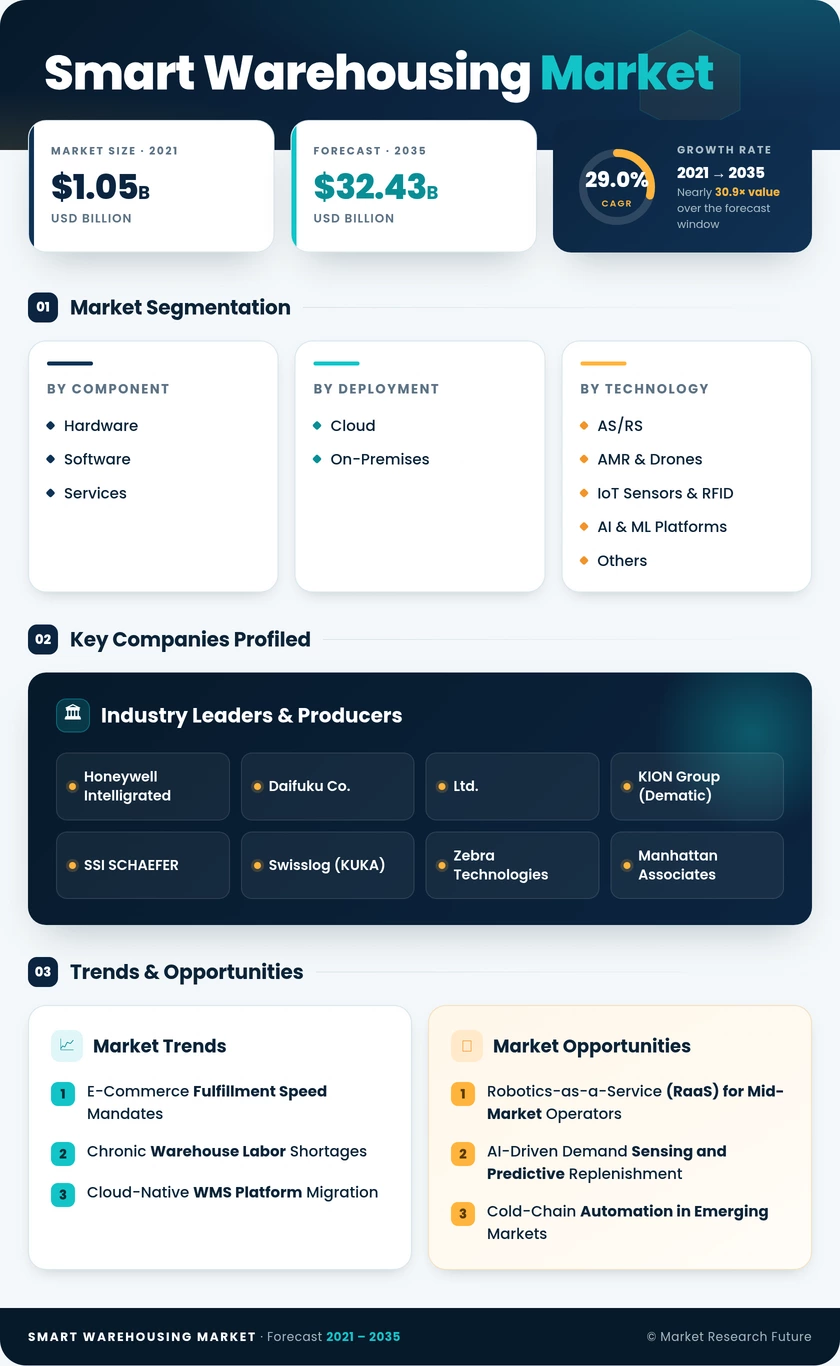
Smart Warehousing Market

ID: MRFR/SEM/10536-CR
128 Pages
Ankit Gupta
Last Updated: June 17, 2026
Smart Warehousing Market Size, Share and Research Report By Component (Hardware, Software, Services), By Deployment (Cloud, On-Premises), By Technology (Automated Storage & Retrieval Systems (AS/RS), Autonomous Mobile Robots & Drones, IoT Sensors & RFID, AI & Machine Learning Platforms, Others (Conveyor Systems, Sortation, Voice-Picking)), By End-User (Retail & E-Commerce, Manufacturing, Healthcare & Pharmaceuticals, Food & Beverage, Third-Party Logistics (3PL), Others (Automotive, Aerospace, Government)) and By Regional (North America, Europe, South America, Asia Pacific, Middle East and Africa) - Industry Forecast to 2035.
Download PDF ×

We do not share your information with anyone. However, we may send you emails based on your report interest from time to time. You may contact us at any time to opt-out.

  1. 1 Market Overview |
    1. 1.1 Study Assumptions & Market Definition |
    2. 1.2 Scope of the Study |
    3. 1.3 Research Methodology
  2. 2 Market Summary & Key Takeaways
  3. 3 Market Dynamics |
    1. 3.1 Market Drivers Analysis | |
      1. 3.1.1 E-Commerce Fulfillment Speed Mandates | |
      2. 3.1.2 Chronic Warehouse Labor Shortages | |
      3. 3.1.3 Cloud-Native WMS Platform Migration | |
      4. 3.1.4 Declining AMR/AGV Hardware Costs | |
      5. 3.1.5 Cold-Chain Compliance Mandates | |
      6. 3.1.6 Government Smart-Logistics Programmes | |
      7. 3.1.7 ESG Reporting on Supply-Chain Carbon |
    2. 3.2 Market Restraints Analysis | |
      1. 3.2.1 High Upfront Capital Expenditure | |
      2. 3.2.2 Integration Complexity with Legacy Systems | |
      3. 3.2.3 Cybersecurity and Data Privacy Risks | |
      4. 3.2.4 Shortage of Skilled Automation Engineers | |
      5. 3.2.5 Fragmented Standards Across Robotics Vendors |
    3. 3.3 Market Opportunity Analysis | |
      1. 3.3.1 Robotics-as-a-Service (RaaS) for Mid-Market Operators | |
      2. 3.3.2 AI-Driven Demand Sensing and Predictive Replenishment | |
      3. 3.3.3 Cold-Chain Automation in Emerging Markets | |
      4. 3.3.4 Data Monetization Through Supply-Chain Visibility Platforms | |
      5. 3.3.5 Micro-Fulfilment Center (MFC) Expansion |
    4. 3.4 Industry Value Chain Analysis |
    5. 3.5 Porter's Five Forces Analysis
  4. 4 Global Smart Warehousing Market Size & Forecast (2021–2035) |
    1. 4.1 Historical Market Size (2021–2025) |
    2. 4.2 Current & Forecast Market Size (2026–2035) |
    3. 4.3 Market Size by Revenue (USD Billion) |
    4. 4.4 Year-over-Year Growth Analysis
  5. 5 Segmentation Analysis |
    1. 5.1 By Component | |
      1. 5.1.1 Hardware | |
      2. 5.1.2 Software | |
      3. 5.1.3 Services |
    2. 5.2 By Deployment | |
      1. 5.2.1 Cloud | |
      2. 5.2.2 On-Premises |
    3. 5.3 By Technology | |
      1. 5.3.1 Automated Storage & Retrieval Systems (AS/RS) | |
      2. 5.3.2 Autonomous Mobile Robots & Drones | |
      3. 5.3.3 IoT Sensors & RFID | |
      4. 5.3.4 AI & Machine Learning Platforms | |
      5. 5.3.5 Others (Conveyor Systems, Sortation, Voice-Picking) |
    4. 5.4 By End-User | |
      1. 5.4.1 Retail & E-Commerce | |
      2. 5.4.2 Manufacturing | |
      3. 5.4.3 Healthcare & Pharmaceuticals | |
      4. 5.4.4 Food & Beverage | |
      5. 5.4.5 Third-Party Logistics (3PL) | |
      6. 5.4.6 Others (Automotive, Aerospace, Government)
  6. 6 Regional Analysis |
    1. 6.1 North America | |
      1. 6.1.1 United States | |
      2. 6.1.2 Canada | |
      3. 6.1.3 Mexico |
    2. 6.2 Europe | |
      1. 6.2.1 Germany | |
      2. 6.2.2 United Kingdom | |
      3. 6.2.3 France | |
      4. 6.2.4 Italy | |
      5. 6.2.5 Spain | |
      6. 6.2.6 Nordic Countries | |
      7. 6.2.7 Russia | |
      8. 6.2.8 Rest of Europe |
    3. 6.3 Asia-Pacific | |
      1. 6.3.1 China | |
      2. 6.3.2 India | |
      3. 6.3.3 Japan | |
      4. 6.3.4 South Korea | |
      5. 6.3.5 ASEAN | |
      6. 6.3.6 Rest of Asia-Pacific |
    4. 6.4 South America | |
      1. 6.4.1 Brazil | |
      2. 6.4.2 Argentina | |
      3. 6.4.3 Rest of South America |
    5. 6.5 Middle East & Africa | |
      1. 6.5.1 Saudi Arabia | |
      2. 6.5.2 UAE | |
      3. 6.5.3 South Africa | |
      4. 6.5.4 Egypt | |
      5. 6.5.5 Rest of MEA
  7. 7 Competitive Landscape |
    1. 7.1 Market Share Analysis (2025) |
    2. 7.2 Competitive Benchmarking Matrix |
    3. 7.3 Company Profiles | |
      1. 7.3.1 Honeywell Intelligrated | |
      2. 7.3.2 Daifuku Co., Ltd. | |
      3. 7.3.3 KION Group (Dematic) | |
      4. 7.3.4 SSI SCHAEFER | |
      5. 7.3.5 Swisslog (KUKA) | |
      6. 7.3.6 Zebra Technologies | |
      7. 7.3.7 Manhattan Associates | |
      8. 7.3.8 Blue Yonder | |
      9. 7.3.9 AutoStore | |
      10. 7.3.10 KNAPP AG
  8. 8 Future Outlook & Strategic Recommendations (2026–2035) |
    1. 8.1 Autonomous Warehouse Orchestration |
    2. 8.2 Platform Economics and Ecosystem Lock-In |
    3. 8.3 Energy Optimization and Sustainability |
    4. 8.4 Edge AI and Hyper-Localized Decision Making
  9. 9 Recent Developments & News
  10. 10 Frequently Asked Questions (FAQs)
  11. 11 Report Scope & Methodology |
    1. 11.1 Study Period & Base Year |
    2. 11.2 Data Sources & Citations |
    3. 11.3 Abbreviations
  12. 12 LIST OF TABLES |
  13. TABLE 1 Global Smart Warehousing Market Size & Forecast, by Revenue (USD Billion), 2021–2035 |
  14. TABLE 2 Global Smart Warehousing Market – Year-over-Year Growth Analysis, 2021–2035 |
  15. TABLE 3 Global Smart Warehousing Market – Driver Impact Analysis |
  16. TABLE 4 Global Smart Warehousing Market – Restraint Impact Analysis |
  17. TABLE 5 Global Smart Warehousing Market Size, by Component, 2021–2035 (USD Billion) |
  18. TABLE 6 Global Smart Warehousing Market Size, by Deployment, 2021–2035 (USD Billion) |
  19. TABLE 7 Global Smart Warehousing Market Size, by Technology, 2021–2035 (USD Billion) |
  20. TABLE 8 Global Smart Warehousing Market Size, by End-User, 2021–2035 (USD Billion) |
  21. TABLE 9 Global Smart Warehousing Market Size, by Region, 2021–2035 (USD Billion) |
  22. TABLE 10 North America Smart Warehousing Market Size, by Country, 2021–2035 (USD Billion) |
  23. TABLE 11 Europe Smart Warehousing Market Size, by Country, 2021–2035 (USD Billion) |
  24. TABLE 12 Asia-Pacific Smart Warehousing Market Size, by Country, 2021–2035 (USD Billion) |
  25. TABLE 13 South America Smart Warehousing Market Size, by Country, 2021–2035 (USD Billion) |
  26. TABLE 14 Middle East & Africa Smart Warehousing Market Size, by Country, 2021–2035 (USD Billion) |
  27. TABLE 15 North America Smart Warehousing Market Size, by Component, 2021–2035 (USD Billion) |
  28. TABLE 16 North America Smart Warehousing Market Size, by Deployment, 2021–2035 (USD Billion) |
  29. TABLE 17 North America Smart Warehousing Market Size, by Technology, 2021–2035 (USD Billion) |
  30. TABLE 18 North America Smart Warehousing Market Size, by End-User, 2021–2035 (USD Billion) |
  31. TABLE 19 Europe Smart Warehousing Market Size, by Component, 2021–2035 (USD Billion) |
  32. TABLE 20 Europe Smart Warehousing Market Size, by Deployment, 2021–2035 (USD Billion) |
  33. TABLE 21 Europe Smart Warehousing Market Size, by Technology, 2021–2035 (USD Billion) |
  34. TABLE 22 Europe Smart Warehousing Market Size, by End-User, 2021–2035 (USD Billion) |
  35. TABLE 23 Asia-Pacific Smart Warehousing Market Size, by Component, 2021–2035 (USD Billion) |
  36. TABLE 24 Asia-Pacific Smart Warehousing Market Size, by Deployment, 2021–2035 (USD Billion) |
  37. TABLE 25 Asia-Pacific Smart Warehousing Market Size, by Technology, 2021–2035 (USD Billion) |
  38. TABLE 26 Asia-Pacific Smart Warehousing Market Size, by End-User, 2021–2035 (USD Billion) |
  39. TABLE 27 South America Smart Warehousing Market Size, by Component, 2021–2035 (USD Billion) |
  40. TABLE 28 South America Smart Warehousing Market Size, by Deployment, 2021–2035 (USD Billion) |
  41. TABLE 29 South America Smart Warehousing Market Size, by Technology, 2021–2035 (USD Billion) |
  42. TABLE 30 South America Smart Warehousing Market Size, by End-User, 2021–2035 (USD Billion) |
  43. TABLE 31 Middle East & Africa Smart Warehousing Market Size, by Component, 2021–2035 (USD Billion) |
  44. TABLE 32 Middle East & Africa Smart Warehousing Market Size, by Deployment, 2021–2035 (USD Billion) |
  45. TABLE 33 Middle East & Africa Smart Warehousing Market Size, by Technology, 2021–2035 (USD Billion) |
  46. TABLE 34 Middle East & Africa Smart Warehousing Market Size, by End-User, 2021–2035 (USD Billion) |
  47. TABLE 35 Competitive Benchmarking Matrix – Global Smart Warehousing Market, 2025 |
  48. TABLE 36 Company Profiles – Key Players, Global Smart Warehousing Market |
  49. TABLE 37 Recent Developments & Strategic Announcements, 2023–2025 |
  50. TABLE 38 Report Scope & Methodology Summary
  51. 13 LIST OF FIGURES |
  52. FIGURE 1 Global Smart Warehousing Market Dynamics — Drivers, Restraints, Opportunities |
  53. FIGURE 2 Industry Value Chain Analysis — Smart Warehousing Market |
  54. FIGURE 3 Porter's Five Forces Analysis — Smart Warehousing Market |
  55. FIGURE 4 Global Smart Warehousing Market Size Trend & Forecast (USD Billion), 2021–2035 |
  56. FIGURE 5 Global Smart Warehousing Market Share, by Component, 2025 (%) |
  57. FIGURE 6 Global Smart Warehousing Market Share, by Deployment, 2025 (%) |
  58. FIGURE 7 Global Smart Warehousing Market Share, by Technology, 2025 (%) |
  59. FIGURE 8 Global Smart Warehousing Market Share, by End-User, 2025 (%) |
  60. FIGURE 9 Global Smart Warehousing Market Share, by Region, 2025 (%) |
  61. FIGURE 10 North America Smart Warehousing Market Size & Country Breakdown, 2021–2035 |
  62. FIGURE 11 Europe Smart Warehousing Market Size & Country Breakdown, 2021–2035 |
  63. FIGURE 12 Asia-Pacific Smart Warehousing Market Size & Country Breakdown, 2021–2035 |
  64. FIGURE 13 South America Smart Warehousing Market Size & Country Breakdown, 2021–2035 |
  65. FIGURE 14 Middle East & Africa Smart Warehousing Market Size & Country Breakdown, 2021–2035 |
  66. FIGURE 15 Competitive Landscape — Market Share Analysis, Smart Warehousing Market, 2025

Segmentation Quick Reference

DimensionSub-SegmentsDominant Segment (2025)Fastest Growing Segment (2026–2035)
ComponentHardware, Software, ServicesSoftware (43.5% share)Services (CAGR 19.3%)
DeploymentCloud, On-PremisesCloud (55.8% share)Cloud (leading CAGR)
TechnologyAS/RS, AMR & Drones, IoT Sensors & RFID, AI & ML Platforms, OthersAS/RS (30.5% share)AI & ML Platforms (CAGR 24.8%)
End-UserRetail & E-Commerce, Manufacturing, Healthcare & Pharma, Food & Beverage, 3PL, OthersRetail & E-Commerce (35.2% share)Healthcare & Pharma (CAGR 22.2%)
GeographyNorth America, Europe, Asia-Pacific, South America, MEANorth America (36.1% share)Asia-Pacific (CAGR 17.9%)


Market Segmentation Overview

By Component

Sub-SegmentKey Trend
HardwareAS/RS and conveyor installations are driving the bulk of capex in greenfield facilities.
SoftwareCloud-native WMS platforms with embedded AI analytics are dominating new deployments.
ServicesSystem integration and managed-service contracts are expanding as automation complexity grows.


Software remains the value center as operators increasingly purchase hardware through bundled software subscriptions rather than stand-alone equipment orders, shifting revenue composition toward recurring license fees.

By Deployment

Sub-SegmentKey Trend
CloudMulti-tenant SaaS WMS enabling rapid multi-site rollouts with centralized analytics
On-PremisesRetained in defense, pharma cold-chain, and data-sovereignty-sensitive verticals


Cloud deployment continues to capture share as API-first architectures simplify integration with ERP, TMS, and IoT sensor ecosystems.

By Technology

Sub-SegmentKey Trend
Automated Storage & Retrieval Systems (AS/RS)High-density cube and shuttle systems for urban micro-fulfillment
Autonomous Mobile Robots & DronesFleet-management software enabling scalable goods-to-person workflows
IoT Sensors & RFIDReal-time condition monitoring and serialized track-and-trace
AI & Machine Learning PlatformsPredictive demand sensing, dynamic slotting, and labor planning
OthersConveyor sortation, voice-directed picking, augmented-reality pick guidance


AS/RS and AMR technologies together represent over half of technology-level revenue, reflecting operator preference for physical automation that delivers immediate throughput and accuracy gains.

By End-User

Sub-SegmentKey Trend
Retail & E-CommerceSame-day and next-day delivery mandates are driving AMR and micro-fulfillment adoption
ManufacturingJust-in-time staging and kitting automation for lean production lines
Healthcare & PharmaceuticalsGDP-compliant cold-chain automation and serialization mandates
Food & BeveragePerishable inventory rotation, freshness tracking, and temperature-controlled AS/RS
Third-Party Logistics (3PL)Multi-client warehouse optimization through flexible, reconfigurable automation
OthersAutomotive spare-parts, aerospace MRO, government strategic reserves


Retail and e-commerce will continue to anchor total market volume, while healthcare and pharmaceutical end-users drive the highest incremental CAGR through regulatory-mandated automation upgrades.