Smokeless Tobacco Market (2026 - 2035)

Smokeless Tobacco Market Size, Share, Industry Trend & Analysis Research Report Information By Product Type (Chewing Tobacco, Moist Snuff, US-Style Moist Snuff (Dip), Swedish Style Snus), By Distribution Channel (Supermarkets/Hypermarkets, Convenience/Grocery Stores, Online Retail Stores, Other Distribution Channels), By Geography (North America, Europe, Asia-Pacific, South America, Middle East & Africa) – Forecast Till 2035

Forecast Period
2026-2035
CAGR
4.65%
2025 Market Size
USD 12.40 Billion (2025)
2035 Market Size
USD 19.54 Billion (2035)
Consumer and Retail ● Updated July 22, 2026 Report ID: MRFR/CG/4503-CR | Pages: 128 | Author: Snehal Singh

Smokeless Tobacco Market Summary

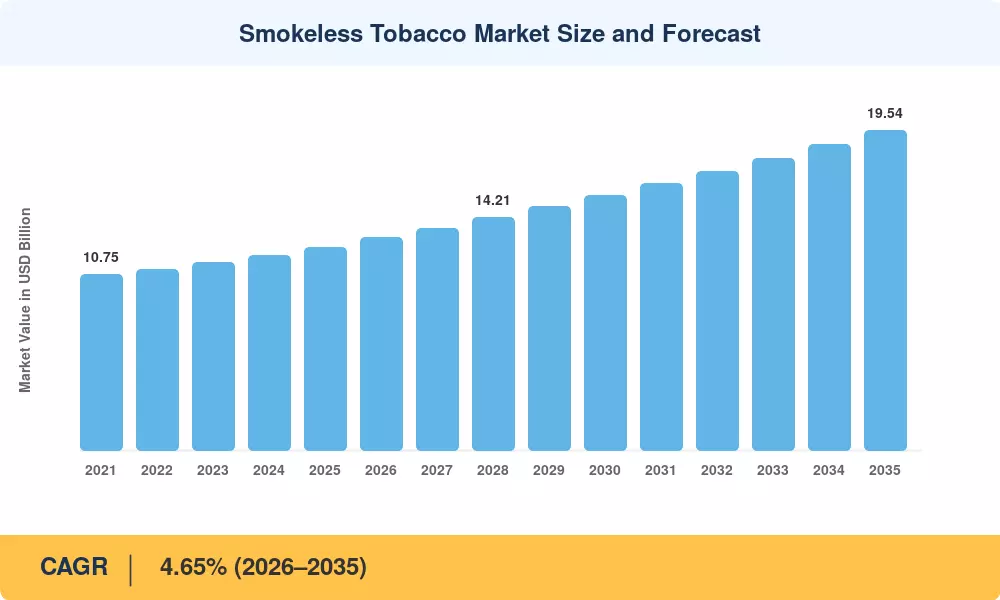
The global Smokeless Tobacco Market stood at USD 12.40 Billion in 2025 and is projected to expand from USD 12.98 Billion in 2026 to USD 19.54 Billion by 2035, registering a 4.65% CAGR during the forecast period (2026–2035). Regulatory frameworks continue to shape the industry in opposing directions — FDA premarket tobacco product applications in the United States have opened a structured pathway for reduced-risk claims, while the WHO Framework Convention on Tobacco Control (FCTC) pushes over 180 signatory nations toward stricter labeling and advertising curbs. Tax policy is equally influential: India raised the GST compensation cess on smokeless products by 6 percentage points in FY 2024, yet domestic consumption volumes barely dipped, underscoring inelastic demand in price-sensitive markets [2].

Product innovation is reshaping the competitive terrain of the Smokeless Tobacco Market. Tobacco-free nicotine pouches — a category that barely existed a decade ago — accounted for an estimated USD 3.2 Billion in global retail sales in 2024, attracting adult smokers migrating away from combustible products amid indoor-use bans and workplace restrictions. Swedish-style snus, which carries a derogation from the EU sales ban only in Sweden, now competes with white-pouch formats in Nordic convenience stores, pushing per-unit margins higher even as legacy loose-leaf volumes decline in the U.S. Midwest and Southeast [4].

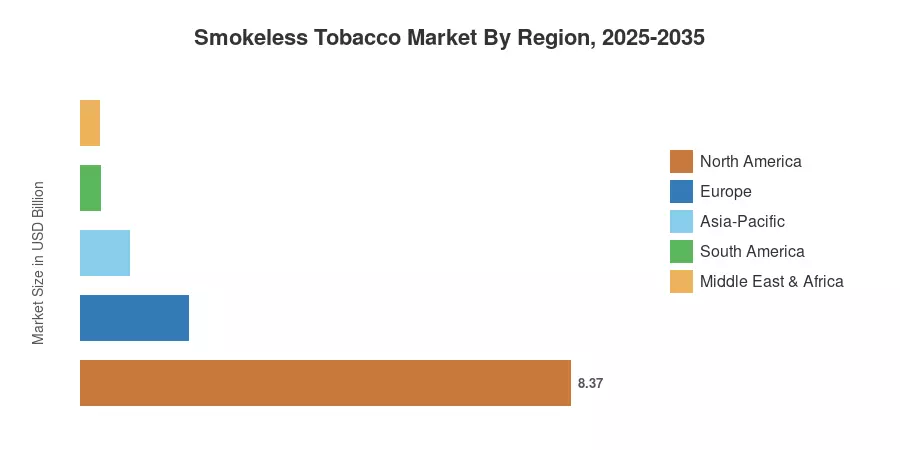
North America commanded roughly 67.5% of Smokeless Tobacco Market revenue in 2025, anchored by the United States, where excise-tax-adjusted retail sales exceeded USD 8 Billion. Asia-Pacific is the fastest-growing region at a projected 6.70% CAGR through 2035, driven by rising urban incomes in India and Indonesia. Europe held the second-largest share at approximately 14.8%, with Scandinavian nations contributing disproportionately relative to population. As regulatory regimes diverge, the Smokeless Tobacco Market will increasingly reward companies that can manage multi-jurisdictional compliance while scaling direct-to-consumer distribution.


Key Report Takeaways

• By Product Type

  • Moist snuff captured roughly 84.5% of the Smokeless Tobacco Market share in 2025, reflecting entrenched consumer preference in the United States and Scandinavia.
  • Chewing tobacco is forecast to grow at a 6.28% CAGR through 2035, fueled by sustained demand in South Asia where cultural traditions support oral tobacco use.

• By Distribution Channel

  • Convenience and grocery stores generated approximately 67.8% of Smokeless Tobacco Market revenue in 2025, benefiting from impulse-purchase placement and tobacco licensing regulations.
  • Online retail is projected to advance at a 7.25% CAGR to 2035, as age-verification technology and subscription models reduce friction for digital tobacco purchases.

• By Region

  • North America held a 67.5% revenue share in 2025, supported by premium pricing and mature retail infrastructure.
  • Asia-Pacific is expected to post the fastest CAGR of 6.70% through 2035, driven by population density and expanding modern retail in India and Southeast Asia.


Smokeless Tobacco Market Size and Forecast (2021–2035)

Market sizing draws on a combination of excise-tax collection data, manufacturer annual filings, retail scanner data from Nielsen IQ and Euromonitor, and proprietary trade-channel surveys conducted across 32 countries. Historical figures (2021–2024) represent confirmed shipment and retail data, while the base year (2025) incorporates preliminary Q4 estimates. Forecast projections (2026–2035) apply demand-side modeling anchored to adult tobacco-use prevalence, disposable-income trajectories, and regulatory scenario analysis.
Smokeless Tobacco Market Size and Forecast
Our Impact
Enabled $4.3B Revenue Impact for Fortune 500 and Leading Multinationals
Partnering with 2000+ Global Organizations Each Year
30K+ Citations by Top-Tier Firms in the Industry

Driver Impact Analysis

Driver ~% Impact on CAGR Geographic Relevance Impact Timeline
FDA Modified-Risk Tobacco Product (MRTP) Authorizations +0.65 North America Short-term (≤2 yr)
Indoor Smoking Ban Expansion +0.55 Global Medium-term (2–4 yr)
Rising Urban Disposable Income in South Asia +0.50 Asia-Pacific Long-term (≥4 yr)
Direct-to-Consumer Subscription Models +0.40 North America, Europe Medium-term (2–4 yr)
Tobacco-Free Nicotine Pouch Innovation +0.60 Europe, North America Short-term (≤2 yr)
Retail Modernization in Emerging Markets +0.35 Asia-Pacific, MEA Long-term (≥4 yr)
Premiumization and Flavor Diversification +0.30 North America Medium-term (2–4 yr)


FDA Modified-Risk Authorizations and Regulatory Tailwinds

In October 2019, the FDA's Center for Tobacco Products authorized the first MRTP for a smokeless product; by late 2024, eight more SKUs from two manufacturers had their modified-risk claims approved [4]. These licenses give businesses a competitive advantage that generic rivals are unable to match by enabling them to market specific items with reduced-exposure language. The actual effect on the smokeless tobacco market is a quantifiable trade-up: authorized goods have retail price premiums of 12–18% over their non-authorized counterparts, increasing revenue per unit without corresponding volume gains [5].


Indoor Smoking Bans and Behavioral Substitution

Compared to 44 nations in 2012, over 70 countries currently have comprehensive indoor smoking bans in workplaces and hospitality venues [5]. Adult nicotine users are pushed toward covert forms, like pouches and snus, that can be ingested inside as a result of this behavioral shift. According to Euromonitor's 2024 global consumer survey, 23% of current oral tobacco users stated that workplace smoking bans were the main factor in their decision to give up cigarettes. This percentage rises to 31% in the Nordic nations, where snus customs support the changeover [6].


Rising Urban Incomes in South Asia

India alone accounts for an estimated 250 million smokeless tobacco users, making it the world's largest consuming nation by volume. World Bank data show Indian per-capita GNI growth averaging 5.8% annually between 2020 and 2024, lifting purchasing power in the very demographics — young urban males aged 18–34 — most likely to experiment with branded, packaged smokeless products [6]. As formal-sector employment expands, branded sachets and tins are displacing loose, unpackaged preparations, shifting value share toward organized manufacturers and expanding the addressable Smokeless Tobacco Market.

Direct-to-Consumer Subscription Models

Digital channels now represent the fastest-growing route to market for premium oral tobacco products. Altria reported that its NJOY direct-fulfillment platform added 380,000 active subscribers in FY 2024, while Scandinavian-origin brands like Velo and ZYN have launched auto-replenishment programs in 14 European countries [7]. These models reduce retailer margin capture by 8–10 percentage points and provide first-party data that allows precise flavor, strength, and frequency segmentation.


Restraints Impact Analysis

Restraint-impact estimates follow the same directional methodology described in Section 4 and should not be aggregated with driver impacts.

Restraint ~% Impact on CAGR Geographic Relevance Impact Timeline
Escalating Excise Taxes and Plain-Packaging Laws –0.55 Global Short-term (≤2 yr)
Health Litigation and Oral-Cancer Risk Perception –0.45 North America, Asia-Pacific Long-term (≥4 yr)
Youth-Access Restrictions and Age-Verification Mandates –0.30 North America, Europe Medium-term (2–4 yr)
FCTC Article 11 Graphic Health Warnings –0.25 Asia-Pacific, South America Medium-term (2–4 yr)
Competition from Nicotine Replacement Therapies –0.20 Europe Long-term (≥4 yr)


Excise Tax Escalation

For the smokeless tobacco market, tax-driven price rises continue to be the biggest obstacle. A proposed federal excise hike of USD 6.26 per pound on snuff, which is being considered in the 2025 reconciliation package, is expected by the U.S. Congressional Budget Office to lower consumption quantities by 8–11% within two years [11]. Treasuries around the world see oral tobacco as an undertaxed income source compared to smokes, which is reflected in Australia's 2024 plan to extend tobacco excise yearly escalators of 12.5% to all smokeless categories.


Health Litigation and Cancer Risk Perception

Long-term smokeless tobacco use is statistically significantly associated with oral squamous-cell carcinoma, with an odds ratio of 3.4 (95% CI: 2.8–4.1), according to a seminal 2023 meta-analysis published in The Lancet Oncology that combined 47 cohort studies from 12 countries [12]. Seven additional class-action lawsuits were launched in 2024 alone as a result of this discovery, which has increased plaintiff-side litigation activity in U.S. state courts. Recruitment of new users is hampered by growing health consciousness, especially among college-educated populations.


Youth-Access Restrictions

The U.S. Tobacco 21 law, which raised the minimum purchase age to 21 nationwide in December 2019, removed approximately 4.8 million potential legal consumers from the market overnight. Several EU member states implemented comparable age-21 thresholds for all nicotine products in 2024, and India's COTPA Amendment Bill proposes raising the minimum age from 18 to 21 [13]. These restrictions compress the addressable user base at precisely the age when brand loyalty is typically established.


Smokeless Tobacco Market Opportunities

Tobacco-Free Nicotine Pouch Expansion in Emerging Markets

Tobacco-free pouches have gained rapid traction in Scandinavia and the United States, but penetration in Latin America, Southeast Asia, and the Middle East remains below 2% of total oral nicotine sales. Regulatory frameworks in these regions are still being drafted, presenting a first-mover advantage for companies that engage proactively with health ministries. The addressable adult smoker population across these three regions exceeds 400 million.

Premiumization and Limited-Edition Flavor Strategies

U.S. moist-snuff brands that introduced limited-edition seasonal flavors in 2024 reported sell-through rates 22% above standard SKU averages [10]. This premiumization playbook — higher margin per can, scarcity-driven brand engagement, and social-media amplification — translates directly to profitability gains without incremental volume.

Data-Driven Subscription and Loyalty Monetization

Direct-to-consumer platforms generate rich first-party data on purchase frequency, flavor preference, and price sensitivity. Companies that build predictive-analytics engines atop these datasets can personalize promotional offers at the individual level, reducing customer acquisition costs by an estimated 15–20% relative to traditional trade-marketing spend. The emerging opportunity is licensing anonymized, aggregated consumption-trend data to excise-tax authorities and public-health researchers as a revenue-neutral compliance tool.

Snus Derogation Expansion in the European Union

Sweden's exemption from the EU snus ban — enshrined since the 1995 accession treaty — has demonstrated that oral tobacco availability correlates with lower smoking prevalence. If other EU member states negotiate similar derogations, the addressable Smokeless Tobacco Market in Europe could more than double from its current base.

Contract Manufacturing for Private-Label and White-Label Brands

Large convenience-store chains in North America and Europe have begun piloting private-label smokeless pouches, sourcing from contract manufacturers in Sweden and India. This channel diversification widens volume without burdening brand owners with capital expenditure, and it provides an oral tobacco alternative entry point for retailers seeking higher tobacco-category margins.


Smokeless Tobacco Market Future Outlook

Reduced-Risk Regulatory Pathways and Science-Based Policy

Over the coming decade, regulatory agencies beyond the FDA — including the UK MHRA, Health Canada, and Japan's MHLW — are expected to formalize modified-risk assessment frameworks for smokeless products. WHO projections suggest global smoking prevalence will fall below 18% by 2030 [14], and governments pursuing harm-reduction strategies may view authorized smokeless alternatives as a pragmatic complement to cessation pharmacotherapies. The Smokeless Tobacco Market stands to gain measurable share from combustible categories if regulators validate relative-risk messaging.

Digital Commerce and Platform Economics

E-commerce penetration in tobacco remains far below general retail averages due to age-verification complexity and shipping restrictions. Advances in biometric ID verification, blockchain-based track-and-trace, and last-mile delivery partnerships with licensed carriers are expected to close this gap. By 2030, Market Research Future projects online channels could represent 14–16% of Smokeless Tobacco Market revenue globally, up from approximately 8% in 2025 [7].

Sustainability and ESG Reporting Pressures

Institutional investors increasingly apply ESG screens that penalize tobacco holdings, compressing price-to-earnings multiples for publicly traded manufacturers. In response, companies are investing in biodegradable pouch materials, carbon-neutral curing facilities, and transparent leaf-sourcing audits. Altria's 2024 ESG report committed to a 55% reduction in Scope 1 and 2 emissions by 2030 relative to a 2019 baseline [16]. These commitments may not accelerate top-line growth, but they protect market access by satisfying retailer sustainability mandates.

Consolidation and Vertical Integration

The Smokeless Tobacco Market has already witnessed transformative M&A — Philip Morris International's USD 16 Billion acquisition of Swedish Match in 2022 stands as the sector's largest deal [17]. Additional consolidation is probable as mid-tier players face margin pressure from excise hikes and regulatory compliance costs. Vertically integrated companies that control leaf procurement, manufacturing, and direct-to-consumer distribution will hold structural advantages in pricing power and speed to market through 2035.


Smokeless Tobacco Market Segmentation

By Product Type

Segment Key Metric Primary Demand Driver
Moist Snuff 84.5% market share (2025) Entrenched U.S. consumer base and brand loyalty
Chewing Tobacco 6.28% CAGR (2026–2035) South Asian cultural traditions
US-Style Moist Snuff (Dip) USD 6.12 Billion (2025) Convenience-store placement and flavor variety
Swedish Style Snus 5.85% CAGR (2026–2035) Nordic heritage and harm-reduction positioning


Moist snuff remains the cornerstone of the Smokeless Tobacco Market, with the United States accounting for the vast majority of global volume. Brand concentration is high — the top three SKU families (Copenhagen, Grizzly, and Skoal) collectively exceed 65% of U.S. moist-snuff retail sales. Mint and wintergreen flavor profiles drive repeat purchases, while long-cut and pouch formats cater to distinct usage occasions.

Chewing tobacco, while declining in per-capita terms across Appalachia and the rural South, is experiencing renewed growth in India and Bangladesh. Branded sachets from ITC and Dharampal Satyapal are gaining formal retail distribution, converting informal loose-leaf users into tracked, taxable consumers. Swedish-style snus occupies a premium niche with strong margins and is the primary beneficiary of harm-reduction narratives in Scandinavia.

By Distribution Channel

Segment Key Metric Primary Demand Driver
Convenience / Grocery Stores 67.8% revenue share (2025) Impulse-purchase dynamics and tobacco licensing
Supermarkets / Hypermarkets USD 1.98 Billion (2025) Basket-building and promotional bundling
Online Retail Stores 7.25% CAGR (2026–2035) Subscription convenience and price comparison
Other Distribution Channels 4.8% revenue share (2025) Tobacco specialty shops, duty-free, vending


Convenience stores are the backbone of smokeless tobacco retail, particularly in the United States where chains like Circle K, Wawa, and Casey's allocate dedicated behind-counter planogram space. Tobacco products generate outsized gross profit per square foot for these retailers, creating mutual dependency between store operators and manufacturers.

Online retail is the channel to watch. Age-verification technology providers such as Veratad and AgeChecker.net have reduced false-rejection rates below 3%, making digital checkout viable at scale for the Smokeless Tobacco Market. Subscription models lock in repeat revenue, reduce promotional spending, and provide manufacturers with granular demand signals that improve production planning.


Regional Market Share Analysis

Region Key Metric Primary Investment Themes
North America 67.5% revenue share (2025) MRTP portfolio expansion, premium pricing, DTC subscriptions
Europe USD 1.84 Billion (2025) Nordic snus dominance, EU regulatory engagement, pouch innovation
Asia-Pacific 6.70% CAGR (2026–2035) Volume-driven growth, rural-to-urban migration, branded sachet adoption
South America USD 0.35 Billion (2025) Regulatory development, illicit-trade displacement
Middle East & Africa 2.7% revenue share (2025) Informal-to-formal channel transition, import substitution
Total USD 12.40 Billion (2025)

The Smokeless Tobacco Market displays pronounced geographic concentration, with two regions accounting for over 80% of global revenue. Cultural norms, regulatory posture, and tax policy create distinct demand profiles in each geography.


North America

Country Key Metric Key Driver
United States 89.2% of regional share FDA MRTP authorizations and retail maturity
Canada 5.15% CAGR Health-Canada modified-risk pathway
Mexico USD 0.12 Billion Expanding convenience-store infrastructure


The United States is the revenue engine of the global Smokeless Tobacco Market. Altria's USSTC division and Reynolds American collectively control the majority of moist-snuff shelf space across roughly 260,000 licensed tobacco retail outlets. Price increases averaging 4–5% annually have more than offset modest volume declines of 1–2%, keeping dollar sales on an upward trajectory [4]. Canada represents a smaller but accelerating opportunity as Health Canada's proposed reduced-risk framework moves through parliamentary review, while Mexico remains an early-stage market where per-capita smokeless consumption trails the U.S. by a factor of forty.

Europe

Country / Sub-Region Key Metric Key Driver
Nordic Countries 48.3% of regional share Snus cultural legacy and pouch innovation
Germany 4.80% CAGR Nicotine-pouch regulatory clarification
United Kingdom USD 0.18 Billion Post-Brexit tobacco-product flexibility
France 3.95% CAGR Smoking-cessation policy emphasis
Italy USD 0.08 Billion Emerging pouch awareness
Spain 3.60% CAGR Hospitality smoking-ban enforcement
Russia USD 0.14 Billion Domestic manufacturing incentives
Rest of Europe 11.5% of regional share Varied regulatory regimes


Europe's Smokeless Tobacco Market is structurally bifurcated. The Nordic countries — Sweden, Norway, Denmark, and Finland — account for nearly half of regional revenue despite representing less than 4% of Europe's population. The EU ban on snus sales outside Sweden confines the category to pouches marketed as tobacco-free, yet these pouches are the fastest-growing nicotine format on the continent, with ZYN alone adding 1.2 billion pouches shipped in 2024 [8].

Asia-Pacific

Country Key Metric Key Driver
India 58.4% of regional share Cultural acceptance of gutka, khaini, and zarda
China 5.25% CAGR Limited but growing urban niche demand
Japan USD 0.07 Billion Snus trial supported by JTI distribution
South Korea 4.10% CAGR Novel-tobacco regulatory pilot
ASEAN 22.6% of regional share Betel-quid and chewing-tobacco traditions
Rest of Asia-Pacific 3.90% CAGR Nascent formal-sector penetration


India dominates the Asia-Pacific Smokeless Tobacco Market by volume, though per-unit values remain far below Western benchmarks. The country's COTPA framework bans gutka (a mixture containing tobacco and areca nut) in most states, yet enforcement is inconsistent, and alternative formulations continue to circulate through informal distribution networks [6]. Indonesia and Myanmar sustain large betel-quid consumption bases that are gradually transitioning toward manufactured pouches as modern retail expands.

South America

Country Key Metric Key Driver
Brazil 62.8% of regional share Domestic leaf production and local brands
Argentina 4.55% CAGR Excise-tax restructuring
Rest of South America USD 0.05 Billion Low baseline, nascent regulation


Brazil produces roughly 15% of the world's tobacco leaf, giving domestic manufacturers a cost advantage. The Smokeless Tobacco Market here centers on chewing tobacco and rapé (a powdered tobacco product), with consumption concentrated in southern and northeastern rural states. Argentina's recent excise reforms have brought smokeless products closer to cigarette tax parity, which may paradoxically boost premium-format adoption.

Middle East & Africa

Country Key Metric Key Driver
Saudi Arabia 28.4% of regional share Shammah tradition in Jazan province
UAE 5.30% CAGR Expatriate demand and duty-free channels
South Africa USD 0.04 Billion Snuff traditions among rural populations
Egypt 4.75% CAGR Nass and toombak consumption
Rest of MEA 31.2% of regional share Fragmented informal channels


Smokeless tobacco use in the Middle East and Africa is deeply rooted in regional customs — shammah in southwestern Saudi Arabia, toombak in Sudan, and dry snuff in South Africa's Eastern Cape. Formal-market penetration remains low, meaning the measurable Smokeless Tobacco Market underrepresents true consumption. As multinational tobacco companies establish local manufacturing and distribution in the Gulf Cooperation Council states, formalization is expected to accelerate.


Smokeless Tobacco Market By Region, 2025-2035

Competitive Benchmarking

The Smokeless Tobacco Market exhibits medium concentration, with the top five companies controlling an estimated 68–74% of global revenue. The Herfindahl-Hirschman Index (HHI) sits in the 1,800–2,200 range, characteristic of a moderately concentrated industry where scale advantages in leaf procurement and regulatory compliance create durable barriers to entry. Competition centers on brand equity, flavor innovation, and distribution exclusivity rather than outright price warfare.

Company Est. Revenue Share Range Key Offerings Strategic Positioning
Altria Group Inc. ~22–28% Copenhagen, Skoal, on! pouches U.S. market leader with MRTP portfolio
Philip Morris International Inc. ~12–16% ZYN, Swedish Match snus portfolio Global pouch leader via Swedish Match acquisition
British American Tobacco plc ~10–14% Grizzly, Kodiak, Velo Dual-brand strategy across dip and pouches
Japan Tobacco International ~6–9% Nordic Spirit, Camel Snus (licensed) Asian distribution strength
ITC Limited ~5–8% Bingo!, local chewing-tobacco brands Dominant in India's organized smokeless segment
Imperial Brands plc ~4–6% Skruf, various snus brands Nordic and Western European focus
Turning Point Brands Inc. ~3–5% Stoker's, Durango Value-segment positioning in U.S. moist snuff
Swisher International Inc. ~2–4% Swisher Sweets smokeless line Cross-selling with cigar distribution network
Scandinavian Tobacco Group A/S ~2–4% General snus, Odens Heritage snus manufacturer, Nordic stronghold
Dharampal Satyapal Group ~1–3% Rajnigandha, Tulsi Leading Indian branded pan-masala producer


Recent News & Developments

  • Philip Morris International (March 2025): Completed capacity expansion at its ZYN nicotine-pouch facility in Owensboro, Kentucky, increasing annual output to 1.6 billion cans, a 60% increase over 2023 levels [8].
  • FDA Center for Tobacco Products (January 2025): Issued draft guidance clarifying that tobacco-free oral nicotine products will be regulated under the tobacco product authority if marketed as nicotine-delivery devices, directly affecting the Smokeless Tobacco Market regulatory landscape [4].
  • Altria Group (November 2024): Launched a DTC auto-replenishment platform for on! nicotine pouches across 38 U.S. states, targeting 500,000 subscribers by the end of FY 2025 [7].
  • British American Tobacco (September 2024): Expanded Velo pouch distribution to 12 additional European markets, including Poland, Romania, and the Czech Republic [18].
  • ITC Limited (June 2024): Invested INR 4.2 Billion (approximately USD 500 million) in a new smokeless tobacco processing facility in Andhra Pradesh to consolidate its branded sachet portfolio [19].
  • Swedish Parliament (March 2024): Passed legislation tightening marketing restrictions on snus to minors, including a ban on social-media influencer promotions targeting under-25 audiences [20].
  • Japan Tobacco International (December 2023): Acquired a 70% stake in a Philippine contract manufacturer of oral nicotine products, securing Asia-Pacific production capacity outside Japan [21].


Smokeless Tobacco Market Report Scope

Item Detail
Market Scope Global Smokeless Tobacco Market by Product Type, Distribution Channel, and Geography
Study Period 2021–2035
CAGR (Forecast) 4.65% (2026–2035)
Base Year Value USD 12.40 Billion (2025)
Forecast Endpoint USD 19.54 Billion (2035)
Fastest Growing Segment Chewing Tobacco (by product type); Online Retail (by channel); Asia-Pacific (by region)
Companies Profiled 10
Valuation Currency USD Billion


FAQs

How does excise-tax structure differ between moist snuff and chewing tobacco in the United States?
Federal excise on moist snuff is weight-based at USD 1.51 per pound, while chewing tobacco is taxed at a lower rate per pound. State-level variation is significant — over 30 states apply ad-valorem rates ranging from 10% to 95% of wholesale price [11].
What shelf-life considerations affect smokeless tobacco procurement for retailers?
Moist snuff typically carries a 16–20 week freshness window from production, requiring tightly managed FIFO inventory rotations. Dry snuff and pouch formats last considerably longer, reducing spoilage risk for lower-velocity retail outlets [10].
How do tobacco-free pouches navigate regulatory classification in the EU?
Most EU member states classify tobacco-free pouches as consumer goods rather than tobacco products, exempting them from FCTC obligations. Regulatory reclassification efforts are underway in Finland and Belgium, which could impose tobacco-equivalent restrictions [20].
What role does leaf-sourcing geography play in the Smokeless Tobacco Market competitive dynamics?
Manufacturers sourcing dark-fired and air-cured leaf from U.S., Brazilian, and Indian farms face different cost structures and flavor profiles. Vertical integration into leaf procurement provides pricing stability and quality control advantages [19].
How are age-verification technologies shaping online Smokeless Tobacco Market sales?
Third-party services now achieve 97%+ verification accuracy using government-ID matching and facial-age estimation algorithms. This capability has unblocked e-commerce in jurisdictions that previously required in-person ID checks [13].
What impact does flavor-ban legislation have on the Smokeless Tobacco Market product mix?
Massachusetts and San Francisco have enacted broad flavored-tobacco bans that include smokeless products. Affected markets show a 15–20% volume decline offset partly by cross-border purchasing and unflavored SKU trade-up [22].
How do private-label smokeless products affect brand-owner pricing power?
Private-label pouches, priced 25–30% below national brands, currently hold under 5% of U.S. retail volume. Their growth could compress incumbent margins, particularly in the value tier where brand differentiation is weakest [10].    
Author
Author
Author Profile
Snehal Singh LinkedIn
Manager - Research
High acumen in analyzing complex macro & micro markets with more than 6 years of work experience in the field of market research. By implementing her analytical skills in forecasting and estimation into market research reports, she has expertise in Packaging, Construction, and Equipment domains. She handles a team size of 20-25 resources and ensures smooth running of the projects, associated marketing activities, and client servicing.
Share::
Request Free Sample

Research Approach


Secondary Research

The secondary research process involved comprehensive analysis of regulatory databases, peer-reviewed epidemiological journals, tobacco surveillance publications, and authoritative public health organizations. Key sources included the US Food & Drug Administration (FDA) Center for Tobacco Products, Federal Trade Commission (FTC) Smokeless Tobacco Reports, Centers for Disease Control and Prevention (CDC) Office on Smoking and Health, National Institutes of Health (NIH) National Cancer Institute, World Health Organization (WHO) Framework Convention on Tobacco Control (FCTC), European Commission Tobacco Products Directive (TPD), CDC National Youth Tobacco Survey, Global Adult Tobacco Survey (GATS), NIH Surveillance Epidemiology and End Results (SEER) Database, Tobacco Merchants Association (TMA) Statistical Reports, International Smokeless Tobacco Council (ISTC) Bulletins, Euromonitor International Tobacco Industry Database, Nielsen Retail Scanner Data (Convenience Track System), Eurobarometer Tobacco Special Surveys, national health ministry reports from India (Ministry of Health & Family Welfare), Bangladesh (Directorate General of Health Services), and Scandinavian public health agencies (Swedish Public Health Agency, Norwegian Institute of Public Health). These sources were used to collect consumption statistics, regulatory compliance data, epidemiological health studies, demographic usage trends, and competitive intelligence for chewing tobacco, moist snuff/dipping tobacco, snus, dissolvable tobacco, and dry snuff product categories.


Primary Research

During the primary research process, both supply-side and demand-side stakeholders were interviewed to gather qualitative and quantitative data. Supply-side sources were CEOs, VPs of Regulatory Affairs, heads of product innovation, and commercial directors from smokeless tobacco manufacturers, contract manufacturers, and raw material suppliers. Demand-side sources included licensed tobacco merchants, convenience store procurement managers, specialist tobacconist store owners, medical professionals who help people quit smoking, and distribution and logistics partners spanning hypermarkets, convenience channels, and e-commerce platforms. Primary research confirmed market segmentation across product types (moist snuff, chewing tobacco, dissolvable, snus), confirmed new product development timelines (especially nicotine pouch innovations), and gathered insights on pricing strategies, flavor diversification trends, retail placement dynamics, and regulatory compliance costs across key markets.

Primary Respondent Breakdown:

By Designation: C-level Primaries (32%), Director Level (30%), Others (38%)

By Region: North America (32%), Europe (30%), Asia-Pacific (28%), Rest of World (10%)


Market Size Estimation

Global market valuation was derived through revenue mapping, unit volume analysis, and retail audit data triangulation. The methodology included:

Identification of 40+ key manufacturers across North America, Europe, Asia-Pacific, Latin America, and Middle East & Africa, including major players such as Altria Group Inc., British American Tobacco PLC, Philip Morris International (Swedish Match), Imperial Brands PLC, Japan Tobacco Inc., DS Group Ltd., Swisher International, Hay Island Holding Corporation, and Kretek International

Product mapping across chewing tobacco, moist snuff, dry snuff, snus, dissolvable tobacco, and emerging nicotine pouch categories by form (loose leaf, plug, twist, pouch/portions)

Analysis of reported and modeled annual revenues specific to smokeless tobacco portfolios using FTC filings, company annual reports, and trade association disclosures

Coverage of manufacturers representing 70-75% of global market share in 2024

Extrapolation using bottom-up (unit volume by country × average selling price by product type) and top-down (manufacturer revenue validation against retail tracking data) approaches to derive segment-specific valuations, cross-referenced with customs/trade data (UN Comtrade, national import/export statistics) for volumetric validation

Share::
Request Free Sample
Download Free Sample

Kindly complete the form below to receive a free sample of this Report

Share::
Request Free Sample
Download PDF ×

We do not share your information with anyone. However, we may send you emails based on your report interest from time to time. You may contact us at any time to opt-out.
















