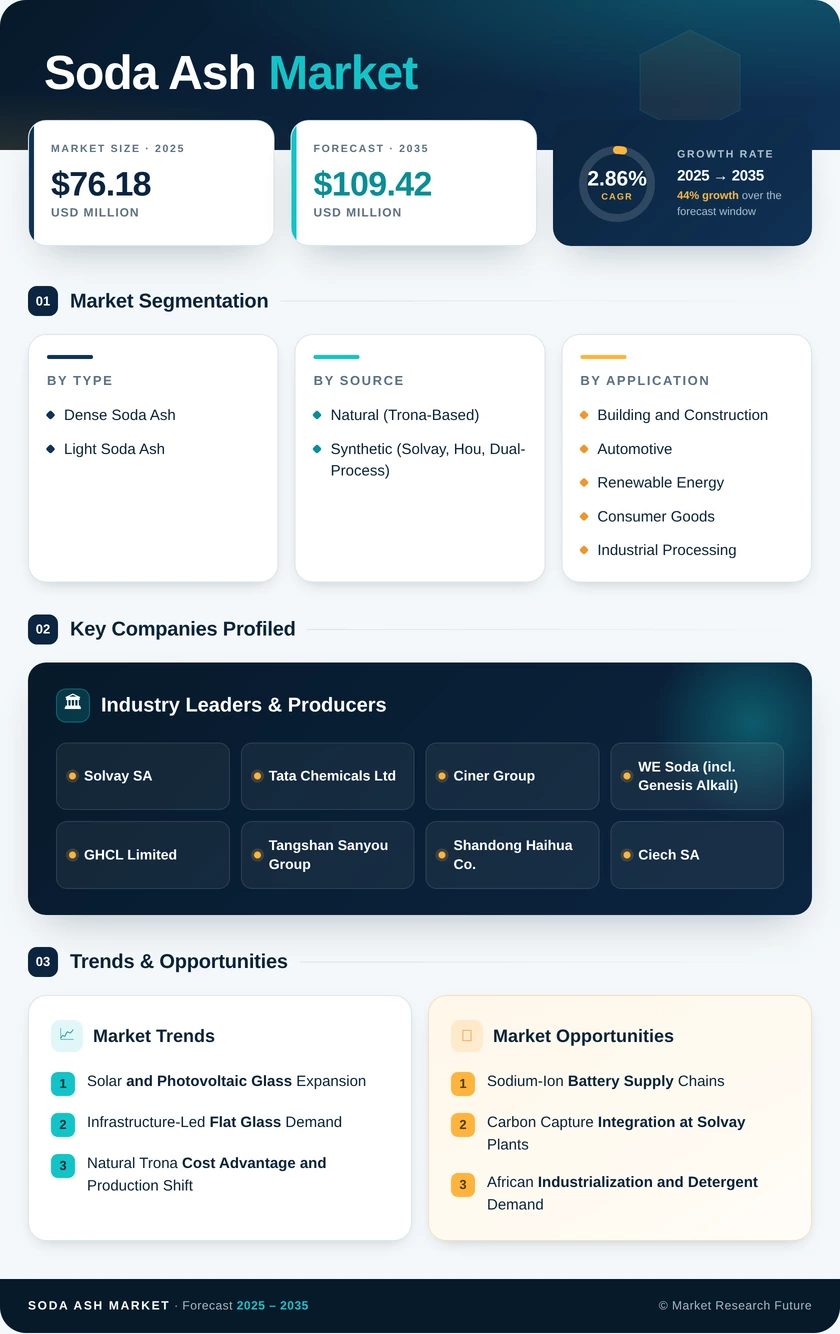
Soda Ash Market

ID: MRFR/CnM/1723-HCR
111 Pages
Chitranshi Jaiswal
Last Updated: June 12, 2026
Soda Ash Market Research Report By Application (Glass Manufacturing, Detergents, Chemical Manufacturing, Sodium Bicarbonate Production, Pulp and Paper), By Type (Dense Soda Ash, Light Soda Ash, Soda Ash By-product), By End Use (Construction, Automotive, Food and Beverage, Pharmaceuticals, Household Care), By Source (Natural Soda Ash, Synthetic Soda Ash) and By Regional (North America, Europe, South America, Asia Pacific, Middle East and Africa) - Forecast to 2035.
Download PDF ×

We do not share your information with anyone. However, we may send you emails based on your report interest from time to time. You may contact us at any time to opt-out.

  1. 1 Market Overview |
    1. 1.1 Study Assumptions & Market Definition |
    2. 1.2 Scope of the Study |
    3. 1.3 Research Methodology
  2. 2 Market Summary & Key Takeaways
  3. 3 Market Dynamics |
    1. 3.1 Market Drivers Analysis | |
      1. 3.1.1 Solar and Photovoltaic Glass Expansion | |
      2. 3.1.2 Infrastructure-Led Flat Glass Demand | |
      3. 3.1.3 Natural Trona Cost Advantage and Production Shift | |
      4. 3.1.4 Sodium-Ion Battery and Lithium Carbonate Precipitation | |
      5. 3.1.5 Detergent Demand in Emerging Economies | |
      6. 3.1.6 Water Treatment Regulatory Mandates |
    2. 3.2 Market Restraints Analysis | |
      1. 3.2.1 Carbon Penalty Exposure for Synthetic Production | |
      2. 3.2.2 Cullet Substitution Reducing Virgin Soda Ash Intensity | |
      3. 3.2.3 Overcapacity Risk from Turkish Expansion | |
      4. 3.2.4 Energy Cost Volatility for Solvay Plants | |
      5. 3.2.5 Liquid Detergent Shift Reducing Light Grade Demand |
    3. 3.3 Market Opportunity Analysis | |
      1. 3.3.1 Sodium-Ion Battery Supply Chains | |
      2. 3.3.2 Carbon Capture Integration at Solvay Plants | |
      3. 3.3.3 African Industrialization and Detergent Demand | |
      4. 3.3.4 Lithium-Processing Reagent Contracts | |
      5. 3.3.5 Smart Water Treatment Infrastructure |
    4. 3.4 Industry Value Chain Analysis |
    5. 3.5 Porter's Five Forces Analysis
  4. 4 Global Soda Ash Market Size & Forecast (2021–2035) |
    1. 4.1 Historical Market Size (2021–2025) |
    2. 4.2 Current & Forecast Market Size (2026–2035) |
    3. 4.3 Market Size by Volume (Million tons) |
    4. 4.4 Year-over-Year Growth Analysis
  5. 5 Segmentation Analysis |
    1. 5.1 By Type | |
      1. 5.1.1 Dense Soda Ash | |
      2. 5.1.2 Light Soda Ash |
    2. 5.2 By Source | |
      1. 5.2.1 Natural (Trona-Based) | |
      2. 5.2.2 Synthetic (Solvay, Hou, Dual-Process) |
    3. 5.3 By Application | |
      1. 5.3.1 Glass Manufacturing | |
      2. 5.3.2 Detergents and Soaps | |
      3. 5.3.3 Water Treatment | |
      4. 5.3.4 Chemicals and Metallurgy | |
      5. 5.3.5 Others (Pulp & Paper, Flue Gas Desulfurization) |
    4. 5.4 By End-User Industry | |
      1. 5.4.1 Building and Construction | |
      2. 5.4.2 Automotive | |
      3. 5.4.3 Renewable Energy | |
      4. 5.4.4 Consumer Goods | |
      5. 5.4.5 Industrial Processing | |
      6. 5.5.6 Building and construction5.5.7 Automotive5.5.8 Healthcare and Pharmaceuticals
  6. 6 Regional Analysis |
    1. 6.1 North America | |
      1. 6.1.1 United States | |
      2. 6.1.2 Canada | |
      3. 6.1.3 Mexico |
    2. 6.2 Europe | |
      1. 6.2.1 Germany | |
      2. 6.2.2 United Kingdom | |
      3. 6.2.3 France | |
      4. 6.2.4 Italy | |
      5. 6.2.5 Spain | |
      6. 6.2.6 Nordic Countries | |
      7. 6.2.7 Russia | |
      8. 6.2.8 Rest of Europe |
    3. 6.3 Asia-Pacific | |
      1. 6.3.1 China | |
      2. 6.3.2 India | |
      3. 6.3.3 Japan | |
      4. 6.3.4 South Korea | |
      5. 6.3.5 ASEAN | |
      6. 6.3.6 Rest of Asia-Pacific |
    4. 6.4 South America | |
      1. 6.4.1 Brazil | |
      2. 6.4.2 Argentina | |
      3. 6.4.3 Rest of South America |
    5. 6.5 Middle East & Africa | |
      1. 6.5.1 Saudi Arabia | |
      2. 6.5.2 UAE | |
      3. 6.5.3 South Africa | |
      4. 6.5.4 Egypt | |
      5. 6.5.5 Rest of MEA
  7. 7 Competitive Landscape |
    1. 7.1 Market Share Analysis (2024) |
    2. 7.2 Competitive Benchmarking Matrix |
    3. 7.3 Company Profiles | |
      1. 7.3.1 Solvay SA | |
      2. 7.3.2 Tata Chemicals Ltd | |
      3. 7.3.3 Ciner Group | |
      4. 7.3.4 WE Soda (incl. Genesis Alkali) | |
      5. 7.3.5 GHCL Limited | |
      6. 7.3.6 Tangshan Sanyou Group | |
      7. 7.3.7 Shandong Haihua Co. | |
      8. 7.3.8 Ciech SA | |
      9. 7.3.9 Nirma Limited | |
      10. 7.3.10 Sisecam Group
  8. 8 Future Outlook & Strategic Recommendations (2026–2035) |
    1. 8.1 Decarbonization of Soda Ash Production |
    2. 8.2 Circular Economy and Glass Recycling |
    3. 8.3 Energy Storage and New Chemical Pathways |
    4. 8.4 Digital Supply Chain and Pricing Transparency
  9. 9 Recent Developments & News
  10. 10 Frequently Asked Questions (FAQs)
  11. 11 Report Scope & Methodology |
    1. 11.1 Study Period & Base Year |
    2. 11.2 Data Sources & Citations |
    3. 11.3 Abbreviations
  12. 12 LIST OF TABLES |
  13. TABLE 1 Global Soda Ash Market Size & Forecast, by Volume (Million tons), 2021–2035 |
  14. TABLE 2 Global Soda Ash Market – Year-over-Year Growth Analysis, 2021–2035 |
  15. TABLE 3 Driver Impact Analysis – Soda Ash Market, 2026–2035 |
  16. TABLE 4 Restraint Impact Analysis – Soda Ash Market, 2026–2035 |
  17. TABLE 5 Global Soda Ash Market Size, by Type, 2021–2035 (Million tons) |
  18. TABLE 6 Global Soda Ash Market Size, by Source, 2021–2035 (Million tons) |
  19. TABLE 7 Global Soda Ash Market Size, by Application, 2021–2035 (Million tons) |
  20. TABLE 8 Global Soda Ash Market Size, by End-User Industry, 2021–2035 (Million tons) |
  21. TABLE 9 Global Soda Ash Market Size, by Region, 2021–2035 (Million tons) |
  22. TABLE 10 North America Soda Ash Market Size, by Country, 2021–2035 (Million tons) |
  23. TABLE 11 Europe Soda Ash Market Size, by Country, 2021–2035 (Million tons) |
  24. TABLE 12 Asia-Pacific Soda Ash Market Size, by Country, 2021–2035 (Million tons) |
  25. TABLE 13 South America Soda Ash Market Size, by Country, 2021–2035 (Million tons) |
  26. TABLE 14 Middle East & Africa Soda Ash Market Size, by Country, 2021–2035 (Million tons) |
  27. TABLE 15 Competitive Benchmarking Matrix – Global Soda Ash Market, 2024 |
  28. TABLE 16 Company Profiles – Key Players, Global Soda Ash Market |
  29. TABLE 17 Recent Developments & Strategic Announcements, 2023–2025 |
  30. TABLE 18 Report Scope & Methodology Summary |
  31. TABLE 19 Detailed Sources and Citations
  32. 13 LIST OF FIGURES |
  33. FIGURE 1 Global Soda Ash Market Dynamics (Drivers, Restraints, Opportunities) |
  34. FIGURE 2 Soda Ash Industry Value Chain Analysis |
  35. FIGURE 3 Porter's Five Forces Analysis — Soda Ash Market |
  36. FIGURE 4 Global Soda Ash Market Size Trend & Forecast, 2021–2035 (Million tons) |
  37. FIGURE 5 Global Soda Ash Market Share, by Type, 2024 (%) |
  38. FIGURE 6 Global Soda Ash Market Share, by Source, 2024 (%) |
  39. FIGURE 7 Global Soda Ash Market Share, by Application, 2024 (%) |
  40. FIGURE 8 Global Soda Ash Market Share, by End-User Industry, 2024 (%) |
  41. FIGURE 9 Global Soda Ash Market Share, by Region, 2024 (%) |
  42. FIGURE 10 North America Soda Ash Market Share, by Country, 2024 (%) |
  43. FIGURE 11 Europe Soda Ash Market Share, by Country, 2024 (%) |
  44. FIGURE 12 Asia-Pacific Soda Ash Market Share, by Country, 2024 (%) |
  45. FIGURE 13 South America Soda Ash Market Share, by Country, 2024 (%) |
  46. FIGURE 14 Middle East & Africa Soda Ash Market Share, by Country, 2024 (%) |
  47. FIGURE 15 Competitive Landscape — Market Share Analysis, 2024

Segmentation Quick Reference

DimensionSub-SegmentsDominant SegmentFastest Growing Segment
By TypeDense Soda Ash, Light Soda AshDense Soda AshLight Soda Ash
By SourceNatural (Trona-Based), Synthetic (Solvay, Hou, Dual-Process)SyntheticNatural (Trona-Based)
By ApplicationGlass Manufacturing, Detergents and Soaps, Water Treatment, Chemicals and Metallurgy, OthersGlass ManufacturingWater Treatment
By End-User IndustryBuilding and Construction, Automotive, Renewable Energy, Consumer Goods, Industrial ProcessingBuilding and ConstructionRenewable Energy
By GeographyAsia-Pacific, North America, Europe, South America, the Middle East & AfricaAsia-PacificMiddle East & Africa


Market Segmentation Overview

By Type

Sub-SegmentKey Trend
Dense Soda AshTightening supply as photovoltaic and automotive glass demand accelerates globally
Light Soda AshGrowth led by powdered detergent formulations in South Asia and Sub-Saharan Africa


Dense soda ash continues to dominate global volume due to its critical function as a glass-batch flux, while light soda ash benefits from structural demand growth in detergent and water treatment applications across emerging economies.

By Source

Sub-SegmentKey Trend
Natural (Trona-Based)Capacity expansion in Wyoming and Türkiye is displacing higher-cost synthetic output
Synthetic (Solvay, Hou, Dual-Process)Carbon penalties and energy costs are driving rationalization in Europe and China


The ongoing production shift from synthetic to natural extraction is the defining structural trend in global soda ash supply, reshaping trade flows and competitive positioning across the industry.

By Application

Sub-SegmentKey Trend
Glass ManufacturingSolar glass and architectural glazing are driving incremental volume demand
Detergents and SoapsStable volumes anchored by emerging market household consumption growth
Water TreatmentFastest-growing application, propelled by tightening municipal effluent standards
Chemicals and MetallurgySodium bicarbonate and lithium carbonate precipitation expanding downstream use
OthersFlue gas desulfurization and pulp processing provide a niche but steady demand


Glass manufacturing remains the overwhelmingly dominant application, but water treatment and energy storage represent the highest-growth incremental channels through 2035.

By End-User Industry

Sub-SegmentKey Trend
Building and ConstructionInfrastructure megaprojects in the Asia-Pacific and MEA are sustaining flat glass demand
AutomotiveEV panoramic roofs and lightweighting trends are increasing the glass content per vehicle
Renewable EnergySolar panel and sodium-ion battery production are creating new demand channels
Consumer GoodsDetergent and personal care sectors are maintaining baseline consumption
Industrial ProcessingChemical intermediates and metallurgical applications provide a diversified demand


Building and construction remains the largest end-user category, while renewable energy applications represent the most dynamic growth vector through the forecast period.