Sodium Chloride Market

Key Players: Cargill, Inc., Compass Minerals International, K+S AG, Tata Chemicals Ltd., China National Salt Industry Group, Archean Chemical Industries, Dampier Salt (Rio Tinto), INEOS Enterprises

Sodium Chloride Market

Sodium Chloride Market Research Report Information By Type (Rock Salt, Solar Salt and Others), By Manufacturing Process (Artificial Evaporation and Solar Evaporation), By Grade (Food Grade, Pharmaceutical Grade and Technical Grade), By Application (Chemical Production, Deicing, Water Conditioning, Agriculture, Food Processing, Pharmaceutical and Others), And By Region (Europe, Asia-Pacific, North America, And Rest Of The World) –Market Forecast Till 2035
ID: MRFR/CnM/6661-HCR
140 Pages
Chitranshi Jaiswal
Last Updated: June 07, 2026
 

Sodium Chloride Market Summary

The Sodium Chloride Market reached an estimated USD 13,250 Million in 2025 and is projected to grow from USD 13,990 Million in 2026 to approximately USD 22,800 Million by 2035, registering a CAGR of 5.58% across the forecast window. Two catalysts stand behind this acceleration: pharmaceutical-grade supply constraints flagged by the U.S. FDA through 2024 continue to strain dialysis and intravenous therapy supply chains, while sodium-ion battery cathode programs — particularly in China — are scaling rapidly, pulling high-purity industrial salt into energy-storage value chains that barely existed five years ago [1].

Legacy extraction and refining methods are giving way to precision-graded processing. Vacuum evaporation facilities now target the sub-10-ppm impurity thresholds demanded by pharmaceutical-grade salt buyers and chlor-alkali electrolysis cells. Concentrated solar-power installations across Morocco, South Africa, and the Gulf states have adopted molten-salt thermal storage, creating a demand channel for chemical processing salt that fossil-fired plants never required [2]. Global investment in these next-generation salt applications exceeded USD 2.8 billion in 2024, according to BloombergNEF estimates [3].

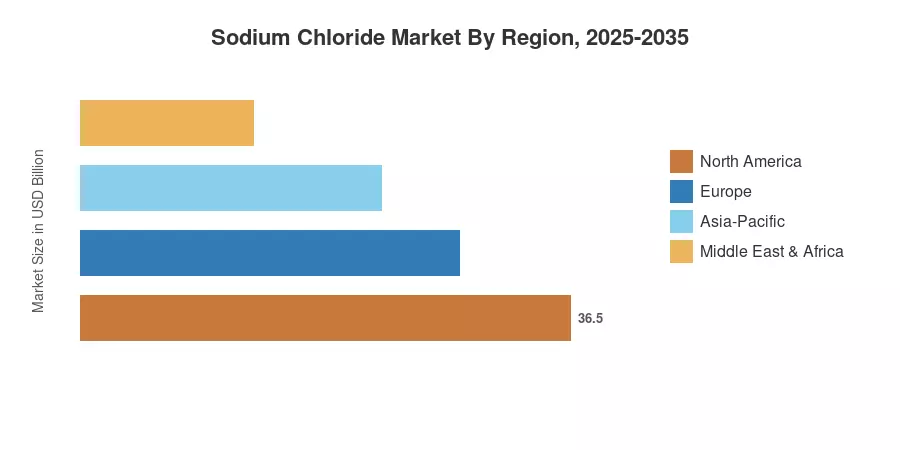
Asia-Pacific commands roughly 49.8% of the Sodium Chloride Market by value, driven by China's integrated chlor-alkali complexes and India's expanding food processing salt output. The region also registers the fastest CAGR at 6.92%. North America follows as the second-largest region, supported by robust deicing salt consumption and water softening salt mandates in hard-water municipalities. Europe rounds out the top three, where tightening EU chemical-safety standards are pushing producers toward higher-purity grades and reshaping the competitive mix heading into the next decade

Key Report Takeaways

• By Grade

  • Rock salt accounted for 38.8% of the Sodium Chloride Market in 2025, reflecting its dominance in deicing salt and bulk chemical feedstock applications
  • Vacuum salt is forecast to expand at a 7.56% CAGR through 2035, fueled by rising demand for pharmaceutical grade salt and high-purity industrial salt
  • Solar salt generated approximately USD 4,320 Million in 2025, anchored by evaporation operations in Australia and India

• By Application

  • Chemical production represented 35.4% of the Sodium Chloride Market size in 2025, with chlor-alkali plants consuming the largest single volume
  • Pharmaceuticals are poised to expand at an 8.44% CAGR during 2026–2035, the fastest of any application segment
  • The Sodium Chloride Market for food processing reached approximately USD 2,220 Million in 2025 as packaged-food output scaled in emerging cities

• By Region

  • Asia-Pacific captured 49.8% of the Sodium Chloride Market in 2025 and is projected to outpace all other regions through 2035
  • North America contributed a 5.12% CAGR, underpinned by water softening salt mandates and highway deicing salt budgets
  • Europe accounted for 17.6% of global value, with Germany and France leading adoption of industrial mineral salts compliant with REACH updates

Market Size and Forecast (2021–2035)

MRFR's sizing methodology triangulates bottom-up production volumes from salt mining products operators, top-down trade-flow data from UN Comtrade, and proprietary pricing models calibrated to regional contract benchmarks. Historical figures (2021–2024) rely on audited filings and customs records; forecast values (2026–2035) apply the calibrated 5.58% CAGR against the 2025 base year.
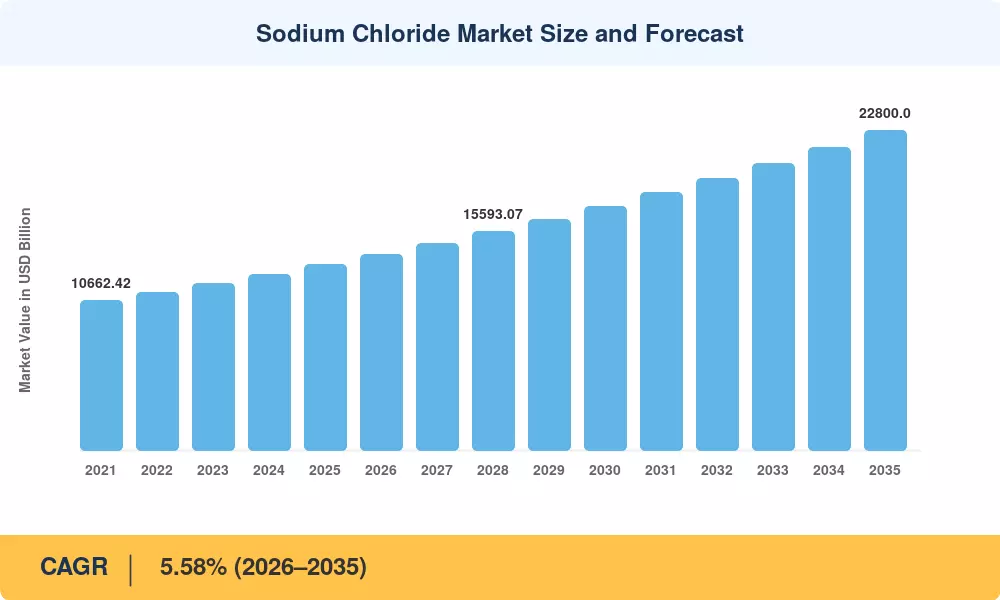
Sodium Chloride Market Size and Forecast
Our Impact
Enabled $4.3B Revenue Impact for Fortune 500 and Leading Multinationals
Partnering with 2000+ Global Organizations Each Year
30K+ Citations by Top-Tier Firms in the Industry
 

Driver Impact Analysis

Driver ~% Impact on CAGR Geographic Relevance Impact Timeline
Chlor-alkali capacity expansion +1.4% Asia-Pacific, Europe Medium-term (2–4 yr)
Sodium-ion battery cathode scaling +0.9% China, South Korea Long-term (≥4 yr)
Pharmaceutical-grade supply gaps +0.8% North America, Europe Short-term (≤2 yr)
Molten-salt thermal energy storage +0.6% MEA, North Africa Long-term (≥4 yr)
Municipal water softening salt mandates +0.5% North America Medium-term (2–4 yr)
Packaged food processing salt demand +0.7% Asia-Pacific, South America Medium-term (2–4 yr)
Highway deicing salt budget increases +0.4% North America, Nordics Short-term (≤2 yr)


Chlor-Alkali Capacity Expansion

China added 4.2 million metric tons of new chlor-alkali electrolysis capacity between 2022 and 2024, with another 2.8 million tons in the pipeline through 2028 [6]. Each ton of caustic soda output requires approximately 1.7 tons of industrial salt feedstock, making chemical processing salt the single largest volume driver in the Sodium Chloride Market. European producers are simultaneously replacing mercury-cell plants with membrane-cell technology under the EU Industrial Emissions Directive, tightening purity requirements and pulling procurement toward vacuum-grade salt mining products [9].

Sodium-Ion Battery Cathode Programs

BloombergNEF projects Chinese sodium-ion battery cathode output could reach 310 GWh by 2034, up from roughly 11 GWh in 2025 [3]. High-purity sodium chloride serves as the upstream precursor for sodium carbonate and sodium hexafluorophosphate electrolytes. This fast-emerging application transforms the Sodium Chloride Market from a slow-growth commodity story into a participant in the broader electrification supercycle, with integrated chemical majors securing long-term offtake agreements at premium pricing.

Pharmaceutical-Grade Supply Constraints

The FDA's 2024 drug shortage database listed sodium chloride injection among persistently constrained products, affecting dialysis centers and IV-therapy providers across the United States [1]. Capacity investments by Baxter International and B. Braun are expected to ease shortages by 2027, yet structural demand for pharmaceutical grade salt continues to rise as outpatient infusion services expand globally. This driver carries the highest per-ton margin contribution in the Sodium Chloride Market and incentivizes producers to invest in clean-room evaporation facilities.

Molten-Salt Thermal Storage for CSP

Morocco's Noor-Ouarzazate III plant demonstrated the commercial viability of molten-salt storage, catalyzing pipeline projects in South Africa, Saudi Arabia, and the UAE valued collectively at USD 6.4 billion [2]. These installations consume industrial salt blends comprising sodium nitrate and potassium nitrate, both of which rely on sodium chloride as a key precursor in the Solvay process pathway. IRENA estimates that 28 GW of CSP capacity will be operational globally by 2032, generating sustained demand for chemical processing salt [12].


Restraints Impact Analysis

The restraint percentages below are directional offsets to the CAGR. Their combined drag effect is already netted into the headline 5.58% figure; these values illustrate relative severity, not a subtractive formula.

Restraint ~% Impact on CAGR Geographic Relevance Impact Timeline
Sodium-reduction health regulations –0.6% North America, Europe Medium-term
Environmental limits on brine discharge –0.4% Europe, Asia-Pacific Long-term
Substitute deicers (calcium magnesium acetate) –0.3% Nordics, Canada Medium-term
Logistics and freight-cost volatility –0.3% Global Short-term
Price compression from oversupply cycles –0.2% China, India Short-term


Sodium-Reduction Health Regulations

The WHO's 2023 global sodium-reduction benchmarks prompted mandatory front-of-pack labeling in 43 countries, and the FDA finalized voluntary targets for processed-food sodium content in 2024 [13]. While these regulations primarily affect edible salt products in consumer-facing channels, they create a perception headwind for the Sodium Chloride Market that pressures food manufacturers to reformulate. The net volume impact on food processing salt is estimated at –2.4% through 2028, partially offset by population growth in low-income economies where salt consumption per capita is still rising.

Environmental Limits on Brine Discharge

The EU's revised Water Framework Directive tightens permissible chloride concentrations in effluent discharged by salt mining product operators and downstream chemical plants [9]. Compliance costs for inland vacuum-salt producers in Germany and Poland could increase operating expenditure by 8–12%, potentially compressing margins and slowing capacity additions. Similar discharge limits under China's Yangtze River Protection Law affect industrial salt facilities along the river basin, creating a medium-term drag on the Sodium Chloride Market in both regions.

Substitute Deicers Gaining Traction

Nordic municipalities and several Canadian provinces have piloted calcium magnesium acetate and beet-juice blends as lower-corrosion alternatives to conventional deicing salt [14]. Adoption remains limited — less than 4% of total North American deicing volume in 2024 — but policy momentum in environmentally sensitive watersheds could erode demand for rock salt in these corridors by up to 6% over the next decade.


Sodium Chloride Market Opportunities

Sodium-Ion Battery Supply Chains

Producers who can provide battery-grade sodium chloride have a high-value adjacency in the electrification megatrend. Partnerships between operators of salt mining products and battery cathode manufacturers are already established in China and South Korea; first-mover producers are positioned to collect price premiums of 20–30% over commodity-grade contracts


Pharma-Grade Capacity in Emerging Markets

India’s pharmaceutical sector, the largest provider of generic drugs in the world, imports a major percentage of its pharmaceutical grade salt for IV solutions and saline making. The USD 400–600 Million addressable gap through 2030 can be filled by setting up domestic high-purity production facilities in proximity to key pharma clusters in Hyderabad and Ahmedabad


Smart Water-Softening Services

IoT-enabled water softening salt delivery devices are enabling recurring-revenue service models in North American home markets. Companies using salt delivery subscription combined with sensor-monitored softener devices have shown customer lifetime value 35% greater than standard bag-salt retail and a data-rich channel inside the Sodium Chloride Market


Integrated Brine-to-Chemicals Platforms

Operators that are vertically integrated, taking raw brine and making chlor-alkali products, soda ash and specialty chemical processing salt on one site are able to capture margin across the whole value chain. The strategy is being pioneered in the salt belt of India’s Gujarat and the Pilbara region of Australia, where it cuts logistics costs by 15–20%


African Market White Space

Sub-Saharan Africa imports roughly 40% of its industrial salt and edible salt products requirements, creating an opportunity for greenfield solar-evaporation projects in Djibouti, Mozambique, and Senegal. The African Continental Free Trade Area (AfCFTA) framework could lower intra-regional tariff barriers enough to justify USD 200–350 Million in new salt mining products investment by 2032


Sodium Chloride Market Future Outlook

Electrification and Energy-Storage Integration

The sodium-ion battery revolution could redefine the ceiling for high-purity sodium chloride demand. IEA projections indicate global stationary energy storage capacity will triple by 2030, and sodium-ion chemistries are positioned to capture 15–20% of that installed base due to cost advantages over lithium alternatives [16]. Producers investing in battery-grade purification lines today will be positioned as critical-mineral suppliers in the broader electrification ecosystem of the Sodium Chloride Market.

Digital Salt-Production Platforms

Automation and AI-driven process control are reaching salt mining products operations. Real-time brine-density monitoring, predictive maintenance for vacuum evaporators, and machine-learning-optimized crystallization cycles can lift yields by 5–8% while reducing energy consumption per ton of industrial salt by up to 12%. These operational efficiencies lower breakeven costs and improve competitiveness for mid-tier producers in the Sodium Chloride Market.

ESG and Sustainable Production Standards

Investors increasingly demand carbon-footprint transparency across commodity supply chains. The Science Based Targets initiative (SBTi) has begun accepting commitments from mining and mineral-processing companies, pushing salt mining products operators to decarbonize evaporation energy sources and reduce brine-discharge impacts [18]. Producers who achieve third-party sustainability certification can command 4–7% price premiums from European and North American buyers of food processing salt and pharmaceutical grade salt.

Trade-Route Realignment and Regionalization

Geopolitical friction and supply-chain resilience strategies are shortening industrial salt trade routes. North American buyers are shifting procurement from overseas shipments to domestic and nearshore sources, while Southeast Asian nations are investing in local solar-evaporation capacity to reduce dependence on Australian and Indian imports. This regionalization trend reshapes the competitive dynamics of the Sodium Chloride Market, favoring producers with diversified geographic footprints.


Sodium Chloride Market Segmentation

By Grade

Segment Key Metric Primary Demand Driver
Rock Salt 38.8% share (2025) Deicing salt and bulk chemical feedstock
Solar Salt USD 4,320 Million (2025) Cost-effective evaporation in tropical climates
Vacuum Salt 7.56% CAGR (2026–2035) Pharmaceutical grade salt and high-purity industrial uses


Rock salt remains the backbone of the Sodium Chloride Market by volume, mined from underground halite deposits across the US, Germany, China, and Canada. Its relatively low processing cost makes it the default feedstock for deicing salt programs and large-scale chemical processing salt contracts where sub-premium purity suffices. Cargill and Compass Minerals operate the largest underground rock-salt mines in North America, while K+S AG dominates European extraction.

Vacuum salt is the fastest-growing grade, driven by applications demanding ultra-high purity — pharmaceutical grade salt for IV solutions, food processing salt for premium consumer products, and feedstock for sodium-ion battery cathode synthesis. Production involves dissolving underground salt deposits, purifying the brine, and recrystallizing under controlled vacuum conditions. Capacity expansions in India and the Netherlands are targeting the Sodium Chloride Market's premium segments, where margins can run 40–60% above commodity rock-salt benchmarks.

By Application

Segment Key Metric Primary Demand Driver
Chemical Production 35.4% share (2025) Chlor-alkali electrolysis and soda-ash synthesis
De-Icing USD 2,410 Million (2025) Highway and airport winter maintenance
Food Processing 4.92% CAGR (2026–2035) Packaged-food expansion in emerging economies
Water Treatment USD 1,640 Million (2025) Municipal water softening salt programs
Agriculture 4.38% CAGR (2026–2035) Livestock mineral supplements and soil conditioning
Pharmaceuticals 8.44% CAGR (2026–2035) IV solutions, dialysis, and saline manufacturing
Other Applications USD 450 Million (2025) Textile, leather, and oil-drilling fluids


Chemical production is the heavyweight application in the Sodium Chloride Market, consuming industrial salt as the primary input for chlor-alkali plants that produce chlorine gas, caustic soda, and hydrogen. Global chlor-alkali capacity exceeded 90 million tons in 2024 [6], and every ton of capacity requires roughly 1.7 tons of salt feedstock. Membrane-cell technology upgrades in Europe and Asia are raising purity specifications, pushing procurement toward higher-grade chemical processing salt.

Pharmaceuticals represent the fastest-growing application, driven by global expansion of outpatient infusion therapy, rising dialysis patient populations, and pandemic-era investments in saline stockpiling. The FDA shortage designation for sodium chloride injection has catalyzed over USD 800 Million in new pharmaceutical grade salt capacity commitments through 2028 [10]. This segment commands the highest price per ton of any application in the Sodium Chloride Market, making it a strategic priority for producers seeking margin improvement.


Regional Market Share Analysis

Region Key Metric Primary Investment Themes
Asia-Pacific 49.8% market share (2025) Chlor-alkali expansion; packaged-food growth
North America USD 2,970 Million (2025) Deicing budgets; water softening mandates
Europe 17.6% market share (2025) REACH compliance; pharma-grade upgrades
South America 5.52% CAGR (2026–2035) Lithium-brine co-production; agricultural salt
Middle East & Africa USD 636 Million (2025) Solar-salt CSP storage; AfCFTA trade flows
Total USD 13,250 Million (2025)

The Sodium Chloride Market spans five major regions, each shaped by distinct end-use profiles, regulatory environments, and resource endowments. Asia-Pacific anchors global consumption through sheer chlor-alkali and food processing salt volumes, while North America's demand profile tilts toward deicing salt and water softening salt. Europe's regulatory landscape drives premiumization, and emerging corridors in South America and MEA represent the next wave of capacity investment.


North America

Country Key Metric Key Driver
US 78.4% of regional value Highway deicing salt and chlor-alkali demand
Canada 5.18% CAGR (2026–2035) Cold-climate deicing; potash co-production
Mexico USD 195 Million (2025) Food processing salt for export-oriented plants


The United States consumes more deicing salt per capita than any other nation, with state DOT budgets allocating over USD 2.3 billion annually to winter road maintenance [11]. Water softening salt demand is accelerating in the Midwest and Southwest as municipalities adopt hardness-reduction ordinances. Canada's salt mining products industry benefits from proximity to US markets, while Mexico's Pacific coast solar-evaporation fields supply growing food processing salt exports to Central America.

Europe

Country Key Metric Key Driver
Germany 28.2% of regional share Chlor-alkali membrane-cell modernization
UK 4.94% CAGR (2026–2035) Pharmaceutical grade salt investment
France USD 308 Million (2025) Industrial mineral salts for chemical complexes
Italy 8.6% of regional share Food processing salt heritage sector
Spain 4.72% CAGR (2026–2035) Solar-salt production along the Mediterranean coast
Nordic Countries USD 142 Million (2025) Deicing salt and environmental-substitute R&D
Russia 11.8% of regional share Domestic self-sufficiency in industrial salt
Rest of Europe 4.48% CAGR (2026–2035) Poland and Romania underground mining expansion


EU regulatory pressure is the defining force in this region. The REACH Revision of 2024 imposes stricter impurity ceilings on industrial salt sold into chemical synthesis, effectively mandating process upgrades at older evaporation plants across Germany and France [9]. The UK's post-Brexit chemicals regime has diverged slightly, creating procurement complexity for pharmaceutical grade salt importers serving NHS supply chains.

Asia-Pacific

Country Key Metric Key Driver
China 54.6% of regional value Chlor-alkali megaplants; sodium-ion battery feedstock
India 6.78% CAGR (2026–2035) Solar-salt expansion in Gujarat; pharma-grade growth
Japan USD 482 Million (2025) High-purity chemical processing salt for electronics
South Korea 7.12% CAGR (2026–2035) Battery-cathode material supply chains
ASEAN 8.4% of regional share Food processing salt for export-oriented food industries
Rest of Asia-Pacific USD 310 Million (2025) Australia's Pilbara salt mining products operations


Asia-Pacific drives nearly half the Sodium Chloride Market, with China alone operating more than 60 chlor-alkali complexes consuming over 50 million tons of industrial salt annually [6]. India's Gujarat coastline hosts the world's largest contiguous solar-evaporation salt field, producing roughly 28 million tons per year for domestic chemical processing salt demand and edible salt products distribution. South Korea's investments in sodium-ion battery technology position it as a fast-growing procurement hub for high-purity feedstock.

South America

Country Key Metric Key Driver
Brazil 62.4% of regional value Chlor-alkali plants in Bahia and São Paulo
Argentina 5.84% CAGR (2026–2035) Lithium-brine co-production synergies
Rest of South America USD 118 Million (2025) Chile and Colombia industrial salt imports


Brazil's chlor-alkali sector anchors the region, with Braskem and Unipar operating integrated complexes that consume locally mined rock salt. Argentina's lithium-triangle brine operations in Salta and Jujuy provinces generate sodium chloride as a co-product, and several operators are exploring commercial valorization of this byproduct stream rather than treating it as waste, adding incremental volume to the Sodium Chloride Market in the region.

Middle East & Africa

Country Key Metric Key Driver
Saudi Arabia 32.8% of regional value Desalination, brine valorization and CSP storage
UAE 5.96% CAGR (2026–2035) Industrial salt for petrochemical complexes
South Africa USD 98 Million (2025) Salt mining products for domestic chemical production
Egypt 14.6% of regional share Solar-evaporation along Red Sea coast
Rest of MEA 5.34% CAGR (2026–2035) AfCFTA-driven intra-regional trade expansion


The Middle East's massive desalination infrastructure generates concentrated brine that several operators are converting into commercial-grade industrial salt, turning an environmental liability into a revenue stream. Saudi Arabia's NEOM project includes a dedicated salt mining products valorization unit, while South Africa's chemical corridor around Sasolburg supports stable demand for chemical processing salt used in PVC and caustic soda manufacturing [12].

Sodium Chloride Market By Region, 2025-2035
 

Competitive Benchmarking

The Sodium Chloride Market exhibits low concentration, with the five largest producers controlling an estimated 28–33% of global capacity. The Herfindahl-Hirschman Index (HHI) sits below 600, characteristic of a fragmented commodity market where regional specialists, state-owned enterprises, and diversified chemical groups compete across geographies and purity tiers. Scale advantages exist in mining and logistics, but premium segments like pharmaceutical grade salt and battery-grade feedstock reward quality differentiation over volume.

Company Est. Revenue Share Range Key Offerings Strategic Positioning
Cargill, Inc. ~6–9% Rock salt, solar salt, water softening salt Vertically integrated North American leader
Compass Minerals International ~4–6% Deicing salt, industrial salt, specialty grades Dominant US highway-deicing supplier
K+S AG ~4–7% Industrial mineral salts, pharmaceutical grade salt European extraction and vacuum-salt technology
Tata Chemicals Ltd. ~3–5% Edible salt products, soda-ash feedstock Indian solar-salt powerhouse with global reach
China National Salt Industry Group ~5–8% Industrial salt, food processing salt State-backed scale across Chinese provinces
Archean Chemical Industries ~2–4% Industrial salt, bromine chemicals Gujarat solar-evaporation and brine-chemistry
Dampier Salt (Rio Tinto) ~2–4% Solar salt, bulk chemical processing salt Pilbara mega-operations for Asian export
INEOS Enterprises ~2–3% Chemical processing salt, vacuum salt Integrated chlor-alkali and specialty chemicals
Salins Group ~1–3% Edible salt products, deicing salt French market leader with Mediterranean solar fields
Mitsui & Co. ~1–2% Salt mining products trading and logistics Japanese trading-house with a global offtake network


Recent News & Developments


  • U.S. FDA (August 2025, ): Extended its drug-shortage designation for sodium chloride injection through 2025, prompting accelerated capacity reviews among pharmaceutical grade salt producers [1].
  • IRENA (June 2023): Published a roadmap projecting 28 GW of global CSP capacity by 2032, highlighting molten-salt thermal storage as the preferred technology — a finding that reinforces long-term demand for chemical processing salt in the Sodium Chloride Market [12].
 

Sodium Chloride Market Report Scope

Parameter Detail
Market Scope Global Sodium Chloride Market across all grades, applications, and regions
Study Period 2021–2035
CAGR (Forecast) 5.58% (2026–2035)
Base Year Value USD 13,250 Million (2025)
Forecast Endpoint USD 22,800 Million (2035)
Fastest Growing Grade Vacuum Salt (7.56% CAGR)
Fastest Growing Application Pharmaceuticals (8.44% CAGR)
Companies Profiled 10 (Cargill, Compass Minerals, K+S AG, Tata Chemicals, CNSG, Archean Chemical, Dampier Salt, INEOS, Salins Group, Mitsui & Co.)
Valuation Currency USD Million
CAGR Driver Disclaimer Impact percentages in Sections 4–5 are directional estimates; they are not additive components of the headline CAGR


FAQs

How do sodium-ion batteries affect procurement strategies for salt buyers?

Battery-grade purity (>99.9%) commands 25–40% premiums over commodity grades, prompting buyers to lock in multi-year offtake contracts. Procurement teams should assess supplier vacuum-purification capabilities before committing volumes [3].

What contract structures best mitigate freight-cost volatility for industrial salt shipments?

Index-linked freight clauses tied to Baltic Dry Index benchmarks reduce margin exposure for bulk cargoes. Buyers shipping over 50,000 tons annually typically negotiate FOB-to-CIF conversions with quarterly resets [5].

How does REACH revision impact salt sourcing for European chemical manufacturers?

Updated REACH annexes cap heavy-metal impurities at lower thresholds, disqualifying some rock-salt grades from direct chlor-alkali use. Manufacturers must audit supplier certificates of analysis against the 2024 thresholds before contracting [9].

What distinguishes pharmaceutical grade salt qualification from food-grade standards?

Pharma-grade requires USP/EP monograph compliance with endotoxin testing and clean-room packaging — criteria absent from food-grade specifications. Qualification audits typically take 12–18 months per production line [10].

Which emerging geographies offer the best greenfield investment returns for salt production?

Djibouti and Mozambique combine high solar irradiance, coastal brine access, and AfCFTA tariff advantages. Projected IRRs for solar-evaporation projects in these corridors range from 14–19% [12].

How are substitute deicers affecting long-term rock-salt demand in cold-climate regions?

Calcium magnesium acetate and beet-juice blends hold under 4% of North American deicing volume today. Environmental policy in sensitive watersheds may push substitution to 8–10% by 2033 [14].

What role does desalination brine valorization play in the Sodium Chloride Market's supply mix?

Gulf-state desalination plants produce brine concentrations suitable for commercial salt recovery, with Saudi Arabia targeting 2 million tons annually by 2030. This converts an environmental cost into a revenue-positive feedstock stream [2].


Author
Author
Author Profile
Chitranshi Jaiswal LinkedIn
Team Lead - Research
Chitranshi is a Team Leader in the Chemicals & Materials (CnM) and Energy & Power (EnP) domains, with 6+ years of experience in market research. She leads and mentors teams to deliver cross-domain projects that equip clients with actionable insights and growth strategies. She is skilled in market estimation, forecasting, competitive benchmarking, and both primary & secondary research, enabling her to turn complex data into decision-ready insights. An engineer and MBA professional, she combines technical expertise with strategic acumen to solve dynamic market challenges. Chitranshi has successfully managed projects that support market entry, investment planning, and competitive positioning, while building strong client relationships. Certified in Advanced Excel & Power BI she leverages data-driven approaches to ensure accuracy, clarity, and impactful outcomes.

Research Approach


Secondary Research

The secondary research process involved comprehensive analysis of regulatory databases, industry publications, chemical manufacturing reports, and authoritative industrial organizations. Key sources included the US Geological Survey (USGS) Mineral Commodity Summaries, US Food & Drug Administration (FDA) for pharmaceutical-grade sodium chloride regulations, European Chemicals Agency (ECHA) for REACH compliance data, Occupational Safety and Health Administration (OSHA) workplace safety standards, National Institute for Occupational Safety and Health (NIOSH) exposure guidelines, World Health Organization (WHO) sodium intake guidelines and food additive standards, Food and Agriculture Organization (FAO) trade statistics, US Department of Agriculture (USDA) food-grade salt regulations, European Food Safety Authority (EFSA) additive safety assessments, China National Chemical Information Center (CNCIC), Indian Bureau of Mines mineral production data, International Salt Association (saltinstitute.org), European Salt Producers' Association (EuSalt), American Chemistry Council (ACC), Sodium Chloride Market Reports from UN Comtrade Database, OECD Chemicals Production Statistics, National Salt Company annual reports, and regional mining and chemical ministry databases from key producing markets.

These sources were used to collect production capacity data, regulatory compliance requirements, industrial application trends, price volatility patterns, and market landscape analysis for de-icing, chemical manufacturing, water treatment, food processing, pharmaceutical, and agricultural applications.


Primary Research

In order to gather both qualitative and quantitative insights, supply-side and demand-side stakeholders were interviewed during the primary research phase. Supply-side sources included CEOs, VPs of Operations, plant managers, and sales directors from sodium chloride producers, salt mining firms, and chemical processors. Road maintenance directors, procurement heads from chemical manufacturing facilities, water treatment plant operators, food processing quality managers, pharmaceutical formulation scientists, and agricultural supply chain managers were examples of demand-side suppliers. Primary research validated market segmentation, confirmed capacity expansion timetables, and gathered information on industry adoption patterns, price contracts, seasonal demand changes, and logistics optimization techniques.

Primary Respondent Breakdown:

Table

Copy

Category Segmentation Percentage

By Company Tier Tier 1 (>USD 5B revenue) 38%

Tier 2 (USD 500M-5B) 31%

By Designation C-level Primaries 32%

Director Level 35%

Others (Managers, Specialists) 33%

By Region North America 28%

Europe 32%

Asia-Pacific 25%

Rest of World (Latin America, Middle East, Africa) 15%

[Note: Tier definitions adjusted for commodity chemicals sector; revenue thresholds as of 2024]


Market Size Estimation

Production volume mapping and end-use industry analysis were used to get the global market valuation. The methods included:

Identification of 60+ important producers across sun evaporation facilities, rock salt mines, and vacuum pan operations across North America, Europe, Asia-Pacific, Middle East, and Latin America

Product mapping between the categories of de-icing salt, chemical grade, food grade, medicinal grade, and agricultural salt Analysis of annual sales for sodium chloride product portfolios and application segments, both reported and modeled

Coverage of manufacturers with 65-70% of global market share in 2024

Extrapolation employing bottom-up (end-use industry consumption volume × ASP by region) and top-down (major producer revenue validation) techniques to create segment-specific valuations

Seasonal adjustment modeling for de-icing applications based on historical weather pattern correlations

Chemical demand forecasts based on downstream derivatives consumption (PVC, soda ash, caustic soda) and capacity utilization rates of the chlor-alkali industry

Download Free Sample

Kindly complete the form below to receive a free sample of this Report

Download PDF ×

We do not share your information with anyone. However, we may send you emails based on your report interest from time to time. You may contact us at any time to opt-out.