×
Request Free Sample ×

Kindly complete the form below to receive a free sample of this Report

Leading companies partner with us for data-driven Insights

clients tt-cursor
Hero Background

Software Defined Radio Market

ID: MRFR/AD/4437-CR
123 Pages
Swapnil Palwe
January 2019

Software Defined Radio Market Research Report Information by Component (Transmitter, Receiver, Software, Auxiliary System), Frequency Band (HF, VHF, UHF), Platform (Land, Airborne, Naval, Space), Application (Defense, Commercial) and Region - Forecast till 2032

Share:
Download PDF ×

We do not share your information with anyone. However, we may send you emails based on your report interest from time to time. You may contact us at any time to opt-out.

Software Defined Radio Market Infographic
Purchase Options

Software Defined Radio Market Summary

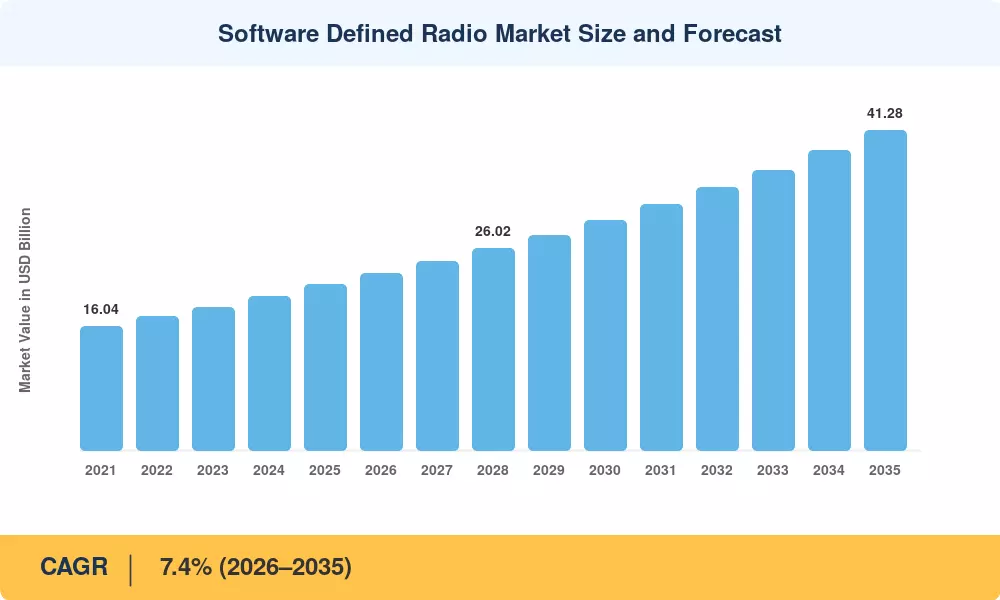
As per MRFR analysis, the Software Defined Radio Market Size was estimated at 1.83 USD Billion in 2024. The Software Defined Radio industry is projected to grow from 2.233 USD Billion in 2025 to 16.31 USD Billion by 2035, exhibiting a compound annual growth rate (CAGR) of 22.0 during the forecast period 2025 - 2035.

Key Market Trends & Highlights

The Software Defined Radio Market is poised for substantial growth driven by technological advancements and increasing demand across various sectors.

  • North America remains the largest market for Software Defined Radio Market, driven by robust defense spending and technological innovation.
  • The Asia-Pacific region is emerging as the fastest-growing market, fueled by rapid economic development and increasing investments in communication technologies.
  • The Airborne segment holds the largest share, while the Naval segment is experiencing the fastest growth due to heightened maritime security concerns.
  • Key market drivers include advancements in communication technologies and increased adoption of IoT devices, which are shaping the future of Software Defined Radio Market.

Market Size & Forecast

2024 Market Size 1.83 (USD Billion)
2035 Market Size 16.31 (USD Billion)
CAGR (2025 - 2035) 22.0%

Major Players

Northrop Grumman (US), Raytheon Technologies (US), Thales Group (FR), General Dynamics (US), L3Harris Technologies (US), Rockwell Collins (US), Boeing (US), Elbit Systems (IL), Harris Corporation (US)

Software Defined Radio Market Trends

The Software Defined Radio Market is currently experiencing a transformative phase, driven by advancements in technology and increasing demand for flexible communication systems. This market encompasses a wide range of applications, including military, commercial, and public safety sectors. The shift towards digital communication and the need for interoperability among various communication systems are propelling the growth of this market. As organizations seek to enhance their operational efficiency, the adoption of software defined radios is becoming more prevalent. Furthermore, the integration of artificial intelligence and machine learning into these systems is likely to enhance their capabilities, making them more adaptable to changing environments. In addition, the Software Defined Radio Market is witnessing a surge in investment from both public and private sectors. This influx of capital is aimed at research and development, fostering innovation and improving product offerings. The increasing focus on secure communication channels, particularly in defense and emergency services, is also contributing to market expansion. As the landscape evolves, stakeholders must remain vigilant to emerging trends and technologies that could reshape the future of communication. Overall, the Software Defined Radio Market appears poised for substantial growth, driven by technological advancements and a growing need for versatile communication solutions.

Integration of AI and Machine Learning

The incorporation of artificial intelligence and machine learning into software defined radios is becoming increasingly prevalent. This trend suggests that these technologies can enhance the adaptability and efficiency of communication systems, allowing for real-time data processing and improved decision-making capabilities.

Growing Demand for Interoperability

There is a rising need for interoperability among various communication systems across different sectors. This trend indicates that organizations are seeking solutions that can seamlessly integrate with existing infrastructure, thereby enhancing operational efficiency and collaboration.

Investment in R&D

An increase in investment from both public and private sectors is evident, focusing on research and development within the Software Defined Radio Market. This trend highlights the commitment to innovation and the continuous improvement of product offerings to meet evolving market demands.

Software Defined Radio Market Drivers

Increased Adoption of IoT Devices

The Software Defined Radio Market is poised for growth due to the increased adoption of Internet of Things (IoT) devices across various sectors. As IoT applications proliferate, the need for versatile communication solutions becomes evident. Software defined radios offer the flexibility to support multiple protocols and standards, making them ideal for IoT applications that require seamless connectivity. The market for IoT devices is projected to expand rapidly, with estimates suggesting that the number of connected devices could exceed 30 billion by 2030. This surge in IoT adoption is likely to drive demand for software defined radios, as they enable efficient data transmission and interoperability among diverse devices.

Military and Defense Applications

The Software Defined Radio Market is significantly influenced by the military and defense sectors, where the demand for advanced communication systems is paramount. Military applications require robust, secure, and adaptable communication solutions that can operate in diverse environments. Software defined radios provide the necessary flexibility to switch between different communication protocols and frequencies, ensuring reliable communication in critical situations. The defense sector's investment in modernizing communication infrastructure is expected to drive substantial growth in the market. Reports indicate that military spending on software defined radios could reach billions of dollars, reflecting the strategic importance of secure and efficient communication systems in defense operations.

Emerging Markets and Economic Growth

The Software Defined Radio Market is experiencing growth driven by emerging markets and their economic development. As countries invest in modernizing their communication infrastructure, the demand for advanced communication technologies, including software defined radios, is on the rise. Emerging economies are increasingly adopting digital technologies, which necessitate flexible and efficient communication solutions. The expansion of telecommunications networks in these regions is expected to create new opportunities for software defined radio manufacturers. Market analysts suggest that the growth in these emerging markets could contribute significantly to the overall expansion of the software defined radio market, potentially leading to a more competitive landscape.

Advancements in Communication Technologies

The Software Defined Radio Market is experiencing a surge due to rapid advancements in communication technologies. Innovations in wireless communication, such as 5G and beyond, necessitate flexible and adaptable radio systems. These advancements enable improved data rates and reduced latency, which are critical for applications ranging from mobile communications to IoT devices. The increasing complexity of communication networks demands software-defined radios that can be easily updated and reconfigured. As a result, the market is projected to grow significantly, with estimates suggesting a compound annual growth rate of over 10% in the coming years. This growth is driven by the need for efficient spectrum utilization and the ability to support multiple communication standards within a single device.

Regulatory Support and Spectrum Management

The Software Defined Radio Market benefits from increasing regulatory support aimed at enhancing spectrum management. Governments and regulatory bodies are recognizing the need for efficient spectrum utilization to accommodate the growing demand for wireless communication. Software defined radios facilitate dynamic spectrum access, allowing users to adapt to changing spectrum availability and optimize communication performance. This regulatory push is expected to foster innovation and investment in software defined radio technologies. As a result, the market is likely to witness a favorable environment for growth, with initiatives aimed at promoting the development and deployment of software defined radios in various applications.

Market Segment Insights

By Platform: Airborne (Largest) vs. Naval (Fastest-Growing)

In the Software Defined Radio Market, the platform segment showcases a diversified distribution, with airborne applications commanding the largest share. Airborne systems leverage advanced communication capabilities, primarily driven by the growing demand for enhanced situational awareness and operational efficiency in military and commercial aviation. In contrast, naval platforms are emerging as the fastest-growing segment, driven by increased investments in naval defense systems and the need for upgraded communication technologies to support effective maritime operations.

Airborne (Dominant) vs. Naval (Emerging)

The Airborne segment in the Software Defined Radio Market is characterized by its dominance due to the rising integration of SDR technologies in both military and commercial aircraft. These systems support complex communication tasks and offer multi-band capabilities, improving interoperability across different platforms. Meanwhile, the Naval segment is categorized as emerging, reflecting its rapid growth driven by technological advancements and defense upgrades. Navies worldwide are increasingly adopting SDR for improved fleet communication, scalability, and adaptability to evolving operational requirements.

By Application: Defense (Largest) vs. Commercial (Fastest-Growing)

In the Software Defined Radio Market (SDR) market, the application segment is primarily divided into Defense and Commercial sectors. The Defense application holds a significant portion of the market share, leveraging reliable and advanced communication capabilities for military operations and national security. The intense focus on modernizing defense communication systems and enhancing interoperability between forces solidifies its leading position in the market. Conversely, the Commercial application segment is witnessing rapid growth, driven by increased demand for advanced communication technologies across various industries. Factors such as the proliferation of mobile communications, Internet of Things (IoT) applications, and the need for efficient spectrum management are propelling the commercial SDR adoption, indicating a robust growth trajectory ahead.

Application: Defense (Dominant) vs. Commercial (Emerging)

The Defense segment of the Software Defined Radio Market is characterized by its substantial investment in research and development, focusing on sophisticated technology that ensures secure and robust communications for military applications. This segment benefits from government funding and a high level of technological innovation, allowing for integrations with various platforms like drones and tactical networks. On the other hand, the Commercial segment is emerging rapidly, driven by the need for flexible and cost-effective communication systems in industries such as telecommunications, transportation, and public safety. It is characterized by diverse applications, encouraging innovation and adaptability, as businesses seek solutions that can efficiently manage communication needs in a fast-paced environment.

By Type: Terrestrial Trunked Radio (Largest) vs. Joint Tactical Radio Systems (Fastest-Growing)

The Software Defined Radio Market exhibits a diverse range of segment values, with Terrestrial Trunked Radio (Tetra) leading the market share due to its widespread adoption in professional mobile radio communications. General-Purpose Radio and Cognitive Radios follow, catering to various commercial and governmental needs. The Joint Tactical Radio Systems (JTRS) segment is gaining momentum, driven by advancements in secure communications and data interoperability, reflecting a critical evolution in defense capabilities.

Technology: Tetra (Dominant) vs. JTRS (Emerging)

Terrestrial Trunked Radio (Tetra) stands out as a dominant force in the Software Defined Radio Market, primarily due to its reliability, efficient spectrum usage, and robust features tailored for public safety and emergency services. This established technology supports seamless communication and is deeply embedded in various sectors. On the other hand, Joint Tactical Radio Systems (JTRS) represents an emerging segment with a focus on adaptive communications for military applications, leveraging software-defined functionalities to enhance performance and flexibility. Both technologies are vital in shaping the future of secure communication, catering to different user requirements and operational environments.

Get more detailed insights about Software Defined Radio Market

Regional Insights

North America : Innovation and Defense Leadership

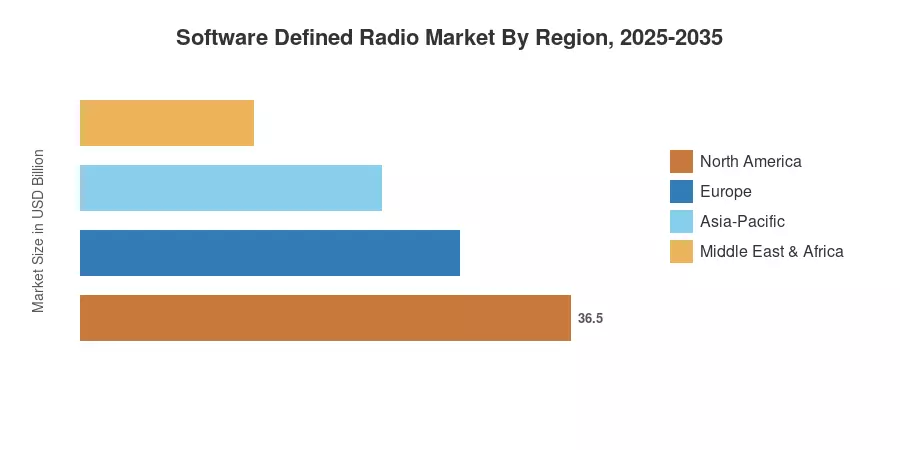
North America is the largest market for Software Defined Radio (SDR), holding approximately 45% of the global share. The region's growth is driven by increasing defense budgets, technological advancements, and a strong focus on R&D. Regulatory support from agencies like the FCC and DoD further catalyzes market expansion, ensuring compliance and innovation in SDR technologies. The U.S. leads in demand, followed closely by Canada, which contributes around 10% to the market share. The competitive landscape in North America is robust, featuring key players such as Northrop Grumman, Raytheon Technologies, and L3Harris Technologies. These companies are at the forefront of developing advanced SDR solutions for military and commercial applications. The presence of established defense contractors and a favorable regulatory environment positions North America as a leader in the SDR market, fostering innovation and collaboration across sectors.

Europe : Emerging Market with Growth Potential

Europe is witnessing significant growth in the Software Defined Radio market, accounting for approximately 30% of the global share. The region's expansion is fueled by increasing defense expenditures, the need for modernized communication systems, and collaborative projects among EU nations. Regulatory frameworks, such as the European Defense Fund, are pivotal in promoting innovation and ensuring interoperability among member states, enhancing the overall market landscape. Leading countries in Europe include France, Germany, and the UK, which are home to major players like Thales Group and BAE Systems. The competitive environment is characterized by strategic partnerships and joint ventures aimed at developing cutting-edge SDR technologies. The presence of government-backed initiatives and a focus on enhancing defense capabilities further solidify Europe's position in the SDR market, driving growth and technological advancements.

Asia-Pacific : Rapid Growth and Adoption

Asia-Pacific is rapidly emerging as a significant player in the Software Defined Radio market, holding around 20% of the global share. The region's growth is driven by increasing military modernization efforts, rising demand for secure communication systems, and government initiatives to enhance defense capabilities. Countries like India and Japan are leading the charge, with substantial investments in SDR technologies to bolster their defense infrastructure and capabilities. The competitive landscape in Asia-Pacific is evolving, with key players such as Elbit Systems and Boeing establishing a strong presence. The region is characterized by a mix of established defense contractors and emerging startups focusing on innovative SDR solutions. Collaborative efforts among nations to enhance regional security and interoperability are further propelling the market, making Asia-Pacific a vital area for SDR development and deployment.

Middle East and Africa : Strategic Defense Initiatives

The Middle East and Africa region is witnessing a burgeoning demand for Software Defined Radio, accounting for approximately 5% of the global market share. This growth is primarily driven by increasing defense budgets, geopolitical tensions, and the need for advanced communication systems. Countries like the UAE and South Africa are investing heavily in SDR technologies to enhance their military capabilities and ensure secure communications in a rapidly changing security landscape. The competitive environment in this region is characterized by a mix of local and international players, with companies like Harris Corporation and Rockwell Collins making significant inroads. The presence of government initiatives aimed at modernizing defense systems and fostering technological advancements is crucial for the growth of the SDR market. As nations prioritize defense spending, the Middle East and Africa are poised for continued growth in SDR adoption and innovation.

Software Defined Radio Market Regional Image

Key Players and Competitive Insights

The Software Defined Radio (SDR) Market is currently characterized by a dynamic competitive landscape, driven by rapid technological advancements and increasing demand for flexible communication systems across various sectors, including defense, telecommunications, and public safety. Key players such as Northrop Grumman (US), Raytheon Technologies (US), and Thales Group (FR) are strategically positioned to leverage their extensive research and development capabilities. Northrop Grumman (US) focuses on innovation in military communications, while Raytheon Technologies (US) emphasizes the integration of AI and machine learning into their SDR solutions. Thales Group (FR) is actively pursuing partnerships to enhance its product offerings, thereby shaping a competitive environment that prioritizes technological sophistication and adaptability.

The market structure appears moderately fragmented, with several players vying for market share through various business tactics. Companies are increasingly localizing manufacturing to reduce costs and enhance supply chain resilience. This trend is particularly evident as firms optimize their operations to respond to regional demands and regulatory requirements. The collective influence of these key players fosters a competitive atmosphere where innovation and operational efficiency are paramount, allowing them to maintain a competitive edge in a rapidly evolving market.

In August 2025, Raytheon Technologies (US) announced a strategic partnership with a leading telecommunications provider to develop next-generation SDR systems tailored for urban environments. This collaboration is expected to enhance the capabilities of urban emergency services, showcasing Raytheon's commitment to integrating advanced technologies into practical applications. The partnership not only strengthens Raytheon's market position but also reflects a broader trend of collaboration between defense contractors and civilian technology firms, aiming to address complex communication challenges.

In September 2025, Thales Group (FR) unveiled a new line of SDR products designed specifically for maritime applications, emphasizing enhanced interoperability and cybersecurity features. This launch is indicative of Thales's strategy to diversify its product portfolio and cater to niche markets, particularly in the defense sector. By focusing on specialized applications, Thales aims to differentiate itself from competitors and capture a larger share of the growing maritime security market.

In October 2025, Northrop Grumman (US) completed the acquisition of a small technology firm specializing in AI-driven signal processing. This acquisition is poised to bolster Northrop Grumman's capabilities in developing next-generation SDR systems that can adapt to various operational environments. The integration of AI technologies is likely to enhance the performance and efficiency of their SDR solutions, positioning Northrop Grumman as a leader in innovation within the market.

As of October 2025, the competitive trends in the Software Defined Radio Market are increasingly defined by digitalization, sustainability, and the integration of artificial intelligence. Strategic alliances are becoming more prevalent, as companies recognize the value of collaboration in driving innovation and addressing complex market demands. Looking ahead, competitive differentiation is expected to evolve, shifting from traditional price-based competition to a focus on technological innovation, reliability in supply chains, and the ability to deliver tailored solutions that meet the specific needs of diverse sectors.

Key Companies in the Software Defined Radio Market market include

Industry Developments

In January, as well as, July 2020, many key market players such as Elbit Systems, BAE Systems, L3Harris Technologies, General Dynamics Corporation, as well as, Leonardo S.p.A. have received orders of bulk quantities from the defense sector of these countries.

The Swedish Army extended a contract to Elbit System for supplying 1,000 E-LynX SDR systems. This contract will be manufactured by the company subsidiaries that are based out in Germany. This kind of contract will help manufacture products with advanced features and will help the market grow in global competition.

The USA Army extended another project to L3Harris Technologies Inc. for low-rate initial production (LRIP). The estimated value of the order stands at 95 million. This took place in April 2020.

The same company in July, as well as, November 2019, had contracts awarded by the US Air Force, as well as, the Special Operation Forces operators for supplying handheld tactical radios, as well as, wideband airborne HF radios. The contact with the SOF operators amounted to USD 86 million.

Future Outlook

Software Defined Radio Market Future Outlook

The Software Defined Radio Market is projected to grow at a 22.0% CAGR from 2024 to 2035, driven by advancements in communication technologies and increasing demand for flexible radio solutions.

New opportunities lie in:

  • Development of integrated SDR platforms for military applications.
  • Expansion into IoT-enabled SDR devices for smart cities.
  • Partnerships with telecom companies for 5G SDR solutions.

By 2035, the Software Defined Radio Market is expected to be robust, reflecting substantial growth and innovation.

Market Segmentation

Software Defined Radio Market Type Outlook

  • Terrestrial trunked radio (Tetra)
  • General-purpose radio
  • Joint tactical radio systems (JTRS)
  • Cognitive or intelligent radio

Software Defined Radio Market Platform Outlook

  • Airborne
  • Space
  • Land
  • Naval

Software Defined Radio Market Application Outlook

  • Defense
  • Commercial

Report Scope

MARKET SIZE 20241.83(USD Billion)
MARKET SIZE 20252.233(USD Billion)
MARKET SIZE 203516.31(USD Billion)
COMPOUND ANNUAL GROWTH RATE (CAGR)22.0% (2024 - 2035)
REPORT COVERAGERevenue Forecast, Competitive Landscape, Growth Factors, and Trends
BASE YEAR2024
Market Forecast Period2025 - 2035
Historical Data2019 - 2024
Market Forecast UnitsUSD Billion
Key Companies ProfiledMarket analysis in progress
Segments CoveredMarket segmentation analysis in progress
Key Market OpportunitiesIntegration of artificial intelligence enhances adaptability in the Software Defined Radio Market.
Key Market DynamicsRising demand for flexible communication solutions drives innovation and competition in the Software Defined Radio market.
Countries CoveredNorth America, Europe, APAC, South America, MEA

Market Highlights

Author
Swapnil Palwe
Team Lead - Research

With a technical background as Bachelor's in Mechanical Engineering, with MBA in Operations Management , Swapnil has 6+ years of experience in market research, consulting and analytics with the tasks of data mining, analysis, and project execution. He is the POC for our clients, for their consulting projects running under the Automotive/A&D domain. Swapnil has worked on major projects in verticals such as Aerospace & Defense, Automotive and many other domain projects. He has worked on projects for fortune 500 companies' syndicate and consulting projects along with several government projects.

Leave a Comment

FAQs

What is the projected market valuation of the Software Defined Radio Market by 2035?

The Software Defined Radio Market is projected to reach a valuation of 16.31 USD Billion by 2035.

What was the market valuation of the Software Defined Radio Market in 2024?

In 2024, the Software Defined Radio Market had a valuation of 1.83 USD Billion.

What is the expected CAGR for the Software Defined Radio Market during the forecast period 2025 - 2035?

The expected CAGR for the Software Defined Radio Market during the forecast period 2025 - 2035 is 22.0%.

Which companies are considered key players in the Software Defined Radio Market?

Key players in the Software Defined Radio Market include Northrop Grumman, Raytheon Technologies, Thales Group, and L3Harris Technologies.

What are the projected valuations for the airborne segment of the Software Defined Radio Market by 2035?

The airborne segment is projected to grow from 0.55 USD Billion in 2024 to 5.0 USD Billion by 2035.

How does the commercial application segment of the Software Defined Radio Market compare to the defense segment?

The commercial application segment is expected to grow from 0.73 USD Billion in 2024 to 7.31 USD Billion by 2035, while the defense segment is projected to increase from 1.1 USD Billion to 9.0 USD Billion.

What is the expected growth for the naval platform segment in the Software Defined Radio Market?

The naval platform segment is anticipated to grow from 0.48 USD Billion in 2024 to 4.01 USD Billion by 2035.

Download Free Sample

Kindly complete the form below to receive a free sample of this Report

Compare Licence

×
Features License Type
Single User Multiuser License Enterprise User
Price $4,950 $5,950 $7,250
Maximum User Access Limit 1 User Upto 10 Users Unrestricted Access Throughout the Organization
Free Customization
Direct Access to Analyst
Deliverable Format
Platform Access
Discount on Next Purchase 10% 15% 15%
Printable Versions