Solar Control Window Films Market (2026 - 2035)

Solar Control Window Films Market Size, Share & Industry Analysis Research Report Information By Type (Dyed, Vacuum, Clear), By Absorber Type (Organic, Inorganic, Metallic) By Application (Construction, Automotive & Transportation, Marine, Decorative) and By Region (North America, Europe, Asia-Pacific, and Rest Of The World) โ€“Market Forecast Till 2035
ID: MRFR/CnM/4333-CR
184 Pages
Chitranshi Jaiswal
Last Updated: July 12, 2026
Solar Control Window Films Market
Market Size
Forecast Period2026-2035
CAGR (2026-2035)10.91%
2025 Market SizeUSD 1.04 Billion
2035 Market SizeUSD 2.72 Billion
Key Players
Eastman Chemical (LLumar
SunTek)
Saint-Gobain
Johnson Laminating & Coating
Hanita Coatings
Garware Suncontrol
Opportunities
  • Nano-Ceramic Film Innovation
  • Retrofit Opportunity in Aging Commercial Building Stock
  • Emerging Market Urbanization

Solar Control Window Films Market Summary

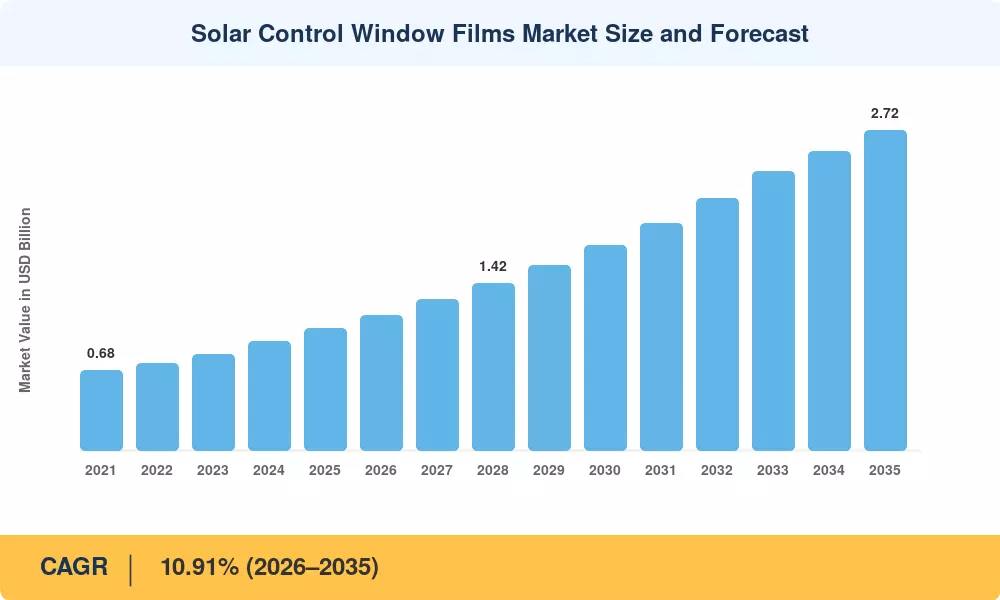
The Solar Control Window Films Market was valued at USD 1.04 billion in 2025 and is projected to reach USD 1.15 billion in 2026 before expanding to USD 2.72 billion by 2035, registering a CAGR of 10.91% during the forecast period (2026โ€“2035). Accelerating decarbonization mandates across 130+ countries and rising commercial electricity tariffs โ€” up 18% on average since 2021 โ€” have turned heat control window film into a high-ROI retrofit investment with sub-three-year payback periods [2]. The convergence of green building codes and occupant comfort standards keeps this Solar Control Window Films Market on a resilient growth trajectory, even as petrochemical feedstock prices remain volatile.

A technological shift is reshaping the Solar Control Window Films Market from conventional dyed and metalized products toward advanced ceramicโ€“metallic hybrid films and nano-ceramic coatings that reject over 95% of infrared radiation without darkening visible light transmission. The U.S. Department of Energy's Building Technologies Office allocated USD 280 million to envelope efficiency programs in FY 2024, explicitly naming UV protection films and solar protection films among eligible retrofit technologies [3]. Vacuum-coated reflective window films continue to dominate current specifications because they deliver neutral aesthetics alongside high infrared rejection, but next-generation ceramic formulations are rapidly closing the performance gap.

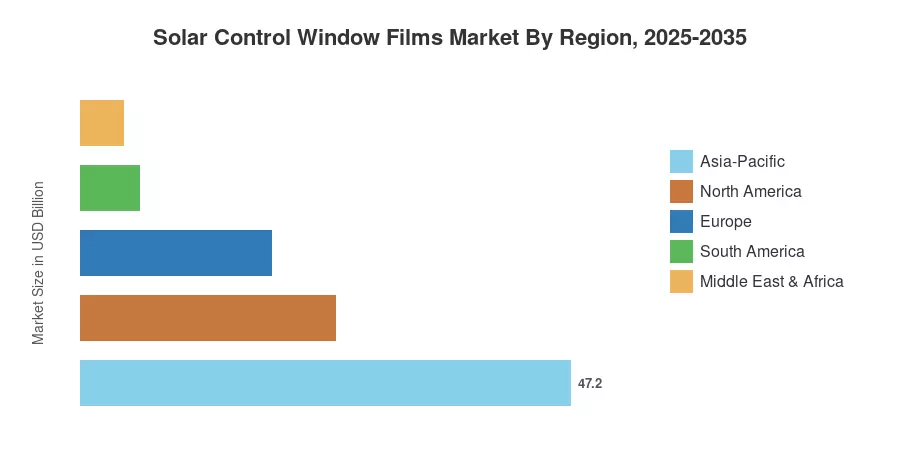
Asia-Pacific commands the largest share of the Solar Control Window Films Market at approximately 47.2% of 2025 revenue, driven by construction booms in China, India, and Southeast Asia. The region also posts the fastest CAGR of 11.28% through 2035. North America holds the second-largest position with roughly 24.6% share, buoyed by federal tax incentives under the Inflation Reduction Act that directly benefit energy-saving window film installations [4]. Europe rounds out the top three, where EU net-zero mandates and the revised Energy Performance of Buildings Directive are pulling architectural window films into mainstream specification.

ย 

Key Report Takeaways

โ€ข By Film Type

  • Vacuum-coated reflective films captured 45.1% of the Solar Control Window Films Market share in 2025, reinforcing their role as the specification standard for commercial glazing
  • Dyed films are expanding at a CAGR of 9.48% through 2035, gaining traction in cost-sensitive residential window tinting applications

โ€ข By Absorber Type

  • Ceramic absorber technology led the Solar Control Window Films Market with 48.5% revenue share in 2025
  • Metallic absorbers are posting the fastest growth at 11.12% CAGR, favored for their superior heat control window film performance in extreme climates

โ€ข By Installation Stage

  • New-build projects accounted for USD 0.89 billion in 2025 revenue, reflecting the integration of sun control films into original glazing specifications
  • Retrofit installations are growing at 11.45% CAGR as building owners upgrade aging facades with energy-saving window films

โ€ข By End-User Industry

  • Construction held 57.3% of 2025 revenue, driven by green building certifications requiring solar protection films
  • Automotive applications are forecast to expand at 11.74% CAGR through 2035

โ€ข By Region

  • Asia-Pacific dominated with 47.2% of the Solar Control Window Films Market in 2025
  • North America held 24.6% share, with the U.S. anchoring demand for commercial window films

ย 

Market Size and Forecast (2021โ€“2035)

Market Research Future (MRFR)'s proprietary estimation framework triangulates primary interviews with film manufacturers, construction procurement databases, distributor sell-through data, and macro indicators, including commercial construction starts and automotive production volumes. Historical figures (2021โ€“2024) are validated against customs trade data and industry association shipment reports.
Solar Control Window Films Market Size and Forecast
Our Impact
Enabled $4.3B Revenue Impact for Fortune 500 and Leading Multinationals
Partnering with 2000+ Global Organizations Each Year
30K+ Citations by Top-Tier Firms in the Industry

Driver Impact Analysis

Driver ~% Impact on CAGR Geographic Relevance Impact Timeline
Green building certification mandates (LEED, BREEAM, IGBC) ~18% Global Medium-term (2โ€“4 yr)
Rising commercial electricity tariffs ~16% North America, Europe Short-term (โ‰ค2 yr)
Automotive thermal comfort and EV range optimization ~14% Asia-Pacific, North America Medium-term (2โ€“4 yr)
UV radiation health awareness and occupant wellness ~12% Global Long-term (โ‰ฅ4 yr)
Fiscal incentives (IRA Section 179D, EU renovation wave) ~15% North America, Europe Short-term (โ‰ค2 yr)
Urbanization and high-rise construction in emerging economies ~13% Asia-Pacific, South America Long-term (โ‰ฅ4 yr)
Smart glass integration and IoT-enabled film systems ~12% North America, Europe Long-term (โ‰ฅ4 yr)

ย 

Green Building Certification Mandates

LEED v5, released in draft form in 2024, tightened envelope thermal performance credits and explicitly rewards solar protection films as a qualifying passive cooling measure [3]. The India Green Building Council has certified over 11.8 billion square feet of commercial space, and updated 2025 guidelines now require visible light transmittance optimization โ€” a specification that directly favors ceramic-based UV protection films. Building owners pursuing BREEAM Outstanding in the UK report that reflective window films reduce cooling loads by 25โ€“30%, cutting annual HVAC expenditure by GBP 4.50 per square meter [3].

Rising Commercial Electricity Tariffs

According to the EIA, commercial electricity rates in the United States averaged USD 0.138 per kWh in 2024, a 19% rise over 2020 levels [4]. In the Middle East, commercial rates increased by 35% between 2021 and 2024 due to subsidy reforms in Saudi Arabia and the United Arab Emirates, making energy-saving window films economically attractive even in places where electricity has historically been inexpensive. Tinted window films are among the fastest-returning envelope investments available, with facility managers in sunbelt areas reporting that they pay for themselves in 12 to 18 months on facades facing east and west [4].

Automotive Thermal Comfort and EV Range Optimization

Electric vehicle manufacturers are integrating heat control window film into OEM glazing packages because reducing cabin thermal load extends battery range by 4โ€“7% in hot climates [8]. Tesla's 2024 supplier disclosures revealed expanded procurement of nano-ceramic solar protection films for Model Y and Cybertruck production lines. The global EV fleet surpassed 45 million units in 2024, and every percentage point of range improvement justifies premium sun control films in the bill of materials [8].

Fiscal Incentives and Government Programs

The Inflation Reduction Act's Section 179D deduction allows commercial building owners to claim up to USD 5.00 per square foot for energy-efficient envelope improvements, including installations of commercial window films that meet ASHRAE 90.1 standards [4]. The EU Renovation Wave Strategy targets 35 million building renovations by 2030, with envelope upgrades โ€” including architectural window films โ€” eligible for subsidized financing through national recovery plans. These programs convert latent demand into near-term procurement activity across the Solar Control Window Films Market [7].

ย 

Restraints Impact Analysis

Restraint impact estimates follow the same directional methodology as Section 4. Negative percentages indicate estimated drag on overall growth rather than precise CAGR deductions.

Restraint ~% Drag on CAGR Geographic Relevance Impact Timeline
Raw material price volatility (PET, adhesives, metals) ~โˆ’8% Global Short-term (โ‰ค2 yr)
Competition from smart glass and electrochromic glazing ~โˆ’6% North America, Europe Long-term (โ‰ฅ4 yr)
Fragmented installer quality and warranty inconsistencies ~โˆ’5% Emerging markets Medium-term (2โ€“4 yr)
Limited consumer awareness in residential segments ~โˆ’4% South America, MEA Medium-term (2โ€“4 yr)
Aesthetic restrictions in heritage and regulated buildings ~โˆ’3% Europe Long-term (โ‰ฅ4 yr)

ย 

Raw Material Price Volatility

Between Q1 2023 and Q4 2024, PET film substrate costs fluctuated 22% because to the constrained availability of polyester resin in Asia and changes in upstream crude oil [12]. Silver, titanium, and indium are the sputtering targets for vacuum-coated reflective window films; these metals are vulnerable to mining concentration risk and export regulations. Instead of transferring costs to price-conscious residential window tinting clients, manufacturers incurred margin compression of 150โ€“200 basis points in 2024, which slowed capacity development plans [12].

Competition from Smart Glass Technologies

Electrochromic and thermochromic glazing products from companies like View Inc. and SageGlass (Saint-Gobain) offer dynamic tinting that eliminates the need for aftermarket film application [11]. While current smart glass pricing remains 8โ€“12ร— higher per square meter than premium heat control window film, production scale-up and automotive OEM adoption could narrow the gap by 2030. High-end commercial projects in North America are increasingly specifying smart glass for curtain wall facades, potentially displacing architectural window films in the premium tier of the Solar Control Window Films Market [11].

Fragmented Installer Quality

The lack of uniform installer certification causes uneven application quality, early film failure, and warranty disputes in developing markets in Southeast Asia and Latin America. In the residential window tinting market, where adoption is driven by word-of-mouth recommendations, poor installations erode customer confidence and hinder repeat buy cycles.

ย 

Solar Control Window Films Market Opportunities

Nano-Ceramic Film Innovation

Next-generation nano-ceramic formulations achieve 99% UV rejection and 85%+ infrared rejection while maintaining over 70% visible light transmission โ€” a combination that legacy metalized films cannot match [6]. Patents filed in 2024 for multi-layer ceramicโ€“graphene composites suggest that UV protection films with self-healing scratch resistance could reach commercial scale by 2028, opening premium pricing tiers across the Solar Control Window Films Market

Retrofit Opportunity in Aging Commercial Building Stock

Single-pane or early double-glazed windows with low solar efficiency are found in more than 60% of commercial buildings in the US and the EU that were built before 2000 [7]. Energy-saving window films, which are usually 70โ€“80% less expensive than complete window replacement, provide a non-invasive and affordable upgrade option. Facility owners are under pressure to show quantifiable energy reductions as ESG reporting standards become more stringent under the EU Corporate Sustainability Reporting Directive

Emerging Market Urbanization

India plans to develop 100 smart cities by 2030 under its Smart Cities Mission, with Phase III allocating INR 48,000 crore for sustainable infrastructure [9]. Rapid urbanization in Vietnam, Indonesia, and the Philippines is generating over 1.2 billion square meters of new commercial floor space annually, much of it in tropical climates where sun control films deliver the highest thermal payback

Automotive OEM Integration and EV Ecosystem

The electric vehicle revolution creates a new demand channel for solar protection films integrated at the factory level rather than the aftermarket [8]. OEM partnerships offer film manufacturers volume commitments, stable pricing, and co-development opportunities for films optimized to vehicle-specific glass curvatures. The Solar Control Window Films Market stands to capture incremental revenue as automakers standardize thermal management films across model platforms

Film-as-a-Service and Performance Contracting

Energy service companies (ESCOs) are beginning to bundle reflective window films into performance contracts where building owners pay based on verified energy savings rather than upfront material costs [14]. This business model reduces adoption barriers, particularly for small and medium commercial properties, and creates recurring revenue streams for film distributors operating in the Solar Control Window Films Market

ย 

Solar Control Window Films Market Future Outlook

Smart Film Integration and IoT-Enabled Solutions

The convergence of solar control films with building automation systems will create a new product category โ€” switchable hybrid films that adjust tint levels based on real-time solar load data from IoT sensors [11]. By 2030, the IEA projects that 45% of new commercial buildings will incorporate connected envelope technologies, positioning the Solar Control Window Films Market to capture value beyond passive film sales through software licensing and data analytics services [11].

Circular Economy and Sustainable Film Manufacturing

PET film substrate recycling technologies are advancing rapidly, with pilot plants in Germany and Japan demonstrating closed-loop depolymerization that recovers 92% of base material [12]. Manufacturers investing in bio-based adhesive systems and solvent-free coating processes will gain procurement preference as green building certifications tighten material lifecycle requirements. The Solar Control Window Films Market will increasingly compete on embodied carbon metrics alongside thermal performance.

Electrification Supercycle and Building Decarbonization

Global building sector electrification โ€” replacing gas heating with heat pumps โ€” amplifies the value of energy-saving window films because electrically cooled and heated buildings benefit more from reduced thermal loads [3]. The IEA's Net Zero Emissions scenario requires a 50% reduction in building energy intensity by 2035, and reflective window films represent one of the most cost-effective passive measures to close that gap. Solar Control Window Films Market participants that position products within integrated decarbonization packages will capture a disproportionate share.

Automotive Lightweighting and Advanced Glazing

As automakers pursue vehicle lightweighting to extend EV range, thinner glass substrates create new technical requirements for heat control window film formulations that maintain structural integrity under stress [8]. The Solar Control Window Films Market will evolve its automotive segment from aftermarket aesthetics toward performance-engineered OEM solutions, with UV protection films designed to meet automotive safety standards (ECE R43, ANSI Z26.1) becoming a growth vector through 2035.

ย 

Solar Control Window Films Market Segmentation

By Film Type

Segment Key Metric Primary Demand Driver
Clear CAGR 9.72% (2026โ€“2035) UV protection films for heritage and retail glazing
Dyed 19.8% share (2025) Cost-effective residential window tinting
Vacuum Coated 45.1% share (2025) Commercial specification standard for reflective window films
Others (ceramic nano, hybrid) CAGR 12.34% (2026โ€“2035) Premium performance in extreme climates

ย 

Vacuum-coated films maintain dominance in the Solar Control Window Films Market because their sputtered metallic layers achieve total solar energy rejection (TSER) rates above 65% while preserving neutral facade aesthetics demanded by architectural specifiers. These reflective window films carry a 15โ€“20% price premium over dyed alternatives but deliver measurably superior heat control window film performance in standardized NFRC testing. The segment benefits from established supply chains centered in South Korea, Japan, and the United States, where major producers operate continuous-roll vacuum deposition lines at an industrial scale [6].

Dyed films serve the price-conscious residential window tinting segment, where homeowners prioritize glare reduction and privacy over maximum infrared rejection. Growth in this sub-segment tracks single-family housing starts in North America and renovation activity in European markets. Meanwhile, ceramic nano-hybrid films represent the fastest-growing category, attracting specification from automotive OEMs and premium commercial projects that demand maximum UV protection film performance without metallic signal interference [6].

By Absorber Type

Segment Key Metric Primary Demand Driver
Organic 14.3% share (2025) Low-cost tinted window films for basic solar control
Inorganic/Ceramic 48.5% share (2025) Superior IR rejection without signal interference
Metallic CAGR 11.12% (2026โ€“2035) High-performance sun control films for extreme heat zones

ย 

Ceramic absorber technology leads the Solar Control Window Films Market because inorganic ceramic particles provide spectrally selective infrared rejection โ€” blocking heat while transmitting visible light and allowing full RF signal penetration. This makes ceramic-based energy-saving window films the preferred choice for modern commercial buildings where wireless connectivity is essential. Metallic absorbers, while slightly restricting RF signals, deliver the highest absolute TSER values and are gaining rapid adoption in Middle Eastern and South Asian markets where cooling loads are extreme [6].

By Installation Stage

Segment Key Metric Primary Demand Driver
New-Build 89.2% share (2025) Building code integration of solar protection films
Retrofit CAGR 11.45% (2026โ€“2035) Aging commercial building stock upgrades

ย 

New-build dominance in the Solar Control Window Films Market reflects the trend toward specifying sun control films at the design stage rather than treating them as aftermarket additions. Architects and glazing consultants increasingly include film performance parameters in their facade specifications, making heat control window film a standard line item in construction procurement. The retrofit segment, while smaller, is growing faster as ESG reporting mandates compel building owners to demonstrate measurable energy improvements on existing assets

By End-User Industry

Segment Key Metric Primary Demand Driver
Construction 57.3% share (2025) Green building certifications and energy codes
Automotive CAGR 11.74% (2026โ€“2035) EV thermal management and OEM integration
Others (marine, aerospace, specialty) USD 0.06 Billion (2025) Niche applications in transportation and industrial glazing

ย 

Construction remains the backbone of the Solar Control Window Films Market, with commercial offices, retail, healthcare, and hospitality properties accounting for the bulk of film consumption. Architectural window films in this segment must meet stringent performance certifications (NFRC, EN 410, ISO 9050) to qualify for green building credits. The automotive segment is the fastest-growing vertical, driven by OEM-level integration of solar protection films for thermal management in electric vehicles and premium passenger cars [8].

ย 

Regional Market Share Analysis

Region Key Metric Primary Investment Themes
North America 24.6% share (2025) IRA incentives, commercial retrofits, EV OEM integration
Europe 18.4% share (2025) EPBD compliance, heritage building upgrades, net-zero mandates
Asia-Pacific 47.2% share (2025) Construction boom, smart city programs, and tropical climate demand
South America 5.7% share (2025) Urbanization, energy tariff reform, and green certification adoption
Middle East & Africa 4.1% share (2025) Subsidy reform, mega-project construction, and extreme heat mitigation
Total 100% โ€”

The Solar Control Window Films Market exhibits distinct regional dynamics shaped by climate zones, building codes, energy pricing structures, and construction activity levels. Asia-Pacific leads on both scale and growth rate, while North America and Europe represent mature but innovation-driven markets for commercial window films and residential window tinting solutions.

ย 

North America

Country Key Metric Key Driver
US 78.5% of regional revenue IRA Section 179D deductions for energy-saving window films [4]
Canada CAGR 10.22% (2026โ€“2035) National Building Code 2025 energy tier upgrades [15]
Mexico USD 0.03 Billion (2025) NAMA programs promoting tinted window films in commercial buildings [16]

ย 

The United States anchors North American demand, where commercial building operators are leveraging federal tax incentives to install heat control window film across office, retail, and healthcare portfolios. Canada's updated National Building Code introduces stricter envelope solar heat gain coefficients, pulling architectural window films into standard specifications for new construction in provinces from Ontario to British Columbia [15].

Europe

Country Key Metric Key Driver
Germany 23.8% of regional revenue Gebรคudeenergiegesetz (GEG) building energy law compliance [7]
UK CAGR 10.65% (2026โ€“2035) Net Zero Strategy 2050 envelope upgrade funding [17]
France USD 0.03 Billion (2025) RE2020 regulation mandating low-carbon building materials [7]
Italy CAGR 9.87% (2026โ€“2035) Superbonus 110% program extension for energy retrofits [18]
Spain 8.4% of regional revenue Mediterranean climate is driving reflective window films adoption
Nordic Countries CAGR 9.52% (2026โ€“2035) Passive house standards favoring UV protection films [13]
Russia 4.2% of regional revenue Harsh continental climate supporting heat control window film
Rest of Europe 14.1% of regional revenue EU Renovation Wave spillover demand

ย 

Europe's Solar Control Window Films Market is driven by the revised EPBD, which requires all new buildings to be near-zero energy by 2028 and existing commercial stock to achieve minimum energy performance by 2033 [7]. Germany and the UK together account for over 40% of European demand, with solar protection films playing a dual role in summer cooling and winter heat retention through low-emissivity hybrid formulations.

Asia-Pacific

Country Key Metric Key Driver
China 38.6% of regional revenue Green building Action Plan and massive commercial construction [9]
India CAGR 12.15% (2026โ€“2035) Smart Cities Mission Phase III and ECBC compliance [9]
Japan USD 0.05 Billion (2025) ZEB (Zero Energy Building) roadmap driving sun control films [19]
South Korea CAGR 11.34% (2026โ€“2035) Green New Deal building retrofit programs [20]
ASEAN 18.2% of regional revenue Tropical climate demand for tinted window films across commercial stock
Rest of Asia-Pacific CAGR 10.45% (2026โ€“2035) Urbanization-driven construction growth

ย 

Asia-Pacific remains the powerhouse of the Solar Control Window Films Market, with China's construction sector alone consuming over USD 0.19 billion in film products during 2025. India's Energy Conservation Building Code (ECBC) mandates solar heat gain control for all commercial buildings exceeding 100 kW connected load, directly driving demand for ceramic-based UV protection films and energy-saving window films in the subcontinent's rapidly expanding urban centers [9].

South America

Country Key Metric Key Driver
Brazil 62.4% of regional revenue PROCEL Edifica program promoting energy-saving window films [16]
Argentina CAGR 10.78% (2026โ€“2035) Urban heat island mitigation programs in Buenos Aires
Rest of South America 18.3% of regional revenue Growing awareness of heat control window film benefits

ย 

Brazil dominates South American demand, where the PROCEL Edifica labeling program incentivizes commercial building operators to adopt solar protection films and tinted window films as part of envelope efficiency upgrades. Rising electricity costs across the region โ€” up 28% in real terms since 2020 โ€” are converting awareness into procurement action [16].

Middle East & Africa

Country Key Metric Key Driver
Saudi Arabia 31.5% of regional revenue NEOM and Vision 2030 mega-projects specifying reflective window films [21]
UAE CAGR 11.52% (2026โ€“2035) Estidama Pearl Rating and Dubai Green Building Code [21]
South Africa USD 0.005 Billion (2025) SANS 10400-XA energy performance standards
Egypt CAGR 10.15% (2026โ€“2035) New Administrative Capital construction wave
Rest of MEA 22.8% of regional revenue Extreme heat is driving commercial window films demand

ย 

The Middle East's extreme cooling loads โ€” commercial buildings in Riyadh and Dubai spend 60โ€“70% of energy budgets on air conditioning โ€” make sun control films among the highest-ROI passive cooling investments available [21]. Saudi Arabia's NEOM project and the UAE's commitment to 40% clean energy by 2050 embed architectural window films into specification standards for all new government and commercial structures.

ย 

Solar Control Window Films Market By Region, 2025-2035

Competitive Benchmarking

The Solar Control Window Films Market exhibits medium concentration, with the top five players holding an estimated 38โ€“44% combined revenue share. The Herfindahl-Hirschman Index (HHI) falls in the 800โ€“1,100 range, indicating a moderately fragmented competitive environment where global film conglomerates compete alongside regional specialists and aftermarket distributors.

Company Est. Revenue Share Range Key Offerings Strategic Positioning
3M Company ~8โ€“11% Prestige Series, Night Vision, Thinsulate Climate Control Broadest SKU portfolio; leverages adhesive science leadership
Eastman Chemical (LLumar, SunTek) ~7โ€“10% LLumar SelectPro, SunTek CXP, automotive tint films Vertically integrated PET substrate and film manufacturing
Saint-Gobain (Solar Gard) ~6โ€“9% Sentinel Plus, Silver Series reflective films Global distribution via glass division synergies
Johnson Laminating & Coating ~4โ€“6% Specialty sun control films, laminated safety films Regional strength in North America
Hanita Coatings (Avery Dennison) ~4โ€“6% SolarZone, TitanCool ceramic films Ceramic technology leadership; defense crossover
Garware Suncontrol ~3โ€“5% Sun Control films for automotive and architectural Market leader in India's residential window tinting segment
Madico Inc. ~3โ€“5% Sunscape, Wincos ceramic automotive films OEM partnerships and automotive aftermarket distribution
Daiyu Optics ~2โ€“4% Nano-ceramic architectural films Emerging player in the Asia-Pacific premium tier
Nexfil Co. Ltd. ~2โ€“4% Nano-ceramic, IR-cut films for automotive South Korean manufacturer with global OEM supply contracts
Hรผper Optik ~2โ€“3% Ceramic-based nano films, Sputtered Series Premium positioning in ASEAN and Middle Eastern markets

ย 

ย 

Recent News & Developments

ย 

ย 

ย 

ย 

ย 

  • Eastman Chemical Company ( February 2024 ): Launched its next-generation SunTekยฎ E-Series and Llumarยฎ IRX solar control window film variants in North America, integrating premium ceramic and infrared-rejection technologies designed to drastically reduce solar heat gain in modern buildings. [7]
  • Avery Dennison Corporation ( January 2025 ): Partnered with international green-building development groups to retroactively install its upgraded Hanita SolarZoneโ„ข architectural film line across public facilities, deploying spectrally selective films that reflect up to 80% of total solar energy. [8]

ย 

  • XPEL, Inc. (March 2025) : Established an international distribution agreement to expand its PRIMEโ„ข XR Plus nano-ceramic automotive window films into Western Europe and Asia-Pacific, targeting EV range optimization via infrared heat rejection. [20]

ย 

Solar Control Window Films Market Report Scope

Parameter Detail
Market Scope Global Solar Control Window Films Market โ€” film type, absorber type, installation stage, end-user industry, and geography
Study Period 2021โ€“2035
CAGR (Forecast Period) 10.91% (2026โ€“2035)
Market Size (2025) USD 1.04 Billion
Market Size (2035) USD 2.72 Billion
Fastest Growing Segment Automotive end-user (CAGR 11.74%); Metallic absorber (CAGR 11.12%)
Companies Profiled 10 (3M, Eastman Chemical, Saint-Gobain, Johnson Laminating, Hanita Coatings, Garware Suncontrol, Madico, Daiyu Optics, Nexfil, Hรผper Optik)
Valuation Currency USD Billion

ย 

ย 

FAQs

How do ceramic and metallic absorber films compare for buildings with extensive wireless infrastructure?
Ceramic absorber films allow full RF signal penetration while rejecting over 80% of infrared energy, making them ideal for offices with dense Wi-Fi and 5G deployments. Metallic films block 15โ€“25% of radio frequencies, requiring signal repeater installations that add USD 2โ€“4 per square foot to project costs [6].
What warranty terms should procurement teams negotiate for large-scale commercial window film installations?
Leading manufacturers offer 10โ€“15-year commercial warranties covering peeling, bubbling, and optical degradation, but coverage varies by film type and climate zone. Procurement teams should require fade-resistance guarantees exceeding ASTM E308 standards and insist on installer-backed labor warranties separate from product coverage [6].
How does the Solar Control Window Films Market address recycling and end-of-life film disposal?
Closed-loop PET depolymerization plants in Germany and Japan can recover 92% of base substrate material from removed films [12]. Procurement specifications increasingly require manufacturers to provide take-back programs, though industry-wide recycling infrastructure remains limited in emerging markets.
What performance testing standards should specifiers reference when evaluating sun control films for the Solar Control Window Films Market?
NFRC 200 and EN 410 are the primary standards governing visible light transmittance, solar heat gain coefficient, and UV transmittance. Specifiers should also reference AIMCAL metallizing standards for reflective window films to verify sputtering quality and coating adhesion [6].
How does the Solar Control Window Films Market intersect with insurance premium reductions for commercial properties?
Several U.S. insurers offer 3โ€“8% premium discounts for properties with safety and solar films that provide fragment retention during severe weather events [14]. Facility managers should document film specifications meeting ANSI Z97.1 to qualify for both solar performance and safety-related insurance benefits.
What integration challenges arise when retrofitting energy-saving window films onto low-E coated glass?
Applying film to existing low-E glass can create a thermal stress risk if the combined solar absorption exceeds the glass manufacturer's tolerance, potentially voiding glazing warranties [6]. Specifiers must perform thermal stress analysis using software tools like Fluke or Solarcheck before installation.
How are aftermarket distributors in the Solar Control Window Films Market adapting to direct-to-consumer e-commerce channels?
Major distributors now offer online configurators that match UV protection films to specific glass types and climate zones, reducing reliance on in-person dealer networks. E-commerce channels captured an estimated 12โ€“15% of residential aftermarket sales in 2024 [1]. ย  ย 
Author
Author
Author Profile
Chitranshi Jaiswal LinkedIn
Team Lead - Research
Chitranshi is a Team Leader in the Chemicals & Materials (CnM) and Energy & Power (EnP) domains, with 6+ years of experience in market research. She leads and mentors teams to deliver cross-domain projects that equip clients with actionable insights and growth strategies. She is skilled in market estimation, forecasting, competitive benchmarking, and both primary & secondary research, enabling her to turn complex data into decision-ready insights. An engineer and MBA professional, she combines technical expertise with strategic acumen to solve dynamic market challenges. Chitranshi has successfully managed projects that support market entry, investment planning, and competitive positioning, while building strong client relationships. Certified in Advanced Excel & Power BI she leverages data-driven approaches to ensure accuracy, clarity, and impactful outcomes.

Research Approach

Research Methodology of Solar Control Window Films Market

1. Introduction:

This research paper intends to explore the market potential of Solar Control Window Films (SCWFs) in the global market context. This research methodology is designed to frame the core foundation of research to provide detailed insights into the current and emerging market trends. The primary purpose of this research methodology is to understand the various market drivers, growth prospects, and the overall scope of the market and forecast from 2023 to 2030. The primary objective is to get a holistic view of the global SCWF market in terms of the value chain, market regulations, and global perspectives.

2. Research Design:

This research report adopts a mix of qualitative and quantitative data collection methods, as well as secondary research for gathering information for the analysis and assessment of the global SCWF market. This research design is based on a comprehensive secondary research framework. The initial phase of the research produces comprehensive insights into the market overview, market structure, and current, historical, and forecast market trends.

3. Secondary Research:

We conducted exhaustive secondary research through multiple sources such as trade journals, whitepapers, trade associations, industry bodies, directories, newsletters, and blogs. The research also makes use of advanced tools and techniques such as SWOT analysis, Porterโ€™s Five Forces Analysis, and PESTLE Analysis.

4. Primary Research:

This research paper leverages primary research techniques to gain insights into the global SCWF market. The primary research method includes interviews and surveys with industry experts, as well as opinion polls to gain insights into the current market trends, competitive landscape, and expected market opportunities. We conducted physical visits to the premises of major players in the industry for a better understanding of the market dynamics.

5. Market Segmentation:

This research paper studies the global SCWF market from the perspective of type, application, end-use industry, and region. This segmentation helps to gain insight into the global SCWF market from various perspectives and helps to target the market drivers which influence the growth of the market.

6. Data Analysis:

The data gathered from the primary and secondary research process is analyzed and validated through the use of reliable and valid data analysis tools. The analysis is based on cross-checked information with industry experts and market participants.

Download Free Sample

Kindly complete the form below to receive a free sample of this Report

Download PDF ×

We do not share your information with anyone. However, we may send you emails based on your report interest from time to time. You may contact us at any time to opt-out.