SEGMENTATION QUICK REFERENCE
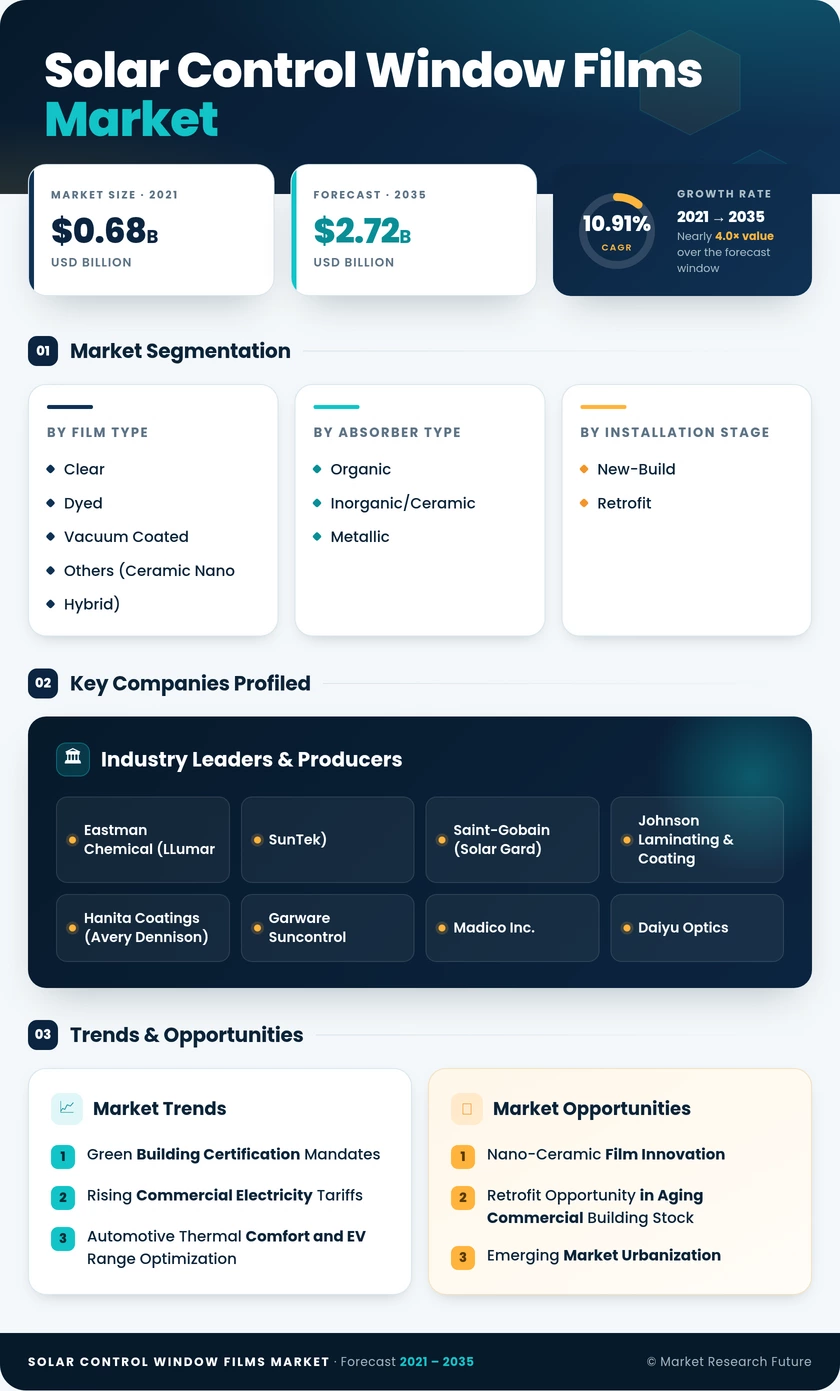
| Dimension | Sub-Segments | Dominant Segment | Fastest Growing Segment |
| Film Type | Clear, Dyed, Vacuum Coated, Others (Ceramic Nano, Hybrid) | Vacuum Coated (45.1% share, 2025) | Others / Ceramic Nano (CAGR 12.34%) |
| Absorber Type | Organic, Inorganic/Ceramic, Metallic | Inorganic/Ceramic (48.5% share, 2025) | Metallic (CAGR 11.12%) |
| Installation Stage | New-Build, Retrofit | New-Build (89.2% share, 2025) | Retrofit (CAGR 11.45%) |
| End-User Industry | Construction, Automotive, Others | Construction (57.3% share, 2025) | Automotive (CAGR 11.74%) |
| Geography | North America, Europe, Asia-Pacific, South America, MEA | Asia-Pacific (47.2% share, 2025) | Asia-Pacific (CAGR 11.28%) |
MARKET SEGMENTATION OVERVIEW
By Film Type
| Sub-Segment | Key Trend |
| Clear | Growing in heritage glazing and retail storefronts requiring maximum light transmission with UV blocking |
| Dyed | Cost-effective option for residential and small commercial applications; steady demand in price-sensitive markets |
| Vacuum Coated | Specification standard for commercial and institutional buildings; the highest installed base globally |
| Others (Ceramic Nano, Hybrid) | Fastest-growing segment driven by automotive OEM integration and premium architectural projects |
Film type selection in the Solar Control Window Films Market is driven by the balance between optical performance, cost, and application-specific requirements. Vacuum-coated products maintain dominance through established specification channels, while ceramic nano and hybrid formulations are capturing share in segments that demand maximum infrared rejection without metallic interference.
By Absorber Type
| Sub-Segment | Key Trend |
| Organic | Budget-tier films for basic solar control; declining share as ceramic alternatives drop in price |
| Inorganic/Ceramic | Largest segment; preferred for modern commercial buildings requiring wireless signal transparency |
| Metallic | Fastest growth; highest absolute thermal rejection for extreme-climate applications |
Absorber technology defines the core performance characteristics of solar control films. Ceramic absorbers lead because they combine high infrared rejection with full RF transparency, a critical requirement in today's connected commercial buildings. Metallic variants are gaining ground in geographies where extreme heat loads justify the trade-off in signal attenuation.
By Installation Stage
| Sub-Segment | Key Trend |
| New-Build | Dominant segment as building codes increasingly mandate solar heat gain control in original glazing specifications |
| Retrofit | Fastest-growing segment driven by ESG compliance, aging building stock, and performance contracting models |
The installation stage dimension reflects the evolution of solar control films from aftermarket accessories to engineered building components. New-build dominance will persist, but the retrofit opportunity is expanding rapidly as regulatory pressure mounts on existing commercial properties.
By End-User Industry
| Sub-Segment | Key Trend |
| Construction | Largest vertical, driven by commercial office, retail, healthcare, and hospitality segments |
| Automotive | Fastest-growing vertical; transitioning from aftermarket tinting to factory-installed OEM solutions |
| Others (Marine, Aerospace, Specialty) | Niche but growing; applications in yacht glazing, aircraft windows, and industrial enclosures |
End-user segmentation reveals that construction will remain the primary demand driver for the Solar Control Window Films Market through 2035, but automotive's share will expand meaningfully as electric vehicle manufacturers integrate thermal management films into standard vehicle specifications.
By Geography
| Sub-Segment | Key Trend |
| North America | Mature market with strong IRA-driven incentives and established commercial retrofit channels |
| Europe | EPBD compliance and net-zero mandates are accelerating adoption in both new-build and renovation |
| Asia-Pacific | Largest and fastest-growing region, led by China and India's construction and urbanization cycles |
| South America | Emerging demand driven by energy tariff reform and green building certification adoption |
| Middle East & Africa | Extreme cooling loads create high-ROI use cases; mega-project construction drives volume |
Regional dynamics in the Solar Control Window Films Market reflect the interplay of climate conditions, regulatory frameworks, construction activity, and energy pricing. Asia-Pacific's dominance will strengthen through 2035 as urbanization and green building adoption accelerate across the region.