×
Request Free Sample ×

Kindly complete the form below to receive a free sample of this Report

* Please use a valid business email

Leading companies partner with us for data-driven Insights

clients tt-cursor
Hero Background

Solar Rooftop Market

ID: MRFR/EnP/2830-HCR
185 Pages
Anshula Mandaokar
October 2025

Solar Rooftop Market Research Report Information By Capacity (<10 kW, 11 kW- 100kW and >100 kW), By Connectivity (On-Grid and Off-Grid), By End User (Residential, Commercial and Industrial) and By Region (North America, Europe, Asia-Pacific, and Rest of the World) – Global Industry Size, Share, Growth, Trends and Forecast To 2035

Share:
Download PDF ×

We do not share your information with anyone. However, we may send you emails based on your report interest from time to time. You may contact us at any time to opt-out.

Solar Rooftop Sales Market Infographic
Purchase Options

Solar Rooftop Market Summary

As per Market Research Future analysis, the Solar Rooftop Sales Market was estimated at 141.21 USD Billion in 2024. The Solar Rooftop industry is projected to grow from 170.3 USD Billion in 2025 to 1108.56 USD Billion by 2035, exhibiting a compound annual growth rate (CAGR) of 20.6% during the forecast period 2025 - 2035.

Key Market Trends & Highlights

The Solar Rooftop Sales Market is experiencing robust growth driven by technological advancements and increasing environmental awareness.

  • North America remains the largest market for solar rooftop sales, driven by strong government incentives and support.
  • The Asia-Pacific region is the fastest-growing market, reflecting a surge in urbanization and energy demand.
  • The residential segment continues to dominate the market, while the commercial segment is witnessing the fastest growth due to rising energy costs.
  • Key market drivers include rising energy costs and government policies that promote renewable energy adoption.

Market Size & Forecast

2024 Market Size 141.21 (USD Billion)
2035 Market Size 1108.56 (USD Billion)
CAGR (2025 - 2035) 20.6%

Major Players

Tesla (US), SunPower (US), First Solar (US), Canadian Solar (CA), JinkoSolar (CN), Trina Solar (CN), LONGi Green Energy (CN), Vivint Solar (US), Enphase Energy (US)

Solar Rooftop Market Trends

The Solar Rooftop Sales Market is currently experiencing a transformative phase, driven by a confluence of technological advancements and shifting consumer preferences. As awareness of environmental issues grows, homeowners and businesses alike are increasingly inclined to adopt renewable energy solutions. This trend is further bolstered by government incentives and policies aimed at promoting clean energy. The integration of solar technology into residential and commercial properties not only reduces energy costs but also enhances property value, making it an attractive investment for many. Moreover, the competitive landscape of the Solar Rooftop Sales Market is evolving, with numerous players striving to innovate and differentiate their offerings. Companies are focusing on improving the efficiency of solar panels and expanding their product lines to include energy storage solutions. This diversification appears to cater to a broader audience, addressing varying energy needs and preferences. As the market continues to mature, it is likely that partnerships and collaborations will become more prevalent, fostering a collaborative environment that encourages further advancements in solar technology.

Increased Adoption of Energy Storage Solutions

The Solar Rooftop Sales Market is witnessing a notable shift towards the integration of energy storage systems. Homeowners are increasingly recognizing the benefits of storing excess energy generated during peak sunlight hours for use during non-peak times. This trend not only enhances energy independence but also maximizes the efficiency of solar installations.

Government Incentives and Support

Government initiatives play a crucial role in shaping the Solar Rooftop Sales Market. Various countries are implementing policies that provide financial incentives for solar adoption, such as tax credits and rebates. These measures are likely to stimulate market growth by making solar installations more accessible to a wider audience.

Technological Advancements in Solar Technology

The Solar Rooftop Sales Market is characterized by rapid technological advancements. Innovations in solar panel efficiency and design are emerging, allowing for more effective energy capture and conversion. This evolution may lead to increased consumer interest and investment in solar solutions, further propelling market expansion.

Solar Rooftop Market Drivers

Rising Electricity Costs

The increasing cost of electricity is a significant driver for the Global Solar Rooftop Market Industry. As utility rates continue to rise, consumers are seeking alternative energy solutions to mitigate their energy expenses. Solar rooftops provide a viable option, allowing users to generate their own electricity and reduce reliance on grid power. This shift not only offers potential savings but also enhances energy independence. The financial benefits associated with solar energy adoption are becoming increasingly apparent, further propelling the market forward as more individuals and businesses consider solar installations as a long-term investment.

Market Growth Projections

The Global Solar Rooftop Market Industry is poised for remarkable growth, with projections indicating a market size of 1108.5 USD Billion by 2035. This anticipated expansion reflects a robust compound annual growth rate of 20.6% from 2025 to 2035, driven by various factors including technological advancements, government incentives, and rising electricity costs. As more consumers and businesses recognize the benefits of solar energy, the market is likely to witness increased investments and innovations. The upward trajectory of the solar rooftop market underscores its potential to play a pivotal role in the global transition towards renewable energy.

Technological Advancements

Technological advancements are pivotal in shaping the Global Solar Rooftop Market Industry. Innovations in solar panel technology, such as bifacial panels and improved energy storage solutions, are enhancing the efficiency and reliability of solar energy systems. These advancements are likely to attract more consumers, as they promise higher energy yields and lower costs over time. Furthermore, the integration of smart technologies allows for better energy management, making solar rooftops more appealing to both residential and commercial users. This trend is expected to contribute to a compound annual growth rate of 20.6% from 2025 to 2035.

Government Incentives and Policies

Government incentives and supportive policies play a crucial role in the expansion of the Global Solar Rooftop Market Industry. Various countries are introducing tax credits, rebates, and feed-in tariffs to encourage solar energy adoption. For instance, in several regions, homeowners can benefit from significant financial incentives that lower the initial investment costs for solar installations. These measures not only stimulate market growth but also contribute to achieving national renewable energy targets. As a result, the market is expected to grow substantially, with projections indicating a market size of 1108.5 USD Billion by 2035.

Growing Demand for Renewable Energy

The Global Solar Rooftop Market Industry is experiencing a surge in demand for renewable energy solutions, driven by increasing awareness of climate change and the need for sustainable energy sources. Governments worldwide are implementing policies and incentives to promote solar energy adoption, which is reflected in the projected market size of 141.2 USD Billion in 2024. This growing demand is further supported by technological advancements that enhance solar panel efficiency and reduce costs, making solar rooftops a more attractive option for residential and commercial properties alike.

Environmental Concerns and Sustainability

Environmental concerns are increasingly influencing consumer behavior, thereby impacting the Global Solar Rooftop Market Industry. As awareness of the environmental impact of fossil fuels grows, more individuals and businesses are opting for solar energy solutions to reduce their carbon footprint. This shift towards sustainability is supported by various international agreements aimed at reducing greenhouse gas emissions. Consequently, the demand for solar rooftops is likely to rise as more stakeholders recognize the importance of sustainable energy practices. This trend aligns with the broader global movement towards cleaner energy sources and responsible consumption.
Market Segment Insights

By Application: Residential (Largest) vs. Commercial (Fastest-Growing)

The Solar Rooftop Sales Market showcases a diverse range of applications, with the residential segment holding the largest market share. This segment has gained considerable traction due to increasing consumer awareness about renewable energy and rising electricity costs, prompting homeowners to invest in solar solutions. On the other hand, the commercial segment is identified as the fastest-growing, driven by the need for companies to cut operational costs and meet sustainability goals. Businesses are increasingly turning to solar rooftops as a means to enhance their green credentials and reduce dependency on conventional energy sources.

Residential (Dominant) vs. Agricultural (Emerging)

The residential segment stands out as the dominant force in the Solar Rooftop Sales Market, characterized by its widespread adoption among homeowners seeking energy independence and sustainability. This segment benefits from various government incentives and rebates, encouraging investments in solar technology. In contrast, the agricultural segment, while emerging, is gaining ground as farmers adopt solar solutions to offset rising energy costs and enhance operational efficiency. Leveraging unused roof space for solar installations allows for increased energy production while simultaneously supporting agricultural initiatives, making it an attractive option for modern farming practices.

By Technology: Photovoltaic (Largest) vs. Concentrated Solar Power (Fastest-Growing)

In the Solar Rooftop Sales Market, the technology segment is characterized primarily by Photovoltaic (PV) systems, which hold the largest share due to their widespread adoption across residential and commercial sectors. PV technology continues to dominate, accounting for the majority of rooftop installations, while Concentrated Solar Power (CSP) follows, gaining traction in larger-scale setups, though it still remains a smaller portion of the market. Building Integrated Photovoltaics (BIPV), Thin Film Solar, and Solar Thermal are also notable but command lesser shares compared to the leading technologies.

Technology: Photovoltaic (Dominant) vs. Concentrated Solar Power (Emerging)

Photovoltaic technology is the backbone of the Solar Rooftop Sales Market, recognized for its reliability and efficiency. These systems convert sunlight directly into electricity, making them highly suitable for urban and rural installations alike. Their integration into building designs through BIPV offers aesthetic appeal alongside functionality. On the other hand, Concentrated Solar Power represents an emerging technology primarily used in large installations, utilizing mirrors or lenses to focus sunlight and generate heat, which drives turbines for electricity. Although it requires large spaces and a consistent sun, its rapid advancements make it a compelling alternative, especially in regions with high solar intensity.

By Installation Type: Rooftop (Largest) vs. On-grid (Fastest-Growing)

The Solar Rooftop Sales Market is prominently shaped by various installation types, with rooftop installations holding the largest market share due to their suitability for residential and commercial buildings. On-grid systems are gaining traction as they offer savings on electricity bills and favorable incentives. Ground-mounted and hybrid systems also contribute, but they cater to different consumer needs and are not as widespread as rooftop installations. Off-grid systems continue to serve as an alternative for remote areas without reliable access to the grid, occupying a niche share of the market.

Installation Type: Rooftop (Dominant) vs. On-grid (Emerging)

Rooftop solar installations are the dominant force in the Solar Rooftop Sales Market, primarily because they seamlessly integrate with existing structures and provide direct energy savings to homeowners and businesses alike. This segment thrives on urbanization and eco-conscious consumer preferences. On the other hand, on-grid installations represent an emerging trend, driven by advancements in technology and increasing government support for renewable energy. They enable users to sell excess energy back to the grid and enjoy lower utility bills, making them appealing as energy prices rise. Both segments reflect the broader shift toward sustainable energy solutions and are essential in meeting future energy demands.

By System Type: Grid-tied (Largest) vs. Hybrid (Fastest-Growing)

In the Solar Rooftop Sales Market, the Grid-tied system segment dominates, accounting for a significant portion of overall market share due to its widespread adoption and integration with the existing power grid. As solar technology becomes more accessible, the Grid-tied systems empower homeowners to leverage solar energy, reducing dependence on traditional energy sources while benefiting from net metering policies.

Grid-tied (Dominant) vs. Hybrid (Emerging)

Grid-tied systems are characterized by their connection to the local power grid, allowing users to export surplus energy back to the grid, thereby offsetting energy costs. They represent the most popular choice among homeowners due to their efficiency and the advantages of energy credits. In contrast, Hybrid systems have emerged as a robust alternative, merging the benefits of both grid-tied and off-grid configurations. These systems incorporate battery storage, enhancing energy resilience and appealing to consumers seeking greater energy independence. The hybrid model is gaining traction, driven by advancements in battery technology and increasing consumer preference for sustainable energy solutions.

By End User: Homeowners (Largest) vs. Businesses (Fastest-Growing)

In the Solar Rooftop Sales Market, homeowners hold the largest market share, significantly driving the overall demand for solar installations. This segment's preference for renewable energy solutions fuels a substantial percentage of sales, with many seeking sustainable options to reduce energy costs. Businesses, on the other hand, are emerging as the fastest-growing segment, looking to enhance their corporate sustainability profiles and decrease operational expenses through solar investments.

Homeowners (Dominant) vs. Businesses (Emerging)

Homeowners dominate the Solar Rooftop Sales Market due to their high interest in energy independence and long-term cost savings from solar energy. This segment is characterized by a growing awareness of environmental issues and incentives supporting solar adoption. Meanwhile, businesses represent an emerging segment, increasingly investing in solar energy to meet regulatory requirements and corporate sustainability goals. They often opt for larger installations to generate significant energy savings or enhance their brand image. As both segments evolve, they highlight distinct motivations and impacts on market growth.

Get more detailed insights about Solar Rooftop Market

Regional Insights

North America : Leading Market Innovators

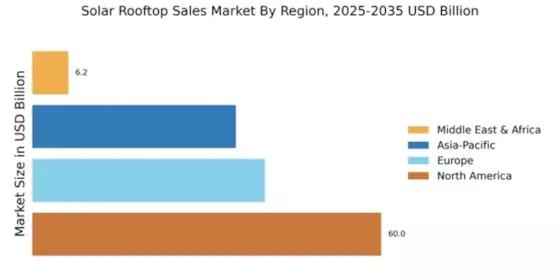
North America is poised to maintain its leadership in the solar rooftop sales market, holding a significant 60.0% share as of December 2025. The region's growth is driven by increasing consumer awareness, favorable government incentives, and advancements in solar technology. Regulatory frameworks, such as tax credits and renewable energy mandates, further catalyze demand for solar installations, making it an attractive market for both residential and commercial sectors. The competitive landscape is characterized by major players like Tesla, SunPower, and First Solar, which are leading the charge in innovation and market penetration. The U.S. remains the largest market, with states like California and Texas driving substantial growth. Canadian Solar also plays a crucial role, contributing to the region's robust supply chain and technological advancements in solar energy solutions.

Europe : Sustainable Energy Transition

Europe is rapidly evolving into a key player in the solar rooftop sales market, with a market share of 40.0% as of December 2025. The region's growth is fueled by stringent environmental regulations, ambitious renewable energy targets, and increasing public support for sustainable energy solutions. Countries like Germany and Spain are leading the charge, supported by government initiatives that promote solar energy adoption and investment in green technologies. The competitive landscape features a mix of established companies and innovative startups, with key players such as JinkoSolar and Trina Solar making significant inroads. The European market is characterized by a strong emphasis on energy efficiency and sustainability, with many countries implementing policies that encourage residential solar installations. This trend is expected to continue, bolstered by the EU's commitment to achieving carbon neutrality by 2050.

Asia-Pacific : Emerging Market Potential

The Asia-Pacific region is witnessing a surge in solar rooftop sales, holding a market share of 35.0% as of December 2025. This growth is driven by increasing energy demands, government incentives, and a shift towards renewable energy sources. Countries like China and India are at the forefront, implementing policies that support solar energy adoption and investment in infrastructure, which are crucial for meeting their growing energy needs. The competitive landscape is dominated by major players such as LONGi Green Energy and JinkoSolar, which are leveraging technological advancements to enhance efficiency and reduce costs. The region's diverse market dynamics present both challenges and opportunities, with varying regulatory environments and consumer preferences. As governments continue to prioritize renewable energy, the Asia-Pacific market is expected to expand significantly in the coming years.

Middle East and Africa : Untapped Renewable Resources

The Middle East and Africa region is emerging as a promising market for solar rooftop sales, with a market share of 6.21% as of December 2025. The growth is primarily driven by abundant sunlight, increasing energy demands, and government initiatives aimed at diversifying energy sources. Countries like South Africa and the UAE are leading the way, implementing policies that encourage solar energy investments and infrastructure development. The competitive landscape is still developing, with a mix of local and international players entering the market. Companies are focusing on innovative financing models and partnerships to enhance accessibility and affordability of solar solutions. As the region continues to explore its renewable energy potential, the solar rooftop market is expected to gain momentum, supported by favorable climatic conditions and growing awareness of sustainable energy.

Key Players and Competitive Insights

The Solar Rooftop Sales Market is currently characterized by a dynamic competitive landscape, driven by increasing demand for renewable energy solutions and technological advancements. Major players such as Tesla (US), SunPower (US), and JinkoSolar (CN) are strategically positioning themselves through innovation and regional expansion. Tesla (US) continues to leverage its brand strength and technological prowess, focusing on integrated energy solutions that combine solar and storage. SunPower (US) emphasizes its high-efficiency solar panels and customer-centric approach, while JinkoSolar (CN) is expanding its manufacturing capabilities to meet global demand, indicating a trend towards localized production to enhance supply chain resilience.

Key business tactics in the Solar Rooftop Sales Market include localizing manufacturing and optimizing supply chains to mitigate risks associated with global disruptions. The market appears moderately fragmented, with a mix of established players and emerging companies vying for market share. The collective influence of these key players shapes competitive dynamics, as they engage in strategic partnerships and collaborations to enhance their market presence and technological capabilities.

In November 2025, Tesla (US) announced the launch of its new solar roof product line, which integrates advanced solar technology with aesthetically pleasing designs. This strategic move is likely to attract a broader customer base, particularly homeowners seeking both functionality and aesthetics in their energy solutions. The introduction of this product line underscores Tesla's commitment to innovation and its aim to capture a larger share of the residential solar market.

In October 2025, SunPower (US) entered into a partnership with a leading home improvement retailer to expand its distribution channels. This collaboration is expected to enhance SunPower's market reach and provide customers with easier access to its solar solutions. By leveraging the retailer's extensive network, SunPower may significantly increase its sales volume and brand visibility in the competitive landscape.

In September 2025, JinkoSolar (CN) announced the establishment of a new manufacturing facility in the United States, aimed at increasing its production capacity and reducing lead times for customers. This strategic investment reflects JinkoSolar's focus on localizing its supply chain and responding to the growing demand for solar products in North America. The facility is anticipated to bolster JinkoSolar's competitive edge by enhancing its operational efficiency and responsiveness to market needs.

As of December 2025, current competitive trends in the Solar Rooftop Sales Market are increasingly defined by digitalization, sustainability, and the integration of artificial intelligence (AI) in operations. Strategic alliances among key players are shaping the landscape, fostering innovation and collaboration. The shift from price-based competition to a focus on technological advancement and supply chain reliability is evident, suggesting that future competitive differentiation will hinge on the ability to innovate and deliver sustainable solutions.

Key Companies in the Solar Rooftop Market market include

Industry Developments

In April 2024, Apple announced plans to team up with CleanMax, a company that develops renewable energy sources. The two companies are joining hands in order to finance six rooftop solar projects across India that will power its operations in the country. When operational, the solar project will produce an additional 14.4 MW of electricity. thereby providing a local solution for powering the company’s offices and two retail stores found Mumbai and New Delhi. 

GAIL (India) had a call for tender notice for rooftop solar PV systems starting in March 2024. In this regard, it is estimated that the whole thing from designing to supplying, installing, testing and commissioning of the grid-tied rooftop solar PV system will be done. Moreover, within the project proposal was a detailed five-year Annual Maintenance Contract (AMC), which could assist in transmitting electricity generated from this scheme to the Krishna Godavari Basin area. 

In 2024, Grid Connected Solar Rooftop Scheme launched by Indian government to encourage state and central government agencies to install solar rooftops. By March 2026 India aims at adding about 40 GW of cumulative installed capacity through GRTPV projects. 

As per Ministry of New & Renewable Energy (MNRE), India became fifth largest global player in terms of installed capacity when it comes to PV segment. 

September 2023 saw the launch of National Portal that simplified process of consumers going online to get their RTS installed.The residential customers anywhere across the nation have permission for them to request for installation of household roof top solar panels to be subsidized in their bank accounts. 

In August 2023, Maharashtra Electricity Regulatory Commission dials up net metering cap for solar rooftop projects. For most states, net-metering applicability stood around 500 kW for rooftop solar plants as directed by MNRE. Proposed amendments approval might increase large consumers adoption of the rooftop projects that may help develop the solar rooftop market in India.

Ministry of New and Renewable Energy launched the Rooftop Solar Programme Phase-II scheme in March 2019 to meet the targets set under it. Accordingly, the ministry is likely to offer Central Financial Assistance (CFA) to consumers for installing RTS in individual households or Resident Welfare Associations/ Group Housing societies. 

The year 2019 saw Khimji Ramdas (KR) announce a major alliance with Nafath RE, one of the leading SMEs within the renewable energy sector. This partnership involves designing, developing, supplying and commissioning Solar Energy systems across Oman KR. This is part of Oman’s goal of achieving 30% power generation from renewables by 2032. The signing ceremony was held to mark the installation of Oman’s first significant one MW rooftop solar PV plant.

Future Outlook

Solar Rooftop Market Future Outlook

The Solar Rooftop Sales Market is projected to grow at a 20.6% CAGR from 2024 to 2035, driven by technological advancements, regulatory support, and increasing energy demands.

New opportunities lie in:

  • Integration of smart energy management systems
  • Expansion into emerging markets with tailored financing options
  • Development of innovative leasing models for residential installations

By 2035, the market is expected to be robust, driven by innovation and expanding consumer adoption.

Market Segmentation

Solar Rooftop Sales Market End User Outlook

  • Homeowners
  • Businesses
  • Government
  • Non-profit Organizations
  • Agricultural Sector

Solar Rooftop Sales Market Technology Outlook

  • Photovoltaic
  • Concentrated Solar Power
  • Building Integrated Photovoltaics
  • Thin Film Solar
  • Solar Thermal

Solar Rooftop Sales Market Application Outlook

  • Residential
  • Commercial
  • Industrial
  • Utility
  • Agricultural

Solar Rooftop Sales Market System Type Outlook

  • Grid-tied
  • Off-grid
  • Hybrid
  • Battery Storage
  • Smart Solar

Solar Rooftop Sales Market Installation Type Outlook

  • Rooftop
  • Ground-mounted
  • Hybrid
  • Off-grid
  • On-grid

Report Scope

MARKET SIZE 2024 141.21(USD Billion)
MARKET SIZE 2025 170.3(USD Billion)
MARKET SIZE 2035 1108.56(USD Billion)
COMPOUND ANNUAL GROWTH RATE (CAGR) 20.6% (2024 - 2035)
REPORT COVERAGE Revenue Forecast, Competitive Landscape, Growth Factors, and Trends
BASE YEAR 2024
Market Forecast Period 2025 - 2035
Historical Data 2019 - 2024
Market Forecast Units USD Billion
Key Companies Profiled Tesla (US), SunPower (US), First Solar (US), Canadian Solar (CA), JinkoSolar (CN), Trina Solar (CN), LONGi Green Energy (CN), Vivint Solar (US), Enphase Energy (US)
Segments Covered Application, Technology, Installation Type, System Type, End User
Key Market Opportunities Growing consumer demand for sustainable energy solutions drives expansion in the Solar Rooftop Sales Market.
Key Market Dynamics Rising consumer demand for renewable energy drives innovation and competition in the Solar Rooftop Sales Market.
Countries Covered North America, Europe, APAC, South America, MEA

Market Highlights

Author
Anshula Mandaokar
Team Lead - Research

Anshula Mandaokar holds an academic degree in Chemical Engineering and has been contributing to the field for more than 5 years. She has expertise in Market Research and Business Consulting and serves as a Team Lead for a reputed Market Research firm under the Chemicals and Materials domain spectrum. She has worked on multiple projects, generating explicit results in a quick turnaround time. Her understanding of data interpretation justifies her role as a leader.

Leave a Comment

FAQs

How much is the Solar Rooftop market?

The global Solar Rooftop market size was valued at USD 141.21 Billion in 2024.

What is the growth rate of the Solar Rooftop market?

The global market is projected to grow at a CAGR of 20.60% during the forecast period, 2025-2034.

Which region held the largest market share in the Solar Rooftop market?

Asia- Pacific had the largest share in the global market

Who are the key players in the Solar Rooftop market?

The key players in the market are SMA Solar Technology AG (Germany), Trina Solar (China), Yingli Green Energy Holding Company Limited (China), Canadian Solar Inc. (Canada), Jinko Solar (China), SolarWorld AG (Germany), SunPower Corporation (U.S.), Shunfeng International Clean Energy Limited. (China), Tata Power Solar Systems Limited (India), Delta Energy Systems (Germany), JA Solar Holdings Co., Ltd. (China) and ABB Ltd. (Switzerland).

Which Capacity led the Solar Rooftop market?

The 11 kW- 100kW category dominated the market in 2022.

Which Connectivity had the largest market share in the Solar Rooftop market?

The On-Grid had the largest share in the global market.

Download Free Sample

Kindly complete the form below to receive a free sample of this Report

Compare Licence

×
Features License Type
Single User Multiuser License Enterprise User
Price $4,950 $5,950 $7,250
Maximum User Access Limit 1 User Upto 10 Users Unrestricted Access Throughout the Organization
Free Customization
Direct Access to Analyst
Deliverable Format
Platform Access
Discount on Next Purchase 10% 15% 15%
Printable Versions