Sorbitol Market (2026 - 2035)

Sorbitol Market Size, Share, Industry Trend & Analysis Research Report Information By Product Type (Liquid Sorbitol, Powder/Crystal Sorbitol), By Application (Food & Beverage, Cosmetics & Personal Care, Dietary Supplements, Pharmaceuticals, Others), By Region (North America, Europe, Asia-Pacific, South America, Middle East & Africa) – Forecast Till 2035
ID: MRFR/FnB/0600-HCR
139 Pages
Varsha More
Last Updated: July 06, 2026
Sorbitol Market
Market Size
Forecast Period2026-2035
CAGR (2026-2035)5.45%
2026 Market SizeUSD 1.95 Billion
2035 Market SizeUSD 3.14 Billion
Key Players
Roquette Frères
Cargill
Incorporated
Archer Daniels Midland
Ingredion Incorporated
Tereos
Opportunities
  • Cassava and Sugarcane Feedstock Diversification
  • Pharmaceutical-Grade Premiumization
  • Moisture-Retentive Cosmetics and Oral Care

Sorbitol Market Summary

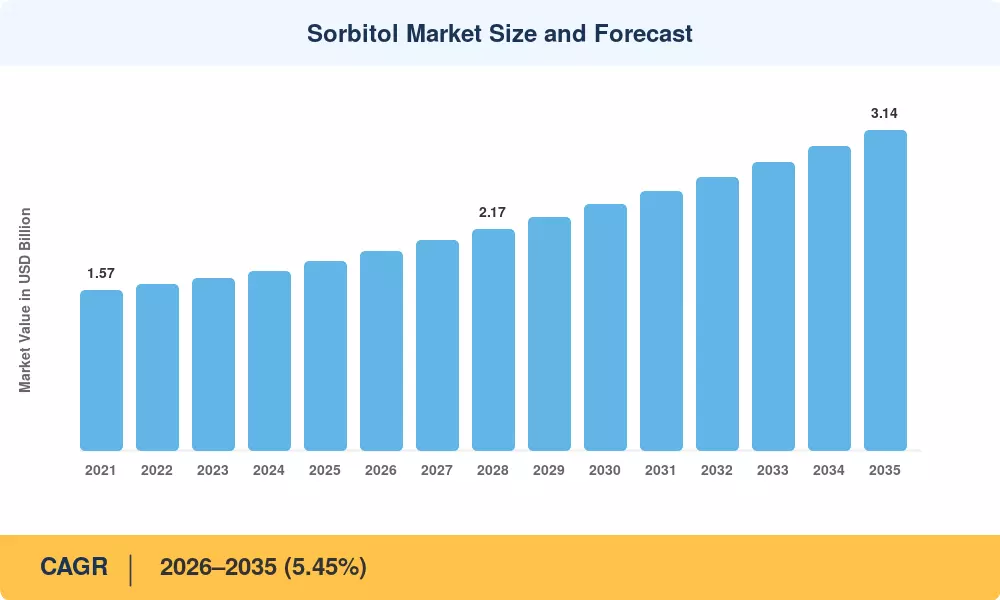
The Sorbitol Market reached USD 1.85 billion in 2025 and is projected to grow from USD 1.95 billion in 2026 to USD 3.14 billion by 2035, registering a CAGR of 5.45% during the forecast period. Two forces are accelerating this trajectory: tightening government sugar-reduction mandates across the EU, ASEAN, and Latin America, and a simultaneous wave of capital flowing into clean-label food ingredient platforms. The WHO's updated free-sugar guidelines, adopted by over 40 countries since 2023, have pushed reformulation budgets higher and made polyol-based sweetening a boardroom priority rather than an R&D footnote [1].

Sorbitol's versatility distinguishes it from single-purpose sweeteners. Legacy sucrose and high-fructose corn syrup are steadily giving ground to sugar alcohols that double as humectants, texturizers, and excipients. Global investment in continuous-crystallization sorbitol plants exceeded USD 420 million between 2022 and 2024, with major capacity additions in China, India, and Brazil targeting both food-grade and pharma-grade output [2]. Regulatory tailwinds include the European Commission's Farm to Fork strategy, which incentivizes low-glycemic ingredients, and India's FSSAI labeling reforms that reward reduced-sugar claims on front-of-pack displays [3].

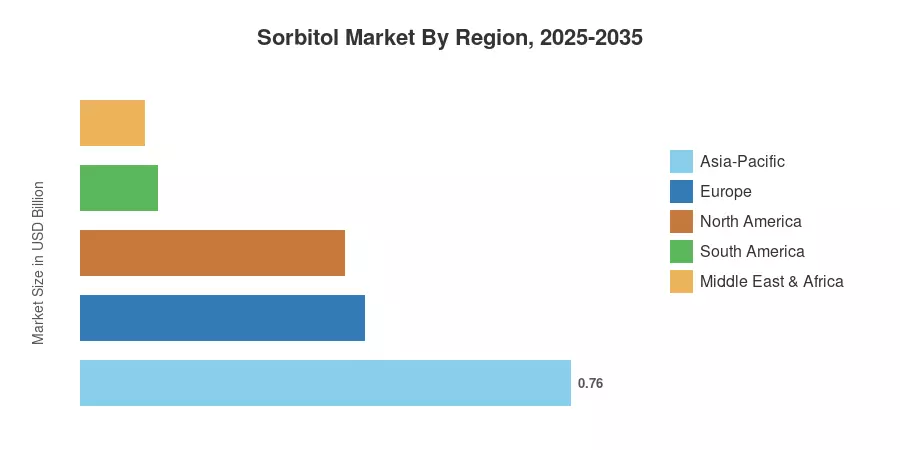
Asia-Pacific commands roughly 41% of the Sorbitol Market, anchored by China's massive corn-processing infrastructure and India's fast-growing confectionery sector. South America is the fastest-growing region at a 6.65% CAGR, driven by Brazil's expanding biorefinery ecosystem and rising domestic demand for sugar-free products. Europe holds the second-largest share at approximately 24%, buoyed by stringent EU health labeling and a mature personal-care industry. As functional-food innovation accelerates across emerging economies, the Sorbitol Market is poised to deliver steady mid-single-digit growth through 2035.


Key Report Takeaways

• By Product Type

  • Liquid sorbitol accounted for roughly 70% of the Sorbitol Market in 2025, supported by cost-efficient bulk logistics and direct-pipe delivery to confectionery and oral-care manufacturers.
  • Powder/crystal sorbitol is on track to register a CAGR of 6.95% through 2035, as pharmaceutical tableting and premium cosmetics demand higher-purity dry forms.

• By Application

  • Food and beverage captured approximately 47% of the Sorbitol Market share in 2025, reflecting broad adoption in sugar-free confectionery, baked goods, and frozen desserts.
  • Dietary supplements are projected to expand at a 7.25% CAGR through 2035, fueled by chewable-vitamin and nutraceutical gummy reformulation.

• By Region

  • Asia-Pacific held the dominant position in the Sorbitol Market with a 41% share in 2025.
  • South America is the fastest-growing region at a projected 6.65% CAGR, led by Brazilian sugarcane-to-sorbitol biorefineries.
  • North America contributed approximately USD 0.41 billion in 2025, driven by diabetic-management and oral-care applications.


Sorbitol Market Size and Forecast (2021–2035)

Market Research Future's sizing model combines bottom-up production-capacity audits, trade-flow analysis from UN Comtrade and national customs databases, and top-down demand modeling validated against annual reports of the ten largest sorbitol producers. Historical figures (2021–2024) are reconciled actuals; the base year (2025) reflects preliminary shipment data; forecast years (2026–2035) apply a calibrated CAGR with micro-adjustments for feedstock cost cycles and regulatory phase-ins.
Sorbitol Market Size and Forecast
Our Impact
Enabled $4.3B Revenue Impact for Fortune 500 and Leading Multinationals
Partnering with 2000+ Global Organizations Each Year
30K+ Citations by Top-Tier Firms in the Industry

Driver Impact Analysis

Driver ~% Impact on CAGR Geographic Relevance Impact Timeline
Government sugar-reduction mandates 18–22% Global Short-term (≤2 yr)
Growth in sugar-free confectionery 15–18% North America, Europe Short-term
Pharma excipient demand expansion 12–15% Asia-Pacific, Europe Medium-term (2–4 yr)
Vitamin C synthesis feedstock pull 10–13% China, India Medium-term
Clean-label and functional-food trends 10–12% Global Medium-term
Premium personal-care formulation 8–10% Europe, North America Long-term (≥4 yr)
Biorefinery investment in South America 7–9% South America Long-term


Government Sugar-Reduction Mandates

Regulatory pressure is the single most powerful near-term accelerant for the Sorbitol Market. The UK's Soft Drinks Industry Levy, extended in 2024 to cover confectionery syrups, pushed reformulation spending across British manufacturers up by an estimated 14% year-on-year [1]. Mexico's updated IEPS sugar tax, effective January 2025, similarly widened the cost gap between sucrose and sorbitol, making polyol substitution financially attractive for mid-tier food producers across Latin America [6]. These mandates create sticky demand because once a formulation is approved with sorbitol, switching back to sugar incurs re-registration costs.

Growth in Sugar-Free Confectionery

The global sugar-free confectionery segment surpassed USD 6.2 billion in 2024, and sorbitol remains the workhorse ingredient for hard candies, chewing gum, and chocolate coatings [6]. Major FMCG brands reformulated over 300 SKUs to sorbitol-based recipes between 2023 and 2025, according to Innova Market Insights data [17]. North American and European retailers are dedicating more shelf space to "no-added-sugar" lines, and private-label expansion in this category further amplifies bulk sorbitol procurement.

Pharma Excipient Demand Expansion

Sorbitol's role as a tablet binder, syrup vehicle, and chewable-tablet sweetener gives it exposure to the fast-growing generic-drug and nutraceutical manufacturing sectors. India's bulk-drug parks initiative, backed by INR 30 billion in central government incentives, specifically targets excipient self-sufficiency, and three new pharma-grade sorbitol facilities broke ground in Gujarat and Telangana during 2024 [8]. The European Pharmacopoeia's harmonized monograph update in 2023 streamlined sorbitol qualification, reducing approval timelines for new suppliers by roughly four months [18].

Vitamin C Synthesis Feedstock Pull

China produces over 80% of the world's ascorbic acid, and sorbitol is the primary feedstock in the Reichstein and modern two-step fermentation processes. Annual Chinese vitamin C output exceeded 200,000 metric tons in 2024, drawing approximately 350,000 metric tons of sorbitol into this channel alone [16]. As preventive-health supplement demand climbs post-pandemic, this industrial pull sustains high-volume, low-margin sorbitol consumption that underpins plant utilization rates across Shandong and Hebei provinces.


Restraints Impact Analysis

The restraint impacts below are directional estimates of each factor's drag on headline CAGR. They reflect qualitative assessment rather than precise subtraction from the growth rate.

Restraint ~% Negative Impact on CAGR Geographic Relevance Impact Timeline
Corn-price volatility and feedstock competition –12 to –15% Global Short-term
Competition from erythritol and allulose –10 to –13% North America, Europe Medium-term
Gastrointestinal tolerance limitations –6 to –8% Global Long-term
Regulatory cap on polyol usage in beverages –4 to –6% EU, Japan Medium-term
Energy-intensive hydrogenation process –3 to –5% Global Long-term


Corn-Price Volatility and Feedstock Competition

Sorbitol production depends heavily on corn-derived glucose, and biofuel mandates — particularly the US Renewable Fuel Standard and Brazil's RenovaBio program — compete for the same feedstock. USDA data show that corn-for-ethanol allocation consumed 36% of the US harvest in 2024, leaving food-ingredient processors exposed to spot-price swings that averaged ±18% quarter-to-quarter [5]. While cassava and wheat-starch alternatives are under pilot, they currently represent less than 8% of global sorbitol feedstock and carry their own supply-chain fragilities.

Competition from Next-Generation Sweeteners

Erythritol and allulose have attracted significant venture capital and consumer buzz, positioning themselves as "zero-calorie" alternatives that outperform sorbitol on glycemic-index metrics. US allulose sales grew an estimated 42% in 2024 after FDA guidance excluded it from added-sugar labeling [19]. Although sorbitol retains advantages in moisture retention and cost, it risks losing share in premium "keto-friendly" and "zero-sugar" positioning where newer polyols command higher consumer willingness to pay.

Gastrointestinal Tolerance Limitations

Sorbitol's osmotic laxative effect at doses above 20 grams per day constrains its use in high-consumption products like beverages and meal-replacement shakes [20]. Regulatory bodies in the EU require mandatory "excessive consumption may produce laxative effects" labeling on products containing more than 10% sorbitol, which creates a ceiling on per-serving inclusion rates and limits total addressable volume in certain Sorbitol Market application categories.


Sorbitol Market Opportunities

Cassava and Sugarcane Feedstock Diversification

Emerging biorefinery initiatives in Thailand, Vietnam and Brazil are exploring commercial scale cassava to sorbitol conversion, with a goal of cost reduction of 15-20% as compared to corn-based approaches [9]. If these ventures are successful with pilot-phase yields they could build a parallel supply chain which insulates the Sorbitol Market from US corn-price cycles and opens production capacity in tropical geographies with cheaper energy costs.


Pharmaceutical-Grade Premiumization

Generic medication manufacturers are moving towards GMP-certified sourcing of excipients, and as such, pharma-grade sorbitol fetches a 25–35% premium above food-grade material [8]. Producers investing in ISO 15378 compliant packaging and validated supply chains can capture this margin boost whilst diversifying away from commodity food-ingredient prices.


Moisture-Retentive Cosmetics and Oral Care

Sorbitol is used more often as a humectant in serums, toothpastes and mouthwashes of personal-care brands rather than glycerin. The worldwide natural-cosmetics segment is valued at approximately USD 40 billion in 2024 and prefers plant-derived polyols that meet clean-beauty positioning. Its non-irritant profile and GRAS classification make it a low-risk formulation choice for firms looking to launch sensitive-skin and pediatric oral-care products.


Shelf-Stable Functional Foods in Emerging Markets

High growing niche is functional foods that move without cold-chain logistics in sub-Saharan Africa, Southeast Asia and rural India. Sorbitol's moisture binding ability extends the shelf life of protein bars, fortified biscuits and gummy vitamins by 30–50% when compared to sucrose based formulations [10]. NGO-supported nutrition programmes and government schoolmeal contracts in these regions offer institutional demand channels with predictable volume.


Data-Driven Supply-Chain Optimization

Large sorbitol producers are deploying predictive analytics and digital-twin technology to optimize hydrogenation reactor throughput, reduce energy consumption by 8–12%, and shorten batch-to-release cycles [22]. Producers that monetize process data through licensing or as-a-service models can create recurring revenue streams independent of commodity sorbitol pricing, representing a new business-model frontier for the Sorbitol Market.


Sorbitol Market Future Outlook

Feedstock Diversification and Biorefinery Integration

The next decade will see sorbitol production decouple from its historical corn-glucose dependency. Sugarcane, cassava, and wheat-starch conversion pathways — currently at pilot scale in Brazil, Thailand, and Australia — are expected to supply 20–25% of global sorbitol feedstock by 2032 [9]. This shift will redistribute production geography, lower carbon intensity, and buffer the Sorbitol Market against US and Chinese corn-price cycles driven by biofuel mandates.

Digitalization of Production and Quality Control

Industry 4.0 adoption across sorbitol manufacturing is accelerating, with leading producers deploying real-time spectroscopic monitoring, AI-driven crystallization control, and digital-twin models for reactor optimization. The IEA estimates that digitalized chemical plants achieve 10–15% energy savings on hydrogenation processes [22]. For the Sorbitol Market, this translates into lower unit costs, tighter quality specifications for pharma-grade output, and faster batch-release cycles that improve working-capital efficiency.

ESG and Sustainability Reporting Pressures

Scope 3 emissions accounting is reshaping procurement decisions across the food, pharma, and cosmetics value chains. Major FMCG companies, including Unilever and Nestlé, have committed to third-party-verified ingredient carbon footprints by 2028, which favors sorbitol producers with certified sustainable sourcing and lower-emission hydrogenation processes [23]. Producers that invest in renewable-energy-powered facilities and verified deforestation-free supply chains will capture share from competitors unable to meet evolving ESG procurement criteria.

Expansion into Shelf-Stable and Cold-Chain-Free Applications

Climate resilience in food systems is becoming a policy priority for multilateral institutions. The World Food Programme and FAO have identified moisture-retentive ingredients as critical enablers of shelf-stable nutritional products for tropical distribution [10]. Sorbitol's ability to reduce water activity while maintaining palatability positions it as a strategic ingredient in humanitarian nutrition products, school-feeding programs, and emergency-ration formulations — creating an institutional demand layer that complements commercial channels.


Sorbitol Market Segmentation

By Product Type

Segment Key Metric Primary Demand Driver
Liquid Sorbitol 70% share (2025) Bulk logistics efficiency and direct integration into F&B and oral-care manufacturing
Powder/Crystal Sorbitol 6.95% CAGR (2026–2035) Pharma tableting, premium cosmetics, and dry-mix applications


Liquid sorbitol dominates the Sorbitol Market because it integrates seamlessly into continuous manufacturing processes for confectionery, toothpaste, and syrups. Major producers ship 70% aqueous solutions via tanker truck and rail, eliminating dissolution steps for buyers. This format also costs 10–15% less per dry-weight equivalent than crystalline grades due to simpler processing.

Powder and crystal sorbitol is gaining ground in applications that require precise dosing, extended shelf stability, or direct-compression tableting. Pharmaceutical manufacturers increasingly specify crystalline sorbitol for chewable tablets and orally disintegrating formulations, while premium cosmetics brands favor spray-dried grades for anhydrous serums and pressed-powder compacts. This segment's faster CAGR reflects a margin-led growth dynamic rather than pure volume.

By Application

Segment Key Metric Primary Demand Driver
Food & Beverage 47% share (2025) Sugar-free confectionery, baked goods, frozen desserts
Cosmetics & Personal Care USD 0.28 Billion (2025) Humectant function in toothpaste, serums, and mouthwash
Dietary Supplements 7.25% CAGR (2026–2035) Gummy vitamins and chewable nutraceuticals
Pharmaceuticals USD 0.22 Billion (2025) Tablet excipient, syrup vehicle, and coating agent
Others 4.8% CAGR (2026–2035) Industrial applications including polyester resins and plasticizers


Food and beverage remains the backbone of the Sorbitol Market, with sugar-free confectionery alone accounting for over half of this segment's volume. Gum base manufacturers rely on sorbitol for its cooling mouthfeel and non-cariogenic properties, while bakery producers value its moisture retention in reduced-sugar cakes and cookies. Regulatory sugar taxes in the UK, Mexico, and several ASEAN nations continue to push reformulation activity toward sorbitol-based recipes.

Dietary supplements represent the fastest-growing application, propelled by the global shift from traditional pill formats to chewable gummies and soft chews. Sorbitol provides the pliable texture and sweetness profile that consumers expect in these formats, and its established regulatory status across FDA, EFSA, and FSSAI frameworks reduces time-to-market for new product launches compared to novel sweetener alternatives.


Regional Market Share Analysis

Region Key Metric Primary Investment Themes
Asia-Pacific 41% share (2025) Corn-processing scale, vitamin C synthesis, confectionery expansion
Europe USD 0.44 Billion (2025) Clean-label reformulation, pharma excipients, personal care
North America 22% share (2025) Sugar-free confectionery, oral care, dietary supplements
South America 6.65% CAGR (2026–2035) Sugarcane biorefineries, domestic F&B growth
Middle East & Africa USD 0.10 Billion (2025) Import substitution, halal-certified ingredients
Total USD 1.85 Billion (2025)

The Sorbitol Market exhibits a regionally diverse demand structure, with Asia-Pacific anchoring volume, Europe driving premiumization, and South America emerging as the fastest-growing frontier.


North America

Country Key Metric Key Driver
United States 78% of regional share Sugar-free confectionery and oral-care dominance
Canada 5.2% CAGR Health-conscious consumer trends and clean-label regulation
Mexico USD 0.03 Billion IEPS sugar-tax driving reformulation


The US accounts for the vast majority of North American Sorbitol Market demand, with Cargill and ADM operating integrated corn-wet-milling-to-sorbitol facilities in the Midwest. FDA's 2024 guidance clarifying sorbitol's GRAS status for novel functional-food applications widened the addressable product set, while Canadian labeling reforms under the Food and Drug Regulations modernization initiative have made sugar-alcohol positioning more consumer-friendly [3].

Europe

Country Key Metric Key Driver
Germany 26% of regional share Pharma excipient and chemical-intermediate demand
United Kingdom 5.6% CAGR Post-SDIL reformulation momentum
France USD 0.06 Billion Confectionery and premium cosmetics
Italy 4.8% CAGR Gelato and baked-goods innovation
Spain USD 0.03 Billion Oral-care manufacturing cluster
Nordic Countries 5.1% CAGR Health-driven confectionery market
Russia USD 0.02 Billion Domestic pharma self-sufficiency drive
Rest of Europe 4.7% CAGR Diversified industrial and food applications


Europe's Sorbitol Market benefits from the EU's Farm to Fork strategy, which targets a 20% reduction in added sugars in processed foods by 2030. Germany's Roquette Frères and Tereos operations supply both food-grade and pharma-grade sorbitol across the continent, while UK manufacturers accelerated polyol adoption after the SDIL extension to confectionery syrups in 2024 [6].

Asia-Pacific

Country Key Metric Key Driver
China 52% of regional share Vitamin C synthesis and corn-processing scale
India 7.1% CAGR Pharma excipient parks and FSSAI labeling reforms
Japan USD 0.06 Billion Oral-care and specialty-confectionery applications
South Korea 5.3% CAGR K-beauty cosmetics and functional-food innovation
ASEAN USD 0.05 Billion Cassava-feedstock pilot projects and F&B growth
Rest of Asia-Pacific 4.9% CAGR Emerging demand in personal care and dietary supplements


China dominates the Asia-Pacific Sorbitol Market through its integrated corn-starch-to-sorbitol value chain, with Shandong Province alone housing over 40% of national production capacity. India is the region's fastest-growing country market, propelled by the government's Production-Linked Incentive scheme for pharmaceuticals and three new pharma-grade sorbitol plants commissioned in 2024 [8].

South America

Country Key Metric Key Driver
Brazil 68% of regional share Sugarcane-based biorefinery integration
Argentina 6.1% CAGR Confectionery exports and domestic sugar-reduction trends
Rest of South America USD 0.01 Billion Early-stage adoption in processed foods


Brazil anchors the South American Sorbitol Market, leveraging its sugarcane infrastructure to develop cost-competitive sorbitol production routes. Raízen and Tereos have jointly invested in pilot-scale sugarcane-to-sorbitol facilities in São Paulo state, targeting commercial output by 2027, which would reduce regional import dependence on Chinese and European suppliers [9].

Middle East & Africa

Country Key Metric Key Driver
Saudi Arabia 32% of regional share Vision 2030 food-processing localization
UAE 5.8% CAGR Halal-ingredient hub for re-export
South Africa USD 0.02 Billion Confectionery and beverage reformulation
Egypt 5.0% CAGR Growing domestic pharmaceutical demand
Rest of MEA USD 0.01 Billion Early-stage market development


The Middle East and Africa Sorbitol Market remains the smallest regional segment but is gaining traction through halal-certified ingredient sourcing and food-manufacturing localization programs. Saudi Arabia's National Industrial Development and Logistics Program (NIDLP) has earmarked incentives for food-additive production, while the UAE serves as a regional trading and re-export hub for sorbitol sourced from India and China [15].


Sorbitol Market By Region, 2025-2035

Competitive Benchmarking

The Sorbitol Market exhibits medium concentration, with the top five producers holding an estimated 45–52% collective revenue share. The Herfindahl-Hirschman Index sits in the 800–1,200 range, indicating a moderately competitive structure where scale advantages in corn-wet-milling coexist with regional niche players specializing in pharma-grade or cassava-based production. Competition increasingly centers on supply-chain reliability, grade diversification, and sustainability credentials rather than price alone.

Company Est. Revenue Share Range Key Offerings Strategic Positioning
Roquette Frères ~12–15% Liquid and crystalline sorbitol, pharma-grade polyols Vertically integrated European leader with pharma specialization
Cargill, Incorporated ~10–13% Food-grade liquid sorbitol, polyol blends Integrated corn-wet-milling with global distribution network
Archer Daniels Midland (ADM) ~8–11% Bulk liquid sorbitol, specialty sweetener systems Scale-driven cost leadership across North America
Ingredion Incorporated ~6–8% Sorbitol solutions, modified starch-polyol blends Application-engineering focus for F&B and personal care
Tereos ~5–7% Liquid sorbitol, starch derivatives European-Latin American production footprint
Gulshan Polyols Ltd. ~4–6% Liquid and powder sorbitol, maltitol Cost-competitive Indian manufacturer with pharma-grade capacity
Shandong Tianli Pharmaceutical Co. ~4–6% Crystalline sorbitol, vitamin C intermediates Largest single-site sorbitol producer in China
PT Sorini Agro Asia (Ecogreen) ~3–5% Liquid sorbitol from cassava-based starch Southeast Asian leader leveraging cassava feedstock
SPI Pharma ~2–4% Pharma-grade excipient sorbitol Niche specialist in directly compressible sorbitol
Merck KGaA ~1–3% High-purity sorbitol for laboratory and pharma use Premium positioning in analytical and GMP segments


Recent News & Developments

  • Roquette Frères (March 2025): Inaugurated a EUR 65 million pharma-grade sorbitol expansion at its Lestrem, France facility, increasing annual capacity by 30,000 metric tons [18].
  • Cargill, Incorporated (January 2025): Announced a strategic partnership with a Brazilian sugarcane cooperative to pilot sugarcane-to-sorbitol conversion technology, targeting commercial-scale output by 2027 [9].
  • Ingredion Incorporated (November 2024): Launched a next-generation sorbitol-maltitol blend optimized for sugar-free chocolate applications, developed at its Bridgewater, NJ innovation center [17].


  • Shandong Tianli Pharmaceutical Co. (February 2024): Secured GMP certification from China's NMPA for its crystalline sorbitol facility, enabling direct export to EU and US pharmaceutical markets [16].


  • ADM (July 2023): Invested USD 35 million in digital-twin and AI-driven process optimization across its Decatur, Illinois corn-processing complex, targeting 12% energy reduction in sorbitol hydrogenation [22].


Sorbitol Market Report Scope

Parameter Detail
Market Scope Global Sorbitol Market, covering production, consumption, and trade flows
Study Period 2021–2035
CAGR Window 2026–2035 (5.45%)
Base Year 2025 (USD 1.85 Billion)
2026 Forecast Start USD 1.95 Billion
2035 Forecast End USD 3.14 Billion
Fastest Growing Segment Dietary Supplements (by application); Powder/Crystal Sorbitol (by product type)
Companies Profiled 10 (Roquette, Cargill, ADM, Ingredion, Tereos, Gulshan Polyols, Shandong Tianli, PT Sorini Agro Asia, SPI Pharma, Merck KGaA)
Valuation Currency USD Billion


FAQs

How does corn-price hedging affect sorbitol procurement strategy?
Most large buyers lock in 6–12-month forward contracts tied to CBOT corn futures, smoothing out spot volatility [5]. Procurement teams should negotiate floor-ceiling pricing bands with suppliers to cap downside risk.
What purity certifications should buyers verify for pharma-grade sorbitol?
Require compliance with European Pharmacopoeia (EP), United States Pharmacopeia (USP), and current GMP standards [18]. Certificate of Analysis for residual glucose, heavy metals, and microbial limits should accompany every shipment.
How does sorbitol compare to maltitol for sugar-free chocolate formulation?
Sorbitol offers superior moisture retention and lower cost, but maltitol provides a closer sweetness profile to sucrose [17]. Formulators often blend both polyols to balance taste, texture, and price.
What logistics considerations apply to liquid sorbitol shipment in tropical climates?
Liquid sorbitol (70% solution) remains stable between 15°C and 40°C but may crystallize below 15°C, requiring heated tanker transport in temperate winters [4]. Tropical buyers benefit from reduced cold-weather handling costs.
Are there regulatory limits on sorbitol in infant food products?
EFSA and Codex Alimentarius restrict polyol use in foods marketed for infants under 12 months [21]. Manufacturers targeting pediatric nutrition must use alternative sweetening and humectant systems.
How can mid-size producers differentiate against integrated giants like Roquette and Cargill?
Niche strategies include pharma-grade specialization, organic-certified sorbitol, or regional cassava-based production with lower carbon footprints [14]. Customized blending services also create switching costs.
What role does sorbitol play in next-generation bioplastics?
Isosorbide, derived from sorbitol dehydration, serves as a monomer for bio-based polycarbonates and polyesters [22]. This emerging application could create a parallel demand channel beyond food and pharma.    
Author
Author
Author Profile
Varsha More LinkedIn
Senior Research Analyst
Experienced business professional with a demonstrated history of working in the CFnB industry. Skilled in market research, and market estimation. Strong professional with a Masters focused in marketing management.

Research Approach


Secondary Research

The secondary research process involved comprehensive analysis of regulatory databases, food safety standards, chemical industry publications, and authoritative health and agriculture organizations. Key sources included the US Food & Drug Administration (FDA) Food Additive Status List, European Food Safety Authority (EFSA) Scientific Opinion on Sorbitol, US Department of Agriculture (USDA) Economic Research Service, Food and Agriculture Organization (FAO) FAOSTAT Database, World Health Organization (WHO) Food Additives Series, US Pharmacopeia (USP-NF) for pharmaceutical-grade specifications, European Medicines Agency (EMA) excipient guidelines, Environmental Protection Agency (EPA) Chemical Data Reporting, National Institute of Standards and Technology (NIST) Chemistry WebBook, Codex Alimentarius Commission food standards, International Organization for Standardization (ISO 9001/22000 for food safety), European Commission Eurostat industrial production data, US Census Bureau Foreign Trade Statistics, International Sweeteners Association (ISA), Corn Refiners Association (CRA), and national food safety authority reports from key markets. These sources were utilized to collect production volume statistics, regulatory compliance data, safety toxicology studies, feedstock price trends (corn/wheat/tapioca), and market landscape analysis for liquid sorbitol, crystalline sorbitol, and specialty pharmaceutical grades.


Primary Research

To gather both qualitative and quantitative information, the primary research process involved interviewing players from both the supply and demand sides. Executives from sorbitol producers, corn/wheat processors, and distributors of specialty chemicals were among the supply-side sources, along with heads of procurement and business development. The demand side was represented by research and development directors from the food and beverage industry, pharmaceutical formulation scientists, cosmetic brand procurement managers, and oral care and industrial applications supply chain executives. Confirmation of capacity expansion timelines, validation of market segmentation across liquid and crystalline forms, insights into substitution patterns with other polyols (xylitol, maltitol, mannitol), pricing volatility related to agricultural commodity cycles, and regulatory compliance costs were all gleaned from primary research.

Primary Respondent Breakdown:

By Designation: C-level Primaries (30%), Director Level (35%), Others (35%)

By Region: North America (32%), Europe (30%), Asia-Pacific (28%), Rest of World (10%)


Market Size Estimation

Global market valuation was derived through production capacity mapping and consumption volume analysis across food & beverage, pharmaceuticals, cosmetics, and chemical applications. The methodology included:

Identification of 35+ key manufacturers across North America, Europe, Asia-Pacific, and Latin America

Product mapping across liquid sorbitol (70% solution), crystalline/powder sorbitol, and pharmaceutical-grade specifications

Analysis of reported and modeled annual revenues specific to sorbitol product portfolios

Coverage of manufacturers representing 65-70% of global installed capacity in 2024

Extrapolation using bottom-up (consumption volume × ASP by end-use industry and region) and top-down (manufacturer revenue validation and trade flow analysis) approaches to derive segment-specific valuations for food sweeteners, moisture-retention agents, tablet excipients, and surfactant feedstocks

Download Free Sample

Kindly complete the form below to receive a free sample of this Report

Download PDF ×

We do not share your information with anyone. However, we may send you emails based on your report interest from time to time. You may contact us at any time to opt-out.














