×
Request Free Sample ×

Kindly complete the form below to receive a free sample of this Report

* Please use a valid business email

Leading companies partner with us for data-driven Insights

clients tt-cursor
Hero Background

South America Biobanking Market

ID: MRFR/MED/52638-HCR
200 Pages
Rahul Gotadki
October 2025

South America Biobanking Market Research Report By Sample Type (Blood Products, Tissues, Cells, Nucleic Acids, Microbiome Samples), By Application (Research and Development, Clinical Trials, Personalized Medicine, Regenerative Medicine), By End Use (Academic Research Institutions, Biotechnology Companies, Pharmaceutical Companies, Government Organizations), By Storage Type (Vapor Phase Storage, Liquid Phase Storage, Cryopreservation Storage) and By Regional (Brazil, Mexico, Argentina, Rest of South America)- Forecast to 2035

Share:
Download PDF ×

We do not share your information with anyone. However, we may send you emails based on your report interest from time to time. You may contact us at any time to opt-out.

South America Biobanking Market Infographic
Purchase Options

South America Biobanking Market Summary

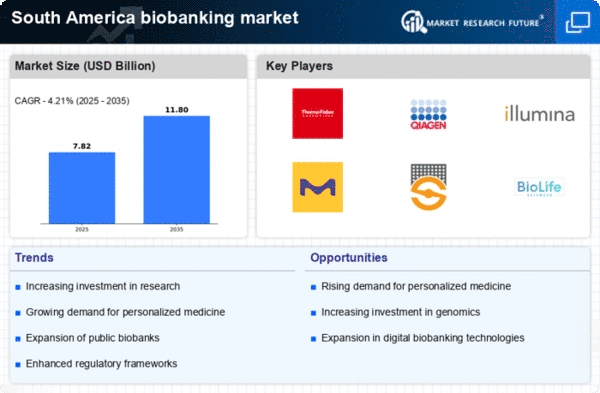
As per MRFR analysis, the South America biobanking market Size was estimated at 7.5 USD Billion in 2024. The South America biobanking market is projected to grow from 7.82 USD Billion in 2025 to 11.8 USD Billion by 2035, exhibiting a compound annual growth rate (CAGR) of 4.21% during the forecast period 2025 - 2035.

Key Market Trends & Highlights

The South America biobanking market is poised for growth driven by technological advancements and increasing demand for personalized medicine.

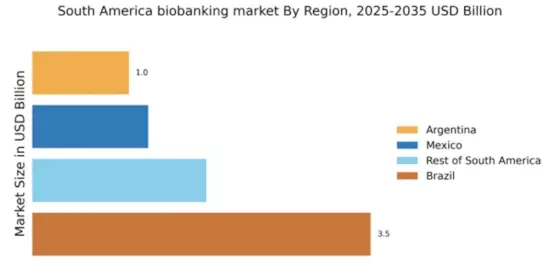
  • Brazil remains the largest market for biobanking services, reflecting a robust infrastructure and investment in research.
  • Mexico is emerging as the fastest-growing region, indicating a rising interest in biobanking and genetic research.
  • Technological advancements are enhancing biobanking operations, leading to improved efficiency and data management.
  • The growing demand for biobanking services and collaboration between public and private sectors are key drivers of market expansion.

Market Size & Forecast

2024 Market Size 7.5 (USD Billion)
2035 Market Size 11.8 (USD Billion)
CAGR (2025 - 2035) 4.21%

Major Players

Thermo Fisher Scientific (US), Qiagen (DE), Illumina (US), Merck KGaA (DE), STEMCELL Technologies (CA), BioLife Sciences (US), ReproCELL (JP), Biobanking Solutions (FI), LGC Group (GB)

South America Biobanking Market Trends

The biobanking market in South America is currently experiencing notable growth, driven by advancements in biotechnology and increasing demand for personalized medicine. The region's diverse population presents unique opportunities for biobanks to collect and store biological samples that can be utilized for research and development. Furthermore, government initiatives aimed at promoting biobanking practices are fostering collaboration between academic institutions and private entities, enhancing the overall infrastructure of the biobanking ecosystem. As a result, the biobanking market is poised for expansion, with a focus on ethical practices and regulatory compliance. In addition, the rising prevalence of chronic diseases in South America is prompting a greater emphasis on biobanking for research purposes. This trend is likely to encourage investment in biobanking facilities and technologies, as stakeholders recognize the potential for biobanks to contribute to public health initiatives. Moreover, the integration of digital technologies in biobanking operations is expected to streamline processes and improve data management. Overall, the biobanking market in South America appears to be on a trajectory of growth, with various factors contributing to its development and sustainability.

Technological Advancements

The biobanking market is witnessing a surge in technological innovations, particularly in sample collection and storage methods. Enhanced automation and digital tracking systems are improving efficiency and accuracy, which is crucial for maintaining sample integrity. These advancements are likely to attract more stakeholders to invest in biobanking initiatives.

Regulatory Framework Development

There is a growing emphasis on establishing robust regulatory frameworks governing biobanking practices in South America. Governments are increasingly recognizing the importance of ethical standards and compliance in biobanking operations. This trend may lead to improved public trust and greater participation in biobanking programs.

Focus on Personalized Medicine

The rising interest in personalized medicine is significantly influencing the biobanking market. As researchers seek to tailor treatments to individual patients, biobanks are becoming essential resources for collecting diverse biological samples. This trend suggests a shift towards more targeted healthcare solutions, potentially enhancing patient outcomes.

South America Biobanking Market Drivers

Rising Awareness of Genetic Research

The rising awareness of genetic research among the South American population is significantly impacting the biobanking market. As individuals become more informed about the importance of genetic testing and personalized medicine, there is a growing willingness to participate in biobanking initiatives. This trend is particularly evident in urban areas, where educational campaigns and outreach programs have successfully increased public engagement. In 2025, it is estimated that participation rates in biobanking studies could rise by 15%, driven by enhanced public understanding of the benefits of biobanking for health outcomes. This increased participation not only enriches the diversity of biological samples available but also supports the development of tailored medical treatments. Consequently, the heightened awareness of genetic research is likely to play a crucial role in the expansion of the biobanking market in South America.

Growing Demand for Biobanking Services

The increasing demand for biobanking services in South America is driven by the rising need for personalized medicine and advanced research. As healthcare systems evolve, there is a notable shift towards precision medicine, which relies heavily on biobanked samples. The biobanking market in South America is projected to grow at a CAGR of approximately 8% from 2025 to 2030. This growth is fueled by the need for high-quality biological samples for research and clinical trials, which are essential for developing targeted therapies. Furthermore, the expansion of biobanks in academic and research institutions enhances the availability of diverse biological materials, thereby supporting innovative research initiatives. As a result, the demand for biobanking services is expected to continue its upward trajectory, reflecting the critical role of biobanks in advancing medical research and healthcare solutions.

Investment in Research and Development

Investment in research and development (R&D) within the biobanking market is a significant driver of growth in South America. Governments and private entities are increasingly allocating funds to enhance biobanking infrastructure and capabilities. For instance, the Brazilian government has initiated several funding programs aimed at supporting biobanking initiatives, which are crucial for advancing scientific research. In 2025, it is estimated that R&D spending in the biobanking sector could reach approximately $200 million, reflecting a growing recognition of the importance of biobanks in medical research. This investment not only facilitates the establishment of new biobanks but also improves existing facilities, ensuring they meet international standards. Consequently, the enhanced R&D environment is likely to attract more researchers and institutions to utilize biobanking services, further propelling the market forward.

Collaboration Between Public and Private Sectors

Collaboration between public and private sectors is emerging as a vital driver for the biobanking market in South America. Partnerships between government agencies, academic institutions, and private companies are fostering innovation and resource sharing. Such collaborations often lead to the establishment of biobanks that are better equipped to meet the needs of researchers and healthcare providers. For example, joint ventures can result in the pooling of financial resources, expertise, and biological samples, enhancing the overall efficiency of biobanking operations. In 2025, it is anticipated that collaborative initiatives could account for nearly 30% of new biobanking projects in the region. This synergy not only accelerates research but also ensures that biobanks are aligned with the latest scientific advancements, ultimately benefiting the healthcare landscape in South America.

Technological Integration in Biobanking Operations

Technological integration in biobanking operations is a key driver for the biobanking market in South America. The adoption of advanced technologies such as automation, data management systems, and biobanking software is enhancing the efficiency and reliability of biobanking processes. In 2025, it is projected that nearly 40% of biobanks in the region will implement automated systems to streamline sample processing and storage. This technological advancement not only reduces human error but also improves sample tracking and data management, which are critical for research integrity. Furthermore, the integration of digital platforms facilitates better collaboration among researchers, enabling them to access and share biobanked samples more effectively. As a result, the ongoing technological evolution is expected to significantly contribute to the growth and sustainability of the biobanking market in South America.


Market Segment Insights

By Sample Type: Blood Products (Largest) vs. Nucleic Acids (Fastest-Growing)

In the South America biobanking market, the distribution of market share among sample types reveals that Blood Products currently hold the largest share, demonstrating strong demand driven by clinical research and diagnostics needs. Following Blood Products, Tissues and Cells also play significant roles, while Nucleic Acids and Microbiome Samples represent emerging categories with increasing relevance in personalized medicine and biotechnology application. Growth trends in the sample type segment are heavily influenced by advancements in genomics and proteomics, leading to a surge in Nucleic Acids as the fastest-growing segment. The rise in biobanking facilities, along with collaborations between research institutes and biopharma companies, is fueling the demand for all sample types, especially as personalized medicine and precision therapies gain traction in the region.

Blood Products (Dominant) vs. Nucleic Acids (Emerging)

Blood Products dominate the South America biobanking market due to their extensive use in transfusions and bioprocessing, benefiting from a well-established regulatory framework and a consistent supply chain. In contrast, Nucleic Acids are emerging rapidly, spurred by innovations in biotechnological applications and increasing investments in genetic research. The demand for precision diagnostics and targeted therapies is contributing to the accelerating growth of Nucleic Acids, making them vital for future biobanking initiatives. Both segments showcase unique characteristics—Blood Products emphasize traditional medical needs, while Nucleic Acids represent the cutting edge of genomic research, highlighting a dynamic interplay in the evolving landscape of biobanking.

By Application: Research and Development (Largest) vs. Clinical Trials (Fastest-Growing)

The biobanking market segment in South America is predominantly driven by Research and Development, which accounts for the largest share due to its critical role in advancing scientific inquiries and medical advancements. Clinical Trials have emerged as a vital component, rapidly gaining traction as new therapies are developed and tested, indicating a healthy distribution among these segments. Growth in the Application segment is primarily fueled by increasing investments in biotechnology and a growing focus on personalized medicine. The demand for innovative healthcare solutions, coupled with an emphasis on Regenerative Medicine, further drives the need for biobanking services. These trends signify an evolving landscape where Research and Development remain foundational while Clinical Trials are set to expand significantly in the coming years.

Research and Development: Dominant vs. Clinical Trials: Emerging

Research and Development is the dominant application in the biobanking sector, playing a crucial role in understanding diseases and developing new therapeutic strategies. Its comprehensive approach to collecting, processing, and storing biological samples makes it essential for cutting-edge research. Clinical Trials, on the other hand, are emerging rapidly as a vital application due to the increasing need for clinical validation of new drugs and treatments. The intersection of these two segments is crucial, as Research and Development provides the foundational knowledge needed for effective Clinical Trials, thereby creating a symbiotic relationship that supports innovation in the biobanking field.

By End-use: Pharmaceutical Companies (Largest) vs. Biotechnology Companies (Fastest-Growing)

In the South America biobanking market, Pharmaceutical Companies hold the largest share, dominating the landscape with their extensive need for biobanked samples for drug development and clinical trials. Academic Research Institutions and Government Organizations also play a significant role, but their market shares are comparatively lower, reflecting the specialized focus of Pharmaceutical Companies in high-stakes research and development activities. Growth trends in this segment are largely driven by increasing investments in healthcare and the rising demand for advanced therapies. Biotechnology Companies are emerging rapidly as they leverage biobanks for innovative research, positioning themselves for lucrative collaboration opportunities with larger pharmaceutical firms. This synergy is expected to fuel significant growth in the biobanking sector across South America, showcasing the dynamic interplay between established and emerging players.

Academic Research Institutions (Dominant) vs. Government Organizations (Emerging)

Academic Research Institutions are essential players in the biobanking market, providing critical contributions to scientific knowledge and medical advancements. They often utilize biobanks for large-scale studies and collaborative research, tapping into diverse biological samples that aid in various research fields. On the other hand, Government Organizations are seeing an increase in their relevance as emerging entities, focusing on public health initiatives and regulatory research. Their involvement is pivotal for the establishment of biobanking standards and practices, encouraging transparency and accessibility of biological data, thus fostering trust and collaboration among stakeholders. As Government Organizations continue to evolve, their role in enhancing biobanking strategies is likely to become more pronounced, making them key players in the sector.

By Storage Type: Vapor Phase Storage (Largest) vs. Liquid Phase Storage (Fastest-Growing)

The market share distribution in the 'Storage Type' segment shows that Vapor Phase Storage holds a dominant position, preferred for its efficiency in long-term biological sample preservation. In comparison, Liquid Phase Storage is emerging rapidly, gaining attention for its ability to provide immediate access to samples and be suitable for various cellular materials, thus diversifying storage capabilities. Growth trends indicate a shift towards Liquid Phase Storage, driven by increasing demand for biobanks to adopt versatile storage solutions and advancements in cryogenic technologies. The need for quick retrieval and sample integrity has propelled this segment's growth as institutions strive for improved sample management and research throughput, making it a key player in the evolving landscape of biobanking.

Storage: Vapor Phase (Dominant) vs. Liquid Phase (Emerging)

Vapor Phase Storage is recognized for its superior temperature stability and sample protection, making it the preferred choice among biobanks for preserving sensitive biological specimens. This method utilizes vapor from liquid nitrogen to maintain conditions ideal for long-term storage. Conversely, Liquid Phase Storage is gaining traction due to its flexibility and rapid sample access capabilities, essential for contemporary research needs. As biobanks look to enhance operational efficiencies and ensure sample viability, these two storage types are defining the future of biobanking practices in the region.

Get more detailed insights about South America Biobanking Market

Regional Insights

Brazil : Strong Demand and Infrastructure Development

Key markets include São Paulo, Rio de Janeiro, and Minas Gerais, where major research institutions and universities are located. The competitive landscape features significant players like Thermo Fisher Scientific and Qiagen, which have established a strong presence. Local dynamics are characterized by collaborations between public and private sectors, fostering innovation. The biobanking sector is increasingly applied in clinical research, drug development, and regenerative medicine, making Brazil a hub for biobanking activities.

Mexico : Growing Investment and Research Focus

Key markets include Mexico City and Guadalajara, where several research institutions are located. The competitive landscape features players like Illumina and Merck KGaA, which are expanding their operations in the region. Local market dynamics are influenced by partnerships between academic institutions and private companies, fostering innovation. The biobanking sector is increasingly utilized in clinical trials and public health research, positioning Mexico as a growing player in the biobanking market.

Argentina : Focus on Research and Development

Key markets include Buenos Aires and Córdoba, where major universities and research centers are located. The competitive landscape features companies like STEMCELL Technologies and BioLife Sciences, which are establishing a presence in the region. Local dynamics are characterized by collaborations between public institutions and private enterprises, promoting innovation. The biobanking sector is increasingly applied in clinical research and drug development, making Argentina a vital player in the South American market.

Rest of South America : Regional Growth and Collaboration

Key markets include countries like Chile, Colombia, and Peru, where research institutions are expanding. The competitive landscape features a mix of local and international players, including LGC Group and ReproCELL, which are establishing operations in these markets. Local dynamics are influenced by collaborations between governments and private sectors, fostering innovation. The biobanking sector is increasingly utilized in public health initiatives and research, positioning the region for future growth.

South America Biobanking Market Regional Image

Key Players and Competitive Insights

The biobanking market in South America is characterized by a dynamic competitive landscape, driven by increasing demand for personalized medicine, advancements in genomics, and a growing emphasis on research and development. Key players such as Thermo Fisher Scientific (US), Qiagen (DE), and Illumina (US) are strategically positioned to leverage these trends. Thermo Fisher Scientific (US) focuses on innovation through its extensive portfolio of biobanking solutions, while Qiagen (DE) emphasizes partnerships to enhance its technological capabilities. Illumina (US) is heavily invested in genomic sequencing technologies, which positions it favorably in the evolving market. Collectively, these strategies contribute to a competitive environment that is increasingly focused on technological advancement and collaborative efforts.

In terms of business tactics, companies are localizing manufacturing and optimizing supply chains to enhance operational efficiency. The market structure appears moderately fragmented, with several key players exerting influence over various segments. This fragmentation allows for niche players to emerge, while larger companies consolidate their market positions through strategic acquisitions and partnerships.

In October 2025, Thermo Fisher Scientific (US) announced a partnership with a leading South American university to establish a biobank dedicated to rare diseases. This initiative not only enhances their local presence but also aligns with their strategy to support research in underrepresented areas. The partnership is expected to facilitate access to critical biological samples, thereby strengthening their market position.

In September 2025, Qiagen (DE) launched a new line of biobanking kits specifically designed for the South American market, tailored to meet local regulatory requirements. This move indicates a strategic focus on regional customization, which is likely to enhance customer satisfaction and expand their market share. By addressing local needs, Qiagen positions itself as a responsive and adaptable player in the biobanking sector.

In August 2025, Illumina (US) expanded its operations in Brazil by opening a new facility aimed at increasing its production capacity for genomic sequencing products. This expansion reflects a commitment to meeting the growing demand for genomic research in the region. The facility is expected to enhance supply chain reliability and reduce lead times for customers, thereby solidifying Illumina's competitive edge.

As of November 2025, current trends in the biobanking market include a strong emphasis on digitalization, sustainability, and the integration of artificial intelligence (AI) in research processes. Strategic alliances are increasingly shaping the competitive landscape, as companies recognize the value of collaboration in driving innovation. Looking ahead, competitive differentiation is likely to evolve from traditional price-based competition to a focus on technological innovation, supply chain reliability, and sustainable practices. This shift suggests that companies that prioritize these areas will be better positioned to thrive in the future.

Key Companies in the South America Biobanking Market market include

Industry Developments

Recent developments in the South America Biobanking Market have been marked by significant growth and increased investments in biobanking facilities. The region has seen advancements in technology, particularly in cellular preservation and genetic testing services. Companies such as Evotec and Natera have expanded their operations, focusing on collaborations aimed at enhancing personalized medicine. In September 2023, Roche announced a strategic partnership with local biobanks to improve access to genomic data, which supports ongoing research initiatives. 

Additionally, in August 2023, a merger between Lifebank and Biobank was finalized, consolidating their resources and expanding their specimen collection capabilities across Brazil.The market valuation for companies such as Thermo Fisher Scientific, Merck KGaA, and AstraZeneca has shown promising increases, largely due to heightened demand for biobanking services amid a growing emphasis on precision medicine in South America. 

Moreover, major happenings over the past couple of years include the establishment of new biobank networks aimed at enhancing research collaboration, with notable projects launched in countries like Argentina and Brazil in early 2022, reflecting the region's commitment to advancing healthcare and disease research through comprehensive biobanking initiatives.


Future Outlook

South America Biobanking Market Future Outlook

The Biobanking Market in South America is projected to grow at a 4.21% CAGR from 2024 to 2035, driven by advancements in personalized medicine, regulatory support, and increasing research funding.

New opportunities lie in:

  • Expansion of biorepository services for rare diseases
  • Development of mobile biobanking units for remote areas
  • Partnerships with pharmaceutical companies for clinical trials

By 2035, the biobanking market is expected to achieve substantial growth and innovation.

Market Segmentation

South America Biobanking Market End-use Outlook

  • Academic Research Institutions
  • Biotechnology Companies
  • Pharmaceutical Companies
  • Government Organizations

South America Biobanking Market Application Outlook

  • Research and Development
  • Clinical Trials
  • Personalized Medicine
  • Regenerative Medicine

South America Biobanking Market Sample Type Outlook

  • Blood Products
  • Tissues
  • Cells
  • Nucleic Acids
  • Microbiome Samples

South America Biobanking Market Storage Type Outlook

  • Vapor Phase Storage
  • Liquid Phase Storage
  • Cryopreservation Storage

Report Scope

MARKET SIZE 2024 7.5(USD Billion)
MARKET SIZE 2025 7.82(USD Billion)
MARKET SIZE 2035 11.8(USD Billion)
COMPOUND ANNUAL GROWTH RATE (CAGR) 4.21% (2024 - 2035)
REPORT COVERAGE Revenue Forecast, Competitive Landscape, Growth Factors, and Trends
BASE YEAR 2024
Market Forecast Period 2025 - 2035
Historical Data 2019 - 2024
Market Forecast Units USD Billion
Key Companies Profiled ["Thermo Fisher Scientific (US)", "Qiagen (DE)", "Illumina (US)", "Merck KGaA (DE)", "STEMCELL Technologies (CA)", "BioLife Sciences (US)", "ReproCELL (JP)", "Biobanking Solutions (FI)", "LGC Group (GB)"]
Segments Covered Sample Type, Application, End-use, Storage Type
Key Market Opportunities Emerging technologies in biobanking enhance personalized medicine and drive demand for innovative storage solutions.
Key Market Dynamics Growing demand for personalized medicine drives biobanking advancements and regulatory adaptations in South America.

Countries Covered Brazil, Mexico, Argentina, Rest of South America

Leave a Comment

FAQs

What is the expected market size of the South America Biobanking Market in 2024?

The South America Biobanking Market is expected to be valued at 411.2 million USD in 2024.

What will the market size reach by 2035?

By 2035, the South America Biobanking Market is projected to reach a value of 640.0 million USD.

What is the anticipated compound annual growth rate (CAGR) for the period from 2025 to 2035?

The expected CAGR for the South America Biobanking Market from 2025 to 2035 is 4.104%.

Which region holds the largest share of the South America Biobanking Market in 2024?

Brazil holds the largest share of the South America Biobanking Market, valued at 145.0 million USD in 2024.

How much is the South America Biobanking Market valued for Blood Products in 2024?

In 2024, the market for Blood Products within the South America Biobanking Market is valued at 120.0 million USD.

What are the key players dominating the South America Biobanking Market?

Key players in the South America Biobanking Market include Evotec, Natera, Roche, and Thermo Fisher Scientific.

What is the market size for Tissues in the South America Biobanking Market in 2035?

The market for Tissues is expected to reach 130.0 million USD in 2035 within the South America Biobanking Market.

What is the growth projection for Argentina's biobanking market by 2035?

Argentina's biobanking market is projected to grow to 100.0 million USD by 2035.

What is the projected value of Microbiome Samples in 2035?

By 2035, the market value for Microbiome Samples is expected to be 115.0 million USD.

What growth opportunities exist for the South America Biobanking Market?

Emerging trends in personalized medicine and increased research funding present growth opportunities in the South America Biobanking Market.

Download Free Sample

Kindly complete the form below to receive a free sample of this Report

Compare Licence

×
Features License Type
Single User Multiuser License Enterprise User
Price $4,950 $5,950 $7,250
Maximum User Access Limit 1 User Upto 10 Users Unrestricted Access Throughout the Organization
Free Customization
Direct Access to Analyst
Deliverable Format
Platform Access
Discount on Next Purchase 10% 15% 15%
Printable Versions