Growing Public Awareness and Support
Public awareness regarding the benefits of biobanking is on the rise in Germany, contributing positively to the biobanking market. Educational campaigns and outreach programs are fostering a better understanding of how biobanks contribute to medical research and public health. This increased awareness is likely to lead to higher participation rates in biobanking initiatives, as individuals become more willing to donate biological samples. Moreover, the support from governmental and non-governmental organizations is further propelling this trend. As public trust in biobanks grows, the market is anticipated to expand, with projections indicating a potential increase of 10% in sample donations over the next few years, thereby benefiting the biobanking market.
Advancements in Biobanking Technologies
Technological innovations are significantly influencing the biobanking market in Germany. The introduction of automated sample processing and advanced storage solutions is enhancing the efficiency and reliability of biobanks. These advancements not only improve sample integrity but also facilitate large-scale data collection and analysis. For instance, the implementation of next-generation sequencing technologies is enabling researchers to extract more information from smaller samples. As a result, biobanks are becoming increasingly valuable resources for both academic and commercial research. The market is expected to witness a growth rate of around 7% annually, driven by these technological enhancements within the biobanking market.
Rising Demand for Personalized Medicine
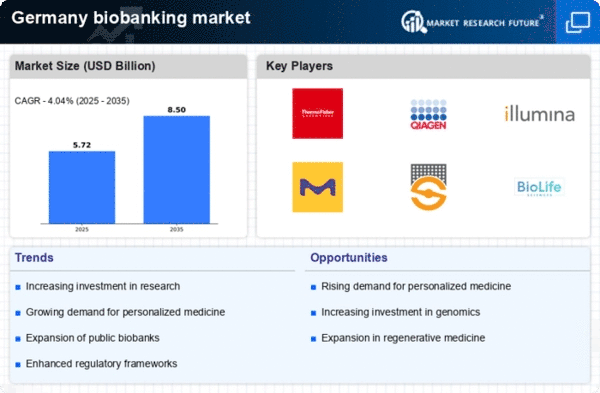
The biobanking market in Germany is experiencing a notable surge in demand for personalized medicine. This trend is driven by the increasing recognition of the importance of tailored treatments based on individual genetic profiles. As healthcare providers and researchers seek to develop more effective therapies, biobanks play a crucial role in providing the necessary biological samples. The market is projected to grow at a CAGR of approximately 8.5% over the next five years, reflecting the growing reliance on biobanks for research and development. Furthermore, the integration of genomic data into clinical practice is expected to enhance the utility of biobanks, thereby solidifying their position within the biobanking market.
Regulatory Support for Biobanking Initiatives
The regulatory landscape in Germany is evolving to support biobanking initiatives, which is a key driver for the biobanking market. Recent policy changes have aimed to streamline the processes involved in biobanking, making it easier for institutions to establish and operate biobanks. This regulatory support is crucial for ensuring ethical standards and compliance, which in turn fosters public confidence in biobanking practices. As regulations become more favorable, it is expected that the number of biobanks will increase, leading to a broader range of biological samples available for research. This trend could potentially enhance the growth of the biobanking market by approximately 6% over the next few years.
Increased Investment in Research and Development
Investment in research and development (R&D) is a significant driver of the biobanking market in Germany. Both public and private sectors are recognizing the value of biobanks in facilitating innovative research. Funding for biobanking initiatives is increasing, with government grants and private investments aimed at enhancing biobanking infrastructure and capabilities. This influx of capital is likely to lead to the establishment of new biobanks and the expansion of existing ones, thereby increasing the availability of diverse biological samples. The biobanking market is projected to benefit from this trend, with an expected growth rate of around 9% in R&D-related biobanking activities over the next few years.

















Leave a Comment