×
Request Free Sample ×

Kindly complete the form below to receive a free sample of this Report

* Please use a valid business email

Leading companies partner with us for data-driven Insights

clients tt-cursor
Hero Background

UK Biobanking Market

ID: MRFR/MED/52631-HCR
200 Pages
Rahul Gotadki
October 2025

UK Biobanking Market Research Report By Sample Type (Blood Products, Tissues, Cells, Nucleic Acids, Microbiome Samples), By Application (Research and Development, Clinical Trials, Personalized Medicine, Regenerative Medicine), By End Use (Academic Research Institutions, Biotechnology Companies, Pharmaceutical Companies, Government Organizations) and By Storage Type (Vapor Phase Storage, Liquid Phase Storage, Cryopreservation Storage)- Forecast to 2035

Share:
Download PDF ×

We do not share your information with anyone. However, we may send you emails based on your report interest from time to time. You may contact us at any time to opt-out.

UK Biobanking Market Infographic
Purchase Options

UK Biobanking Market Summary

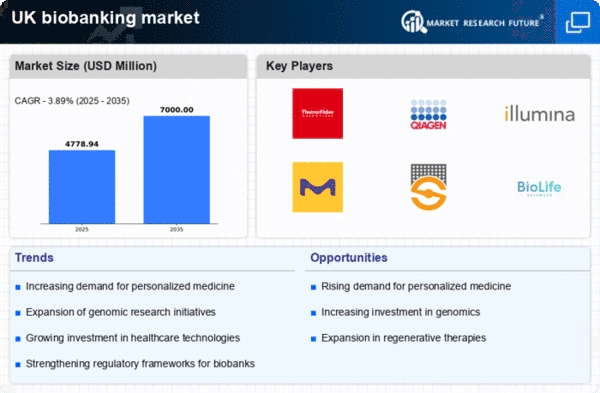
As per MRFR analysis, the UK biobanking market Size was estimated at 4600.0 USD Million in 2024. The UK biobanking market is projected to grow from 4778.94 USD Million in 2025 to 7000.0 USD Million by 2035, exhibiting a compound annual growth rate (CAGR) of 3.89% during the forecast period 2025 - 2035.

Key Market Trends & Highlights

The UK biobanking market is poised for growth driven by technological advancements and increasing collaboration.

  • Technological advancements are enhancing biobanking operations, leading to improved sample management and data integration.
  • Regulatory developments are fostering a supportive environment for biobanking, encouraging innovation and compliance.
  • Increased collaboration among research institutions and biobanks is facilitating knowledge sharing and resource optimization.
  • The growing demand for personalized medicine and rising investment in research and development are key drivers of market expansion.

Market Size & Forecast

2024 Market Size 4600.0 (USD Million)
2035 Market Size 7000.0 (USD Million)
CAGR (2025 - 2035) 3.89%

Major Players

Thermo Fisher Scientific (US), Qiagen (DE), Illumina (US), Merck KGaA (DE), STEMCELL Technologies (CA), BioLife Sciences (US), ReproCELL (JP), Tissue Regenix (GB)

UK Biobanking Market Trends

The biobanking market is currently experiencing notable growth, driven by advancements in biotechnology and an increasing emphasis on personalized medicine. This sector plays a crucial role in the collection, storage, and distribution of biological samples, which are essential for research and development in various fields, including genomics, drug discovery, and disease prevention. The rising demand for biobanks is largely attributed to the need for high-quality biological materials that can facilitate innovative research and improve healthcare outcomes. Furthermore, collaborations between academic institutions, healthcare providers, and private companies are fostering a more integrated approach to biobanking, enhancing the overall efficiency and effectiveness of sample utilization. In addition, regulatory frameworks and ethical guidelines are evolving to support the biobanking market, ensuring that the collection and use of biological samples adhere to strict standards. This regulatory environment is crucial for building public trust and encouraging participation in biobanking initiatives. As the landscape continues to change, the biobanking market is likely to expand further, with new technologies and methodologies emerging to optimize sample management and analysis. Overall, the future appears promising, with potential for significant contributions to medical research and public health initiatives.

Technological Advancements

Innovations in biobanking technologies are enhancing sample collection, processing, and storage. Automation and digitalization are streamlining operations, improving data management, and ensuring sample integrity. These advancements are likely to increase efficiency and reduce costs in the biobanking market.

Regulatory Developments

The evolving regulatory landscape is shaping the biobanking market by establishing clear guidelines for ethical practices and data protection. Compliance with these regulations is essential for fostering public trust and encouraging participation in biobanking initiatives.

Increased Collaboration

There is a growing trend of collaboration among academic institutions, healthcare organizations, and private entities. These partnerships are facilitating resource sharing and enhancing research capabilities, which may lead to more impactful discoveries in the biobanking market.

UK Biobanking Market Drivers

Supportive Regulatory Framework

A supportive regulatory framework is essential for the growth of the biobanking market in the UK. Regulatory bodies are establishing guidelines that facilitate ethical biobanking practices while ensuring the protection of donor rights. Recent updates to regulations have streamlined the approval processes for biobanking initiatives, encouraging more institutions to engage in biobanking activities. This regulatory support is crucial for fostering innovation and collaboration within the biobanking sector. As the regulatory landscape continues to evolve, it is expected that the biobanking market will experience increased stability and growth, attracting further investment and participation from various stakeholders.

Growing Demand for Personalized Medicine

The biobanking market is experiencing a notable surge in demand for personalized medicine, driven by advancements in genomics and biotechnology. This trend is reflected in the increasing number of biobanks that are being established to support research and development in this area. In the UK, the market is projected to grow at a CAGR of approximately 8% over the next five years, as healthcare providers and researchers seek to tailor treatments to individual genetic profiles. The integration of biobanking with personalized medicine not only enhances patient outcomes but also fosters innovation in drug development, thereby expanding the biobanking market. As a result, stakeholders are increasingly investing in biobanking initiatives to capitalize on this growing demand.

Increased Public Awareness and Participation

Public awareness regarding the importance of biobanking is on the rise, which is positively influencing the biobanking market. Educational campaigns and outreach programs are encouraging individuals to participate in biobanking initiatives, thereby increasing the availability of diverse biological samples. In the UK, participation rates in biobanking studies have improved, with estimates suggesting that over 30% of the population is now aware of biobanking's role in advancing healthcare. This heightened awareness not only facilitates the collection of valuable data but also fosters trust between the public and biobanking institutions. As more individuals engage with biobanks, the market is likely to expand, providing researchers with a broader array of samples for their studies.

Rising Investment in Research and Development

Investment in research and development (R&D) is a critical driver for the biobanking market, particularly in the UK. The government and private sector are allocating substantial funds to support biobanking initiatives, which are essential for advancing medical research. In 2025, R&D expenditure in the UK is expected to reach £45 billion, with a significant portion directed towards biobanking projects. This influx of capital enables the establishment of state-of-the-art biobanks equipped with advanced technologies for sample collection, storage, and analysis. Consequently, the biobanking market is likely to benefit from enhanced capabilities, leading to improved research outcomes and increased collaboration among academic institutions and industry players.

Technological Integration in Biobanking Operations

The integration of advanced technologies into biobanking operations is transforming the landscape of the biobanking market. Innovations such as artificial intelligence, machine learning, and blockchain are being adopted to enhance sample management, data analysis, and security. In the UK, biobanks are increasingly utilizing these technologies to streamline processes and improve efficiency. For instance, AI-driven analytics can optimize sample selection for research, while blockchain ensures the integrity and traceability of biological samples. This technological evolution not only boosts operational efficiency but also enhances the overall quality of biobanking services, making them more attractive to researchers and healthcare providers alike.


Market Segment Insights

By Sample Type: Blood Products (Largest) vs. Cells (Fastest-Growing)

In the UK biobanking market, the sample type segment showcases a diverse array of collection materials. Blood products dominate this landscape, holding the largest share in the market due to their extensive use in research and clinical applications. However, cells are emerging rapidly, driven by advances in regenerative medicine and personalized therapies. The increasing reliance on biological specimens for pharmaceuticals and diagnostics significantly contributes to the competitive positioning of these samples. Growth trends indicate that blood products will continue to lead the market; however, the segment for cells is projected to expand quickly. The shift towards personalized medicine and innovations in cell therapy are propelling this growth. Starting from foundational cell lines, the demand for novel applications including stem cells and immune cells is increasing, setting a positive trajectory for this sector.

Blood Products (Dominant) vs. Cells (Emerging)

Blood products have established themselves as the dominant sample type in the UK biobanking market, primarily due to their critical role in transfusions, disease diagnostics, and therapeutic interventions. Their extensive applications have ensured a steady demand from both research institutions and healthcare facilities. In contrast, cells represent an emerging segment characterized by rapid innovations and increasing clinical relevance. The scalability of cell-based therapies, including CAR-T and stem cell technologies, is seen as a key growth driver. As research progresses in regenerative medicine, the versatility and potential of cellular applications are likely to reshape the sample landscape, making cells a dynamic force in the market.

By Application: Personalized Medicine (Largest) vs. Regenerative Medicine (Fastest-Growing)

In the UK biobanking market, the application segment is prominently dominated by Personalized Medicine, which holds the largest market share due to its increasing relevance in tailoring treatments to individual patient needs. Research and Development follows closely, playing a significant role in the ongoing evolution of therapeutic strategies. Meanwhile, Clinical Trials are integral for validating these personalized approaches, supporting a shift towards more targeted healthcare solutions as regulatory bodies seek more robust data to ensure efficacy and safety. Growth trends within the application segment are largely driven by advancements in technology and an increasing emphasis on patient-centric healthcare. Regenerative Medicine is emerging rapidly, fueled by innovations in cell and gene therapy. This segment's fast expansion is supported by rising investments from both public and private sectors, aiming to develop treatments that address previously untreatable conditions, thus reshaping the overall healthcare landscape in the process.

Research and Development (Dominant) vs. Clinical Trials (Emerging)

The Research and Development application within the UK biobanking market is characterized by its foundational role in the discovery and validation of new therapies, making it a dominant force. This segment benefits from substantial funding and collaboration with academic institutions. In contrast, Clinical Trials have emerged as a critical component of the research ecosystem, facilitating the transition of innovative findings from laboratories into the clinical setting. They are essential for ensuring that new therapies undergo rigorous testing to demonstrate safety and effectiveness. The interplay between these two segments highlights the importance of a robust research infrastructure and the dynamic nature of clinical investigations as they strive to meet evolving healthcare needs.

By End-use: Academic Research Institutions (Largest) vs. Biotechnology Companies (Fastest-Growing)

In the UK biobanking market, the end-use segment is prominently dominated by Academic Research Institutions, which hold a substantial share due to their extensive research initiatives and funding availability. These institutions leverage biobanks for various studies, making them pivotal in the collection and preservation of biological samples. Following closely are Biotechnology Companies, which are rapidly increasing their utilization of biobanks for development and testing of novel therapies. The growth trend within this segment is driven by a surge in research activities and the increasing number of collaborations between academic institutions and biotechnology firms. Furthermore, advancements in biobanking technologies, such as automated sample handling and data management systems, are enhancing efficiency. Government Organizations also contribute significantly, although they are increasingly partnering with private entities to bolster research outputs and innovation in biobanking.

Academic Research Institutions: Dominant vs. Biotechnology Companies: Emerging

Academic Research Institutions remain the dominant force within the UK biobanking market, focusing on providing invaluable resources for genomics, proteomics, and other biological studies. These institutions often have longstanding relationships with a diverse range of biobanks and benefit from steady funding streams for research. On the other hand, Biotechnology Companies are emerging as significant players by aggressively expanding their engagement with biobanks to foster innovation in drug discovery and personalized medicine. Their emphasis on integrating biobanking data into research and development enhances their capabilities to bring new therapies to market. The interplay between these two segments underscores a dynamic landscape where academic excellence and commercial agility complement each other.

By Storage Type: Cryopreservation Storage (Largest) vs. Vapor Phase Storage (Fastest-Growing)

In the UK biobanking market, the storage type segment is characterized by three main categories: Vapor Phase Storage, Liquid Phase Storage, and Cryopreservation Storage. Among these, Cryopreservation Storage holds the largest share, capturing significant attention due to its ability to preserve biological samples at ultra-low temperatures, thus ensuring sample integrity. Vapor Phase Storage is also gaining traction, reflecting a shift towards more advanced preservation techniques. As trends indicate an increased demand for biobanking services, the growth of Vapor Phase Storage is particularly noteworthy, making it the fastest-growing segment. Factors contributing to this growth include technological advancements in storage solutions and an expanding biobanking industry that requires reliable and efficient methods for sample preservation. The rising focus on personalized medicine and regenerative therapies is expected to further drive growth in this subcategory.

Cryopreservation Storage (Dominant) vs. Liquid Phase Storage (Emerging)

Cryopreservation Storage is currently the dominant method in the UK biobanking market, known for its reliability and long-term preservation capabilities of biological samples. This method allows for the preservation of cells, tissues, and organs at temperatures reaching -196°C, thus minimizing cellular damage. On the other hand, Liquid Phase Storage, while established, remains an emerging segment in terms of market growth, as it typically uses temperatures above -80°C. Although it is utilized for a range of biological materials, its limitations in long-term preservation make it less favorable compared to Cryopreservation. The contrasting characteristics of these two storage methods highlight the growing preference for more robust and efficient solutions within the biobanking sector.

Get more detailed insights about UK Biobanking Market

Key Players and Competitive Insights

The biobanking market exhibits a dynamic competitive landscape characterized by rapid technological advancements and increasing demand for biobanked samples in research and clinical applications. Key growth drivers include the rising prevalence of chronic diseases, advancements in personalized medicine, and the growing emphasis on regenerative medicine. Major players such as Thermo Fisher Scientific (US), Qiagen (DE), and Illumina (US) are strategically positioned to leverage these trends. Thermo Fisher Scientific (US) focuses on innovation through its extensive portfolio of biobanking solutions, while Qiagen (DE) emphasizes partnerships to enhance its sample preparation technologies. Illumina (US) is heavily invested in genomic sequencing technologies, which are integral to biobanking operations. Collectively, these strategies foster a competitive environment that prioritizes technological innovation and strategic collaborations.

In terms of business tactics, companies are increasingly localizing manufacturing and optimizing supply chains to enhance operational efficiency. The market structure appears moderately fragmented, with several key players holding substantial market shares. This fragmentation allows for a diverse range of offerings, yet the influence of major companies like Thermo Fisher Scientific (US) and Illumina (US) is pronounced, as they set industry standards and drive technological advancements.

In October 2025, Thermo Fisher Scientific (US) announced the launch of a new biobanking platform designed to streamline sample management and enhance data integration capabilities. This strategic move is likely to bolster its market position by providing researchers with more efficient tools for managing biobanked samples, thereby addressing the growing demand for integrated solutions in biobanking.

In September 2025, Qiagen (DE) expanded its collaboration with a leading UK university to develop advanced biobanking protocols aimed at improving sample quality and accessibility. This partnership underscores Qiagen's commitment to enhancing its technological offerings and reflects a broader trend of academic-industry collaborations that are essential for driving innovation in biobanking practices.

In August 2025, Illumina (US) unveiled a new genomic sequencing technology that significantly reduces the time required for sample analysis. This innovation not only enhances the efficiency of biobanking operations but also positions Illumina as a leader in the integration of genomic data into biobanking, which is increasingly critical for personalized medicine applications.

As of November 2025, current competitive trends in the biobanking market are heavily influenced by digitalization, sustainability initiatives, and the integration of artificial intelligence (AI) into operational processes. Strategic alliances are becoming more prevalent, as companies recognize the value of collaborative efforts in enhancing technological capabilities and market reach. Looking ahead, competitive differentiation is expected to evolve, with a notable shift from price-based competition towards innovation, technological advancements, and supply chain reliability. This transition suggests that companies that prioritize R&D and strategic partnerships will likely emerge as leaders in the biobanking market.

Key Companies in the UK Biobanking Market market include

Industry Developments

Recent developments in the UK Biobanking Market indicate a dynamic environment influenced by advancements in technology and significant collaborations among key players. Companies such as Oxford Biomedica and UK Biobank are focusing on expanding their capabilities, with Oxford Biomedica reporting increased investments in gene therapy. Current affairs reflect a growing emphasis on biobanking as a crucial component of biomedical research, evidenced by initiatives at institutions like The Francis Crick Institute and The Wellcome Trust. In terms of mergers and acquisitions, no significant transactions involving the listed companies have been made public recently. 

However, the market is characterized by strategic partnerships aimed at enhancing operational efficiency and research capabilities. For instance, Thermo Fisher Scientific continues to expand its biobanking solutions portfolio amidst rising demand for biobanks in clinical research. The UK government, through initiatives supported by the National Health Service, is fostering biobanking efforts, aiming to enhance the country's research infrastructure. 

Growth in market valuation remains strong as companies adapt to the evolving landscape, focusing on personalized medicine and data-driven research. Furthermore, the UK Biobank has played a pivotal role over the past few years, facilitating numerous studies since its inception in 2006, further solidifying its importance in global health research.


Future Outlook

UK Biobanking Market Future Outlook

The Biobanking Market is projected to grow at 3.89% CAGR from 2024 to 2035, driven by advancements in personalized medicine, increased research funding, and regulatory support.

New opportunities lie in:

  • Expansion of biorepository services for rare diseases
  • Development of automated sample processing technologies
  • Partnerships with pharmaceutical companies for drug discovery initiatives

By 2035, the biobanking market is expected to achieve robust growth and enhanced service offerings.

Market Segmentation

UK Biobanking Market End-use Outlook

  • Academic Research Institutions
  • Biotechnology Companies
  • Pharmaceutical Companies
  • Government Organizations

UK Biobanking Market Application Outlook

  • Research and Development
  • Clinical Trials
  • Personalized Medicine
  • Regenerative Medicine

UK Biobanking Market Sample Type Outlook

  • Blood Products
  • Tissues
  • Cells
  • Nucleic Acids
  • Microbiome Samples

UK Biobanking Market Storage Type Outlook

  • Vapor Phase Storage
  • Liquid Phase Storage
  • Cryopreservation Storage

Report Scope

MARKET SIZE 2024 4600.0(USD Million)
MARKET SIZE 2025 4778.94(USD Million)
MARKET SIZE 2035 7000.0(USD Million)
COMPOUND ANNUAL GROWTH RATE (CAGR) 3.89% (2024 - 2035)
REPORT COVERAGE Revenue Forecast, Competitive Landscape, Growth Factors, and Trends
BASE YEAR 2024
Market Forecast Period 2025 - 2035
Historical Data 2019 - 2024
Market Forecast Units USD Million
Key Companies Profiled Thermo Fisher Scientific (US), Qiagen (DE), Illumina (US), Merck KGaA (DE), STEMCELL Technologies (CA), BioLife Sciences (US), ReproCELL (JP), Tissue Regenix (GB)
Segments Covered Sample Type, Application, End-use, Storage Type
Key Market Opportunities Advancements in personalized medicine drive demand for innovative biobanking solutions and technologies.
Key Market Dynamics Growing demand for personalized medicine drives innovation and competition in the biobanking market.
Countries Covered UK

Leave a Comment

FAQs

What is the expected market size of the UK Biobanking Market in 2024?

The UK Biobanking Market is expected to be valued at 257.0 million USD in 2024.

What is the projected market size for the UK Biobanking Market by 2035?

By 2035, the UK Biobanking Market is projected to reach a value of 352.0 million USD.

What is the expected compound annual growth rate (CAGR) for the UK Biobanking Market from 2025 to 2035?

The UK Biobanking Market is expected to grow at a CAGR of 2.901% from 2025 to 2035.

Which sample type is projected to lead the UK Biobanking Market in 2024?

Blood Products are projected to lead the UK Biobanking Market with a value of 80.0 million USD in 2024.

How much is the Tissues segment expected to be worth in the UK Biobanking Market by 2035?

The Tissues segment is expected to be valued at 82.0 million USD in the UK Biobanking Market by 2035.

Who are the major players in the UK Biobanking Market?

Major players in the UK Biobanking Market include Oxford Biomedica, UK Biobank, and Thermo Fisher Scientific among others.

What is the expected market value for Cells in the UK Biobanking Market in 2024?

The Cells segment is expected to be valued at 50.0 million USD in the UK Biobanking Market in 2024.

What challenges is the UK Biobanking Market facing in the current global scenario?

The UK Biobanking Market is facing challenges such as regulatory hurdles and data privacy concerns.

What is the projected market value for Microbiome Samples in 2035?

Microbiome Samples are projected to be valued at 43.0 million USD in the UK Biobanking Market by 2035.

Which market segment is likely to experience significant growth between 2025 to 2035?

The Nucleic Acids segment is likely to experience significant growth, with a projected value of 54.0 million USD by 2035.

Download Free Sample

Kindly complete the form below to receive a free sample of this Report

Compare Licence

×
Features License Type
Single User Multiuser License Enterprise User
Price $4,950 $5,950 $7,250
Maximum User Access Limit 1 User Upto 10 Users Unrestricted Access Throughout the Organization
Free Customization
Direct Access to Analyst
Deliverable Format
Platform Access
Discount on Next Purchase 10% 15% 15%
Printable Versions