×
Request Free Sample ×

Kindly complete the form below to receive a free sample of this Report

* Please use a valid business email

Leading companies partner with us for data-driven Insights

clients tt-cursor
Hero Background

South Korea Biobanking Market

ID: MRFR/HC/52632-HCR
200 Pages
Rahul Gotadki
October 2025

South Korea Biobanking Market Research Report By Sample Type (Blood Products, Tissues, Cells, Nucleic Acids, Microbiome Samples), By Application (Research and Development, Clinical Trials, Personalized Medicine, Regenerative Medicine), By End Use (Academic Research Institutions, Biotechnology Companies, Pharmaceutical Companies, Government Organizations) and By Storage Type (Vapor Phase Storage, Liquid Phase Storage, Cryopreservation Storage)- Forecast to 2035

Share:
Download PDF ×

We do not share your information with anyone. However, we may send you emails based on your report interest from time to time. You may contact us at any time to opt-out.

South Korea Biobanking Market Infographic
Purchase Options

South Korea Biobanking Market Summary

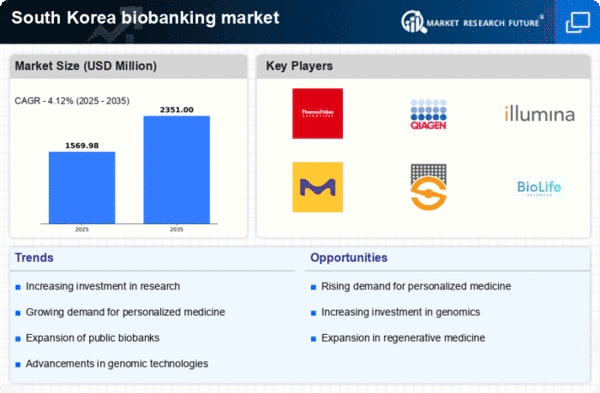
As per MRFR analysis, the South Korea biobanking market Size was estimated at 1507.86 USD Million in 2024. The South Korea biobanking market is projected to grow from 1569.98 USD Million in 2025 to 2351.0 USD Million by 2035, exhibiting a compound annual growth rate (CAGR) of 4.12% during the forecast period 2025 - 2035.

Key Market Trends & Highlights

The South Korea biobanking market is poised for growth driven by technological advancements and increasing demand for personalized medicine.

  • Technological advancements are enhancing biobanking processes and data management capabilities.
  • The regulatory framework is evolving to support biobanking operations and ensure compliance with international standards.
  • Collaboration among research institutions and biobanks is increasing, fostering innovation and resource sharing.
  • Rising demand for personalized medicine and advancements in biobanking technologies are key drivers of market growth.

Market Size & Forecast

2024 Market Size 1507.86 (USD Million)
2035 Market Size 2351.0 (USD Million)
CAGR (2025 - 2035) 4.12%

Major Players

Thermo Fisher Scientific (US), Qiagen (NL), Illumina (US), Merck KGaA (DE), STEMCELL Technologies (CA), BioLife Sciences (US), ReproCELL (JP), Tecan Group (CH), Biosample Solutions (US)

South Korea Biobanking Market Trends

The biobanking market in South Korea is currently experiencing notable growth, driven by advancements in biotechnology and increasing demand for personalized medicine. The nation has established a robust infrastructure for biobanking, supported by government initiatives aimed at enhancing research capabilities and fostering innovation. This environment encourages collaboration between academic institutions, healthcare providers, and private enterprises, which collectively contribute to the expansion of biobanking services. Furthermore, the rising awareness of the importance of genetic research and biobanking in disease prevention and treatment is propelling investments in this sector. In addition, South Korea's aging population and the corresponding rise in chronic diseases are likely to further stimulate the biobanking market. The collection and preservation of biological samples are essential for understanding disease mechanisms and developing targeted therapies. As the market evolves, ethical considerations surrounding biobanking practices are becoming increasingly prominent, necessitating stringent regulations and guidelines to protect donor rights and ensure the responsible use of biological materials. Overall, the biobanking market in South Korea appears poised for continued growth, with a focus on innovation, collaboration, and ethical practices.

Technological Advancements

The biobanking market is witnessing rapid technological advancements, particularly in sample collection, storage, and analysis. Innovations such as automated biorepositories and advanced data management systems enhance efficiency and accuracy, thereby improving research outcomes. These developments are crucial for maintaining the integrity of biological samples and facilitating large-scale studies.

Regulatory Framework Enhancements

Recent enhancements in the regulatory framework governing biobanking practices in South Korea indicate a commitment to ethical standards and donor protection. Stricter guidelines are being implemented to ensure transparency and accountability in the collection and use of biological materials, which may foster public trust and encourage participation in biobanking initiatives.

Increased Collaboration

There is a growing trend of collaboration among various stakeholders in the biobanking market, including academic institutions, healthcare organizations, and private companies. Such partnerships are likely to enhance resource sharing, promote innovation, and accelerate research efforts, ultimately contributing to the advancement of personalized medicine and improved health outcomes.

South Korea Biobanking Market Drivers

Supportive Government Policies

The South Korean government is actively promoting biobanking initiatives, which is a key driver for the biobanking market. Policies aimed at enhancing research capabilities and funding for biobanks are being implemented. For example, the government has allocated substantial resources to support biobanking infrastructure and research projects. This support is crucial for fostering innovation and collaboration within the sector. As a result, the biobanking market is expected to benefit from increased investment and improved regulatory frameworks that facilitate research and development.

Emerging Research Opportunities

The biobanking market in South Korea is experiencing growth due to emerging research opportunities in various fields, including genomics, proteomics, and personalized medicine. Researchers are increasingly relying on biobanks to access high-quality biological samples for their studies. This trend is likely to expand as new research initiatives are launched, particularly in areas such as cancer research and rare diseases. The demand for diverse biological samples is expected to drive the market, with projections indicating a potential increase in market size by over 15% in the coming years.

Advancements in Biobanking Technologies

Technological innovations are significantly impacting the biobanking market in South Korea. The introduction of automated sample processing and advanced storage solutions enhances the efficiency and reliability of biobanks. For instance, the integration of artificial intelligence in data management systems allows for better sample tracking and analysis. As a result, biobanks can offer more comprehensive services to researchers and healthcare institutions. The market is projected to grow at a CAGR of around 10% over the next five years, driven by these technological advancements that improve operational capabilities and data integrity.

Rising Demand for Personalized Medicine

The increasing focus on personalized medicine is driving the biobanking market in South Korea. As healthcare shifts towards tailored treatments, the need for biobanks to store diverse biological samples becomes crucial. This trend is reflected in the growing investment in biobanking facilities, with estimates suggesting that the market could reach approximately $1.5 billion by 2027. Personalized medicine relies heavily on genetic and molecular data, which biobanks provide. Consequently, the biobanking market is likely to expand as healthcare providers seek to enhance patient outcomes through customized therapies.

Growing Public Awareness and Participation

Public awareness regarding the importance of biobanking is increasing in South Korea, which is positively influencing the biobanking market. Educational campaigns and community outreach programs are encouraging individuals to donate biological samples for research purposes. This heightened awareness is expected to lead to a larger pool of samples available for research, thereby enhancing the quality of studies conducted. As participation rates rise, biobanks are likely to see an increase in funding and support from both governmental and private sectors, further propelling market growth.

Market Segment Insights

Biobanking Market Sample Type Insights

The South Korea Biobanking Market has a lot of different parts, especially in the Sample Type category, which is quite important for how biobanks work as a whole. In this area, a wide range of biological samples are gathered and stored. These samples are very important for research and development, diagnostics, and personalized therapy. 

Blood products make up a large part of this market since they can be used in many different ways, such as in transfusions and as the basis for many clinical research investigations. 

Tissues taken from different origins help scientists learn more about how cells interact with one other and make progress in regenerative medicine and cancer research. Also, cells, especially stem cells, are being used to treat a wide range of disorders, which increases their need in this area. DNA and RNA are examples of nucleic acids that are very important for genetic research. 

They have led to advances in gene therapy and tailored treatment strategies. Researchers are also looking into microbiome samples to learn more about the close link between human health and microbial ecosystems. This is a new area of research in personalized medicine. 

The South Korean biobanking market has been moving toward these types of samples over time. This is because the government has been pushing for biobanks to be more important in healthcare innovation.This part of the market is set to increase a lot because of improvements in storage technology and more partnerships between biotech businesses and academic institutions. 

Biobanking Market Application Insights

The Application segment of the South Korea Biobanking Market plays a crucial role in advancing healthcare and medical research within the region. This segment is primarily driven by factors such as increasing investments in Research and Development, which significantly enhances the understanding of diseases and the development of innovative treatments. 

Clinical Trials benefit immensely from biobanking, as access to diverse biological samples aids in producing more effective and targeted therapies. Personalized Medicine is gaining traction, as it leverages biobanked samples to tailor treatments individually, improving patient outcomes and satisfaction.

Additionally, Regenerative Medicine is emerging as a vital area, utilizing biobanked cells and tissues for innovative therapies that restore or replace damaged tissues and organs. The overall growth in the South Korea Biobanking Market is supported by a robust healthcare framework, government initiatives promoting research, and collaboration among institutions, making it a significant contributor to advancements in medical science. 

The potential for innovation in this area presents various opportunities, including enhanced patient care, improved diagnostic tools, and the development of cutting-edge therapies that address unmet medical needs.

Biobanking Market End Use Insights

The South Korea Biobanking Market is witnessing significant growth across its End Use segment, which encompasses a variety of critical players such as Academic Research Institutions, Biotechnology Companies, Pharmaceutical Companies, and Government Organizations. Academic Research Institutions represent a substantial part of this market, as they engage in extensive studies that often require vast biobanked samples, driving advancements in genomics and personalized medicine. 

Biotechnology Companies are equally vital, utilizing biobanks to facilitate the development of novel therapeutics and diagnostic tools, thereby enhancing innovation.Pharmaceutical Companies leverage biobanks for Research and Development purposes, which allows them to conduct clinical trials more effectively by accessing a rich diversity of biological samples. 

Government Organizations play a crucial role by providing regulatory frameworks that support biobanking initiatives, which helps in promoting ethical standards while securing funding for research projects. The interplay among these segments contributes to the overall South Korea Biobanking Market revenue, positioning the country as a leader in biobanking within the region.

The increasing focus on precision medicine and the growing need for data-driven approaches in healthcare are driving opportunities for growth and collaboration among these entities. As a result, the South Korea Biobanking Market segmentation continues to evolve, reflecting the diverse interests and needs of stakeholders involved in biobanking activities.

Biobanking Market Storage Type Insights

The Storage Type segment of the South Korea Biobanking Market plays a crucial role in preserving biological samples, which is pivotal for research and diagnostics. Within this segment, Vapor Phase Storage is significant due to its ability to maintain samples at ultra-low temperatures, minimizing cellular damage and maximizing sample integrity. 

Liquid Phase Storage also holds importance, particularly for tissues and other biological materials that require precise temperature control to remain viable over time. 

Cryopreservation Storage dominates in the biobanking sector since it facilitates long-term storage of cells, tissues, and even embryos, which is essential for regenerative medicine and fertility treatments.The advancements in storage technologies have further propelled the growth of this segment, aligning with the increasing emphasis on personalized medicine and Research and Development initiatives in South Korea's healthcare industry. 

As the demand for biological samples continues to rise, driven by trends in genomics and proteomics, the Storage Type segment is set to gain a larger share of the South Korea Biobanking Market, supporting the overall market growth and contributing to significant advancements in medical research and innovation.

Get more detailed insights about South Korea Biobanking Market

Key Players and Competitive Insights

The biobanking market in South Korea is characterized by a dynamic competitive landscape, driven by advancements in biotechnology and increasing demand for personalized medicine. Key players such as Thermo Fisher Scientific (US), Qiagen (NL), and Illumina (US) are at the forefront, leveraging their extensive portfolios to enhance operational capabilities. Thermo Fisher Scientific (US) focuses on innovation through continuous investment in R&D, while Qiagen (NL) emphasizes strategic partnerships to expand its market reach. Illumina (US) is known for its cutting-edge sequencing technologies, which are pivotal in biobanking applications. Collectively, these strategies foster a competitive environment that is increasingly oriented towards technological advancement and collaborative growth.

In terms of business tactics, companies are localizing manufacturing and optimizing supply chains to enhance efficiency and reduce costs. The market structure appears moderately fragmented, with several players vying for market share. However, the influence of major companies is substantial, as they set industry standards and drive innovation. This competitive structure encourages smaller firms to adopt niche strategies or seek partnerships to remain relevant in the evolving landscape.

In October 2025, Thermo Fisher Scientific (US) announced the launch of a new biobanking solution aimed at improving sample preservation and data management. This strategic move is significant as it aligns with the growing emphasis on data integrity and sample quality in biobanking, potentially enhancing the company's competitive edge in the market. By addressing these critical needs, Thermo Fisher Scientific (US) positions itself as a leader in biobanking solutions, catering to the demands of research institutions and healthcare providers.

In September 2025, Qiagen (NL) expanded its collaboration with a leading South Korean university to develop advanced genomic analysis tools for biobanking applications. This partnership is indicative of Qiagen's strategy to integrate local expertise and resources, thereby enhancing its product offerings. Such collaborations not only strengthen Qiagen's market presence but also facilitate the development of tailored solutions that meet specific regional needs, thereby fostering innovation in the biobanking sector.

In August 2025, Illumina (US) unveiled a new platform designed to streamline the biobanking process, integrating AI-driven analytics for better sample tracking and management. This initiative reflects a broader trend towards digitalization within the industry, as companies seek to leverage technology to improve operational efficiency. By adopting AI solutions, Illumina (US) enhances its value proposition, making it a formidable competitor in the biobanking market.

As of November 2025, current trends in the biobanking market include a pronounced shift towards digitalization, sustainability, and AI integration. Strategic alliances are increasingly shaping the competitive landscape, enabling companies to pool resources and expertise. Looking ahead, competitive differentiation is likely to evolve, with a focus on innovation and technology rather than price-based competition. Companies that prioritize supply chain reliability and technological advancements will likely emerge as leaders in this rapidly changing environment.

Key Companies in the South Korea Biobanking Market market include

Industry Developments

Recent developments in the South Korea Biobanking Market indicate significant growth and innovations. Companies such as Kgenics and MedRex are advancing their biobanking technologies, enhancing the quality of biological samples for research and clinical applications. In September 2023, Celltrion announced an expansion of its biobank facilities to accommodate an increase in demand for cell and gene therapies, representing an investment in developing personalized medicine strategies. 

Sangamo Therapeutics has been focusing on collaborations aimed at using its gene-editing technology for therapeutic development, thereby enhancing its biobanking capabilities. Furthermore, in August 2022, Biogen established a partnership with Theragen Etex to introduce precision medicine solutions utilizing advanced biobanking practices. Green Cross Corporation has recently invested in R&D to leverage biobanks for vaccine development, showcasing a heightened focus on public health. 

Growth in market valuations across these companies is underpinned by rising investments in biobanking for therapeutic advancements, with expectations of increased government support through initiatives from the Korea Research Institute of Bioscience and Bioengineering. Over the past few years, key events like the establishment of new biobanking regulations in March 2021 have also fostered a conducive environment for research and innovation within this market.

Future Outlook

South Korea Biobanking Market Future Outlook

The Biobanking Market in South Korea is projected to grow at a 4.12% CAGR from 2024 to 2035, driven by advancements in personalized medicine, increased research funding, and technological innovations.

New opportunities lie in:

  • Development of automated biorepository management systems
  • Expansion of partnerships with pharmaceutical companies for clinical trials
  • Investment in advanced cryopreservation technologies for sample integrity

By 2035, the biobanking market is expected to achieve robust growth and enhanced operational efficiencies.

Market Segmentation

South Korea Biobanking Market End-use Outlook

  • Academic Research Institutions
  • Biotechnology Companies
  • Pharmaceutical Companies
  • Government Organizations

South Korea Biobanking Market Application Outlook

  • Research and Development
  • Clinical Trials
  • Personalized Medicine
  • Regenerative Medicine

South Korea Biobanking Market Sample Type Outlook

  • Blood Products
  • Tissues
  • Cells
  • Nucleic Acids
  • Microbiome Samples

South Korea Biobanking Market Storage Type Outlook

  • Vapor Phase Storage
  • Liquid Phase Storage
  • Cryopreservation Storage

Report Scope

MARKET SIZE 20241507.86(USD Million)
MARKET SIZE 20251569.98(USD Million)
MARKET SIZE 20352351.0(USD Million)
COMPOUND ANNUAL GROWTH RATE (CAGR)4.12% (2024 - 2035)
REPORT COVERAGERevenue Forecast, Competitive Landscape, Growth Factors, and Trends
BASE YEAR2024
Market Forecast Period2025 - 2035
Historical Data2019 - 2024
Market Forecast UnitsUSD Million
Key Companies ProfiledThermo Fisher Scientific (US), Qiagen (NL), Illumina (US), Merck KGaA (DE), STEMCELL Technologies (CA), BioLife Sciences (US), ReproCELL (JP), Tecan Group (CH), Biosample Solutions (US)
Segments CoveredSample Type, Application, End-use, Storage Type
Key Market OpportunitiesAdvancements in personalized medicine drive demand for innovative biobanking solutions in South Korea.
Key Market DynamicsGrowing demand for personalized medicine drives innovation and competition in the biobanking market.
Countries CoveredSouth Korea

Leave a Comment

FAQs

What is the expected market value of the South Korea Biobanking Market in 2024?

The South Korea Biobanking Market is expected to be valued at 102.8 million USD in 2024.

What is the projected market value for the South Korea Biobanking Market by 2035?

By 2035, the South Korea Biobanking Market is projected to reach a value of 250.0 million USD.

What is the expected CAGR for the South Korea Biobanking Market from 2025 to 2035?

The expected compound annual growth rate (CAGR) for the South Korea Biobanking Market from 2025 to 2035 is 8.414%.

Which segment accounts for the largest share in the South Korea Biobanking Market?

The Blood Products segment is anticipated to account for the largest share, valued at 30.0 million USD in 2024.

How much is the Tissues segment projected to be valued at in 2035?

The Tissues segment is projected to be valued at 60.0 million USD by 2035.

Who are the key competitors in the South Korea Biobanking Market?

Key players in the market include Kgenics, MedRex, Celltrion, and Biogen among others.

What is the expected market size for Cells by 2035?

The market size for Cells is expected to reach 50.0 million USD by 2035.

What are the growth drivers for the South Korea Biobanking Market?

Growth drivers include advancements in biobanking technologies and increasing demand for personalized medicine.

How much is the Nucleic Acids segment valued at in 2024?

The Nucleic Acids segment is valued at 15.0 million USD in 2024.

What is the expected market size for Microbiome Samples by 2035?

Microbiome Samples are projected to reach a market size of 30.0 million USD by 2035.

Download Free Sample

Kindly complete the form below to receive a free sample of this Report

Compare Licence

×
Features License Type
Single User Multiuser License Enterprise User
Price $4,950 $5,950 $7,250
Maximum User Access Limit 1 User Upto 10 Users Unrestricted Access Throughout the Organization
Free Customization
Direct Access to Analyst
Deliverable Format
Platform Access
Discount on Next Purchase 10% 15% 15%
Printable Versions