×
Request Free Sample ×

Kindly complete the form below to receive a free sample of this Report

* Please use a valid business email

Leading companies partner with us for data-driven Insights

clients tt-cursor
Hero Background

Spain Geospatial Analytics Market

ID: MRFR/ICT/59014-HCR
200 Pages
Aarti Dhapte
October 2025

Spain Geospatial Analytics Market Research Report By Service (Consulting, Integration and Deployment, Support and Maintenance), By Type (Surface and Field Analytics, Network and Location Analytics, Geo-visualization, Other types), and By Technology (Remote Sensing GIS GPS, Other technologies)- Forecast to 2035

Share:
Download PDF ×

We do not share your information with anyone. However, we may send you emails based on your report interest from time to time. You may contact us at any time to opt-out.

Spain Geospatial Analytics Market Infographic
Purchase Options

Spain Geospatial Analytics Market Summary

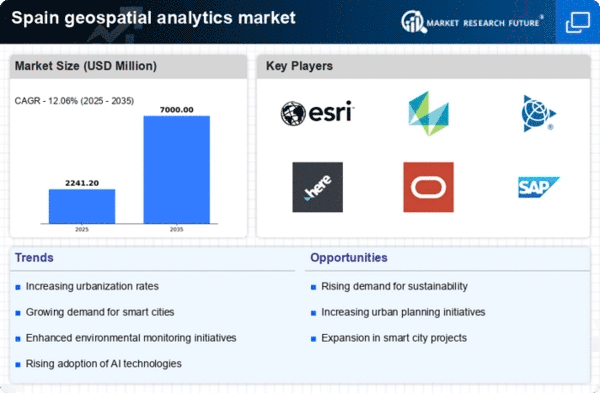
As per MRFR analysis, the geospatial analytics market size was estimated at 2000.0 USD Million in 2024. The geospatial analytics market is projected to grow from 2241.2 USD Million in 2025 to 7000.0 USD Million by 2035, exhibiting a compound annual growth rate (CAGR) of 12.06% during the forecast period 2025 - 2035.

Key Market Trends & Highlights

The Spain geospatial analytics market is experiencing robust growth driven by technological advancements and increasing demand for location-based services.

  • The market is witnessing increased adoption of GIS technologies across various sectors.
  • Smart city initiatives are gaining traction, leading to enhanced urban planning and management.
  • AI and machine learning integration is transforming data analysis and decision-making processes.
  • Rising demand for location-based services and government investments in infrastructure development are key market drivers.

Market Size & Forecast

2024 Market Size 2000.0 (USD Million)
2035 Market Size 7000.0 (USD Million)
CAGR (2025 - 2035) 12.06%

Major Players

Esri (US), Hexagon (SE), Trimble (US), HERE Technologies (NL), Oracle (US), SAP (DE), IBM (US), Microsoft (US), Google (US)

Spain Geospatial Analytics Market Trends

The geospatial analytics market in Spain is experiencing notable growth, driven by advancements in technology and increasing demand for location-based services. The integration of geographic information systems (GIS) with big data analytics is transforming how businesses and government entities operate. This evolution allows for enhanced decision-making processes, improved resource management, and more effective urban planning. As organizations recognize the value of spatial data, investments in geospatial technologies are likely to rise, fostering innovation and efficiency across various sectors. Moreover, the Spanish government is actively promoting the use of geospatial data to support sustainable development and environmental management. Initiatives aimed at improving data accessibility and interoperability are paving the way for more informed policy-making. The emphasis on smart cities and infrastructure development further underscores the importance of geospatial analytics in addressing urban challenges. As the market matures, collaboration between public and private sectors may lead to the emergence of new applications and services, ultimately enhancing the overall landscape of geospatial analytics in Spain.

Increased Adoption of GIS Technologies

Organizations in Spain are increasingly adopting geographic information systems (GIS) to enhance operational efficiency. This trend is driven by the need for accurate spatial data to support decision-making processes across various industries, including transportation, agriculture, and urban planning.

Focus on Smart City Initiatives

The push for smart city development in Spain is significantly influencing the geospatial analytics market. Local governments are leveraging spatial data to optimize urban infrastructure, improve public services, and enhance citizen engagement, thereby creating more sustainable urban environments.

Integration of AI and Machine Learning

The integration of artificial intelligence (AI) and machine learning technologies into geospatial analytics is gaining traction. This convergence allows for more sophisticated data analysis, enabling organizations to derive actionable insights from complex spatial datasets, which can lead to improved strategic planning.

Spain Geospatial Analytics Market Drivers

Rising Demand for Location-Based Services

The geospatial analytics market in Spain experiences a notable surge in demand for location-based services. Businesses across various sectors, including retail, logistics, and tourism, increasingly rely on geospatial data to enhance operational efficiency and customer engagement. For instance, the retail sector utilizes geospatial analytics to optimize store locations and tailor marketing strategies based on consumer behavior patterns. This trend is reflected in the market's projected growth, with estimates suggesting a compound annual growth rate (CAGR) of approximately 15% over the next five years. As organizations recognize the value of spatial data in decision-making, the geospatial analytics market is poised for substantial expansion.

Emergence of Environmental Monitoring Needs

The growing awareness of environmental issues in Spain drives the demand for geospatial analytics in environmental monitoring. With climate change and urbanization posing significant challenges, stakeholders are increasingly utilizing geospatial data to assess environmental impacts and manage natural resources. The geospatial analytics market is witnessing a rise in applications related to land use planning, pollution tracking, and biodiversity conservation. Reports indicate that the market for environmental geospatial analytics could reach €1 billion by 2027, reflecting the increasing reliance on spatial data for informed decision-making. This trend underscores the critical role of geospatial technologies in addressing pressing environmental concerns.

Advancements in Satellite and Drone Technologies

Technological advancements in satellite and drone capabilities are reshaping the geospatial analytics market in Spain. The proliferation of high-resolution satellite imagery and drone-based data collection enhances the accuracy and timeliness of geospatial analyses. Industries such as agriculture, forestry, and construction are leveraging these technologies to improve productivity and resource management. For example, precision agriculture utilizes drone imagery to monitor crop health and optimize irrigation practices. The market is expected to benefit from these innovations, with projections indicating a potential increase in market size by 20% over the next few years as more sectors adopt these advanced geospatial solutions.

Government Investments in Infrastructure Development

Government initiatives in Spain aimed at infrastructure development significantly influence the geospatial analytics market. Investments in transportation, urban planning, and environmental management necessitate the use of geospatial technologies for effective project execution. The Spanish government has allocated over €10 billion for infrastructure projects in recent years, emphasizing the importance of data-driven decision-making. This investment creates opportunities for geospatial analytics firms to provide solutions that enhance project planning and execution. As public sector entities increasingly adopt geospatial tools, the market is likely to witness accelerated growth, driven by the demand for innovative solutions that support sustainable development.

Integration of Geospatial Data in Business Intelligence

The integration of geospatial data into business intelligence systems is becoming increasingly prevalent in Spain, significantly impacting the geospatial analytics market. Organizations are recognizing the value of combining traditional data with spatial information to gain deeper insights into market trends and consumer behavior. This integration allows for enhanced visualization and analysis, leading to more informed strategic decisions. As businesses invest in advanced analytics tools, the geospatial analytics market is likely to experience growth, with estimates suggesting a market expansion of approximately 12% annually. This trend highlights the importance of spatial data in driving competitive advantage across various sectors.


Market Segment Insights

By Service: Consulting (Largest) vs. Integration and Deployment (Fastest-Growing)

In the service segment of the Spain geospatial analytics market, consulting holds the largest market share, capitalizing on the demand for strategic insights and implementation guidance. Integration and deployment services are quickly gaining traction, appealing to organizations looking to incorporate geospatial technologies into their existing infrastructures. Support and maintenance services follow, providing essential ongoing care for deployed solutions. The growth of the service segment is primarily driven by the rapid adoption of geospatial analytics across various sectors, including urban planning, environmental management, and logistics. Businesses are increasingly recognizing the value of actionable insights derived from geographic data, fueling the demand for consulting services. Moreover, the push towards digital transformation and the need for real-time data analytics significantly contribute to the expansion of integration and deployment services, marking them as a key growth area.

Consulting (Dominant) vs. Support and Maintenance (Emerging)

Consulting services dominate the service segment, characterized by a comprehensive approach to problem-solving and strategic planning for clients in diverse industries. These services often involve tailored solutions that meet specific business needs, which establishes strong relationships with organizations. On the other hand, support and maintenance services are emerging as vital components of successful geospatial implementations. As more businesses deploy geospatial solutions, the need for effective support to ensure optimal performance creates a steady demand. This segment focuses on troubleshooting, regular updates, and user training, which are essential for building long-term client satisfaction and loyalty within the Spain geospatial analytics market.

By Type: Surface and Field Analytics (Largest) vs. Geovisualization (Fastest-Growing)

In the Spain geospatial analytics market, Surface and Field Analytics holds the largest market share among the type segments, driven by an increasing demand for precision agriculture and land management solutions. This segment leverages advanced technologies to provide critical insights for various applications, maintaining a significant position due to its versatility and applicability across different sectors. On the other hand, Geovisualization is emerging as the fastest-growing segment, fueled by the rising need for intuitive data representation and user-friendly interfaces. The growth of big data and cloud computing has catalyzed this trend, enabling organizations to visualize complex data easily and effectively. The increasing emphasis on location-based decision-making further contributes to the upward trajectory of this innovative segment.

Surface and Field Analytics (Dominant) vs. Geovisualization (Emerging)

Surface and Field Analytics stands as the dominant force in the Spain geospatial analytics market, extensively utilized for agricultural monitoring and urban planning. Its ability to supply granular data on land use and environmental changes makes it indispensable for stakeholders seeking optimal management practices. In contrast, Geovisualization, although emerging, is rapidly gaining traction, especially in sectors demanding enhanced data insight capabilities. By transforming complex datasets into understandable visual formats, it allows for quicker decision-making and better public engagement. Both segments highlight the evolving landscape of geospatial analytics, where demand for real-time data and visualization continues to grow.

By Technology: Remote Sensing (Largest) vs. GIS (Fastest-Growing)

The Spain geospatial analytics market displays a diverse distribution among its technology segments, with Remote Sensing holding the largest market share. Its extensive applications in environmental monitoring and resource management contribute significantly to its dominance. GIS follows closely, capturing a notable share as well, driven by increasing adoption across various industries that rely on spatial data for decision-making. Growth trends in the technology segment reflect a robust upward trajectory, particularly for GIS, which is emerging as the fastest-growing area. The demand for enhanced decision-support systems, fueled by advancements in data analytics and cloud computing, is propelling the growth of GIS technologies. Meanwhile, Remote Sensing is experiencing steady growth due to its critical role in climate studies and urban planning, ensuring a sustained interest from stakeholders.

Technology: Remote Sensing (Dominant) vs. GIS (Emerging)

Remote Sensing is characterized by its comprehensive capability to gather data over large areas, making it indispensable for applications ranging from agriculture to disaster management. Its dominant status in the market is bolstered by technological advancements in satellite imaging and aerial surveys. On the other hand, GIS is rapidly emerging as a critical tool for businesses and governments aiming to optimize their operations through spatial data analysis. Its user-friendly interfaces and integration with big data technologies are attracting a broader user base, marking it as a crucial segment for future growth.

Get more detailed insights about Spain Geospatial Analytics Market

Key Players and Competitive Insights

The geospatial analytics market in Spain is characterized by a dynamic competitive landscape, driven by advancements in technology and increasing demand for data-driven decision-making across various sectors. Key players such as Esri (US), Hexagon (SE), and HERE Technologies (NL) are at the forefront, leveraging their innovative capabilities to enhance their market positioning. Esri (US) focuses on expanding its cloud-based solutions, which cater to a growing need for scalable and flexible analytics. Meanwhile, Hexagon (SE) emphasizes its commitment to integrating AI and machine learning into its offerings, thereby enhancing the accuracy and efficiency of geospatial data analysis. HERE Technologies (NL) is strategically positioning itself through partnerships with automotive and logistics companies, aiming to capitalize on the burgeoning demand for location-based services.

The business tactics employed by these companies reflect a concerted effort to optimize operations and enhance customer engagement. Localizing manufacturing and supply chain optimization are prevalent strategies, allowing firms to respond swiftly to market demands. The competitive structure of the market appears moderately fragmented, with several players vying for market share. However, the collective influence of major companies like Esri (US) and Hexagon (SE) suggests a trend towards consolidation, as these firms seek to leverage synergies through strategic partnerships and acquisitions.

In September 2025, Esri (US) announced a significant partnership with a leading telecommunications provider to enhance its geospatial data capabilities. This collaboration is expected to facilitate the integration of real-time data analytics into urban planning initiatives, thereby improving infrastructure development and resource management. The strategic importance of this partnership lies in its potential to position Esri (US) as a key player in the smart city movement, aligning with global trends towards urbanization and sustainability.

In October 2025, HERE Technologies (NL) launched a new suite of location-based services tailored for the logistics sector. This initiative aims to optimize route planning and fleet management through advanced geospatial analytics. The strategic significance of this launch is underscored by the increasing demand for efficiency in supply chain operations, particularly in the context of rising fuel costs and environmental concerns. By enhancing its service offerings, HERE Technologies (NL) is likely to strengthen its competitive edge in a rapidly evolving market.

In August 2025, Hexagon (SE) unveiled a new AI-driven analytics platform designed to improve environmental monitoring and disaster response. This platform integrates geospatial data with predictive analytics, enabling organizations to make informed decisions in real-time. The strategic relevance of this development is profound, as it aligns with global priorities surrounding climate change and disaster preparedness, positioning Hexagon (SE) as a leader in sustainable geospatial solutions.

As of November 2025, the competitive trends within the geospatial analytics market are increasingly defined by digitalization, sustainability, and the integration of AI technologies. Strategic alliances are becoming pivotal, as companies recognize the need to collaborate in order to enhance their technological capabilities and market reach. Looking ahead, competitive differentiation is likely to evolve from traditional price-based competition towards a focus on innovation, technological advancement, and supply chain reliability. This shift underscores the importance of agility and responsiveness in a market that is rapidly adapting to new challenges and opportunities.

Key Companies in the Spain Geospatial Analytics Market market include

Industry Developments

In July 2024, Carto, a geospatial analytics company based in Madrid, introduced its AI Agents, which utilize Large Language Models to facilitate conversational analysis of spatial data.This innovation enables non-technical users in public and private sectors to query mapping data using natural language, significantly reducing adoption barriers and enhancing analytics utilization within Spain's government and commercial sectors.In November 2023, Hexagon AB maintained robust engagement in the Spanish market by launching its Nexus Connected Worker suite via its Manufacturing Intelligence division.

The platform integrates personnel, sensors, digital assets, and environmental context in real-time, transforming factory and utility operations into dynamic, geospatially-aware digital twins utilized by Spanish industrial firms.

Oracle Spatial Studio 23.2 was released in December 2023, introducing improved redlining tools, custom symbology, and native embedding components. These features have been integrated into Spain's imagery analytics workflows for the visualization of critical infrastructure and retail site planning.Oracle's spatial platform is referenced in several geospatial market reports focused on Spain as a significant provider of analytic tools.These developments—Carto’s AI-driven interface, Hexagon’s digital twin tools, and Oracle’s enhanced embedded analytics—illustrate the progression of geospatial analytics in Spain across urban, industrial, and public sectors.

Future Outlook

Spain Geospatial Analytics Market Future Outlook

The Geospatial Analytics Market is projected to grow at a 12.06% CAGR from 2024 to 2035, driven by advancements in technology, increased data availability, and demand for location-based services.

New opportunities lie in:

  • Development of AI-driven predictive analytics tools for urban planning.
  • Integration of geospatial data with IoT for real-time asset tracking.
  • Expansion of mobile geospatial applications for enhanced customer engagement.

By 2035, the market is expected to be robust, driven by innovative applications and increasing demand.

Market Segmentation

Spain Geospatial Analytics Market Type Outlook

  • Surface and Field Analytics
  • Network and Location Analytics
  • Geovisualization
  • Other types

Spain Geospatial Analytics Market Service Outlook

  • Consulting
  • Integration and Deployment
  • Support and Maintenance

Spain Geospatial Analytics Market Technology Outlook

  • Remote Sensing
  • GIS
  • GPS
  • Other technologies

Report Scope

MARKET SIZE 2024 2000.0(USD Million)
MARKET SIZE 2025 2241.2(USD Million)
MARKET SIZE 2035 7000.0(USD Million)
COMPOUND ANNUAL GROWTH RATE (CAGR) 12.06% (2024 - 2035)
REPORT COVERAGE Revenue Forecast, Competitive Landscape, Growth Factors, and Trends
BASE YEAR 2024
Market Forecast Period 2025 - 2035
Historical Data 2019 - 2024
Market Forecast Units USD Million
Key Companies Profiled Esri (US), Hexagon (SE), Trimble (US), HERE Technologies (NL), Oracle (US), SAP (DE), IBM (US), Microsoft (US), Google (US)
Segments Covered Service, Type, Technology
Key Market Opportunities Integration of artificial intelligence in geospatial analytics enhances decision-making and operational efficiency.
Key Market Dynamics Rising demand for location-based services drives innovation and competition in the geospatial analytics market.
Countries Covered Spain

Leave a Comment

FAQs

What is the expected market size of the Spain Geospatial Analytics Market in 2024?

The Spain Geospatial Analytics Market is expected to be valued at 1.78 USD Billion in 2024.

What is the projected market size for the Spain Geospatial Analytics Market in 2035?

By 2035, the market is projected to reach 5.05 USD Billion.

What is the expected CAGR for the Spain Geospatial Analytics Market from 2025 to 2035?

The expected compound annual growth rate (CAGR) for the market from 2025 to 2035 is 9.908%.

Which segment of the Spain Geospatial Analytics Market has the largest value in 2024?

The Integration and Deployment segment holds the largest value at 0.65 USD Billion in 2024.

What is the projected value of the Consulting segment in the Spain Geospatial Analytics Market by 2035?

The Consulting segment is projected to be valued at 1.2 USD Billion by 2035.

Who are the key players in the Spain Geospatial Analytics Market?

Major players include HERE Technologies, Hexagon, SAP, and Esri among others.

What will be the value of the Support and Maintenance segment in 2035?

The Support and Maintenance segment is expected to reach 2.05 USD Billion in 2035.

What key opportunities exist in the Spain Geospatial Analytics Market?

Growth opportunities are prevalent in sectors requiring data-driven decision-making and location intelligence.

How has the growth rate of the Spain Geospatial Analytics Market been influenced by technological advancements?

Technological advancements have significantly propelled the growth rate, enhancing data analysis capabilities.

What challenges are currently faced by the Spain Geospatial Analytics Market?

Challenges include data privacy issues and integration complexities within existing systems.

Download Free Sample

Kindly complete the form below to receive a free sample of this Report

Compare Licence

×
Features License Type
Single User Multiuser License Enterprise User
Price $4,950 $5,950 $7,250
Maximum User Access Limit 1 User Upto 10 Users Unrestricted Access Throughout the Organization
Free Customization
Direct Access to Analyst
Deliverable Format
Platform Access
Discount on Next Purchase 10% 15% 15%
Printable Versions