×
Request Free Sample ×

Kindly complete the form below to receive a free sample of this Report

* Please use a valid business email

Leading companies partner with us for data-driven Insights

clients tt-cursor
Hero Background

Spain iPS Cell Derived Organoids Market

ID: MRFR/LS/51887-HCR
200 Pages
Rahul Gotadki
October 2025

Spain IPS Cell-Derived Organoids Market Research Report By Type (Brain Organoids, Heart Organoids, Lung Organoids, Liver Organoids, Kidney Organoids, Others), By Application (Drug Discovery and Development, Disease Modelling, Regenerative Medicine) and By End User (Pharmaceutical and Biotechnology Companies, Academic and Research Institutes, Contract Research Organization) - Forecast to 2035

Share:
Download PDF ×

We do not share your information with anyone. However, we may send you emails based on your report interest from time to time. You may contact us at any time to opt-out.

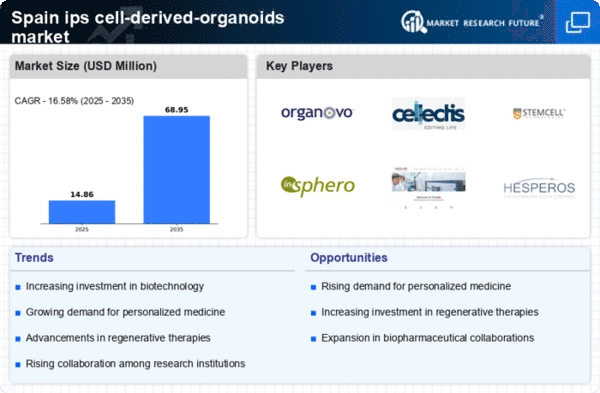
Spain iPS Cell Derived Organoids Market Infographic
Purchase Options

Spain iPS Cell Derived Organoids Market Summary

As per MRFR analysis, the ips cell-derived-organoids market size was estimated at 12.75 USD Million in 2024. The ips cell-derived-organoids market is projected to grow from 14.86 USD Million in 2025 to 68.95 USD Million by 2035, exhibiting a compound annual growth rate (CAGR) of 16.58% during the forecast period 2025 - 2035.

Key Market Trends & Highlights

The Spain ips cell-derived-organoids market is poised for growth driven by technological advancements and increasing research funding.

  • The market is witnessing a surge in research funding, which is likely to enhance innovation in ips cell-derived organoids.
  • Regulatory advancements are facilitating the development and approval of new therapies, thereby boosting market potential.
  • Technological integration in organoid research is expected to improve efficiency and accuracy in drug testing and disease modeling.
  • Rising demand for personalized medicine and advancements in stem cell research are key drivers propelling market growth.

Market Size & Forecast

2024 Market Size 12.75 (USD Million)
2035 Market Size 68.95 (USD Million)
CAGR (2025 - 2035) 16.58%

Major Players

Organovo Holdings Inc (US), Cellectis SA (FR), Stemcell Technologies Inc (CA), InSphero AG (CH), TissUse GmbH (DE), Hesperos Inc (US), Asterand Bioscience Inc (US), Reprocell Inc (JP)

Spain iPS Cell Derived Organoids Market Trends

this market is currently experiencing notable growth, driven by advancements in regenerative medicine and personalized therapies. In Spain, research institutions and biotechnology companies are increasingly focusing on the development of organoids derived from induced pluripotent stem cells (iPSCs). This trend appears to be fueled by the rising demand for innovative drug testing methods and disease modeling, which organoids can effectively provide. Furthermore, collaborations between academic institutions and private enterprises are likely enhancing the research landscape, fostering innovation and accelerating the translation of scientific discoveries into clinical applications. Moreover, regulatory frameworks in Spain seem to be evolving to accommodate the unique challenges posed by the use of iPSCs in research and therapy. This regulatory support may encourage investment in the ips cell-derived-organoids market, as stakeholders seek to navigate the complexities of ethical considerations and safety assessments. As the market matures, it is anticipated that the integration of advanced technologies, such as 3D bioprinting and artificial intelligence, will enhance organoid capabilities. This may lead to breakthroughs in personalized medicine and therapeutic interventions.. The future landscape of this market appears promising, with ongoing research and development likely to yield significant advancements in the coming years.

Increased Research Funding

There is a noticeable rise in funding for research initiatives focused on ips cell-derived organoids. This trend is likely driven by both public and private sectors recognizing the potential of organoids in advancing medical research and therapeutic applications. Increased financial support may facilitate innovative projects and collaborations, enhancing the overall development of the market.

Regulatory Advancements

Regulatory bodies in Spain appear to be adapting their frameworks to better accommodate the unique aspects of ips cell-derived organoids. This evolution in regulations may streamline the approval processes for research and clinical applications, potentially fostering a more conducive environment for market growth.

Technological Integration

The integration of cutting-edge technologies into the ips cell-derived-organoids market is becoming increasingly prevalent. Innovations such as 3D bioprinting and advanced imaging techniques may enhance the functionality and applicability of organoids, suggesting a future where these technologies play a crucial role in personalized medicine.

Spain iPS Cell Derived Organoids Market Drivers

Advancements in Stem Cell Research

Ongoing advancements in stem cell research are significantly influencing the ips cell-derived-organoids market in Spain. The discovery of new techniques for generating and manipulating iPSCs has expanded the potential applications of organoids in regenerative medicine and drug discovery. For instance, recent studies have demonstrated the ability to create complex organoid structures that closely resemble human tissues. This innovation is likely to attract investment, as the Spanish government has allocated €150 million to stem cell research initiatives, fostering a conducive environment for the growth of the ips cell-derived-organoids market.

Growing Investment in Biotech Sector

The growing investment in the biotechnology sector in Spain is significantly impacting the ips cell-derived-organoids market. Venture capital funding for biotech startups has surged, with investments reaching €500 million in 2025 alone. This influx of capital is facilitating the development of innovative organoid technologies and applications. Furthermore, the Spanish government has introduced incentives to attract foreign investment in biotech, which is likely to enhance the capabilities of local firms in the ips cell-derived-organoids market. As a result, the market is expected to expand rapidly, with a projected growth rate of 14% annually, reflecting the increasing interest in biotechnological advancements.

Rising Demand for Personalized Medicine

The increasing emphasis on personalized medicine in Spain is driving the ips cell-derived-organoids market. As healthcare shifts towards tailored treatments, organoids derived from induced pluripotent stem cells (iPSCs) offer a promising avenue for drug testing and disease modeling. This trend is underscored by a report indicating that the personalized medicine market in Spain is projected to reach €2 billion by 2026, reflecting a compound annual growth rate (CAGR) of 10%. The ability of organoids to mimic patient-specific responses enhances their utility in developing targeted therapies, thereby propelling the demand for iPS cell-derived organoids in clinical and research settings.

Regulatory Support for Innovative Therapies

Regulatory support for innovative therapies is playing a crucial role in shaping the ips cell-derived-organoids market in Spain. The Spanish Medicines Agency has streamlined approval processes for regenerative medicine products, thereby encouraging the development and commercialization of iPS cell-derived organoids. This regulatory environment not only enhances the safety and efficacy of new therapies but also instills confidence among investors and researchers. As a result, the market is expected to see a surge in new product launches, with a projected 15% increase in market size over the next three years due to favorable regulations..

Collaborations Between Academia and Industry

Collaborative efforts between academic institutions and industry players are emerging as a key driver for the ips cell-derived-organoids market in Spain. These partnerships facilitate the translation of research findings into practical applications, enhancing the development of organoid technologies. Notably, several Spanish universities have established research centers focused on stem cell applications, which have led to the creation of innovative organoid models. Such collaborations are expected to increase the market's value, with projections suggesting a growth rate of 12% annually over the next five years, as more entities recognize the potential of iPS cell-derived organoids.


Market Segment Insights

By Type: Brain Organoids (Largest) vs. Lung Organoids (Fastest-Growing)

In the Spain ips cell-derived-organoids market, brain organoids hold the largest share among the various types of organoids, significantly leading the market due to their extensive applications in neuroscience and drug development. They are closely followed by lung organoids, which have been gaining traction rapidly due to increased research in respiratory diseases and the recent focus on personalized medicine applications. Other types, such as liver and kidney organoids, also contribute to the market but to a lesser extent. The growth trends for these segment values indicate a robust trajectory for lung organoids, driven by technological advancements and heightened awareness of respiratory conditions. Additionally, ongoing research into organ-on-a-chip technologies and regenerative medicine propels the demand for brain organoids, while continuous innovation in organoid culture techniques facilitates expansion across all types. The mix of inherent biological properties and growing funding in biotechnology severely impacts growth in this sector.

Brain Organoids (Dominant) vs. Lung Organoids (Emerging)

Brain organoids are positioned as the dominant segment in the market, primarily due to their role in mimicking the human brain's complex structures which are vital for neuroscience research. Their applications range from understanding neurodevelopmental disorders to screening new therapies for neurological diseases. Meanwhile, lung organoids represent an emerging segment, showcasing rapid growth fueled by a surge in research focused on pulmonary diseases and advancements in biotechnological methods. These organoids allow researchers to study disease mechanisms in a more physiologically relevant context, paving the way for breakthroughs in treatment strategies. As investment in regenerative medicine increases, both segment values are expected to evolve significantly, with lung organoids catching up quickly due to their innovative potential.

By Application: Drug Discovery (Largest) vs. Regenerative Medicine (Fastest-Growing)

In the Spain ips cell-derived-organoids market, the Application segment showcases a diverse distribution of values, with Drug Discovery and Development leading the charge as the largest contributor. This segment holds a significant share owing to its application in preclinical testing and therapeutic development, which has become increasingly crucial for biopharmaceutical firms. Disease Modelling follows closely, making notable contributions as researchers leverage organoids for in vitro simulations of diseases, while Regenerative Medicine is emerging rapidly as the fastest-growing segment, reflecting a rising demand for innovative therapies. Growth trends in the Application segment are driven by advancements in stem cell technology and the increasing demand for personalized medicine. Drug Discovery is buoyed by rigorous R&D activities in therapeutics, alongside a stronger push for targeted therapies. The burgeoning interest in Regenerative Medicine, paired with increased funding for related research, is propelling its growth. Regulations favoring organoid applications in clinical trials further enhance the appeal of this market, indicating strong future potential across various applications.

Disease Modelling (Dominant) vs. Regenerative Medicine (Emerging)

In the Spain ips cell-derived-organoids market, Disease Modelling stands out as the dominant segment, recognized for its robust role in advancing medical research and therapeutic strategies. Its capability to recreate disease environments in vitro provides valuable insights into mechanisms and potential treatments, making it invaluable for pharmaceutical development. On the other hand, Regenerative Medicine is emerging with significant momentum, driven by breakthroughs in cell therapies and tissue engineering. This segment focuses on restoring or replacing damaged tissues and organs, catering to the growing need for innovative solutions in treating chronic diseases and injuries. As the two segments evolve, their interdependence will likely foster further innovations, continually shaping the landscape of regenerative health solutions.

By End User: Pharmaceutical and Biotechnology Companies (Largest) vs. Academic and Research Institutes (Fastest-Growing)

In the Spain ips cell-derived-organoids market, the distribution of market share among the end user segments reveals a significant lead for pharmaceutical and biotechnology companies, which comprise the largest portion of the market. This dominance is primarily due to their increasing investment in drug discovery and personalized medicine, which drives demand for sophisticated model systems like ips cell-derived organoids. Conversely, academic and research institutes hold a notable share, driven by their focus on advanced research methodologies and collaborations with industry partners for innovative applications. Growth trends within the end user segment highlight a robust expansion, particularly among academic and research institutes, which are becoming the fastest-growing category. Factors fueling this growth include heightened funding for academic research, the push for advancements in regenerative medicine, and the incorporation of organoid technology for disease modeling. Moreover, contract research organizations are experiencing steady growth due to rising demand for outsourced research services from pharmaceutical companies, further diversifying the end user landscape.

Pharmaceutical and Biotechnology Companies (Dominant) vs. Academic and Research Institutes (Emerging)

Pharmaceutical and biotechnology companies are positioned as the dominant players in the Spain ips cell-derived-organoids market, leveraging their substantial resources for extensive R&D initiatives. These companies utilize ips cell-derived organoids to streamline drug discovery processes, improve predictive modeling for clinical trials, and develop targeted therapies. In contrast, academic and research institutes represent an emerging segment, characterized by a rapid adoption of organoid technologies for groundbreaking research. They focus on innovative applications, such as exploring disease mechanisms and testing new drugs in more physiologically relevant models. As funding and collaboration opportunities increase, these institutes are evolving into key contributors to the overall growth and advancement of the market.

Get more detailed insights about Spain iPS Cell Derived Organoids Market

Key Players and Competitive Insights

The ips cell-derived-organoids market in Spain is characterized by a dynamic competitive landscape, driven by advancements in regenerative medicine and personalized therapies. Key players such as Organovo Holdings Inc (US), Cellectis SA (FR), and Stemcell Technologies Inc (CA) are at the forefront, each adopting distinct strategies to enhance their market presence. Organovo Holdings Inc (US) focuses on innovation in bioprinting technologies, aiming to create complex tissue structures that can be utilized for drug testing and disease modeling. Meanwhile, Cellectis SA (FR) emphasizes its gene-editing capabilities, which are crucial for developing organoids that can mimic human disease more accurately. Stemcell Technologies Inc (CA) is leveraging partnerships with academic institutions to foster research and development, thereby enhancing its product offerings and market reach. Collectively, these strategies contribute to a competitive environment that is increasingly centered on technological advancement and collaborative research initiatives.

In terms of business tactics, companies are localizing manufacturing and optimizing supply chains to enhance efficiency and reduce costs. The market structure appears moderately fragmented, with several players vying for market share, yet the influence of major companies is significant. This competitive structure allows for a diverse range of products and services, catering to various research and clinical needs within the field of organoid technology.

In October 2025, Organovo Holdings Inc (US) announced a strategic partnership with a leading pharmaceutical company to develop organoid models for drug discovery. This collaboration is expected to enhance the efficacy of drug testing processes, potentially reducing the time and cost associated with bringing new therapies to market. Such partnerships are indicative of a broader trend towards collaborative innovation in the sector.

In September 2025, Cellectis SA (FR) launched a new line of genetically engineered organoids designed to study specific cancer types. This initiative not only strengthens its product portfolio but also positions the company as a leader in precision oncology research. The ability to create tailored organoid models could significantly impact cancer treatment strategies, making this a pivotal move for the company.

In August 2025, Stemcell Technologies Inc (CA) expanded its product line to include advanced organoid culture systems, which are designed to improve the growth and maintenance of organoids in laboratory settings. This expansion reflects the company's commitment to enhancing research capabilities and meeting the evolving needs of scientists in the field. By providing more sophisticated tools, Stemcell Technologies Inc (CA) is likely to solidify its market position.

As of November 2025, current competitive trends in the ips cell-derived-organoids market include a strong emphasis on digitalization, sustainability, and the integration of artificial intelligence (AI) in research processes. Strategic alliances are increasingly shaping the landscape, as companies recognize the value of collaboration in driving innovation. Looking ahead, competitive differentiation is expected to evolve, with a shift from price-based competition towards a focus on technological innovation, reliability in supply chains, and the development of cutting-edge solutions that address specific market needs.

Key Companies in the Spain iPS Cell Derived Organoids Market market include

Industry Developments

The Spain iPS Cell-Derived Organoids Market has recently seen notable developments, particularly with significant growth observed over the past couple of years, driven by advancements in stem cell technology and organoid applications in drug development and disease modeling. In September 2023, milestones were achieved with key collaborations among organizations like Tissue Regeneration and Lonza, enhancing their capabilities in tissue engineering and regenerative medicine. The market's valuation reflects increasing investments and expanding Research and Development activities from corporations such as Roche and Thermo Fisher Scientific, focusing on innovative solutions for biomedical research. 

Recent advancements have also facilitated the integration of high-throughput screening methods from companies like Tecan Group and Cytiva, contributing to efficiency in organoid cultivation and analysis. Notably, in June 2023, a significant acquisition was made by Redwood Bioscience, bolstering its product portfolio in iPS cell technology, which highlights the growing trend of mergers and acquisitions in this sector. Furthermore, STEMCELL Technologies has inaugurated a new facility in Spain aimed at enhancing its production capabilities, showcasing the region's importance in the iPS cell-derived organoids landscape. These developments illustrate Spain's rising prominence in global organoid research and applications.

Future Outlook

Spain iPS Cell Derived Organoids Market Future Outlook

The IPS Cell Derived Organoids Market is projected to grow at a 16.58% CAGR from 2024 to 2035, driven by advancements in regenerative medicine, drug discovery, and personalized therapies.

New opportunities lie in:

  • Development of tailored organoid models for specific diseases
  • Partnerships with pharmaceutical companies for drug testing
  • Investment in automated organoid culture systems for scalability

By 2035, the market is expected to achieve substantial growth and innovation.

Market Segmentation

Spain iPS Cell Derived Organoids Market Type Outlook

  • Brain Organoids
  • Heart Organoids
  • Lung Organoids
  • Liver Organoids
  • Kidney Organoids
  • Others

Spain iPS Cell Derived Organoids Market End User Outlook

  • Pharmaceutical and Biotechnology Companies
  • Academic and Research Institutes
  • Contract Research Organization

Spain iPS Cell Derived Organoids Market Application Outlook

  • Drug Discovery and Development
  • Disease Modelling
  • Regenerative Medicine

Report Scope

MARKET SIZE 2024 12.75(USD Million)
MARKET SIZE 2025 14.86(USD Million)
MARKET SIZE 2035 68.95(USD Million)
COMPOUND ANNUAL GROWTH RATE (CAGR) 16.58% (2024 - 2035)
REPORT COVERAGE Revenue Forecast, Competitive Landscape, Growth Factors, and Trends
BASE YEAR 2024
Market Forecast Period 2025 - 2035
Historical Data 2019 - 2024
Market Forecast Units USD Million
Key Companies Profiled Organovo Holdings Inc (US), Cellectis SA (FR), Stemcell Technologies Inc (CA), InSphero AG (CH), TissUse GmbH (DE), Hesperos Inc (US), Asterand Bioscience Inc (US), Reprocell Inc (JP)
Segments Covered Type, Application, End User
Key Market Opportunities Advancements in personalized medicine drive demand for innovative applications in the ips cell-derived-organoids market.
Key Market Dynamics Rising investment in Research and Development for innovative applications of induced pluripotent stem cell-derived organoids.

Countries Covered Spain

Leave a Comment

FAQs

What is the expected market size of the Spain iPS Cell-Derived Organoids Market in 2024?

The Spain iPS Cell-Derived Organoids Market is expected to be valued at 12.75 million USD in 2024.

What is the projected market size for the Spain iPS Cell-Derived Organoids Market by 2035?

By 2035, the market is projected to reach a value of 29.64 million USD.

What is the expected CAGR for the Spain iPS Cell-Derived Organoids Market from 2025 to 2035?

The expected compound annual growth rate (CAGR) for the market is 7.971% from 2025 to 2035.

Which type of organoid is projected to have the largest market size in 2035?

The Brain Organoids segment is projected to have the largest market size, valued at 7.0 million USD in 2035.

What is the market value for Lung Organoids in 2024?

The market value for Lung Organoids in 2024 is expected to be 2.25 million USD.

How much is the Heart Organoids market expected to grow from 2024 to 2035?

The Heart Organoids market is expected to grow from 2.5 million USD in 2024 to 5.7 million USD in 2035.

What challenges are anticipated in the Spain iPS Cell-Derived Organoids Market?

Challenges include regulatory hurdles and the need for advanced technology in organoid development.

What are some key players in the Spain iPS Cell-Derived Organoids Market?

Major players include Tissue Regeneration, Redwood Bioscience, Roche, and Thermo Fisher Scientific.

What opportunities exist for growth in the Spain iPS Cell-Derived Organoids Market?

Opportunities include advancements in personalized medicine and increasing demand for organoid models in drug development.

How does regionality play a role in the market dynamics of iPS Cell-Derived Organoids in Spain?

Regionality influences market dynamics through variations in healthcare investment and research initiatives across different Spanish regions.

Download Free Sample

Kindly complete the form below to receive a free sample of this Report

Compare Licence

×
Features License Type
Single User Multiuser License Enterprise User
Price $4,950 $5,950 $7,250
Maximum User Access Limit 1 User Upto 10 Users Unrestricted Access Throughout the Organization
Free Customization
Direct Access to Analyst
Deliverable Format
Platform Access
Discount on Next Purchase 10% 15% 15%
Printable Versions