×
Request Free Sample ×

Kindly complete the form below to receive a free sample of this Report

* Please use a valid business email

Leading companies partner with us for data-driven Insights

clients tt-cursor
Hero Background

Spain Optical Imaging Market

ID: MRFR/MED/54193-HCR
200 Pages
Rahul Gotadki
October 2025

Spain Optical Imaging Market Research Report By Product Type (Imaging systems, Software, Lenses, Illuminations systems, Cameras, Others), By Techniques (Optical coherence tomography (OCT), Photoacoustic imaging, Diffused optical tomography, Cardiology, Near infrared spectroscopy, Super-resolution microscopy), By Therapeutic area (Neurology, Oncology, Opthalmology, Cardiology, Dentistry, Dermatology), By Application (Pre-clinical and clinical research, Pathological imaging, Intra-operative imaging) and By End User (Hospitals & Diagnostics... read more

Share:
Download PDF ×

We do not share your information with anyone. However, we may send you emails based on your report interest from time to time. You may contact us at any time to opt-out.

Spain Optical Imaging Market Infographic
Purchase Options

Spain Optical Imaging Market Summary

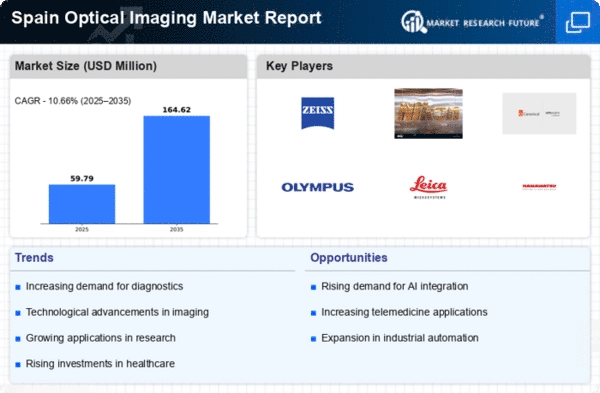
As per analysis, the Spain optical imaging market Size was estimated at 54.03 USD Million in 2024. The Spain optical imaging market is projected to grow from 59.79 USD Million in 2025 to 164.62 USD Million by 2035, exhibiting a compound annual growth rate (CAGR) of 10.66% during the forecast period 2025 - 2035.

Key Market Trends & Highlights

The Spain optical imaging market is poised for growth driven by technological advancements and increasing healthcare applications.

  • Technological advancements are enhancing the capabilities of optical imaging systems, leading to improved diagnostic accuracy.
  • The healthcare applications segment remains the largest, driven by the rising demand for non-invasive procedures.
  • Research and development initiatives are fostering innovation, making Spain one of the fastest-growing markets in Europe.
  • Key market drivers include the growing demand for non-invasive procedures and increased investment in healthcare infrastructure.

Market Size & Forecast

2024 Market Size 54.03 (USD Million)
2035 Market Size 164.62 (USD Million)
CAGR (2025 - 2035) 10.66%

Major Players

Carl Zeiss AG (DE), Nikon Corporation (JP), Canon Inc. (JP), Olympus Corporation (JP), Leica Microsystems (DE), Hamamatsu Photonics K.K. (JP), Thorlabs Inc. (US), Edmund Optics Inc. (US), Motic (CN)

Spain Optical Imaging Market Trends

The optical imaging market in Spain is currently experiencing a notable evolution, driven by advancements in technology and increasing applications across various sectors. The integration of optical imaging systems in healthcare, particularly in diagnostics and surgical procedures, appears to be a key factor propelling growth. Furthermore, the demand for high-resolution imaging solutions in industries such as manufacturing and security is likely to enhance market dynamics. As organizations seek to improve efficiency and accuracy, the adoption of innovative optical imaging technologies is expected to rise, fostering a competitive landscape. In addition, the emphasis on research and development within Spain's scientific community suggests a promising future for the optical imaging market. Collaborations between academic institutions and industry players may lead to breakthroughs in imaging techniques and applications. Moreover, government initiatives aimed at promoting technological advancements could further stimulate market growth. Overall, the optical imaging market in Spain seems poised for expansion, with various sectors increasingly recognizing the value of sophisticated imaging solutions.

Technological Advancements

Recent innovations in optical imaging technologies are transforming the landscape. Enhanced imaging systems, including those utilizing artificial intelligence, are becoming more prevalent. These advancements are likely to improve diagnostic accuracy and operational efficiency across multiple sectors.

Healthcare Applications

The healthcare sector is increasingly adopting optical imaging solutions for diagnostics and treatment. This trend indicates a growing reliance on advanced imaging techniques to enhance patient outcomes and streamline medical procedures.

Research and Development Initiatives

There is a notable focus on research and development within Spain, particularly in the field of optical imaging. Collaborative efforts between universities and industry stakeholders may lead to significant advancements, fostering innovation and expanding application areas.

Spain Optical Imaging Market Drivers

Advancements in Imaging Technologies

Technological advancements in optical imaging systems are a driving force behind the growth of the optical imaging market in Spain. Innovations such as high-resolution imaging, improved light sources, and advanced data processing algorithms are enhancing the capabilities of optical imaging devices. These advancements enable healthcare professionals to obtain more accurate and detailed images, which are crucial for effective diagnosis and treatment planning. As of 2025, the market is projected to witness a surge in the adoption of next-generation optical imaging technologies, with an expected market value of €600 million. This trend indicates a strong correlation between technological progress and the expansion of the optical imaging market in Spain.

Rising Prevalence of Chronic Diseases

The optical imaging market in Spain is significantly influenced by the rising prevalence of chronic diseases, such as cardiovascular disorders and cancer. As these conditions become more common, there is an increasing need for effective diagnostic tools that can facilitate early detection and monitoring. Optical imaging technologies, known for their precision and ability to provide real-time imaging, are becoming essential in managing these diseases. In 2025, it is estimated that the market for optical imaging solutions aimed at chronic disease management will account for approximately 30% of the total market share. This growing demand underscores the critical role that optical imaging plays in the healthcare landscape of Spain.

Growing Demand for Non-Invasive Procedures

The optical imaging market in Spain experiences a notable increase in demand for non-invasive diagnostic procedures. This trend is driven by a growing awareness among patients and healthcare providers regarding the benefits of non-invasive techniques, which minimize patient discomfort and reduce recovery times. As a result, the market for optical imaging technologies, such as optical coherence tomography and fluorescence imaging, is projected to expand significantly. In 2025, the market is expected to reach approximately €500 million, reflecting a compound annual growth rate (CAGR) of around 8%. This shift towards non-invasive methods is likely to enhance the adoption of optical imaging solutions across various medical specialties, thereby propelling the overall growth of the optical imaging market in Spain.

Growing Research and Development Activities

The optical imaging market in Spain benefits from a robust environment for research and development activities. Academic institutions and private companies are increasingly investing in R&D to explore new applications and improve existing optical imaging technologies. This focus on innovation is likely to lead to the development of novel imaging techniques and products that cater to the evolving needs of the healthcare sector. By 2025, it is projected that R&D expenditures in the optical imaging field will reach €200 million, reflecting a growing commitment to advancing the capabilities of optical imaging solutions. This emphasis on research is expected to drive the market forward, fostering collaboration between academia and industry.

Increased Investment in Healthcare Infrastructure

Spain's commitment to enhancing its healthcare infrastructure plays a crucial role in the growth of the optical imaging market. The government has allocated substantial funding to modernize healthcare facilities and integrate advanced imaging technologies. This investment is expected to facilitate the adoption of state-of-the-art optical imaging systems, which can improve diagnostic accuracy and patient outcomes. By 2025, it is anticipated that the healthcare sector's expenditure on imaging technologies will exceed €1 billion, with a significant portion directed towards optical imaging solutions. This influx of capital is likely to stimulate innovation and drive the development of new optical imaging applications, further solidifying the market's position in Spain.


Market Segment Insights

By Imaging Technique: Optical Coherence Tomography (Largest) vs. Fluorescence Imaging (Fastest-Growing)

In the Spain optical imaging market, Optical Coherence Tomography (OCT) holds the largest share, reflecting its critical role in medical imaging and diagnostics. This technique is favored for its ability to provide high-resolution cross-sectional images, making it invaluable in ophthalmology and cardiology. Conversely, Fluorescence Imaging is witnessing rapid growth, driven by its applications in biomedical research and diagnostics, as it allows for real-time imaging of biological processes.

Fluorescence Imaging (Emerging) vs. Optical Coherence Tomography (Dominant)

Fluorescence Imaging is gaining traction due to its sensitivity and ability to visualize cellular processes in real-time, making it an emerging player in the Spain optical imaging market. This technique is widely utilized in various research fields, including oncology and molecular biology. In contrast, Optical Coherence Tomography is firmly established as the dominant technology, recognized for its precision and depth of imaging, particularly in medical applications. As the demand for minimally invasive diagnostic tools grows, both techniques will play crucial roles in advancing the capabilities of optical imaging.

By Application: Diagnostics (Largest) vs. Research Development (Fastest-Growing)

The Spain optical imaging market displays a well-distributed market share across various application segments, with diagnostics leading due to its critical role in healthcare. Following diagnostics, therapeutic guidance and surgical planning hold significant shares, reflecting the importance of imaging in clinical decision-making. Preclinical imaging, while smaller, is gaining traction among research institutions as technology advances and contributes to innovative solutions. Growth trends in the Spain optical imaging market are propelled by the increasing demand for early disease detection and the advancement of imaging technologies. Innovations in imaging modalities are enhancing diagnostic accuracy and therapeutic procedures, resulting in a surge in adoption across hospitals and clinics. Research development is evolving rapidly, driven by collaborations between technology firms and healthcare providers, indicating a promising trajectory for this segment.

Diagnostics (Dominant) vs. Research Development (Emerging)

Diagnostics remains the dominant segment in the Spain optical imaging market, supported by its integral role in patient care and disease management. The technologies involved in diagnostics are crucial for the timely detection of medical conditions, enhancing treatment outcomes. In contrast, research development is emerging as a vital segment with significant growth potential, focusing on developing cutting-edge imaging technologies. This segment is characterized by strong investment from both private and public sectors, aiming to improve imaging efficiency and effectiveness. The interplay between diagnostics and research development fosters a symbiotic relationship, where advancements in one can lead to breakthroughs in the other, ultimately benefiting healthcare delivery.

By End User: Hospitals (Largest) vs. Research Laboratories (Fastest-Growing)

In the Spain optical imaging market, hospitals constitute the largest segment, commanding a substantial share through their extensive use of imaging technologies for diagnostics and treatment. This is complemented by the significant contributions from research laboratories, which have emerged rapidly in recent years due to increased funding and focus on innovation in medical imaging solutions. Growth trends indicate a dynamic shift within the segment values, especially with research laboratories witnessing the fastest growth due to advancements in imaging technologies and rising demand for research and development activities. Hospitals are also growing, albeit at a steadier pace, as they continue to invest in upgrading their imaging equipment and enhancing patient care services made possible by the latest imaging capabilities.

Hospitals: Dominant vs. Research Laboratories: Emerging

Hospitals are recognized as the dominant force in the optical imaging market due to their pivotal role in healthcare delivery, where imaging is essential for precise diagnostics and treatment planning. They utilize a wide range of imaging technologies including MRI, CT scans, and ultrasound systems that enhance patient outcomes. In contrast, research laboratories represent an emerging segment characterized by their focus on innovation and development of new imaging techniques. These facilities are increasingly funded for projects that push the boundaries of traditional imaging, leading to rapid advancements and a growing market presence as they cater to both academic research and commercial applications.

By Product Type: Imaging Systems (Largest) vs. Imaging Software (Fastest-Growing)

In the Spain optical imaging market, Imaging Systems capture the largest market share, establishing themselves as the leading product type. This segment thrives due to advancements in technology and a rise in demand for high-quality imaging solutions among healthcare providers. Imaging Software follows as a significant contributor, enabling seamless integration with imaging systems and enhancing operational efficiencies. The growth trends within this segment indicate a favorable outlook for Imaging Software, which is recognized as the fastest-growing category. Factors driving this growth include increasing adoption of digital imaging solutions, innovations in AI and machine learning, and a push towards more efficient healthcare practices. As healthcare continues to evolve, the demand for sophisticated software tailored for imaging will likely intensify.

Imaging Systems (Dominant) vs. Accessories (Emerging)

Imaging Systems stand out as the dominant force in the Spain optical imaging market, serving critical roles in diagnostics and patient assessments across various healthcare sectors. These systems are equipped with advanced technology, offering high-resolution imaging and capabilities that improve diagnostic accuracy. On the other hand, Accessories represent the emerging segment, driving growth through innovations that enhance the functionality of existing imaging systems. These include specialized lenses, mounts, and software tools that optimize performance. As healthcare facilities prioritize comprehensive imaging solutions, the importance of both imaging systems and accessories in providing complete diagnostic solutions cannot be overstated.

Get more detailed insights about Spain Optical Imaging Market

Key Players and Competitive Insights

The optical imaging market in Spain exhibits a dynamic competitive landscape characterized by rapid technological advancements and a growing demand for high-resolution imaging solutions across various sectors, including healthcare, industrial, and scientific research. Key players such as Carl Zeiss AG (DE), Nikon Corporation (JP), and Canon Inc. (JP) are at the forefront, leveraging innovation and strategic partnerships to enhance their market positions. These companies focus on developing cutting-edge imaging technologies, which not only cater to existing customer needs but also anticipate future demands, thereby shaping the competitive environment.

In terms of business tactics, companies are increasingly localizing manufacturing and optimizing supply chains to enhance operational efficiency and reduce costs. The market structure appears moderately fragmented, with several players competing for market share. However, the collective influence of major companies like Olympus Corporation (JP) and Leica Microsystems (DE) is notable, as they drive trends in product development and customer engagement strategies.

In October 2025, Nikon Corporation (JP) announced a strategic partnership with a leading Spanish research institution to develop advanced imaging solutions tailored for biomedical applications. This collaboration is expected to enhance Nikon's product offerings and strengthen its foothold in the Spanish market, reflecting a broader trend of companies seeking to align their innovations with local research needs.

In September 2025, Canon Inc. (JP) launched a new line of high-resolution imaging systems designed specifically for industrial applications. This product introduction not only showcases Canon's commitment to innovation but also highlights its strategy to penetrate niche markets within Spain, where demand for precision imaging is on the rise. Such initiatives are likely to bolster Canon's competitive edge in a market that increasingly values specialized solutions.

In August 2025, Olympus Corporation (JP) expanded its distribution network in Spain by partnering with local distributors to enhance its market reach. This move is indicative of Olympus's strategy to localize its operations and improve customer accessibility to its advanced imaging technologies, thereby fostering stronger relationships with end-users and enhancing brand loyalty.

As of November 2025, current trends in the optical imaging market are heavily influenced by digitalization, sustainability, and the integration of artificial intelligence (AI) into imaging solutions. Strategic alliances are becoming increasingly vital, as companies recognize the need to collaborate to innovate and meet evolving customer expectations. Looking ahead, competitive differentiation is likely to shift from price-based strategies to a focus on technological innovation, reliability in supply chains, and the ability to deliver tailored solutions that address specific market needs.

Key Companies in the Spain Optical Imaging Market market include

Industry Developments

In recent months, the Spain Optical Imaging Market has seen notable developments, particularly with companies such as Canon, Sony, and Nikon expanding their product lines to cater to increasing consumer demand for high-resolution imaging. In June 2023, Canon announced the launch of a new mirrorless camera in Spain aimed at professional photographers, leveraging advancements in optical imaging technology.

Furthermore, in August 2023, Hikvision reported an expansion of its security camera offerings tailored for smart cities, coinciding with Spain's push for advanced surveillance systems. Notably, in September 2023, Fujifilm confirmed its strategic partnership with local businesses to enhance its imaging solutions tailored for healthcare applications.

While there haven't been recent high-profile mergers or acquisitions among key players like Ricoh and Olympus, market dynamics have been influenced by strong competition and technological innovations.

According to industry reports, the optical imaging market in Spain is projected to grow significantly due to the rising popularity of photography and videography, spurred on by social media trends and the increasing demand for high-quality visual content. This growth represents a vital aspect of Spain's commitment to advancing its imaging technology sector.


Future Outlook

Spain Optical Imaging Market Future Outlook

The Optical Imaging Market in Spain is projected to grow at a 10.66% CAGR from 2024 to 2035, driven by technological advancements and increasing healthcare demands.

New opportunities lie in:

  • Development of AI-driven imaging software solutions
  • Expansion of portable imaging devices for remote diagnostics
  • Investment in advanced imaging technologies for personalized medicine

By 2035, the optical imaging market is expected to achieve substantial growth and innovation.

Market Segmentation

Spain Optical Imaging Market End User Outlook

  • Hospitals
  • Research Laboratories
  • Academic Institutions
  • Diagnostic Centers

Spain Optical Imaging Market Application Outlook

  • Diagnostics
  • Therapeutic Guidance
  • Surgical Planning
  • Research Development
  • Preclinical Imaging

Spain Optical Imaging Market Product Type Outlook

  • Imaging Systems
  • Imaging Software
  • Accessories

Spain Optical Imaging Market Imaging Technique Outlook

  • Fluorescence Imaging
  • Phase Contrast Imaging
  • Near-Infrared Imaging
  • Optical Coherence Tomography
  • Diffuse Optical Imaging

Report Scope

MARKET SIZE 2024 54.03(USD Million)
MARKET SIZE 2025 59.79(USD Million)
MARKET SIZE 2035 164.62(USD Million)
COMPOUND ANNUAL GROWTH RATE (CAGR) 10.66% (2024 - 2035)
REPORT COVERAGE Revenue Forecast, Competitive Landscape, Growth Factors, and Trends
BASE YEAR 2024
Market Forecast Period 2025 - 2035
Historical Data 2019 - 2024
Market Forecast Units USD Million
Key Companies Profiled Carl Zeiss AG (DE), Nikon Corporation (JP), Canon Inc. (JP), Olympus Corporation (JP), Leica Microsystems (DE), Hamamatsu Photonics K.K. (JP), Thorlabs Inc. (US), Edmund Optics Inc. (US), Motic (CN)
Segments Covered Imaging Technique, Application, End User, Product Type
Key Market Opportunities Advancements in optical imaging technologies enhance diagnostic capabilities in healthcare and industrial applications.
Key Market Dynamics Technological advancements drive innovation in optical imaging, enhancing diagnostic capabilities and expanding market applications.
Countries Covered Spain

Leave a Comment

FAQs

What is the expected market size of the Spain Optical Imaging Market in 2024?

The expected market size of the Spain Optical Imaging Market in 2024 is valued at 33.9 million USD.

What is the anticipated valuation of the Spain Optical Imaging Market by 2035?

The anticipated valuation of the Spain Optical Imaging Market by 2035 is 99.2 million USD.

What is the expected compound annual growth rate (CAGR) of the Spain Optical Imaging Market from 2025 to 2035?

The expected CAGR of the Spain Optical Imaging Market from 2025 to 2035 is 10.253%.

Which product segment is projected to have the highest growth in the Spain Optical Imaging Market?

The Imaging systems segment is projected to grow from 13.0 million USD in 2024 to 36.8 million USD by 2035.

Who are the key players in the Spain Optical Imaging Market?

Key players in the Spain Optical Imaging Market include Leica, Sony, Ricoh, Canon, and Nikon among others.

What is the market value of the software segment in the Spain Optical Imaging Market for 2024?

The software segment in the Spain Optical Imaging Market is valued at 7.5 million USD in 2024.

How much is the illuminations systems segment expected to grow by 2035?

The illuminations systems segment is expected to grow from 4.0 million USD in 2024 to 11.4 million USD by 2035.

What is the market growth rate for the cameras segment in the Spain Optical Imaging Market?

The cameras segment is valued at 4.0 million USD in 2024 and is expected to rise to 14.0 million USD by 2035.

What are the emerging opportunities in the Spain Optical Imaging Market?

Emerging opportunities in the Spain Optical Imaging Market include advancements in imaging systems and increasing demand for high-quality optical solutions.

What challenges does the Spain Optical Imaging Market currently face?

Challenges in the Spain Optical Imaging Market include competitive pricing pressure and rapidly evolving technology.

Download Free Sample

Kindly complete the form below to receive a free sample of this Report

Compare Licence

×
Features License Type
Single User Multiuser License Enterprise User
Price $4,950 $5,950 $7,250
Maximum User Access Limit 1 User Upto 10 Users Unrestricted Access Throughout the Organization
Free Customization
Direct Access to Analyst
Deliverable Format
Platform Access
Discount on Next Purchase 10% 15% 15%
Printable Versions