Download Free Sample
Kindly complete the form below to receive a free sample of this Report
Stainless Steel Fermenter Market Size, Share, Industry Trend & Analysis Research Report: Information By Type (Batch, Fed-Batch, Continuous), By Application (Food, Beverages, and Healthcare & Cosmetics) And By Region (North America, Europe, Asia-Pacific, And Rest Of The World) – Forecast Till 2035.
As per MRFR analysis, the Stainless Steel Fermenter Market Size was estimated at 1340.3 USD Million in 2024. The Stainless Steel Fermenter industry is projected to grow from 1449.48 USD Million in 2025 to 2833.31 USD Million by 2035, exhibiting a compound annual growth rate (CAGR) of 7.0% during the forecast period 2025 - 2035.
The Stainless Steel Fermenter Market is poised for growth driven by sustainability and technological advancements.
| 2024 Market Size | 1340.3 (USD Million) |
| 2035 Market Size | 2833.31 (USD Million) |
| CAGR (2025 - 2035) | 7.0% |
The Stainless Steel Fermenter Market is currently experiencing a notable evolution, driven by the increasing demand for high-quality fermentation processes across various industries. This market encompasses a range of applications, including food and beverage production, pharmaceuticals, and biotechnology. The shift towards sustainable practices and the need for efficient production methods appear to be influencing the adoption of stainless steel fermenters. These fermenters are favored for their durability, ease of cleaning, and resistance to corrosion, which enhances their appeal in diverse settings. Moreover, the market seems to be benefiting from technological advancements that facilitate better control over fermentation parameters. Innovations in automation and monitoring systems are likely to improve efficiency and product consistency. As industries continue to prioritize quality and sustainability, the Stainless Steel Fermenter Market is poised for growth, with manufacturers exploring new designs and features to meet evolving consumer preferences. The emphasis on hygiene and safety standards further underscores the relevance of stainless steel as a material of choice in fermentation processes, suggesting a robust future for this market segment.
The trend towards sustainability is becoming increasingly prominent within the Stainless Steel Fermenter Market. Manufacturers are exploring eco-friendly practices and materials, aiming to reduce environmental impact while maintaining efficiency. This shift is likely to resonate with consumers who prioritize sustainable products.
Technological innovations are playing a crucial role in shaping the Stainless Steel Fermenter Market. Enhanced automation and monitoring systems are being integrated into fermenters, allowing for improved control over fermentation processes. This trend may lead to increased efficiency and product quality.
Customization is emerging as a key trend in the Stainless Steel Fermenter Market. As industries seek tailored solutions to meet specific fermentation needs, manufacturers are offering versatile designs that can accommodate various applications. This adaptability could enhance market competitiveness.
The Global Stainless Steel Fermenter Market Industry is poised for substantial growth, with projections indicating a market value of 5500 USD Million by 2035. This growth is underpinned by various factors, including rising consumer demand for fermented products, technological advancements, and increasing regulatory compliance. The compound annual growth rate of 4.9% from 2025 to 2035 suggests a steady expansion trajectory, driven by the evolving landscape of the food and beverage industry. As manufacturers continue to innovate and adapt to changing consumer preferences, the stainless steel fermenter market is likely to witness sustained growth, reflecting broader trends in health, sustainability, and quality assurance.
The craft beverage industry is experiencing exponential growth, which significantly impacts the Global Stainless Steel Fermenter Market Industry. As more small and independent breweries, distilleries, and wineries emerge, the need for efficient fermentation equipment becomes paramount. Stainless steel fermenters are particularly well-suited for craft beverage production due to their ability to maintain product integrity and flavor. This trend is reflected in the increasing number of craft beverage producers globally, which drives demand for high-quality fermentation solutions. The craft beverage sector's expansion is likely to contribute to the overall growth of the stainless steel fermenter market, aligning with the projected market value of 3250 USD Million in 2024.
The Global Stainless Steel Fermenter Market Industry experiences a notable surge in demand for fermented products, driven by increasing consumer awareness of health benefits associated with probiotics. As consumers gravitate towards products like yogurt, kombucha, and fermented vegetables, manufacturers are compelled to invest in advanced fermentation technologies. This trend is reflected in the market's projected value of 3250 USD Million in 2024, indicating a robust growth trajectory. The shift towards natural and organic food products further amplifies this demand, as stainless steel fermenters provide a hygienic and efficient solution for large-scale production, ensuring product quality and safety.
The Global Stainless Steel Fermenter Market Industry is significantly influenced by stringent regulatory standards concerning food safety and quality. Governments worldwide are implementing rigorous regulations to ensure that food products meet safety standards, thereby driving manufacturers to invest in high-quality fermentation equipment. Stainless steel fermenters are favored for their ease of cleaning and resistance to contamination, making them compliant with food safety regulations. This compliance not only enhances consumer trust but also positions manufacturers favorably in the market. As food safety regulations continue to evolve, the demand for stainless steel fermenters is expected to rise, further solidifying their role in the industry.
Sustainability emerges as a critical driver in the Global Stainless Steel Fermenter Market Industry, as consumers and businesses alike prioritize eco-friendly practices. Stainless steel, known for its recyclability and durability, aligns with the growing emphasis on sustainable manufacturing processes. Companies are increasingly adopting stainless steel fermenters to minimize their environmental footprint while maintaining product quality. This shift is indicative of a broader trend towards sustainable production methods in the food and beverage industry. As the market evolves, the focus on sustainability is likely to bolster the demand for stainless steel fermenters, contributing to a compound annual growth rate of 4.9% from 2025 to 2035.
Technological innovations play a pivotal role in shaping the Global Stainless Steel Fermenter Market Industry. The integration of automation and smart technologies enhances fermentation processes, allowing for precise control over temperature, pressure, and pH levels. These advancements not only improve product consistency but also increase operational efficiency. As a result, manufacturers are increasingly adopting stainless steel fermenters equipped with advanced monitoring systems. This trend is expected to contribute to the market's growth, with a projected value of 5500 USD Million by 2035. The ability to optimize fermentation processes through technology positions stainless steel fermenters as a preferred choice in the food and beverage sector.
The Stainless Steel Fermenter Market is characterized by a diverse range of applications, with the food and beverage sector holding the largest market share. This segment comprises a significant portion of the overall demand due to the ubiquitous use of stainless steel fermenters in breweries, wineries, and other food processing facilities. Following closely are pharmaceuticals and chemical processing, which also contribute to market dynamics, albeit at a smaller scale. As we look towards the future, biofuel production is emerging rapidly, driven by the global push for renewable energy sources. This segment is gaining momentum due to technological advancements and increased investments. Demand from environmental regulations further fuels the growth of biofuel production, making it one of the fastest-growing applications in the stainless steel fermenter market.
Food and Beverage (Dominant) vs. Pharmaceutical (Emerging)
The food and beverage sector stands as the dominant force in the Stainless Steel Fermenter Market, leveraging robust production processes, quality control, and stringent health regulations that necessitate the use of stainless steel. Breweries and fermentation plants favor stainless steel for its corrosion resistance and hygiene standards. In contrast, the pharmaceutical sector, though smaller, is emerging due to the increasing focus on biopharmaceutical production and biologics. This segment demands high-quality fermenters for vaccine production and bioreactor applications, driving innovation and investment in advanced fermenter technologies. The distinction between these two sectors highlights the versatility of stainless steel fermenters, catering to both classical and cutting-edge applications.
In the Stainless Steel Fermenter Market, breweries represent the largest segment, commanding a significant share due to their substantial production capacities and established practices. Wineries, while currently smaller in overall market share, are witnessing rapid growth as artisan and boutique wine production gains popularity, appealing to a broader consumer base. Distilleries and research laboratories also contribute to the market, albeit to a lesser extent, with distinct needs for stainless steel fermenters tailored to their specific processes and regulations.
The growth trends within this segment are driven by increasing consumer demand for craft beverages and sustainable production methods. Breweries are expanding their operations to meet this rise in demand, while wineries are investing in advanced technology to enhance product quality. Distilleries are also innovating by utilizing stainless steel for its durability and ease of maintenance, ensuring they can produce high-quality spirits efficiently. Research laboratories continue to adopt stainless steel fermenters for their capability to ensure precise fermentation processes, thereby supporting scientific advancements in fermentation technologies.
Breweries: Dominant vs. Distilleries: Emerging
Breweries dominate the Stainless Steel Fermenter Market, primarily due to the rise of craft beer and microbreweries that prioritize quality and efficiency in their fermentation processes. This segment benefits from the established infrastructure and consumer interest in diverse brewing styles. In contrast, distilleries are viewed as an emerging segment within this market, driven by the increasing popularity of craft spirits and premium liquor. Distilleries require state-of-the-art fermentation equipment to produce distinct flavors and maintain quality standards, which stainless steel fermenters facilitate. As the market evolves, both breweries and distilleries will continue to innovate, addressing varying consumer preferences while leveraging the advantages of stainless steel in fermentation.
The Stainless Steel Fermenter Market exhibits a diverse distribution among its capacity segments, with Large Scale fermenters dominating the market. This segment caters primarily to industrial applications, where high fermentation volumes are required for mass production. In contrast, the Medium Scale segment is increasingly gaining traction, particularly among craft breweries and artisanal producers, who seek to optimize production efficiency without compromising the quality that smaller scales afford. As the demand for diverse product offerings continues to grow, both segments are poised for significant evolution within the market.
Medium Scale (Emerging) vs. Small Scale (Dominant)
The Medium Scale fermentation segment is characterized by its adaptability, catering to both small breweries that are scaling up and larger enterprises looking for flexibility. This segment is emerging as a dynamic player, driven by innovation and the trend toward craft brewing. Conversely, the Small Scale segment remains dominant, serving niche markets and small breweries that emphasize artisanal production. Small Scale fermenters are often prized for their ability to create unique, high-quality products and their suitability for experimental batches, ensuring they retain a significant footprint in the hallowed grounds of craft fermentation.
In the Stainless Steel Fermenter Market, 316 Stainless Steel holds the largest share due to its superior corrosion resistance and suitability for sanitary applications. This material is often the preferred choice for various fermentation processes, especially in sectors like food and beverage, dairy, and pharmaceuticals. Following that, Duplex Stainless Steel is gaining traction, serving as a strong alternative that offers a balance between cost and performance, targeting specific applications that require higher strength and resistance to chloride stress corrosion cracking.
The growth trends in this segment are driven largely by the increasing demand for high-quality fermentation processes. Industries are prioritizing materials that ensure both durability and compliance with sanitary standards. As the fermentation sector, particularly in brewing and wine production, expands, Duplex Stainless Steel is expected to grow rapidly as manufacturers identify new applications for its unique properties. This growth signals a broader acceptance of advanced materials in fermentation technology, reflecting an evolving landscape in the Stainless Steel Fermenter Market.
316 Stainless Steel (Dominant) vs. Duplex Stainless Steel (Emerging)
316 Stainless Steel is regarded as the dominant material in the Stainless Steel Fermenter Market due to its excellent corrosion resistance, making it ideal for fermenters subjected to various acids and chemicals. Its smooth finish ensures that fermentation processes remain contamination-free, crucial for industries such as pharmaceuticals and food processing. On the other hand, Duplex Stainless Steel is emerging as a viable alternative, particularly attractive for its combination of high strength and resistance to corrosion. This material is becoming increasingly popular in applications that require robust solutions, reflecting the industry's shift towards materials that enhance efficiency and safety in fermentation operations. Both materials contribute to a competitive landscape where performance and compliance are paramount.
In the Stainless Steel Fermenter Market, Vertical Fermenters hold the largest market share, attributed to their efficiency in large-scale fermentation processes and ability to accommodate significant volumes of liquid. These fermenters are favored in industries such as brewing and winemaking, where large batches are essential for production. Meanwhile, Conical Fermenters are emerging as the fastest-growing segment, appealing to craft brewers and smaller operations due to their design that allows for better yeast management and sedimentation. This growth signifies a shift towards more versatile, user-friendly equipment, catering to niche markets.
Vertical Fermenters (Dominant) vs. Conical Fermenters (Emerging)
Vertical Fermenters are dominant in the market due to their robust construction and ability to handle substantial fermentation volumes, making them ideal for large-scale operations. Their vertical design facilitates efficient mixing and temperature control, which is crucial in maintaining quality during fermentation. On the other hand, Conical Fermenters are quickly becoming the preferred choice for smaller breweries and experimental batches with their innovative shape that allows for easier yeast harvesting and enhances fermentation efficiency. While Vertical Fermenters serve traditional, large-volume needs, Conical Fermenters are revolutionizing the craft segment of the market, allowed for greater flexibility and creativity.
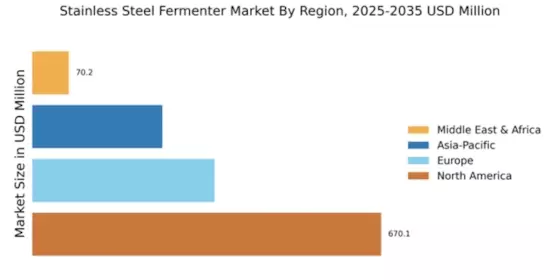
North America is poised to maintain its leadership in the stainless steel fermenter market, holding a significant market share of 670.15 million in 2024. The region's growth is driven by increasing demand for high-quality fermentation processes in the food and beverage industry, alongside stringent regulations promoting food safety and quality. The rise in craft brewing and artisanal food production further fuels this demand, making North America a key player in the global market. The competitive landscape in North America is characterized by the presence of major players such as GEA Group, Alfa Laval, and Krones AG. These companies are investing in innovative technologies and sustainable practices to enhance their product offerings. The U.S. stands out as the leading country, supported by a robust manufacturing base and a growing emphasis on automation in fermentation processes. This dynamic environment positions North America as a hub for advancements in stainless steel fermenters.
Europe's stainless steel fermenter market is valued at 350.0 million, reflecting a growing trend towards sustainable and efficient fermentation processes. The region benefits from a strong regulatory framework that encourages innovation and quality in food production. Increasing consumer demand for organic and locally sourced products is driving manufacturers to adopt advanced fermentation technologies, thereby enhancing market growth. The focus on sustainability and environmental regulations further catalyzes this trend. Leading countries in Europe include Germany, Italy, and the UK, where companies like Ziemann Holvrieka and Della Toffola are prominent. The competitive landscape is marked by a mix of established firms and emerging players, all striving to meet the evolving demands of the market. The European market is characterized by a strong emphasis on research and development, ensuring that it remains at the forefront of fermentation technology advancements. "The European food industry is committed to sustainability and innovation, driving the demand for advanced fermentation solutions."
The Asia-Pacific region, with a market size of 250.0 million, is witnessing rapid growth in the stainless steel fermenter market. This growth is fueled by increasing investments in the food and beverage sector, particularly in countries like China and India. The rising population and changing consumer preferences towards fermented products are significant drivers of demand. Additionally, government initiatives promoting food safety and quality standards are enhancing the market landscape in this region. China and India are the leading countries in this market, with a growing number of local manufacturers entering the space. The competitive landscape is evolving, with both domestic and international players vying for market share. Companies like Praj Industries are making strides in innovation, focusing on sustainable practices and advanced fermentation technologies. This dynamic environment positions Asia-Pacific as a key player in The Stainless Steel Fermenter.
The Middle East and Africa (MEA) region, with a market size of 70.15 million, presents significant growth opportunities in the stainless steel fermenter market. The increasing demand for processed food and beverages, coupled with a growing population, is driving market expansion. Additionally, government initiatives aimed at improving food safety standards are catalyzing the adoption of advanced fermentation technologies. The region's diverse culinary traditions further enhance the demand for innovative fermentation solutions. Countries like South Africa and the UAE are leading the charge in this market, with a mix of local and international players establishing a presence. The competitive landscape is characterized by emerging companies focusing on niche markets, while established firms are exploring partnerships to enhance their offerings. The MEA region is gradually becoming a focal point for investment in fermentation technologies, indicating a promising future for the stainless steel fermenter market.
The Stainless Steel Fermenter Market is currently characterized by a dynamic competitive landscape, driven by increasing demand for high-quality fermentation processes across various industries, including food and beverage, pharmaceuticals, and biotechnology. Key players such as GEA Group (DE), Alfa Laval (SE), and Krones AG (DE) are strategically positioned to leverage their technological expertise and extensive product portfolios. GEA Group (DE) focuses on innovation and sustainability, emphasizing energy-efficient solutions, while Alfa Laval (SE) is enhancing its market presence through strategic partnerships and digital transformation initiatives. Krones AG (DE) is also investing in automation and smart technology, which collectively shapes a competitive environment that prioritizes efficiency and sustainability.The market structure appears moderately fragmented, with several players competing for market share through localized manufacturing and optimized supply chains. This fragmentation allows for a diverse range of offerings, catering to specific customer needs. The collective influence of these key players is significant, as they not only drive technological advancements but also set industry standards that smaller competitors must follow.
In November GEA Group (DE) announced the launch of a new line of energy-efficient fermenters designed to reduce operational costs for breweries. This strategic move is likely to enhance GEA's competitive edge by addressing the growing demand for sustainable production methods. The introduction of these fermenters aligns with global trends towards energy conservation and could potentially attract environmentally conscious clients.
In October Alfa Laval (SE) expanded its partnership with a leading biotechnology firm to develop advanced fermentation technologies. This collaboration is indicative of Alfa Laval's commitment to innovation and positions the company to capitalize on emerging market opportunities in the biotech sector. By aligning with a key player in biotechnology, Alfa Laval may enhance its product offerings and strengthen its market position.
In September Krones AG (DE) unveiled a new smart fermenter equipped with IoT capabilities, allowing for real-time monitoring and data analytics. This development not only showcases Krones' dedication to digitalization but also reflects a broader industry trend towards integrating technology into fermentation processes. The ability to monitor fermentation in real-time could lead to improved product quality and operational efficiency, further solidifying Krones' reputation as a leader in the market.
As of December current competitive trends indicate a strong shift towards digitalization, sustainability, and the integration of AI technologies within the Stainless Steel Fermenter Market. Strategic alliances are increasingly shaping the landscape, enabling companies to pool resources and expertise to drive innovation. The competitive differentiation is likely to evolve from traditional price-based competition to a focus on technological advancements, sustainability, and supply chain reliability, suggesting that companies that prioritize these areas will be better positioned for future success.




On March 10, 2024, GEA Group announced the marketing of a new generation of high-capacity stainless steel fermenters intended for biopharmaceutical and food industries. This type of fermenters is equipped with notable levels of automation to improve process and operational efficiency.
In February 2024, Alfa Laval focused on small- and medium-scaled brewers by launching modular stainless steel fermenters. With these fermenters, the brewers are able to configure their setup and scale as needed, particularly as the craft beer market grows.
On January 2024, ZETA Biopharma announced for the first time that it has agreed with a major European biopharmaceutical company on a joint project to develop stainless steel fermenters designed specifically for cell culture. These fermenters would be manufactured to meet the requirements of the industry for sterile and precise processing.
On December 2023, Applikon Biotechnology presented new bench-size stainless steel fermenters addressed to the academic world and the industrial research space. The fermenters devised are also equipped with integrated data analysis systems enabling the available fermentation parameters to be changed within reasonable limits thus making them suitable for R&D purposes.
In November 2023, Paul Mueller Company has seen an increase in the number of orders from the dairy sector for the stainless steel fermenters used for the ambient yogurt and cheese The company established its production facility in North America to cater for this burgeoning demand.
In October 2023, Solaris Biotech introduced enhanced versions of its stainless steel fermenters that now serve multiple functions and have better temperature control and agitation systems. These fermenters are intended for the food, beverage manufactures and biofuels industries.
In September 2023, the Indian government declared subsidies for local manufacturers of stainless steel fermenters to increase local production in favour of the developing biotech and food processing sectors in India.
The Stainless Steel Fermenter Market is projected to grow at a 7.0% CAGR from 2025 to 2035, driven by increasing demand for high-quality fermentation processes and sustainable production methods.
New opportunities lie in:
By 2035, the market is expected to solidify its position as a leader in fermentation technology.
| MARKET SIZE 2024 | 1340.3(USD Million) |
| MARKET SIZE 2025 | 1449.48(USD Million) |
| MARKET SIZE 2035 | 2833.31(USD Million) |
| COMPOUND ANNUAL GROWTH RATE (CAGR) | 7.0% (2025 - 2035) |
| REPORT COVERAGE | Revenue Forecast, Competitive Landscape, Growth Factors, and Trends |
| BASE YEAR | 2024 |
| Market Forecast Period | 2025 - 2035 |
| Historical Data | 2019 - 2024 |
| Market Forecast Units | USD Million |
| Key Companies Profiled | GEA Group (DE), Alfa Laval (SE), Krones AG (DE), Ziemann Holvrieka (DE), Praj Industries (IN), Della Toffola (IT), Brau Union Österreich (AT), Meyer Industries (US), Süffert (DE) |
| Segments Covered | Application, End Use, Capacity, Material Grade, Design Type |
| Key Market Opportunities | Growing demand for sustainable fermentation processes drives innovation in the Stainless Steel Fermenter Market. |
| Key Market Dynamics | Rising demand for sustainable fermentation processes drives innovation in stainless steel fermenter technology and design. |
| Countries Covered | North America, Europe, APAC, South America, MEA |
The projected market valuation for the Stainless Steel Fermenter Market is expected to reach 2833.31 USD Million by 2035.
The overall market valuation of the Stainless Steel Fermenter Market was 1340.3 USD Million in 2024.
The expected CAGR for the Stainless Steel Fermenter Market during the forecast period 2025 - 2035 is 7.0%.
Key players in the Stainless Steel Fermenter Market include GEA Group AG, Alfa Laval AB, and Krones AG, among others.
The main applications of stainless steel fermenters include Food and Beverage, Pharmaceutical, Biofuel Production, and Chemical Processing.
The market segments by end use include Breweries, Wineries, Distilleries, and Research Laboratories, with varying valuations.





Kindly complete the form below to receive a free sample of this Report

“This is really good guys. Excellent work on a tight deadline. I will continue to use you going forward and recommend you to others. Nice job”


“Thanks. It’s been a pleasure working with you, please use me as reference with any other Intel employees.”


“Thanks for sending the report it gives us a good global view of the Betaïne market.”


“Thank you, this will be very helpful for OQS.”


“We found the report very insightful! we found your research firm very helpful. I'm sending this email to secure our future business.”


“I am very pleased with how market segments have been defined in a relevant way for my purposes (such as "Portable Freezers & refrigerators" and "last-mile"). In general the report is well structured. Thanks very much for your efforts.”


“I have been reading the first document or the study, ,the Global HVAC and FP market report 2021 till 2026. Must say, good info! I have not gone in depth at all parts, but got a good indication of the data inside!”


“We got the report in time, we really thank you for your support in this process. I also thank to all of your team as they did a great job.”


“The Automotive 48V ECU Components Procurement Intelligence Study” was a complex project, but the Market Research Future (MRFR) team handled it with quality, agility, and customer-centricity. They delivered all requested data on time and within the agreed scope. The team, including Shubhendra Anand and Rahul Gotadki, was always readily available to clarify questions and swiftly implement necessary adjustments, driving the project to a successful conclusion within a very demanding timeframe.
I would also like to specifically commend Akshay Agarwal for his responsiveness and support at every stage—from our initial inquiry on May 6th through to final delivery on June 18th. His dedication made the entire process seamless.”



