×
Request Free Sample ×

Kindly complete the form below to receive a free sample of this Report

* Please use a valid business email

Leading companies partner with us for data-driven Insights

clients tt-cursor
Hero Background

Sugar Free Chocolate Market

ID: MRFR/FnB/1168-CR
156 Pages
Snehal Singh
February 2021

Sugar-free Chocolate Market Research Report Information By Main Ingredients (Cocoa Beans, Sugar Substitute, Cocoa Butter, Fat & Oil, Cocoa Liquor and Others), By Category (100% Sugar Free and No Added Sugar), By Type (Dark, Milk and White), By Distribution Channel (Store-Based And Non-Store-Based) And By Region (North America, Europe, Asia-Pacific, And Rest Of The World) –Market Forecast Till 2035

Share:
Download PDF ×

We do not share your information with anyone. However, we may send you emails based on your report interest from time to time. You may contact us at any time to opt-out.

Sugar Free Chocolate Market Infographic
Purchase Options

Sugar Free Chocolate Market Summary

As per MRFR analysis, the Sugar Free Chocolate Market Size was estimated at 1522.26 USD Million in 2024. The Sugar Free Chocolate industry is projected to grow from 1604.5 USD Million in 2025 to 2715.37 USD Million by 2035, exhibiting a compound annual growth rate (CAGR) of 5.4 during the forecast period 2025 - 2035.

Key Market Trends & Highlights

The Sugar Free Chocolate Market is experiencing robust growth driven by health consciousness and innovative product offerings.

  • Health consciousness is significantly driving demand for sugar free chocolate, particularly in North America.
  • Product innovation and variety are expanding the appeal of sugar free chocolate across diverse consumer segments.
  • E-commerce expansion is facilitating access to sugar free chocolate, especially among younger demographics in Asia-Pacific.
  • Rising demand for low-calorie options and increased awareness of health risks are key drivers propelling market growth.

Market Size & Forecast

2024 Market Size 1522.26 (USD Million)
2035 Market Size 2715.37 (USD Million)
CAGR (2025 - 2035) 5.4%

Major Players

Lindt & Sprüngli (CH), Hershey's (US), Mars, Incorporated (US), Mondelez International (US), Nestle (CH), Ferrero (IT), Ghirardelli Chocolate Company (US), Cavalier (BE), ChocZero (US)

Sugar Free Chocolate Market Trends

The Sugar Free Chocolate Market is currently experiencing a notable transformation, driven by evolving consumer preferences and a growing awareness of health and wellness. As individuals increasingly seek alternatives to traditional sweets, the demand for sugar-free options appears to be on the rise. This shift is likely influenced by a broader trend towards healthier lifestyles, where consumers are more conscious of their dietary choices. The market seems to be expanding as manufacturers innovate and introduce a variety of products that cater to diverse tastes and dietary needs. Furthermore, the increasing prevalence of diabetes and other health conditions may further propel the interest in sugar-free alternatives, suggesting a sustained growth trajectory for this segment. In addition to health considerations, the Sugar Free Chocolate Market is also witnessing a surge in product variety and availability. Retailers are expanding their offerings, providing consumers with a wider selection of flavors and formats. This diversification may enhance consumer engagement and encourage trial among those who are hesitant to switch from traditional chocolate. Moreover, the rise of e-commerce platforms is facilitating easier access to these products, potentially broadening the consumer base. As the market continues to evolve, it is essential for stakeholders to remain attuned to changing consumer preferences and emerging trends to capitalize on the opportunities that lie ahead.

Health Consciousness Driving Demand

The increasing awareness of health issues among consumers is significantly influencing the Sugar Free Chocolate Market. As more individuals prioritize their well-being, the preference for sugar-free options is likely to grow. This trend suggests that manufacturers may need to focus on creating products that align with health-conscious lifestyles.

Product Innovation and Variety

Innovation within the Sugar Free Chocolate Market is becoming increasingly important. Companies are exploring new flavors, textures, and formulations to attract a broader audience. This trend indicates that diversity in product offerings could play a crucial role in capturing consumer interest.

E-commerce Expansion

The rise of online shopping is transforming how consumers access sugar-free products. E-commerce platforms are providing greater convenience and variety, which may enhance market penetration. This trend suggests that digital channels could be vital for reaching new customers and expanding the Sugar Free Chocolate Market.

Sugar Free Chocolate Market Drivers

Evolving Retail Landscape

The evolving retail landscape significantly impacts the Global Sugar-free Chocolate Market Industry. With the rise of e-commerce and online grocery shopping, consumers have greater access to a variety of sugar-free chocolate products. Retailers are increasingly showcasing these products in dedicated health and wellness sections, making them more visible to consumers. This shift in retail strategy not only enhances product accessibility but also encourages impulse purchases. Additionally, brick-and-mortar stores are expanding their offerings of sugar-free chocolates to meet growing consumer demand. As a result, the market is poised for growth, with the convenience of purchasing sugar-free chocolates likely contributing to increased sales.

Market Growth Projections

The Global Sugar-free Chocolate Market Industry is projected to experience substantial growth in the coming years. With a market value expected to reach 1.52 USD Billion in 2024 and further expand to 2.72 USD Billion by 2035, the industry is on a promising trajectory. This growth is indicative of changing consumer preferences towards healthier snacking options and the increasing availability of innovative sugar-free products. The anticipated CAGR of 5.43% from 2025 to 2035 suggests a robust market environment, driven by factors such as rising health consciousness and the demand for low-calorie alternatives. These projections highlight the potential for sustained investment and development within the sugar-free chocolate sector.

Rising Health Consciousness

The increasing awareness of health and wellness among consumers drives the Global Sugar-free Chocolate Market Industry. As individuals become more health-conscious, they actively seek alternatives to traditional sugary products. This trend is particularly pronounced among populations in developed nations, where obesity rates are rising. The Global Sugar-free Chocolate Market is projected to reach 1.52 USD Billion in 2024, reflecting a growing preference for healthier options. Consumers are increasingly opting for sugar-free chocolates that offer indulgence without compromising their dietary goals. This shift in consumer behavior is likely to propel the market forward, as manufacturers respond with innovative sugar-free formulations.

Expansion of Product Offerings

The Global Sugar-free Chocolate Market Industry is witnessing a notable expansion in product offerings. Manufacturers are diversifying their portfolios to include a variety of flavors, textures, and formats, catering to diverse consumer preferences. This expansion is evident in the introduction of premium sugar-free chocolate bars, snacks, and confectionery items. As a result, the market is becoming more competitive, with brands striving to differentiate themselves through unique selling propositions. This trend not only enhances consumer choice but also stimulates market growth. The anticipated increase in market value to 2.72 USD Billion by 2035 underscores the importance of product innovation in driving consumer interest and engagement.

Growing Demand for Low-Calorie Alternatives

The demand for low-calorie alternatives is a significant driver of the Global Sugar-free Chocolate Market Industry. As consumers become more calorie-conscious, they are increasingly seeking products that provide indulgence without excessive caloric intake. Sugar-free chocolates often contain fewer calories compared to their traditional counterparts, making them appealing to a broad audience. This trend is particularly relevant in regions with high obesity rates, where consumers are actively looking for healthier snack options. The Global Sugar-free Chocolate Market is expected to grow at a CAGR of 5.43% from 2025 to 2035, indicating a sustained interest in low-calorie alternatives that align with modern dietary preferences.

Increased Availability of Natural Sweeteners

The rise in the availability of natural sweeteners is transforming the Global Sugar-free Chocolate Market Industry. Sweeteners such as stevia, erythritol, and monk fruit are gaining popularity as healthier alternatives to sugar. These natural sweeteners not only provide sweetness but also align with the growing consumer preference for clean-label products. As manufacturers incorporate these ingredients into their sugar-free chocolates, they enhance the appeal of their offerings. This trend is likely to attract health-conscious consumers who are wary of artificial additives. The incorporation of natural sweeteners is expected to play a crucial role in shaping the future landscape of the Global Sugar-free Chocolate Market.
Market Segment Insights

By Application: Confectionery (Largest) vs. Baking (Fastest-Growing)

The Sugar Free Chocolate Market is characterized by diverse application segments, including Confectionery, Baking, Snacking, and Desserts. Among these segments, Confectionery holds the largest market share, driven by growing consumer demand for healthier alternatives to traditional chocolates. As health consciousness rises, more consumers are turning to sugar-free options in their chocolate purchases, significantly boosting this segment's market presence. In contrast, Baking is emerging as the fastest-growing segment, fueled by a surge in health-focused baking trends and the increasing popularity of low-calorie desserts among home bakers. The evolution of consumer preferences toward healthier eating habits is catalyzing growth across these application segments. The Confectionery segment remains robust due to its versatility and widespread appeal. Meanwhile, Baking is experiencing a rapid expansion thanks to the rise of DIY dessert makers and an increasing number of recipes utilizing sugar-free chocolate as a substitute. These trends indicate a continuous shift in consumer behavior, favoring healthier yet enjoyable treats that align with their dietary choices.

Confectionery: Dominant vs. Baking: Emerging

In the Sugar Free Chocolate Market, the Confectionery segment stands out as the dominant player, offering a wide range of products that appeal to health-conscious consumers without sacrificing taste. This segment encompasses chocolates, bars, and other confectioneries, which have become integral for those seeking indulgence while adhering to a sugar-free lifestyle. On the other hand, the Baking segment is emerging rapidly, catalyzed by a growing trend of home baking and health-conscious recipe adaptations. As more consumers experiment with sugar-free options in their baking endeavors, this segment is expected to flourish. Both segments highlight a shift in consumer preferences toward healthier alternatives, with Confectionery leading in market stability and Baking showing promising growth potential.

By End Use: Retail (Largest) vs. Online Sales (Fastest-Growing)

In the Sugar Free Chocolate Market, the retail segment commands the largest market share, owing to its established presence and wide accessibility in supermarkets and health stores. This segment thrives due to the increasing consumer demand for health-conscious options, prompting retailers to stock a diverse range of sugar-free offerings. On the other hand, the online sales segment is gaining traction, capturing a rapidly growing share as consumers increasingly prefer the convenience and variety available through e-commerce platforms.

Retail (Dominant) vs. Online Sales (Emerging)

The retail segment is a dominant player in the Sugar Free Chocolate Market, characterized by strong brand presence and consumer trust. Supermarkets, health food stores, and specialty shops provide a substantial distribution network, making sugar-free chocolates easily accessible to a broad audience. In contrast, the online sales segment is emerging as a significant force, appealing to tech-savvy consumers who prioritize convenience and personalized shopping experiences. The rapid digitalization of retail channels, coupled with promotional offers and targeted marketing strategies, is propelling online sales, making it the fastest-growing segment in this market.

By Ingredient Type: Natural Sweeteners (Largest) vs. Artificial Sweeteners (Fastest-Growing)

In the Sugar Free Chocolate Market, the ingredient landscape is primarily dominated by Natural Sweeteners, which attract health-conscious consumers looking for alternatives to traditional sugar. This category not only holds the largest market share but also encompasses a range of plant-derived options such as stevia and monk fruit that appeal to a wider consumer base. On the other hand, Artificial Sweeteners, while still significant, are marked by rapid growth due to their cost-effectiveness and high sweetness intensity, making them a popular choice within the market.

Natural Sweeteners (Dominant) vs. Artificial Sweeteners (Emerging)

Natural Sweeteners, as the dominant ingredient in the Sugar Free Chocolate Market, excel in offering a clean label appeal and are derived from natural sources, which enhances their desirability among consumers prioritizing health. Products that incorporate these sweeteners often boast enhanced nutritional profiles. Emerging in parallel, Artificial Sweeteners are gaining traction due to their affordability and versatility, catering to manufacturers aiming to balance taste and calorie reduction. The expansion of these sweeteners in new product formulations reflects a growing acceptance driven by increasing awareness of sugar substitutes. As manufacturers innovate, the competition between these two segments is expected to intensify.

By Packaging Type: Bags (Largest) vs. Bars (Fastest-Growing)

In the Sugar Free Chocolate Market, the packaging type segment is characterized by diverse formats, with bags currently holding the largest market share. This popularity can be ascribed to their convenience for both consumers and retailers, making them an ideal choice for on-the-go snacking. Conversely, bars are witnessing rapid growth due to their appeal as a healthier snack alternative, especially among health-conscious consumers looking for guilt-free indulgence. The growth trends indicate a shift towards more convenient and health-focused packaging. As consumers increasingly prioritize healthy lifestyles, the demand for sugar-free options is driving innovations in packaging. Furthermore, the rise of e-commerce has encouraged brands to invest in packaging that not only protects the product but also enhances consumer experience, leading to burgeoning sales in the bar format.

Bags (Dominant) vs. Bars (Emerging)

Bags are the dominant packaging type in the Sugar Free Chocolate Market, favored for their practicality and ease of access. They cater to a wide consumer base, providing options for various quantities and serving sizes. Their resealable feature also adds a layer of convenience, which appeals to consumers seeking to enjoy snacks without compromising freshness. On the other hand, bars represent an emerging packaging type, gaining traction due to their individual packaging which promotes portion control and convenience. The rising trend of healthy snacking fuels the demand for bars as consumers are drawn to their perceived health benefits. While bags continue to lead, bars are swiftly capturing attention, making them a vital segment to watch in the evolving market.

By Consumer Demographics: Health Conscious (Largest) vs. Diabetic (Fastest-Growing)

The Sugar Free Chocolate Market exhibits a diverse range of consumer demographics, with the health-conscious segment commanding the largest share. This group primarily seeks products that align with their lifestyle choices, emphasizing clean ingredients and overall wellness. Following closely is the diabetic demographic, which is rapidly gaining traction due to increasing awareness around health management for diabetes, significantly contributing to market dynamics.

Health Conscious (Dominant) vs. Diabetic (Emerging)

The health-conscious segment is characterized by consumers who prioritize healthier options in their diet, often opting for sugar-free chocolates as a guilt-free indulgence. They are typically more engaged with nutritional content and actively seek products that support a balanced lifestyle. In contrast, the diabetic segment represents a growing demographic that is increasingly turning to sugar-free options as they navigate dietary restrictions. This group is promoting innovations in the market, showcasing the rising demand for sugar substitutes and improved taste profiles in products tailored specifically for diabetes management.

Get more detailed insights about Sugar Free Chocolate Market

Regional Insights

North America : Market Leader in Innovation

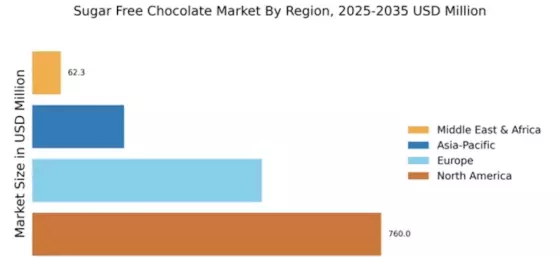
North America is the largest market for sugar free chocolate, holding a significant share of the global market at $760.0M in 2024. The growth is driven by increasing health consciousness among consumers, leading to a surge in demand for low-sugar alternatives. Regulatory support for healthier food options further catalyzes this trend, with initiatives promoting reduced sugar consumption across the region. The competitive landscape is robust, featuring key players such as Hershey's, Mars, and Mondelez International. The U.S. leads the market, supported by a strong distribution network and innovative product offerings. Companies are increasingly focusing on clean label products, appealing to health-conscious consumers. The presence of established brands ensures a dynamic market environment, fostering continuous growth and innovation.

Europe : Emerging Market with Potential

Europe's sugar free chocolate market is valued at $500.0M, reflecting a growing trend towards healthier eating habits. The demand is driven by rising awareness of health issues related to sugar consumption, prompting consumers to seek alternatives. Regulatory frameworks in the EU are increasingly supportive of low-sugar products, encouraging manufacturers to innovate and expand their offerings. Leading countries include Germany, France, and the UK, where consumer preferences are shifting towards sugar free options. Key players like Lindt & Sprüngli and Ferrero are actively investing in product development to capture this growing market. The competitive landscape is characterized by a mix of established brands and emerging companies, all vying for market share in this evolving sector.

Asia-Pacific : Rapidly Growing Market Segment

The Asia-Pacific region, with a market size of $200.0M, is witnessing a rapid increase in demand for sugar free chocolate. This growth is fueled by rising disposable incomes and changing dietary preferences among consumers. Health awareness is on the rise, leading to a shift towards healthier snack options. Regulatory bodies are also promoting healthier food choices, which supports market expansion. Countries like Japan and Australia are at the forefront of this trend, with a growing number of local and international brands entering the market. Key players such as Ghirardelli and ChocZero are expanding their presence, focusing on innovative flavors and formulations. The competitive landscape is becoming increasingly dynamic, with new entrants challenging established brands.

Middle East and Africa : Niche Market with Growth Potential

The Middle East and Africa region, valued at $62.26M, is a niche market for sugar free chocolate, but it shows promising growth potential. Increasing health awareness and a shift towards healthier lifestyles are driving demand for sugar free products. Regulatory initiatives aimed at promoting healthier eating habits are also contributing to market growth. Countries like South Africa and the UAE are leading the way, with a growing number of consumers seeking low-sugar alternatives. The competitive landscape is still developing, with both local and international brands exploring opportunities in this emerging market. Key players are beginning to recognize the potential, leading to increased product offerings and marketing efforts.

Key Players and Competitive Insights

The Sugar Free Chocolate Market is currently characterized by a dynamic competitive landscape, driven by increasing health consciousness among consumers and a growing demand for low-calorie alternatives. Major players such as Lindt & Sprüngli (CH), Hershey's (US), and Mars, Incorporated (US) are strategically positioning themselves through innovation and product diversification. Lindt & Sprüngli (CH) has focused on enhancing its product line with premium sugar-free options, while Hershey's (US) has been expanding its distribution channels to reach a broader audience. Mars, Incorporated (US) is investing in sustainable sourcing practices, which not only appeals to environmentally conscious consumers but also strengthens its brand image. Collectively, these strategies contribute to a competitive environment that emphasizes quality, health benefits, and sustainability.

Key business tactics within the Sugar Free Chocolate Market include localizing manufacturing and optimizing supply chains to enhance efficiency and reduce costs. The market structure appears moderately fragmented, with several key players holding substantial market shares. This fragmentation allows for niche brands to emerge, catering to specific consumer preferences, while the collective influence of major companies drives innovation and sets quality standards across the industry.

In November 2025, Lindt & Sprüngli (CH) launched a new line of organic sugar-free chocolates, which reflects a growing trend towards organic and health-oriented products. This strategic move not only caters to health-conscious consumers but also positions the brand as a leader in the premium segment of the market. The introduction of organic ingredients may enhance consumer trust and loyalty, potentially leading to increased market share.

In October 2025, Hershey's (US) announced a partnership with a leading health food retailer to create exclusive sugar-free chocolate products. This collaboration is likely to enhance Hershey's visibility in the health food sector and attract a new demographic of health-conscious consumers. By leveraging the retailer's established customer base, Hershey's may effectively increase its market penetration and brand recognition in the sugar-free segment.

In September 2025, Mars, Incorporated (US) unveiled its commitment to achieving carbon neutrality in its sugar-free chocolate production by 2030. This ambitious goal underscores the company's dedication to sustainability and may resonate well with environmentally aware consumers. By integrating sustainable practices into its operations, Mars could not only improve its brand image but also potentially reduce operational costs in the long run.

As of December 2025, current competitive trends in the Sugar Free Chocolate Market are increasingly defined by digitalization, sustainability, and the integration of artificial intelligence in product development and marketing strategies. Strategic alliances among key players are shaping the landscape, fostering innovation and enhancing supply chain efficiencies. Looking ahead, competitive differentiation is likely to evolve from traditional price-based competition to a focus on innovation, technology, and reliability in supply chains. This shift may ultimately redefine consumer expectations and drive the market towards more sophisticated and health-oriented offerings.

Key Companies in the Sugar Free Chocolate Market market include

Industry Developments

April 2022: Yumy Candy Company Inc. announced that it is cooperating with the largest US distribution networks that share the company's guiding principles to enter the American market with its lower-sugar, healthier confections.

March 2022: The company Cocomels announced that it is producing new '1g Sugar' chocolate-covered sea salt and crispy nibbles, each with less than 1g of sugar and only 100 calories. The company's well-liked '1g sugar' line is being expanded. Additionally, the product has no dairy, chemical additives, gluten, corn syrup, cholesterol, sugar alcohols, or palm oil. 60% dark chocolate has been sweetened with allulose, a natural sugar replacement, in the newly released Cocomels nibbles.

Future Outlook

Sugar Free Chocolate Market Future Outlook

The Sugar Free Chocolate Market is projected to grow at a 5.4% CAGR from 2024 to 2035, driven by rising health consciousness and demand for low-calorie alternatives.

New opportunities lie in:

  • Expansion into e-commerce platforms for direct consumer sales.
  • Development of innovative flavor profiles to attract diverse consumer segments.
  • Partnerships with health-focused retailers to enhance market reach.

By 2035, the Sugar Free Chocolate Market is expected to achieve substantial growth and increased consumer adoption.

Market Segmentation

Sugar Free Chocolate Market End Use Outlook

  • Retail
  • Food Service
  • Online Sales

Sugar Free Chocolate Market Application Outlook

  • Confectionery
  • Baking
  • Snacking
  • Desserts

Sugar Free Chocolate Market Packaging Type Outlook

  • Bags
  • Boxes
  • Bars
  • Bulk

Sugar Free Chocolate Market Ingredient Type Outlook

  • Natural Sweeteners
  • Artificial Sweeteners
  • Cocoa Solids
  • Emulsifiers

Sugar Free Chocolate Market Consumer Demographics Outlook

  • Health Conscious
  • Diabetic
  • Weight Watchers
  • Vegan

Report Scope

MARKET SIZE 20241522.26(USD Million)
MARKET SIZE 20251604.5(USD Million)
MARKET SIZE 20352715.37(USD Million)
COMPOUND ANNUAL GROWTH RATE (CAGR)5.4% (2024 - 2035)
REPORT COVERAGERevenue Forecast, Competitive Landscape, Growth Factors, and Trends
BASE YEAR2024
Market Forecast Period2025 - 2035
Historical Data2019 - 2024
Market Forecast UnitsUSD Million
Key Companies ProfiledLindt & Sprüngli (CH), Hershey's (US), Mars, Incorporated (US), Mondelez International (US), Nestle (CH), Ferrero (IT), Ghirardelli Chocolate Company (US), Cavalier (BE), ChocZero (US)
Segments CoveredApplication, End Use, Ingredient Type, Packaging Type, Consumer Demographics
Key Market OpportunitiesGrowing consumer demand for healthier alternatives drives innovation in the Sugar Free Chocolate Market.

Key Market DynamicsRising consumer demand for healthier options drives innovation and competition in the sugar free chocolate market.
Countries CoveredNorth America, Europe, APAC, South America, MEA

Market Highlights

Author
Snehal Singh
Assistant Manager - Research

High acumen in analyzing complex macro & micro markets with more than 6 years of work experience in the field of market research. By implementing her analytical skills in forecasting and estimation into market research reports, she has expertise in Packaging, Construction, and Equipment domains. She handles a team size of 20-25 resources and ensures smooth running of the projects, associated marketing activities, and client servicing.

Leave a Comment

FAQs

How much is the sugar-free chocolate market?

The sugar-free chocolate market size was valued at USD 1.44 Billion in 2023.

What is the growth rate of the sugar-free chocolate market?

The market is projected to grow at a CAGR of 5.4% during the forecast period, 2025-2034.

Which region held the largest market share in the sugar-free chocolate market?

North America had the largest share in the market

Who are the key players in the sugar-free chocolate market?

The key players in the market are Hershey (U.S.), Godiva Chocolatier (U.S.), Lindt & Sprüngli (France), Russell Stover (U.S.), Ghirardelli Chocolate Company (U.S.), Thin (U.S.), and Guilin (Belgium).

Which type led the sugar-free chocolate market?

The darj category dominated the market in 2023.

Which distribution channel had the largest market share in the sugar-free chocolate market?

The store based had the largest share in the market.

Download Free Sample

Kindly complete the form below to receive a free sample of this Report

Compare Licence

×
Features License Type
Single User Multiuser License Enterprise User
Price $4,950 $5,950 $7,250
Maximum User Access Limit 1 User Upto 10 Users Unrestricted Access Throughout the Organization
Free Customization
Direct Access to Analyst
Deliverable Format
Platform Access
Discount on Next Purchase 10% 15% 15%
Printable Versions