Sunglasses Market (2026 - 2035)

Sunglasses Market Size, Share, Industry Trend & Analysis Research Report Information By Product Type (Polarized, Non-Polarized), By End User (Men, Women, Kids), By Product Category (Mass, Premium), By Distribution Channel (Offline Retail Stores, Online Retail Stores), By Geography (North America, Europe, Asia-Pacific, South America, Middle East & Africa) - Forecast Till 2035
ID: MRFR/CG/1325-HCR
128 Pages
Pradeep Nandi
Last Updated: July 06, 2026
Sunglasses Market
Market Size
Forecast Period2026-2035
CAGR (2026-2035)5.70%
2025 Market SizeUSD 23.10 Billion
2035 Market SizeUSD 40.24 Billion
Key Players
EssilorLuxottica
Kering Eyewear
Safilo Group
Marchon Eyewear
Marcolin Group
De Rigo Vision
Opportunities
  • Prescription Sunglass Convergence
  • Sustainable Materials and Circular Business Models
  • Emerging-Market Retail Modernization

Sunglasses Market Summary

The global Sunglasses Market reached an estimated USD 23.10 Billion in 2025, driven by a convergence of rising health awareness, fashion-forward consumer behavior, and expanding retail digitization. Entering the forecast window at USD 24.42 Billion in 2026, the Sunglasses Market is projected to climb to USD 40.24 Billion by 2035, registering a CAGR of 5.70% across the period. Growing awareness around ultraviolet radiation risks — reinforced by dermatology associations and public-health campaigns in over 40 countries — has elevated sunglasses from a seasonal accessory to a year-round wellness essential [1]. Government-backed eye-health programs in India, Brazil, and several ASEAN nations have further expanded addressable demand among first-time buyers.

A technology transformation is reshaping the Sunglasses Market from the lens outward. Legacy CR-39 polymer lenses are steadily giving way to advanced photochromic, electrochromic, and blue-light-filtering substrates. EssilorLuxottica's USD 150 million R&D commitment through 2027 signals the scale of investment flowing into smart eyewear platforms that pair audio, heads-up display, and adaptive tinting into a single frame [2]. Bio-based acetate and recycled ocean-plastic frames have moved beyond niche positioning; leading producers now allocate 12–18% of new SKUs to sustainable materials, responding to EU Ecodesign Directive extensions expected to cover eyewear accessories by 2028 [3].

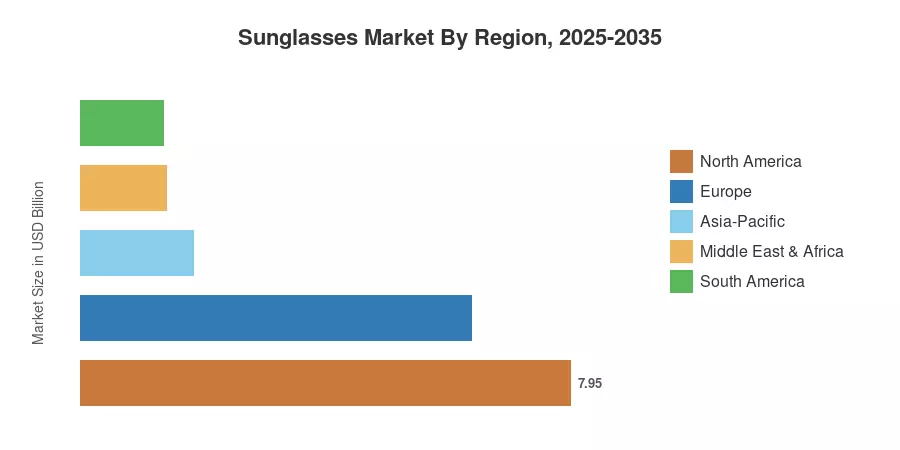
North America commands approximately 34.4% of the global Sunglasses Market, anchored by high per-capita spending and a mature optician-retail network across the United States and Canada. Asia-Pacific is the fastest-growing region with a projected 7.98% CAGR, fueled by middle-class expansion in China and India. Europe holds the second-largest share at roughly 27.5%, supported by luxury-house brand portfolios and strong tourism-driven seasonal demand. As premiumization accelerates and digital channels gain share, the Sunglasses Market is poised for sustained double-digit revenue gains in several emerging corridors through 2035.


Key Report Takeaways

• By Product Type

  • Polarized sunglasses captured approximately 75.4% of the Sunglasses Market in 2025, reflecting consumer preference for glare reduction in driving and outdoor recreation segments.
  • Non-polarized variants are forecast to expand at a 7.15% CAGR through 2035, propelled by fashion-oriented buyers prioritizing style versatility over technical lens performance.

• By End User

  • Women represented an estimated 57.2% of the Sunglasses Market in 2025, driven by higher purchase frequency and broader style repertoires across mass and premium tiers.
  • The kids segment is on track to register a 6.72% CAGR through 2035, supported by pediatric eye-care awareness and character-licensed collections from major brand houses.

• By Region

  • North America led the Sunglasses Market with a 34.4% revenue share in 2025, underpinned by strong retail infrastructure and high brand penetration.
  • Asia-Pacific is projected to grow at a 7.98% CAGR through 2035, driven by urbanization, rising disposable incomes, and an expanding e-commerce ecosystem across China, India, and Southeast Asia.


Market Size and Forecast (2021–2035)

Market Research Future's estimates draw on a triangulated methodology combining top-down revenue modeling from manufacturer filings, bottom-up unit-volume analysis from distributor and retail-channel data, and demand-side calibration through consumer surveys across 25 countries. Historical figures reflect actual shipment and sell-through data; forecast values apply the calibrated 5.70% CAGR with adjustments for macroeconomic, regulatory, and technology-adoption variables.
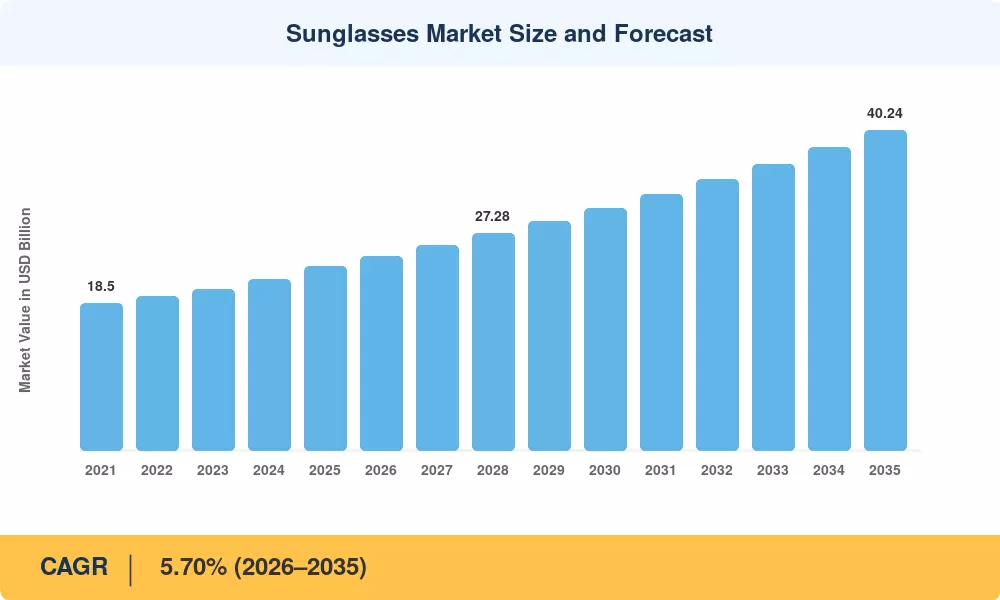
Sunglasses Market Size and Forecast
Our Impact
Enabled $4.3B Revenue Impact for Fortune 500 and Leading Multinationals
Partnering with 2000+ Global Organizations Each Year
30K+ Citations by Top-Tier Firms in the Industry

Driver Impact Analysis

Driver ~% Impact on CAGR Geographic Relevance Impact Timeline
Rising UV awareness and eye-health campaigns ~18% Global Short-term (≤2 yr)
Premiumization and luxury brand expansion ~16% North America, Europe Medium-term (2–4 yr)
E-commerce and DTC channel acceleration ~15% Asia-Pacific, North America Short-term (≤2 yr)
Smart-eyewear and wearable integration ~14% North America, Europe Long-term (≥4 yr)
Sustainability regulation and bio-material adoption ~12% Europe, Asia-Pacific Medium-term (2–4 yr)
Emerging-market urbanization and disposable income growth ~14% Asia-Pacific, South America Long-term (≥4 yr)
Prescription sunglass convergence ~11% Global Medium-term (2–4 yr)


Rising UV Awareness and Eye-Health Campaigns

Public-health messaging around ultraviolet radiation damage has shifted consumer perception of sunglasses from a fashion accessory to a health necessity. The World Health Organization's VISION 2020 successor program and national ophthalmology associations in over 40 countries now include sunglass use in recommended eye-protection guidelines [1]. Australia's SunSmart program — which has reduced melanoma incidence by an estimated 9% since inception — is being replicated in modified forms across Southeast Asian and Latin American health ministries, broadening the addressable buyer pool for the Sunglasses Market in regions where penetration has historically been below 15% of the adult population.

E-Commerce and Direct-to-Consumer Channel Acceleration

Online retail platforms have fundamentally altered distribution economics in the Sunglasses Market. Virtual try-on technology, powered by augmented-reality face-mapping algorithms, has cut online return rates by roughly 22% since 2022, according to Shopify merchant analytics [9]. Brands such as Warby Parker and Lenskart have demonstrated that a DTC-first model can reach USD 500 million-plus annual revenue while maintaining gross margins above 60%. The channel's share of total sunglasses revenue is projected to surpass 30% by 2030 — up from an estimated 21% in 2025 — pulling incremental demand from first-time online eyewear buyers in tier-2 and tier-3 cities.

Premiumization and Luxury Brand Expansion

Average selling prices across the Sunglasses Market have risen approximately 4.2% annually since 2021 as consumers trade up to branded, technology-enhanced frames [8]. Kering Eyewear's integration of Maui Jim and expansion of Gucci and Saint Laurent sunglass lines added an estimated USD 1.8 Billion in premium-tier volume between 2022 and 2025. LVMH's Thélios joint venture has similarly broadened Dior and Celine collections. This premiumization trend lifts value growth faster than unit growth and is especially pronounced in North America and Western Europe.

Smart-Eyewear and Wearable Integration

Meta's Ray-Ban smart glasses — which shipped an estimated 2 million units in 2024 — demonstrate that the intersection of eyewear and consumer electronics can expand the Sunglasses Market beyond traditional fashion and sun-protection use cases [2]. Qualcomm's dedicated AR-glasses chipset roadmap and Apple's spatial-computing ecosystem signal sustained R&D investment that will bring camera, audio, and display capabilities into mainstream sunglass form factors by the early 2030s.


Restraints Impact Analysis

Restraint ~% Drag on CAGR Geographic Relevance Impact Timeline
Counterfeit and unregulated product proliferation ~–20% Asia-Pacific, South America Short-term (≤2 yr)
Price sensitivity in low-income segments ~–18% South America, MEA, South Asia Long-term (≥4 yr)
Seasonal demand concentration ~–15% Europe, North America Short-term (≤2 yr)
Regulatory fragmentation for UV-standard labeling ~–12% Global Medium-term (2–4 yr)
Raw-material cost volatility (acetate, titanium) ~–10% Global Medium-term (2–4 yr)


Counterfeit and Unregulated Product Proliferation

Counterfeit sunglasses, many of which give little UV protection despite claims on the label, make up an estimated 15–20% of unit volume in regions of Southeast Asia, South America and sub-Saharan Africa [12]. According to the International AntiCounterfeiting Coalition, fraudulent eyeglasses cost legal producers over $3 billion a year in lost sales and can cause retinal damage to users. Enforcement is proving difficult, and the existence of cross-border e-commerce platforms and informal street markets provides distribution channels that are largely outside the reach of the regulatory authority, which continues to put downward pressure on pricing power and brand equity in the Sunglasses Market.


Price Sensitivity in Low-Income Segments

UV-related eye illness knowledge is growing, but sunglasses are still a discretionary choice for about 3 billion consumers in low and lower-middle-income economies [10]. In regions such as Nigeria, Bangladesh and rural India, the average sunglass spend is under USD 5 per unit, restricting the revenue pool that can be addressed for branded and technology enhanced items. This price sensitivity hampers the potential of the Sunglasses Market to convert awareness to value growth in the world’s fastest expanding population centers.


Seasonal Demand Concentration

Europe and North America contribute about 55–60% of yearly sunglass sell-through from April to August, generating inventory management problems and margin pressure in off-peak times [13]. In the Sunglasses Market, retailers often run 30-40% off-season sales that educate consumers to postpone buying and diminish full-price sell-through rates.


Sunglasses Market Opportunities

Prescription Sunglass Convergence

According to WHO [11], in 2024, the number of people around the world who need vision correction was above 4.4 billion. There is still a big gap to be filled by prescription sunglasses, which account for less than 12% of all sunglass units. The lead time for prescription sunglass production has been cut from 10 days to less than 48 hours using digital surfacing technology, enabling online retailers to offer on-demand fulfillment and increasing the addressable Sunglasses Market in developed and emerging economies.


Sustainable Materials and Circular Business Models

EU Ecodesign Directive expansions, including eyewear accessories by 2028, will compel producers to provide information on material composition, repairability scores and end-of-life recyclability [3]. Pioneers like Stella McCartney Eyewear and Sea2See – creating frames from retrieved ocean debris – have proven consumers will pay a 15-20% premium for proven sustainable eyewear. Frame take-back and lens-replacement programs provide recurring-revenue models that improve customer lifetime value in the Sunglasses Market.


Emerging-Market Retail Modernization

Organized retail penetration in India, Indonesia, and Nigeria is forecast to grow 8–12% annually through 2030, bringing branded sunglass displays into shopping malls, pharmacy chains, and airport terminals that previously stocked only unbranded alternatives [10]. Reliance Retail's expansion of optical-format stores across 300 Indian cities exemplifies the infrastructure buildout that will unlock volume growth for the Sunglasses Market in Asia-Pacific and Africa.

Data-Enabled Smart Eyewear Platforms

Smart sunglasses equipped with biometric sensors, spatial audio, and AR micro-displays are transitioning from novelty to platform products. Licensing wearable-collected health and navigation data — with user consent — opens adjacent revenue streams for eyewear manufacturers. Meta's annual revenue from Ray-Ban Stories accessories and subscriptions reportedly exceeded USD 200 million in 2024, demonstrating a viable data-monetization pathway for the broader Sunglasses Market.

Sports and Performance Eyewear Growth

Global sports-participation rates rose 6% between 2020 and 2024, driven by running, cycling, and outdoor recreation [16]. Performance sunglasses with interchangeable lenses, ventilated frames, and impact-rated certifications command ASPs two to three times higher than fashion equivalents. The 2028 Los Angeles Olympics and growing professional-athlete endorsement deals will further elevate the performance segment within the Sunglasses Market.


Sunglasses Market Future Outlook

AI-Enabled Personalization and Virtual Try-On

Artificial intelligence is poised to reshape how consumers discover and purchase sunglasses. Face-shape analysis algorithms, skin-tone matching, and style-preference engines will power hyper-personalized recommendations at scale. By 2030, an estimated 40% of online sunglass purchases will involve AI-assisted selection, reducing return rates to below 10% and lifting conversion rates by 25–30% relative to unassisted browsing [9]. This digital personalization layer strengthens the value proposition of the Sunglasses Market's online channel.

Sustainability as a Competitive Moat

Regulatory momentum — led by the EU Ecodesign Directive and California's SB-253 climate-disclosure requirements — will make sustainability reporting table stakes for major producers by 2028 [3]. Brands that invest early in recycled-polymer supply chains, carbon-neutral manufacturing, and verifiable ESG reporting will secure shelf-space priority with major retailers. The International Optical Industry Association projects that bio-based and recycled frames will represent 25% of global sunglass unit volume by 2032, up from roughly 6% in 2025.

Platform Economics and Subscription Models

Subscription eyewear services — where consumers receive curated sunglass selections quarterly for a fixed fee — are redefining customer-lifetime economics in the Sunglasses Market. Sunglass Hut's pilot subscription program in the United States reported 35% higher annual spend per subscriber compared with one-time buyers. As lens-replacement and frame-swap logistics mature, subscription and rental models could capture 8–12% of total market revenue by 2035, paralleling trends in fashion rental and personal care [18].

Health-Tech Convergence and Wellness Eyewear

The boundary between sunglasses and health-monitoring wearables will continue to blur. Intraocular-pressure sensors embedded in frame temples — currently in clinical trials by Imec and several university labs — could enable passive glaucoma screening during everyday wear [19]. Blue-light-filtering lenses, already a USD 2.3 Billion sub-category in broader eyewear, will increasingly converge with sun-protection lenses into all-day adaptive products. This convergence expands the Sunglasses Market's total addressable use case from outdoor-only to an indoor-outdoor continuum wear.


Sunglasses Market Segmentation

By Product Type

Segment Key Metric Primary Demand Driver
Polarized 75.4% share (2025) Driving, fishing, and outdoor recreation performance needs
Non-Polarized 7.15% CAGR (2026–2035) Fashion versatility; lower price point accessibility


Polarized sunglasses dominate the Sunglasses Market because they address a functional need — glare elimination — that consumers increasingly associate with safety during driving and water-based activities. Auto-industry partnerships, where carmakers bundle polarized sunglasses in vehicle accessory kits, have further entrenched the segment. Non-polarized models, however, are growing faster in percentage terms as fashion brands and fast-fashion retailers expand style-forward collections that prioritize aesthetics over technical lens performance. Trend-cycle acceleration — driven by social media, where sunglass styles can peak and fade within a single season — favors the lower-cost, rapid-turnover economics of non-polarized offerings.

By End User

Segment Key Metric Primary Demand Driver
Women 57.2% share (2025) Higher purchase frequency; broader style range
Men USD 8.92 Billion (2025) Performance and outdoor utility purchases
Kids 6.72% CAGR (2026–2035) Pediatric eye-care awareness; licensed character collections


Women's sunglasses account for the largest share of the Sunglasses Market, reflecting both higher fashion sensitivity and a purchase cadence that averages 2.1 pairs per year versus 1.4 for men in developed markets. Men's demand skews toward performance and sporty silhouettes, with polarized lens adoption particularly high in this cohort. The kids segment is the fastest-growing end-user category, boosted by campaigns from the American Academy of Ophthalmology recommending UV-protective eyewear starting at age three and by collaborations between eyewear brands and entertainment franchises that make sunglass-wearing aspirational for children.

By Product Category

Segment Key Metric Primary Demand Driver
Mass 65.2% share (2025) Affordable price points; broad retail distribution
Premium 7.55% CAGR (2026–2035) Brand aspiration; advanced lens technology


Mass-market sunglasses underpin the volume base of the Sunglasses Market, with price points typically ranging from USD 10 to USD 80. These products move through fast-fashion chains, pharmacies, gas stations, and marketplace e-commerce listings. Premium sunglasses — defined here as products retailing above USD 150 — are growing faster because luxury houses have intensified their eyewear licensing and in-house strategies. Kering Eyewear's revenue surpassed EUR 1.5 Billion in 2024, validating the margin advantage of brand-driven premiumization.

By Distribution Channel

Segment Key Metric Primary Demand Driver
Offline Retail Stores 79.1% share (2025) In-store try-on experience; optician trust
Online Retail Stores 8.91% CAGR (2026–2035) Virtual try-on; convenience; price transparency


Offline retail still commands the lion's share of the Sunglasses Market because eyewear remains a high-touch, fit-sensitive purchase. Sunglass Hut operates over 3,000 stores globally, and independent opticians collectively manage tens of thousands of additional points of sale. Online channels, however, are eroding this dominance at nearly nine percentage points of annual growth, powered by AR try-on, liberal return policies, and mobile-first shopping in emerging markets. The channel shift is most pronounced in Asia-Pacific, where digital-native brands like Lenskart and Bolon bypass traditional wholesale entirely.


Regional Market Share Analysis

Region Key Metric Primary Investment Themes
North America 34.4% share (2025) Premium brand dominance; DTC digital expansion
Europe USD 6.35 Billion (2025) Luxury house portfolios; sustainability regulation
Asia-Pacific 7.98% CAGR (2026–2035) Urban middle-class adoption; e-commerce penetration
South America 5.85% CAGR (2026–2035) Organized retail buildout; UV-awareness campaigns
Middle East & Africa 6.0% share (2025) Tourism-driven demand; regional brand emergence
Total USD 23.10 Billion (2025)

The Sunglasses Market displays pronounced regional variation in product mix, distribution structure, and growth trajectory. North America leads on value, while Asia-Pacific leads on unit-volume momentum.


North America

Country Key Metric Key Driver
United States 78.5% of regional revenue Largest optical-retail network; high per-capita spending
Canada 12.8% of regional revenue Outdoor recreation culture; growing Asian-diaspora demand
Mexico 5.92% CAGR (2026–2035) Rising middle-class consumption; cross-border brand entry


The United States alone accounts for over three-quarters of North America's Sunglasses Market revenue, supported by an estimated 45,000 optical retail outlets and deep penetration of insurance-adjacent vision-benefit programs that subsidize prescription sunglasses [7]. Canada's outdoor recreation economy — worth approximately CAD 21 Billion annually — sustains year-round demand for performance and polarized styles. Mexico's organized retail expansion, anchored by chains such as Ópticas Lux and El Palacio de Hierro, is lifting branded sunglasses out of informal-market dominance and into structured distribution.

Europe

Country Key Metric Key Driver
Germany USD 1.18 Billion (2025) Engineering-driven lens innovation; automotive partnership
United Kingdom 5.48% CAGR (2026–2035) Fashion-forward consumer base; strong online adoption
France USD 0.95 Billion (2025) Luxury brand headquarters; tourism-driven seasonal peaks
Italy 18.6% of regional revenue Global manufacturing hub for premium frames
Spain 5.35% CAGR (2026–2035) Tourism volume; outdoor lifestyle culture
Nordic Countries USD 0.42 Billion (2025) High disposable income; sustainability-conscious buyers
Russia 4.80% CAGR (2026–2035) Domestic brand growth amid import substitution
Rest of Europe USD 0.68 Billion (2025) Expanding organized retail and e-commerce access


Italy's Veneto region remains the epicenter of global sunglass manufacturing, housing production facilities for EssilorLuxottica, Safilo, De Rigo, and Marcolin. The EU's proposed Ecodesign Directive extension to eyewear will compel manufacturers to adopt lifecycle-assessment reporting by 2028, reinforcing Europe's regulatory leadership in the Sunglasses Market [3]. France and Spain benefit disproportionately from inbound tourism — roughly 170 million combined annual visitors — that generates high-margin impulse sunglass purchases at airports and resort destinations.

Asia-Pacific

Country Key Metric Key Driver
China 38.2% of regional revenue Domestic brand rise; massive e-commerce infrastructure
India 8.65% CAGR (2026–2035) Organized retail expansion; pediatric eye-care programs
Japan USD 1.02 Billion (2025) Aging population driving prescription-sunglass demand
South Korea 7.80% CAGR (2026–2035) K-fashion influence; high digital-channel penetration
ASEAN USD 0.74 Billion (2025) Tourism corridors; rising UV awareness
Rest of Asia-Pacific 6.55% CAGR (2026–2035) Infrastructure modernization; first-time buyer conversion


Asia-Pacific's Sunglasses Market growth is underpinned by the region adding an estimated 300 million new middle-class consumers between 2025 and 2035 [10]. China's domestic eyewear brands — led by Bolon and Prsr — have captured over 20% of the local market by combining competitive pricing with social-media-driven marketing on Douyin and Xiaohongshu. India's Lenskart, valued at approximately USD 4.5 Billion, is integrating sunglasses into its omnichannel optical network spanning 2,000-plus stores, pulling volume from unorganized roadside vendors.

South America

Country Key Metric Key Driver
Brazil 62.3% of regional revenue Largest Latin American consumer market; beach culture
Argentina 5.40% CAGR (2026–2035) Fashion-conscious urban consumers; import liberalization
Rest of South America USD 0.38 Billion (2025) Growing organized retail; UV-campaign spillover effects


Brazil dominates South America's Sunglasses Market, with a population of 215 million and a strong cultural association between eyewear and beach lifestyle. The Chilli Beans franchise network — exceeding 900 stores across Brazil and Latin America — has pioneered an affordable-fashion model that rotates collections every two weeks, driving repeat purchases. Currency volatility remains a headwind, but local production in the Manaus free-trade zone insulates domestic pricing from import-duty swings.

Middle East & Africa

Country Key Metric Key Driver
Saudi Arabia 28.5% of regional revenue Vision 2030 retail modernization; luxury tourism hubs
UAE USD 0.35 Billion (2025) Duty-free retail dominance; expat purchasing power
South Africa 5.15% CAGR (2026–2035) Growing urban middle class; outdoor sports culture
Egypt 6.10% CAGR (2026–2035) Youth demographics; rising brand awareness
Rest of MEA USD 0.30 Billion (2025) Informal-market migration to branded products


The Middle East & Africa Sunglasses Market is anchored by Gulf Cooperation Council countries, where per-capita luxury spending ranks among the world's highest. Dubai Duty Free reported sunglass sales exceeding USD 85 million in 2024, making its airport retail corridor one of the single largest points of sale globally [17]. Saudi Arabia's Vision 2030 entertainment and tourism investments — including NEOM and the Red Sea Project — are expected to generate incremental seasonal demand for the Sunglasses Market across hospitality and leisure channels.


Sunglasses Market By Region, 2025-2035

Competitive Benchmarking

The Sunglasses Market exhibits moderate concentration, with the top five players collectively controlling an estimated 50–58% of global revenue. EssilorLuxottica's portfolio — spanning Ray-Ban, Oakley, Persol, and Oliver Peoples — gives it unmatched vertical integration from lens manufacturing through owned retail. The competitive environment is dynamic; mid-tier players are carving niches through sustainability positioning, DTC digital models, and regional brand strength.

Company Est. Revenue Share Range Key Offerings for Sunglasses Market Strategic Positioning
EssilorLuxottica ~28–32% Ray-Ban, Oakley, Persol, Oliver Peoples, Sunglass Hut retail Vertically integrated; lens-to-retail dominance
Kering Eyewear ~7–10% Gucci, Saint Laurent, Bottega Veneta, Maui Jim Luxury house in-house eyewear; premium positioning
Safilo Group ~5–8% Carrera, Polaroid, Smith; licenses for Dior, Fendi Heritage manufacturer; license portfolio depth
Marchon Eyewear (VSP Global) ~4–6% Calvin Klein, Nike Vision, Lacoste Insurance-adjacent distribution; mass-premium bridge
Marcolin Group ~3–5% Tom Ford, Adidas, Guess, Max Mara Italian craftsmanship; celebrity-brand licensing
De Rigo Vision ~2–4% Police, Lozza, Sting; Chopard license Family-owned Italian manufacturer; dual brand-license model
LVMH (Thélios) ~2–4% Dior, Celine, Loewe, Fendi (transitioning from Safilo) Luxury vertical integration; brand exclusivity control
Maui Jim (Kering) ~2–3% Maui Jim branded polarized lenses Performance polarized niche; patented PolarizedPlus2
Titan Eyeplus ~1–2% Titan, Fastrack, John Jacobs India's largest eyewear retailer; omnichannel model
Silhouette International ~1–2% Silhouette, Neubau; rimless and lightweight specialty Ultra-lightweight engineering; Austrian precision manufacturing


Recent News & Developments


  • Kering Eyewear (June 2025) bought Italian manufacturer Lenti, expanding its manufacturing capacity and vertical integration strategy to better compete with EssilorLuxottica’s full control of the supply chain.


  • Safilo Group (July 2025) strengthens its premium brand portfolio with a 10-year global licensing arrangement with Victoria Beckham and a multi-year renewal of its licensing agreement with Carolina Herrera .


Sunglasses Market Report Scope

Parameter Detail
Market Scope Global Sunglasses Market — by product type, end user, product category, distribution channel, and geography
Study Period 2021–2035
CAGR 5.70% (2026–2035)
Base Year Market Size USD 23.10 Billion (2025)
Forecast Year Market Size USD 40.24 Billion (2035)
Fastest Growing Segment Online retail stores (8.91% CAGR by distribution channel); Asia-Pacific (7.98% CAGR by region)
Companies Profiled EssilorLuxottica, Kering Eyewear, Safilo Group, Marchon Eyewear, Marcolin Group, De Rigo Vision, LVMH (Thélios), Maui Jim, Titan Eyeplus, Silhouette International
Valuation Currency USD Billion


FAQs

How does lens material choice affect long-term durability and replacement cost?
Glass lenses resist scratching better than polycarbonate but weigh 40% more and shatter more easily on impact. Polycarbonate and Trivex offer the best safety-to-weight ratio, with replacement costs typically 30–50% lower than mineral glass equivalents [14].
What certifications should procurement teams verify when sourcing sunglasses for corporate or safety programs?
Look for ISO 12312-1 compliance for general-use sunglasses and ANSI Z87.1 for occupational safety eyewear. Both standards ensure validated UV-blocking performance and impact resistance for employee-facing applications [14].
How are tariff and trade-policy shifts affecting landed costs for imported sunglasses?
U.S. Section 301 tariffs on Chinese-origin eyewear currently add 7.5–25% to landed costs. Manufacturers are nearshoring production to Vietnam, Italy, and Mexico to mitigate duty exposure [15].
What role do optometrist referrals play in driving premium sunglass purchases?
Optometrist-recommended sunglasses convert at roughly 3× the rate of unassisted retail browsing. Patients perceive clinical endorsement as validation, lifting average transaction values by 40–60% at point of sale [7].
How should retailers evaluate virtual try-on platforms for integration into existing e-commerce systems?
Prioritize platforms with sub-200ms rendering latency, accurate pupillary-distance mapping, and multi-skin-tone calibration. These technical benchmarks correlate with 15–20% higher conversion rates than basic overlay solutions [9].
What is the typical margin structure across mass versus premium sunglass tiers?
Mass-market sunglasses yield gross margins of 45–55%, while premium branded frames achieve 60–72%. The premium tier's margin advantage stems from brand licensing fees being offset by significantly higher ASPs [8].
How will adaptive-tint lens technology reshape the category boundary between prescription glasses and sunglasses?
Next-generation electrochromic lenses transition in under two seconds — versus 30+ seconds for traditional photochromics — enabling a single pair to serve both indoor and outdoor use cases. This could reduce multi-pair ownership over the coming decade [2].    
Author
Author
Author Profile
Pradeep Nandi LinkedIn
Senior Research Analyst
I have a bachelor's degree in mechanical engineering and an MBA. I have more than two years of expertise in the retail, food, and beverage, chemical, and material industries, and hence have developed a sound cross-domain expertise. A firm believer in lifelong learning and sharing of knowledge. Having a proclivity for hatching ideas and trying to absorb as much information as possible in a short amount of time. Introducing corporates to the data and insight, which enables them to move from probability to possibility, has been my key areas of interest. 

Research Approach


Secondary Research

The secondary research process involved comprehensive analysis of regulatory databases, industry publications, eyewear trade journals, and authoritative market intelligence sources. Key sources included the US Food & Drug Administration (FDA) for medical device classifications and UV protection standards, European Commission Directorate-General for Internal Market, Industry, Entrepreneurship and SMEs (DG GROW) for product safety regulations, International Organization for Standardization (ISO 12312-1) for sunglass standards compliance, American Optometric Association (AOA), Vision Council of America, National Sunglass Day Initiative, National Eye Institute (NEI/NIH), World Health Organization (WHO) Vision Report databases, US Bureau of Labor Statistics Consumer Expenditure Surveys, EU Eurostat Consumer Goods Database, International Trade Centre (ITC) Trade Map for import/export data, US International Trade Commission (USITC), ** eyewear industry associations including IOFT (International Optical Fair Tokyo)**, MIDO (Milan International Optics, Optometry & Ophthalmology Exhibition), and national trade ministry reports from key manufacturing hubs including China National Light Industry Council, Federopticos (Spain), and Optical Suppliers Association (UK). These sources were used to collect consumer spending patterns, regulatory compliance data, UV protection technology studies, demographic purchasing trends, and competitive landscape analysis for polarized lenses, photochromic lenses, prescription sunglasses, and smart eyewear technologies.


Primary Research

During the primary research process, both supply-side and demand-side stakeholders were interviewed to gather qualitative and quantitative views. Supply-side sources were CEOs, VPs of Product Innovation, heads of Eyewear Design and Development, sustainability officers, and heads of Omnichannel. Luxury fashion businesses, sporty brands, independent eyewear makers, and optical retail chains all sell things. Optometrists, ophthalmologists, optical store owners, fashion buyers, procurement managers from department stores and duty-free shops, and e-commerce category managers who focus on accessories and eyeglasses were also sources of demand. Primary research established market segmentation, corroborated the deadlines for sustainable material innovation, and acquired information on omnichannel distribution strategies, premium pricing dynamics, seasonal demand patterns, and the effect of using digital screens on the adoption of blue-light filtering lenses.

Primary Respondent Breakdown:

Table

Copy

Category Segmentation Percentage

By Company Tier Tier 1 (>USD 5B revenue) 38%

Tier 2 (USD 500M-5B) 31%

By Designation C-level Executives 29%

Director Level 34%

Others (Managers, Specialists, Consultants) 37%

By Region North America 32%

Europe 29%

Asia-Pacific 33%

Rest of World (Latin America, Middle East, Africa) 6%


Market Size Estimation

Global market valuation was derived through revenue mapping and unit volume analysis across multiple distribution channels. The methodology included:

Identification of 55+ key manufacturers and brands across North America, Europe, Asia-Pacific, and Latin America, spanning luxury fashion houses, sport-specific eyewear specialists, mass-market retailers, and independent designers

Product mapping across lens technologies including polarized, photochromic, gradient, mirrored, prescription-compatible, and blue-light filtering variants, as well as frame materials (acetate, metal, titanium, sustainable bio-based materials, recycled ocean plastics)

Channel analysis covering optical specialty stores, department stores, brand flagship boutiques, e-commerce direct-to-consumer, duty-free/travel retail, and third-party online marketplaces

Analysis of reported and modeled annual revenues specific to sunglass portfolios, including licensed eyewear operations and private label manufacturing

Coverage of manufacturers and brands representing 72-78% of global market share in 2024

Extrapolation using bottom-up (unit volume × average selling price by country/region, adjusted for channel mix and price tier distribution) and top-down (manufacturer revenue validation, retail audit data, and import/export trade statistics) approaches to derive segment-specific valuations for premium, mid-range, and mass-market categories

Key Adjustments Made:

Company Tiers: Adjusted revenue thresholds downward (USD 5B vs. USD 10B) to reflect eyewear industry structure

Regional weights: Increased Asia-Pacific (33% vs. 30%), reduced North America (32% vs. 35%), increased Europe (29% vs. 27%), reduced Rest of World (6% vs. 8%)

Download Free Sample

Kindly complete the form below to receive a free sample of this Report

Download PDF ×

We do not share your information with anyone. However, we may send you emails based on your report interest from time to time. You may contact us at any time to opt-out.
















