Syringe Needle Market (2026 - 2035)

Syringe and Needle Market Research Report By Type (Blood Collection Syringes and Needles, Ophthalmic Syringes and Needles, Bone Marrow Syringes and Needles, Catheter Syringes and Needles), By Application (General Surgery, Diagnostic, Respiratory, Orthopedics, Cardiovascular, Dental), By Usability (Disposable, Reusable) and By Regional (North America, Europe, South America, Asia Pacific, Middle East and Africa) - Industry Forecast to 2035.
ID: MRFR/MED/0252-HCR
105 Pages
Rahul Gotadki, Kinjoll Dey
Last Updated: July 10, 2026
Syringe Needle Market
Market Size
Forecast Period2026-2035
CAGR (2026-2035)6.95%
2025 Market SizeUSD 28.10 Billion
2026 Market SizeUSD 30.05 Billion
2035 Market SizeUSD 55.01 Billion
Key Players
Terumo Corporation
B. Braun Melsungen AG
Nipro Corporation
Cardinal Health
Gerresheimer AG
Smiths Medical
Opportunities
  • Connected and Smart Injection Devices
  • Emerging Market Immunization Infrastructure
  • Self-Administration and Home-Healthcare Platforms

Syringe Needle Market Summary

The Syringe and Needle Market size was valued at USD 28.10 Billion in 2025, and the market is projected to grow from USD 30.05 Billion in 2026 to USD 55.01 Billion by 2035, registering a CAGR of 6.95% during the forecast period 2026–2035. This expansion is being fueled by rising global immunization campaigns — the WHO's Immunization Agenda 2030 targets a 50% reduction in vaccine-preventable diseases by the end of the decade — and a rapid scale-up of GLP-1 receptor agonist therapies that require weekly or daily subcutaneous injections [1]. Government procurement commitments, particularly across Gavi-supported low- and middle-income countries, continue to generate sustained volume demand for the Syringe and Needle Market.

A structural transformation is reshaping how injectable therapies are delivered. Traditional glass-barrel reusable devices are giving way to single-use, auto-disable syringes mandated by WHO guidelines, while prefilled syringes are capturing share in biologics delivery pipelines. The U.S. Needlestick Safety and Prevention Act and the EU Medical Device Regulation (MDR 2017/745) have accelerated adoption of safety-engineered devices, with an estimated USD 3.2 billion invested globally in retractable and shielded needle technologies between 2022 and 2025 [2].

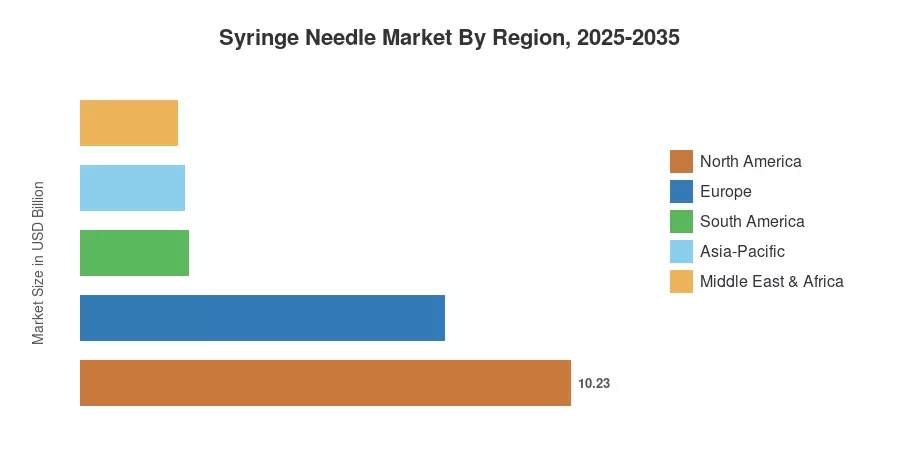
North America commands roughly 36.4% of global Syringe and Needle Market revenue, anchored by high per-capita healthcare spending and stringent occupational safety mandates. Asia-Pacific represents the fastest-growing region at a projected 7.75% CAGR, propelled by universal health coverage expansions in India and China's centralized procurement reforms. Europe holds the second-largest share at approximately 27%, with Germany and France leading demand through hospital automation and chronic disease management programs. The next decade will be defined by self-administration platforms and connected injection devices that generate real-time adherence data.


Key Report Takeaways

• By Product Category

  • Syringes held an estimated 70.2% revenue share of the Syringe and Needle Market in 2025, driven by single-use and auto-disable formats mandated across immunization programs.
  • Needles are advancing at approximately 7.45% CAGR through 2035, reflecting rising demand from blood collection, biopsy, and point-of-care diagnostics.

• By Material

  • Plastic-based devices captured 48.4% of the Syringe and Needle Market share in 2025, supported by cost advantages and lightweight design.
  • Stainless-steel components are expanding at a 7.35% CAGR, underpinned by precision-engineering requirements in specialty needles.

• By Application

  • Insulin administration accounted for 32.6% of total Syringe and Needle Market revenue in 2025, correlating with the 537 million adults living with diabetes globally.
  • Blood collection is the fastest-growing application at a 7.60% CAGR through 2035.

• By End User

  • Hospitals and clinics represented 49.1% of Syringe and Needle Market demand in 2025.
  • Home-healthcare settings post the strongest end-user CAGR at 7.65%, reflecting chronic disease self-management trends.

• By Region

  • North America led the Syringe and Needle Market with a 36.4% revenue share in 2025.
  • Asia-Pacific is projected to grow at 7.75% CAGR during 2026–2035.


Market Size and Forecast (2021–2035)

Market Research Future derives historical estimates from import/export trade databases, manufacturer revenue disclosures, hospital procurement records, and WHO/UNICEF supply division data. Forecast projections incorporate epidemiological trend models, regulatory pipeline analysis, and macroeconomic healthcare expenditure assumptions across 45 countries.
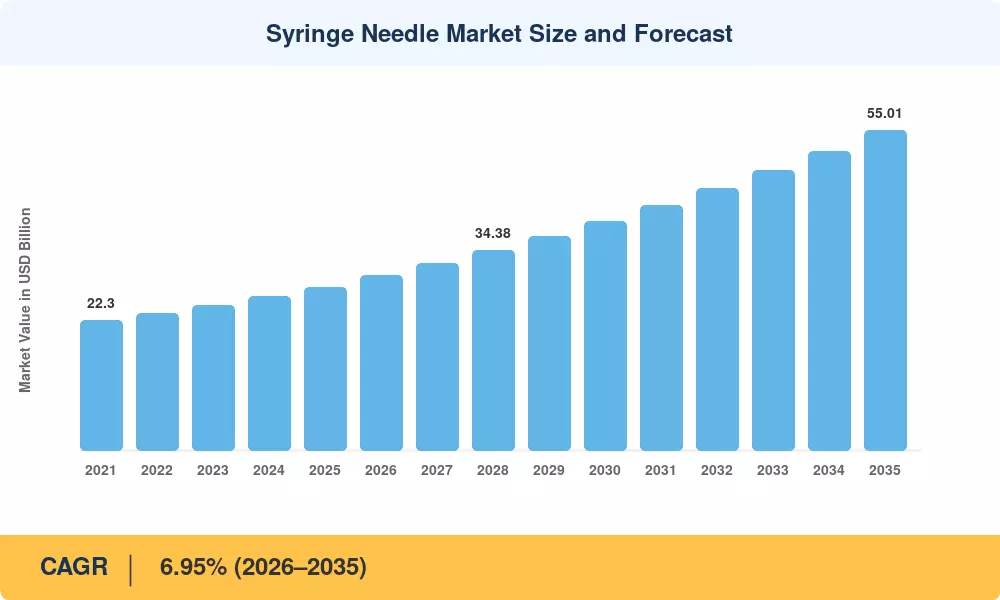
Syringe Needle Market Size and Forecast
Our Impact
Enabled $4.3B Revenue Impact for Fortune 500 and Leading Multinationals
Partnering with 2000+ Global Organizations Each Year
30K+ Citations by Top-Tier Firms in the Industry

Driver Impact Analysis

Driver ~% Impact on CAGR Geographic Relevance Impact Timeline
Rising global diabetes prevalence ~22% Global Long-term (≥4 yr)
Expanded immunization and booster programs ~18% Asia-Pacific, Africa Medium-term (2–4 yr)
GLP-1 and biologics injection volume growth ~17% North America, Europe Short-term (≤2 yr)
Needlestick safety regulations ~15% North America, EU Medium-term (2–4 yr)
Home-healthcare and self-administration shift ~14% Global Long-term (≥4 yr)
Point-of-care diagnostics expansion ~8% Asia-Pacific, Latin America Medium-term (2–4 yr)
Smart and connected injection devices ~6% North America, Europe Long-term (≥4 yr)


Rising Global Diabetes Prevalence

In 2021, the International Diabetes Federation reported that 537 million adults aged 20–79 were living with diabetes. This figure is anticipated to increase to 783 million by 2045 [6]. Annually, over 1 billion syringe and needle units are consumed for diabetes management alone, as insulin-dependent patients require an average of 3–4 daily injections or regular pen-needle changes. In the Syringe and Needle Market, procurement volumes are being driven by national programs such as India's PM Abhiyan and the U.S. Medicare Part D insulin limit at USD 35 per month, which are expanding access.


Expanded Immunization and Booster Programs

WHO and UNICEF shipped approximately 3.4 billion vaccine doses in 2023, each requiring at least one syringe-needle assembly [1]. The introduction of year-round adult booster schedules for influenza, COVID-19, and RSV — combined with Gavi's allocation of USD 11.9 billion for 2026–2030 immunization commitments — sustains high-volume recurring demand across the Syringe and Needle Market, particularly in Sub-Saharan Africa and Southeast Asia.

GLP-1 and Biologics Injection Volume Growth

The rapid clinical adoption of semaglutide and tirzepatide has created a step-change in subcutaneous injection volumes. Global GLP-1 receptor agonist sales exceeded USD 50 billion in 2024, with each weekly dose requiring a single-use pen needle or syringe [7]. This has placed pressure on supply chains and is redirecting manufacturer capacity toward pre-fillable glass and polymer syringe barrels optimized for viscous biologic formulations.

Needlestick Safety Regulations

OSHA's Bloodborne Pathogens Standard and the EU Directive 2010/32/EU mandate the use of sharps-injury prevention devices across healthcare settings. Non-compliance penalties can reach USD 156,259 per willful violation in the U.S. [2]. These regulations have shifted hospital purchasing budgets toward retractable, shielded, and blunting needle systems, creating a sustained premium-product migration within the Syringe and Needle Market.


Restraints Impact Analysis

Restraint ~% Impact on CAGR Geographic Relevance Impact Timeline
Price erosion from generic/low-cost imports ~−1.8% Global Short-term (≤2 yr)
Needle-free injection technology substitution ~−1.4% North America, Europe Long-term (≥4 yr)
Regulatory fragmentation across emerging markets ~−1.1% Asia-Pacific, Africa Medium-term (2–4 yr)
Sharps waste disposal and environmental concerns ~−0.9% Europe, North America Medium-term (2–4 yr)
Raw material supply chain disruptions ~−0.7% Global Short-term (≤2 yr)


Price Erosion from Generic and Low-Cost Imports

Commoditization of standard disposable syringes has driven average selling prices down by 12–15% between 2020 and 2024 in several Asian and African markets [11]. Chinese and Indian contract manufacturers now supply over 60% of global disposable syringe volume, compressing margins for branded players and reducing overall Syringe and Needle Market revenue growth despite unit volume expansion.

Needle-Free Injection Technology Substitution

Jet injectors, microneedle patches, and oral biologics delivery platforms represent a long-term competitive threat. The needle-free injection market is projected to exceed USD 18 billion by 2032. While current adoption remains limited to niche vaccine delivery and specific dermatological applications, continued investment by pharma companies could erode the addressable portion of the Syringe and Needle Market over the forecast period.

Sharps Waste and Environmental Concerns

Globally, an estimated 16 billion injections are administered annually, resulting in substantial quantities of sharps residue [14]. Procurement teams are being compelled to assess reusable or biodegradable alternatives in the Syringe and Needle Market due to growing hospital sustainability mandates and tightening EU regulations on single-use plastics. This has resulted in cost headwinds for conventional single-use devices.


Syringe Needle Market Opportunities

Connected and Smart Injection Devices

Bluetooth-enabled auto-injectors and connected pen needles that transmit dose-timing data to companion apps represent a high-growth adjacency. Pharmaceutical companies are embedding NFC chips into syringe packaging for track-and-trace compliance under the EU Falsified Medicines Directive, creating a hardware upgrade cycle worth an estimated USD 2.1 billion by 2030.

Emerging Market Immunization Infrastructure

There is still a lack of penetration for routine immunization in Sub-Saharan Africa and South Asia. The investment strategy of GAVI for the years 2026–2030 is designed to target an additional 300 million children in 57 countries, each of whom necessitates multiple injection contacts [1]. In the Syringe and Needle Market, manufacturers who establish local fill-finish partnerships or transmit auto-disable syringe technology have the potential to capture significant recurring volume.


Self-Administration and Home-Healthcare Platforms

The shift toward patient self-injection for biologics, insulin, and fertility treatments is expanding the Syringe and Needle Market beyond traditional institutional channels. Over 40% of new biologic drug approvals between 2022 and 2025 included a subcutaneous self-administration pathway, and home-healthcare spending in the U.S. is forecast to exceed USD 200 billion by 2028 [8].

Specialty Needle Applications in Diagnostics

Liquid biopsy, microsampling, and capillary blood collection techniques are driving demand for ultra-fine-gauge specialty needles. The global point-of-care diagnostics market is expanding at over 9% annually, and each testing platform requires compatible needle-syringe assemblies for sample acquisition.

Sustainable and Recyclable Device Design

Hospital procurement organizations in Scandinavia and the UK have begun weighting sustainability criteria at 10–15% in tender evaluations [14]. Companies developing bio-based polymer syringes or closed-loop needle recycling systems can differentiate in the Syringe and Needle Market and capture premium pricing tiers.


Syringe Needle Market Future Outlook

AI-Optimized Manufacturing and Quality Control

Machine-vision inspection systems are replacing manual quality checks on syringe production lines, with defect detection accuracy exceeding 99.7%. By 2030, manufacturers adopting AI-driven predictive maintenance and real-time dimensional measurement are expected to reduce production waste by 18–22%, strengthening margins across the Syringe and Needle Market while meeting tightening regulatory quality thresholds.

Platform Economics and Drug-Device Convergence

Pharmaceutical companies are increasingly co-developing injectable drugs alongside proprietary delivery platforms, binding patients to specific syringe-needle ecosystems. This drug-device convergence mirrors the razor-razorblade model, where the delivery device generates recurring aftermarket revenue. The Syringe and Needle Market will see consolidated partnerships between CDMOs and device OEMs through the late 2020s [21].

Sustainability and Circular Device Design

In the United States alone, the healthcare sector is responsible for the generation of an estimated 5.9 million tons of waste annually, with sharps accounting for a substantial portion [14]. The Syringe and Needle Market is being driven toward recyclable polymer containers and reduced-plastic packaging by the European Green Deal targets and NHS Net Zero commitments. It is anticipated that procurement tenders will incorporate life-cycle assessment (LCA) requirements by 2028.


Decentralized Clinical Trials and Self-Injection

Decentralized and hybrid clinical trial designs rose from 7% to 34% of all new trials between 2019 and 2024, and each home-based dosing event requires patient-administered injection kits [22]. This shift expands the Syringe and Needle Market's addressable channels from institutional to direct-to-patient, demanding simplified device ergonomics, training-integrated packaging, and cold-chain-compatible syringe formats.


Syringe Needle Market Segmentation

By Product Category

Segment Key Metric Primary Demand Driver
Syringes (Disposable and Reusable) 70.2% share (2025) Immunization mandates and auto-disable requirements
Needles (Hypodermic and Specialty) 7.45% CAGR (2026–2035) Blood collection and diagnostics growth


Syringes dominate the Syringe and Needle Market by product category, with disposable formats accounting for the vast majority of unit volumes. WHO's global mandate for auto-disable syringes in immunization programs ensures sustained procurement from UNICEF Supply Division, which distributed 2.4 billion syringes in 2023 alone [1]. Reusable syringes retain a niche in veterinary and laboratory settings where sterilization protocols are established.

Needles represent the faster-growing product segment, propelled by expanding applications in blood collection, biopsy sampling, and interventional radiology. Ultra-fine-gauge needles (31G–34G) are gaining traction in insulin and biologics delivery for improved patient comfort, and specialty needle designs for cryoablation and nerve-block procedures are commanding premium pricing in the Syringe and Needle Market.

By Material

Segment Key Metric Primary Demand Driver
Plastic 48.4% share (2025) Cost-effective disposable formats
Glass USD 6.18 Billion (2025) Prefilled syringe compatibility with biologics
Stainless Steel and Others 7.35% CAGR (2026–2035) Precision specialty needle applications


Plastic remains the dominant material in the Syringe and Needle Market, used primarily for polypropylene syringe barrels and polyethylene plunger components. Glass syringe barrels are critical for prefilled formats where drug-container compatibility and low extractable profiles are required — Type I borosilicate glass remains the gold standard for biologic storage. Stainless steel is essential for all needle cannulae and is expanding as specialty needle applications grow.

By Application

Segment Key Metric Primary Demand Driver
Insulin Administration 32.6% share (2025) Global diabetes epidemic
Vaccination USD 5.90 Billion (2025) Routine and pandemic immunization
Blood Collection 7.60% CAGR (2026–2035) Point-of-care diagnostics expansion
Drug Administration (Other Injectables) 18.5% share (2025) Biologics and oncology therapies
Others USD 1.95 Billion (2025) Veterinary and research applications


Insulin administration commands the largest application share in the Syringe and Needle Market as the diabetes patient population grows at approximately 3% annually, with each patient consuming 100–1,500 needle units per year depending on therapy regimen [6]. Blood collection is the fastest-growing application segment, driven by laboratory automation and the expansion of blood bank infrastructure across developing nations where donation rates remain below WHO targets of 10 per 1,000 population.

By End User

Segment Key Metric Primary Demand Driver
Hospitals and Clinics 49.1% share (2025) High-volume institutional procurement
Home Healthcare 7.65% CAGR (2026–2035) Chronic disease self-management
Ambulatory Surgery Centers USD 3.65 Billion (2025) Outpatient procedure migration
Others (Labs, Blood Banks) 10.8% share (2025) Diagnostic and research demand


Hospitals and clinics remain the largest end-user channel in the Syringe and Needle Market, driven by GPO-negotiated bulk procurement contracts and standardized formulary requirements. Home healthcare is the fastest-growing channel as payers incentivize outpatient management of diabetes, rheumatoid arthritis, multiple sclerosis, and other chronic conditions requiring regular injections [8].


Regional Market Share Analysis

Region Key Metric Primary Investment Themes
North America 36.4% share (2025) Biologics delivery, needlestick safety compliance
Europe USD 7.59 Billion (2025) MDR compliance, sustainability mandates
Asia-Pacific 7.75% CAGR (2026–2035) Universal health coverage, local manufacturing
South America USD 2.25 Billion (2025) Public immunization, diabetes management
Middle East & Africa 7.20% CAGR (2026–2035) Immunization access, cold chain expansion
Total USD 28.10 Billion (2025)

The Syringe and Needle Market exhibits distinct regional dynamics shaped by healthcare infrastructure maturity, regulatory frameworks, and disease burden profiles.


North America

Country Key Metric Key Driver
United States 78.2% of regional share Medicare Part D insulin access, OSHA mandates
Canada 12.5% of regional share Provincial procurement modernization
Mexico 9.3% of regional share INSABI universal health program


The United States dominates the North American Syringe and Needle Market, driven by the highest per-capita injectable biologic utilization globally. FDA clearances for combination products — where the drug and delivery device are regulated as a single entity — rose 23% between 2022 and 2024, accelerating the Syringe and Needle Market upgrade cycle toward integrated prefilled formats [16]. Canada's bulk provincial purchasing agreements and Mexico's transition to the IMSS-Bienestar centralized procurement model add steady volume growth across the region.

Europe

Country Key Metric Key Driver
Germany 6.45% CAGR Hospital automation and chronic disease management
United Kingdom USD 1.18 Billion (2025) NHS procurement consolidation
France 16.8% of regional share National diabetes plan investment
Italy 12.4% of regional share Aging population and insulin demand
Spain 5.95% CAGR Expanded primary care injection capacity
Nordic Countries USD 0.52 Billion (2025) Sustainability-driven procurement
Russia 8.1% of regional share Import substitution policy
Rest of Europe 6.10% CAGR EU MDR harmonization


Europe's Syringe and Needle Market is shaped by the Medical Device Regulation (MDR 2017/745), which requires enhanced post-market surveillance and UDI traceability for all injection devices sold in the EU. Germany's Krankenhausreform hospital reform act is channeling investment into automated medication preparation systems that consume standardized syringe formats, while the UK's NHS centralized procurement through the Supply Chain Coordination Limited (SCCL) has compressed supplier margins but increased unit volumes [17].

Asia-Pacific

Country Key Metric Key Driver
China 34.5% of regional share Centralized volume-based procurement (VBP)
India 8.20% CAGR Ayushman Bharat and local manufacturing
Japan USD 1.42 Billion (2025) Aging demographics and biologics adoption
South Korea 6.85% CAGR Biosimilar production scaling
ASEAN 15.2% of regional share Immunization coverage expansion
Rest of Asia-Pacific 6.70% CAGR Healthcare infrastructure build-out


Asia-Pacific is the fastest-growing region in the Syringe and Needle Market, led by China's volume-based procurement program that has driven syringe prices down by 40–60% while dramatically increasing utilization volumes [18]. India's production-linked incentive (PLI) scheme allocated INR 27 billion for medical device manufacturing between 2021 and 2028, attracting BD, Nipro, and domestic players to establish auto-disable syringe capacity exceeding 5 billion units annually. Japan's aging society — 29.1% of the population is over 65 — sustains steady demand for insulin delivery and biologics injection systems.

South America

Country Key Metric Key Driver
Brazil 58.7% of regional share SUS public health procurement
Argentina 6.40% CAGR Diabetes prevalence growth
Rest of South America USD 0.54 Billion (2025) Pan American Health Organization programs


Brazil's Sistema Único de Saúde (SUS) is the largest single public purchaser in the region, distributing over 800 million syringe-needle units annually across 5,570 municipalities [19]. The Syringe and Needle Market in South America benefits from PAHO's revolving fund mechanism, which pools procurement across member states to negotiate competitive pricing for immunization supplies.

Middle East & Africa

Country Key Metric Key Driver
Saudi Arabia 28.3% of regional share Vision 2030 healthcare expansion
UAE 6.95% CAGR Medical tourism and premium device adoption
South Africa USD 0.31 Billion (2025) HIV/TB injection therapy programs
Egypt 18.5% of regional share Population scale and public health campaigns
Rest of MEA 7.40% CAGR Gavi-supported immunization programs


The Middle East & Africa Syringe and Needle Market is characterized by dual dynamics: Gulf states investing in premium hospital infrastructure and advanced injection systems, while Sub-Saharan Africa relies heavily on donor-funded auto-disable syringe supply chains. Saudi Arabia's National Transformation Program has earmarked USD 65 billion for healthcare infrastructure through 2030, including localized medical device manufacturing [20].


Syringe Needle Market By Region, 2025-2035

Competitive Benchmarking

The Syringe and Needle Market exhibits low-to-moderate concentration, with the top five players controlling an estimated 45–50% of global revenue. The HHI index sits below 1,000, reflecting a fragmented competitive structure where large multinationals compete alongside regional specialists and contract manufacturers. Competitive differentiation increasingly depends on safety-engineering capabilities, prefilled syringe manufacturing capacity, and integrated drug-device partnership agreements [21].

Company Est. Revenue Share Range Key Offerings Strategic Positioning
Becton, Dickinson and Company (BD) ~14–18% Disposable syringes, safety needles, prefilled systems Global market leader with broadest product portfolio
Terumo Corporation ~8–11% Hypodermic needles, insulin syringes, blood collection Precision engineering and thin-wall needle technology
B. Braun Melsungen AG ~6–9% Disposable syringes, IV administration sets European market strength with integrated infusion systems
Nipro Corporation ~5–7% Disposable syringes, pen needles, glass prefillable barrels High-volume OEM manufacturing for pharma partners
Cardinal Health ~4–6% Syringe distribution, private-label devices Supply chain and distribution network scale
Gerresheimer AG ~3–5% Glass and polymer prefillable syringe systems Drug-device packaging and primary containment
Smiths Medical (ICU Medical) ~3–5% Safety syringes, needle-free connectors Acute care and infusion therapy specialization
Retractable Technologies Inc. ~2–3% Retractable safety syringes and blood collection Patent-protected retractable needle mechanism
Hindustan Syringes & Medical Devices ~2–4% Auto-disable syringes, disposable syringes Largest AD syringe manufacturer by volume
Medline Industries ~2–3% Private-label syringes, procedure kits U.S. hospital distribution and bundled supply contracts


Recent News & Developments


  • Terumo Corporation (June 2024): Launched the Nanopass 34G ultra-thin needle in the European market, targeting pain-free insulin delivery for pediatric and elderly diabetic patients [23].
  • B. Braun Melsungen (March 2024): Received CE marking under MDR 2017/745 for its Introcan Safety IV catheter system, extending its safety-device portfolio in the Syringe and Needle Market [17].


  • WHO/UNICEF (January 2024): Awarded a three-year, 4.5-billion-unit auto-disable syringe supply contract to Hindustan Syringes & Medical Devices and Star Syringe for Gavi-supported immunization programs [1].


Syringe Needle Market Report Scope

Parameter Detail
Market Scope Global Syringe and Needle Market
Study Period 2021–2035
CAGR (Forecast Period) 6.95% (2026–2035)
Base Year Value USD 28.10 Billion (2025)
2026 Forecast Value USD 30.05 Billion
2035 Forecast Value USD 55.01 Billion
Fastest Growing Segment Needles by product; Home Healthcare by end user
Companies Profiled 10+ (BD, Terumo, B. Braun, Nipro, Cardinal Health, Gerresheimer, Smiths Medical, Retractable Technologies, Hindustan Syringes, Medline Industries, and others)
Valuation Currency USD Billion


FAQs

How do hospital group purchasing organizations influence syringe procurement pricing?
GPOs aggregate purchasing volume across member hospitals to negotiate 15–30% discounts from list price. Contracts typically lock for 2–3 years, limiting mid-cycle supplier switching [16].
What quality certifications should buyers verify before sourcing injection devices?
Confirm ISO 7886-1 for single-use syringes, ISO 7864 for sterile needles, and CE marking or 510(k) clearance. WHO prequalification is essential for donor-funded procurement [13].
How does needle gauge selection affect clinical outcomes in biologics delivery?
Thinner gauges (29G–34G) reduce injection pain and improve patient adherence. However, high-viscosity biologics may require 25G–27G to maintain acceptable injection time under 15 seconds [23].
What are the total cost-of-ownership differences between safety and conventional syringes?
Safety devices cost 20–40% more per unit but reduce needlestick injury costs, averaging USD 3,000 per incident. Facilities typically achieve net savings within 18 months of conversion [2].
How are cold-chain requirements shaping syringe material choices for biologic drugs?
Cyclic olefin polymer barrels outperform glass in freeze-thaw stability for biologic storage at −20°C. Pharma companies increasingly specify COP for mRNA and antibody-based therapies [21].
What role do contract device manufacturers play in the Syringe and Needle Market?
CDMOs handle 30–35% of global prefilled syringe fill-finish volume, enabling pharma companies to launch injection products without investing in dedicated device manufacturing lines [18].
How might microneedle patch technology reshape the Syringe and Needle Market by 2035?
Dissolving microneedle patches are in Phase II/III trials for vaccines and insulin. Widespread adoption could displace 8–12% of conventional syringe volumes in specific applications by 2035 [12].    
What is the current size of the syringe and needle market?
The syringe and needle market reached USD 28.10 billion in 2025 and is projected to reach USD 55.01 billion by 2035.
What is the CAGR of the syringe and needle market?
The syringe and needle market is projected to grow at a CAGR of 6.95% during the forecast period 2026–2035.
Which region leads the syringe and needle market?
North America holds the largest share at 36.4%, while Asia-Pacific is the fastest-growing region at 7.75% CAGR.
Author
Author
Author Profile
Rahul Gotadki LinkedIn
Research Manager
He holds an experience of about 9+ years in Market Research and Business Consulting, working under the spectrum of Life Sciences and Healthcare domains. Rahul conceptualizes and implements a scalable business strategy and provides strategic leadership to the clients. His expertise lies in market estimation, competitive intelligence, pipeline analysis, customer assessment, etc.
Co-Author
Co-Author Profile
Kinjoll Dey LinkedIn
Senior Research Analyst
He is an extremely curious individual currently working in Healthcare and Medical Devices Domain. Kinjoll is comfortably versed in data centric research backed by healthcare educational background. He leverages extensive data mining and analytics tools such as Primary and Secondary Research, Statistical Analysis, Machine Learning, Data Modelling. His key role also involves Technical Sales Support, Client Interaction and Project management within the Healthcare team. Lastly, he showcases extensive affinity towards learning new skills and remain fascinated in implementing them.

Research Approach


Secondary Research

The secondary research process involved comprehensive analysis of medical device regulatory databases, peer-reviewed clinical engineering journals, healthcare safety publications, and authoritative health organizations. Key sources included the US Food & Drug Administration (FDA) 510(k) Premarket Notification Database and Medical Device Reporting (MDR), European Medicines Agency (EMA) Medical Device Regulations (MDR 2017/745), International Organization for Standardization (ISO 7864, ISO 7886 for sterile hypodermic equipment), World Health Organization (WHO) Safe Injection Global Network (SIGN) and Vaccination Delivery Guidelines, US Centers for Disease Control and Prevention (CDC) One & Only Campaign Injection Safety Guidelines and National Surveillance System for Healthcare Workers (NaSH), Occupational Safety and Health Administration (OSHA) Bloodborne Pathogens Standard (29 CFR 1910.1030), National Institutes of Health (NIH) Division of Healthcare Safety Research, GAVI Alliance Vaccine Market Insights, UNICEF Supply Division Product Procurement Data, Healthcare Infection Control Practices Advisory Committee (HICPAC) Guidelines, National Health Service (NHS) England Medical Device Alerts, Japan Ministry of Health Labour and Welfare (MHLW) Medical Device Safety Information, and national health ministry procurement reports from key markets. These sources were used to collect device approval data, safety incident statistics, vaccination program volumes, needle-stick injury surveillance, regulatory compliance standards, and market landscape analysis for conventional syringes, safety-engineered devices, pre-filled syringes, and specialty needles.


Primary Research

Qualitative and quantitative insights were obtained by interviewing supply-side and demand-side stakeholders during the primary research process. Supply-side sources comprised CEOs, VPs of Manufacturing Operations, regulatory affairs managers, and commercial directors from medical device distributors, precision injection molding companies, and syringe/needle manufacturers. Infection control officers, procurement managers from hospital systems, clinical nurse specialists, ambulatory surgery center administrators, and supply chain directors from diagnostic laboratories, blood banks, and vaccination centers comprised demand-side sources. Product segmentation was validated across blood collection, ophthalmic, and specialty needles through primary research. Safety device adoption timelines were confirmed, and insights were garnered on bulk purchasing patterns, GPO contracting structures, and compliance with needle-stick prevention legislation.

Primary Respondent Breakdown:

By Designation: C-level Primaries (28%), Director Level (32%), Others (40%)

By Region: North America (32%), Europe (35%), Asia-Pacific (25%), Rest of World (8%)


Market Size Estimation

Global market valuation was derived through revenue mapping and procedure volume analysis. The methodology included:

Identification of 50+ key manufacturers across North America, Europe, Asia-Pacific, and Latin America including safety device specialists and generic disposable suppliers

Product mapping across blood collection needles, ophthalmic syringes, bone marrow aspiration needles, catheter syringes, and safety-engineered devices

Analysis of reported and modeled annual revenues specific to injection and infusion portfolios

Coverage of manufacturers representing 75-80% of global market share in 2024

Extrapolation using bottom-up (procedure volume × ASP by country/setting) and top-down (manufacturer revenue validation) approaches to derive segment-specific valuations for disposable versus reusable categories and safety versus conventional devices

Integration of WHO/UNICEF vaccination demand forecasts and national immunization program procurement data to estimate public sector volumes

Analysis of safety conversion rates in accordance with OSHA compliance deadlines and EU MDR implementation timelines to model safety-engineered device penetration

Download Free Sample

Kindly complete the form below to receive a free sample of this Report

Download PDF ×

We do not share your information with anyone. However, we may send you emails based on your report interest from time to time. You may contact us at any time to opt-out.
















