North America : Innovation and Demand Growth
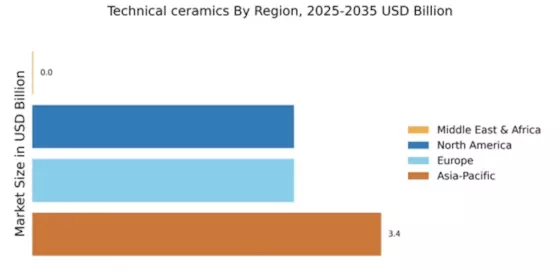
North America holds a significant Technical Ceramics Market share in the regional scenario, with a market size of $2.58 billion. Key drivers include advancements in manufacturing technologies and increasing demand from the aerospace and automotive sectors. Regulatory support for high-performance materials is also a catalyst for growth, as industries seek to enhance product durability and efficiency. The region's focus on innovation is expected to sustain this growth trend into 2025. The competitive landscape in North America is characterized by the presence of major players such as 3M Company and CoorsTek Inc. These companies are investing in R&D to develop advanced ceramic materials that meet stringent industry standards. The U.S. and Canada are leading markets, driven by their robust industrial base and technological advancements. As the demand for high-performance ceramics continues to rise, North America is poised to maintain its significant market share.
Europe : Strong Manufacturing Base
Europe's technical ceramics market, also valued at $2.58B, is characterized by a strong manufacturing base and diverse applications across industries such as healthcare, automotive, and electronics. The region benefits from stringent regulations promoting high-quality materials, which drive demand for advanced ceramics. The market is expected to grow as industries increasingly adopt these materials for their superior properties. Germany, France, and the UK are leading countries in this sector, with key players like CeramTec GmbH and Saint-Gobain. The competitive landscape is marked by innovation and collaboration among companies, enhancing product development. The presence of research institutions further supports advancements in technical ceramics, ensuring Europe remains a key player in the global market.
Asia-Pacific : Emerging Powerhouse in Ceramics
Asia-Pacific is the largest Technical Ceramics Market, with a market size of $3.44 billion. The region's growth is fueled by rapid industrialization, urbanization, and increasing investments in technology. Countries like China and Japan are leading the charge, with a strong focus on innovation and production efficiency. The demand for technical ceramics in electronics, automotive, and healthcare sectors is driving market expansion, supported by favorable government policies and investments in infrastructure. China, Japan, and South Korea are the dominant players in this market, with companies like Kyocera Corporation and NGK Insulators Ltd. leading the way. The competitive landscape is characterized by a mix of local and international players, all vying for market share. As the region continues to invest in advanced manufacturing technologies, the demand for high-quality technical ceramics is expected to grow, solidifying Asia-Pacific's position as a market leader.
Middle East and Africa : Emerging Market Opportunities
Technical Ceramics Market analysis reveals that that the Middle East and Africa regions have a valuation of $0.01 billion. However, there are emerging opportunities driven by increasing industrial activities and a growing focus on advanced materials. The region's growth is supported by investments in infrastructure and energy sectors, which are beginning to recognize the benefits of technical ceramics in enhancing performance and durability. Regulatory frameworks are gradually evolving to support this transition. Countries like South Africa and the UAE are starting to explore the potential of technical ceramics, with local companies beginning to invest in production capabilities. The competitive landscape is still developing, with few established players. However, as industries in the region continue to grow and diversify, the demand for technical ceramics is expected to rise, presenting significant opportunities for market entrants.