Download Free Sample
Kindly complete the form below to receive a free sample of this Report
Technology and Software Development Consulting Services Market Research Report By Client Size (Small Enterprises, Medium Enterprises, Large Enterprises, Startups), By Service Type (Custom Software Development, Software Integration, Cloud Consulting, Mobile Application Development, Enterprise Software Solutions), By Technology Stack (Artificial Intelligence, Blockchain, Internet of Things, Big Data, Cloud Computing), By Industry Vertical (Healthcare, Finance, Retail, Manufacturing, Telecommunications) And By Region (North America, Europe, Asia-Pacific, And Rest Of The World) – Market Forecast Till 2035.
As per MRFR analysis, the Technology and Software Development Consulting Services Market was estimated at 700.0 USD Billion in 2024. The industry is projected to grow from 735.14 USD Billion in 2025 to 1200.0 USD Billion by 2035, exhibiting a compound annual growth rate (CAGR) of 5.02% during the forecast period 2025 - 2035.
The Technology and Software Development Consulting Services Market is experiencing robust growth driven by digital transformation and advanced technology integration.
| 2024 Market Size | 700.0 (USD Billion) |
| 2035 Market Size | 1200.0 (USD Billion) |
| CAGR (2025 - 2035) | 5.02% |
Accenture (IE), IBM (US), Deloitte (GB), Capgemini (FR), Cognizant (US), Tata Consultancy Services (IN), Infosys (IN), Wipro (IN), HCL Technologies (IN), PwC (GB)
Our Impact
Enabled $4.3B Revenue Impact for Fortune 500 and Leading Multinationals
Partnering with 2000+ Global Organizations Each Year
30K+ Citations by Top-Tier Firms in the Industry
The Technology and Software Development Consulting Services Market is currently experiencing a dynamic evolution, driven by the increasing demand for digital transformation across various industries. Organizations are increasingly seeking expert guidance to navigate the complexities of technology integration, software development, and system optimization. This market appears to be characterized by a growing emphasis on agile methodologies, cloud computing, and data analytics, which are reshaping how businesses operate and deliver value to their customers. As companies strive to enhance operational efficiency and innovate their service offerings, the role of consulting services becomes more critical. Moreover, the rise of emerging technologies such as artificial intelligence, machine learning, and the Internet of Things is likely to further influence the landscape of the Technology and Software Development Consulting Services Market. Firms are expected to leverage these advancements to gain competitive advantages and improve decision-making processes. The ongoing shift towards remote work and digital collaboration tools may also contribute to the demand for specialized consulting services, as organizations seek to optimize their technology infrastructure and ensure seamless operations in a rapidly changing environment.
Organizations are increasingly adopting agile methodologies to enhance their software development processes. This trend indicates a shift towards iterative development, allowing for greater flexibility and responsiveness to changing requirements. Consulting services that specialize in agile practices are likely to see heightened demand as businesses aim to improve project outcomes and accelerate time-to-market.
The transition to cloud-based solutions continues to gain traction within the Technology and Software Development Consulting Services Market. Companies are recognizing the benefits of scalability, cost-effectiveness, and enhanced collaboration that cloud technologies offer. Consulting firms that provide expertise in cloud migration and management are positioned to play a pivotal role in this ongoing transformation.
The integration of advanced technologies such as artificial intelligence and machine learning is becoming increasingly prevalent. Organizations are seeking consulting services that can help them harness these innovations to drive efficiency and improve decision-making. This trend suggests a growing need for specialized knowledge in implementing and optimizing these technologies within existing business frameworks.
The demand for custom software solutions is a prominent driver in the Technology and Software Development Consulting Services Market. As businesses face unique challenges and requirements, off-the-shelf software often falls short of meeting their specific needs. Consequently, organizations are turning to consulting services that specialize in developing tailored software solutions. This trend is particularly evident in sectors such as healthcare, finance, and retail, where bespoke software can significantly enhance operational efficiency and customer engagement. Market data indicates that the custom software development segment is poised for substantial growth, as more companies recognize the value of personalized solutions. Consulting firms that can deliver innovative and effective custom software solutions are likely to thrive in this evolving landscape, further contributing to the expansion of the Technology and Software Development Consulting Services Market.
The Technology and Software Development Consulting Services Market is experiencing a notable surge in demand for digital transformation initiatives. Organizations across various sectors are increasingly recognizing the necessity to modernize their operations and enhance customer experiences through technology. This trend is driven by the need to remain competitive in a rapidly evolving digital landscape. According to recent data, the market for digital transformation services is projected to reach substantial figures, indicating a robust growth trajectory. As businesses seek to leverage advanced technologies, consulting services that facilitate this transition are becoming indispensable. The emphasis on integrating digital solutions into traditional business models is likely to propel the demand for consulting services, thereby shaping the future of the Technology and Software Development Consulting Services Market.
The Technology and Software Development Consulting Services Market is benefiting from a marked increase in investment in IT infrastructure. Organizations are recognizing the critical importance of robust IT systems to support their business operations and drive innovation. This trend is reflected in the growing budgets allocated for IT consulting services, as companies seek expert guidance in optimizing their infrastructure. Data indicates that the IT services market is expected to experience significant growth, driven by the need for scalable and secure IT solutions. Consulting firms that specialize in IT infrastructure are well-positioned to assist organizations in navigating the complexities of modern technology environments. As businesses continue to prioritize IT investments, the demand for consulting services in this area is likely to remain strong, further fueling the growth of the Technology and Software Development Consulting Services Market.
In the current landscape, the Technology and Software Development Consulting Services Market is witnessing an escalating focus on cybersecurity solutions. As cyber threats become increasingly sophisticated, organizations are compelled to prioritize the protection of their digital assets. This heightened awareness has led to a significant increase in investments in cybersecurity consulting services. Data suggests that The Technology and Software Development Consulting Services is expected to grow substantially, reflecting the urgent need for expert guidance in navigating complex security challenges. Consulting firms that specialize in cybersecurity are well-positioned to capitalize on this trend, offering tailored solutions that address the unique vulnerabilities of different industries. Consequently, the demand for cybersecurity consulting services is likely to remain strong, further driving growth within the Technology and Software Development Consulting Services Market.
The integration of artificial intelligence (AI) and machine learning (ML) technologies is emerging as a pivotal driver within the Technology and Software Development Consulting Services Market. Organizations are increasingly seeking to harness the power of AI and ML to enhance operational efficiency, improve decision-making processes, and deliver personalized customer experiences. The market for AI and ML consulting services is projected to expand significantly, as businesses recognize the potential of these technologies to transform their operations. Consulting firms that offer expertise in AI and ML are likely to see increased demand for their services, as organizations strive to implement these advanced technologies effectively. This trend not only reflects a shift towards data-driven strategies but also underscores the critical role of consulting services in facilitating successful AI and ML adoption within the Technology and Software Development Consulting Services Market.
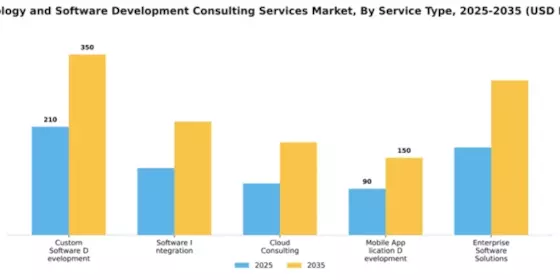
In the Technology and Software Development Consulting Services Market, Custom Software Development holds the largest share, driven by increasing demand for tailored solutions that cater to specific business needs. Following closely, Software Integration and Enterprise Software Solutions also contribute significantly to the market, as companies seek to enhance operational efficiency through effective syncing of diverse software systems. Meanwhile, Mobile Application Development plays a critical role, targeted towards the mobile-first approach adopted by businesses.
Software Integration (Dominant) vs. Mobile Application Development (Emerging)
Software Integration, as a dominant segment, is noted for its crucial role in unifying various software systems and enhancing operational workflows across industries. Businesses are increasingly prioritizing seamless integration to optimize functionality and reduce redundancies. In contrast, Mobile Application Development is an emerging segment, gaining traction due to the growing reliance on mobile technologies. Organizations are investing in innovative mobile solutions to engage users effectively and improve overall customer experience, showcasing a shift towards mobile-centric strategies in service delivery.
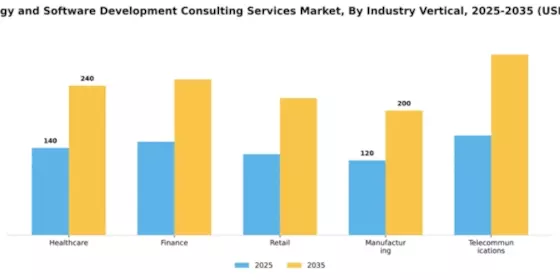
In the Technology and Software Development Consulting Services Market, the Healthcare sector stands as the largest segment, driven by the increasing demand for digitization and enhanced patient care solutions. Following closely is the Finance sector, which has shown remarkable growth due to rising adoption of fintech solutions and the growing need for cybersecurity in financial transactions. Retail, Manufacturing, and Telecommunications also contribute notably to the market, but their impact is overshadowed by the more dynamic developments in Healthcare and Finance.
Healthcare: Dominant vs. Finance: Emerging
The Healthcare sector is characterized by its extensive focus on integrating advanced technologies such as AI and machine learning to improve patient outcomes and streamline operations. This segment benefits from substantial investments in electronic health records and telemedicine solutions, making it a priority for consulting services. On the other hand, the Finance sector is emerging rapidly, fueled by innovations in blockchain, payment processing, and regulatory technology. Financial institutions are increasingly seeking consulting services to navigate digital transformation and to ensure compliance with evolving regulations, creating a demand for technology solutions that enhance operational efficiency and security.
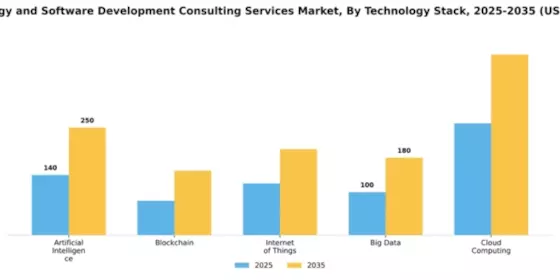
The Technology and Software Development Consulting Services Market is distinctly segmented into various technology stacks, with Artificial Intelligence commanding the largest market share. Its integration across multiple industries, enhancing automation and decision-making processes, positions it as a frontrunner. Following AI, Cloud Computing has emerged as a substantial segment, reflecting growing enterprise demands for scalable solutions and improved operational efficiency. In terms of growth trends, the market is witnessing significant advancements driven by innovations in AI and Machine Learning, which continuously shape service offerings. Concurrently, Cloud Computing is experiencing rapid growth due to businesses transitioning to cloud environments for flexibility and cost-effectiveness. Both segments are further propelled by increasing investments in technology and the need for digital transformation across sectors.
Artificial Intelligence (Dominant) vs. Cloud Computing (Emerging)
Artificial Intelligence is the dominant force in the Technology and Software Development Consulting Services Market, offering transformative solutions that enhance productivity and innovation for businesses. This segment's prevalence stems from its ability to analyze large datasets, automate processes, and improve decision-making efficiency. Conversely, Cloud Computing is emerging vigorously, responding to market demands for more agile and cost-effective IT solutions. As organizations increasingly adopt cloud technologies, they seek not only storage but also advanced computing capabilities and services. While AI focuses on data intelligence and automation, Cloud Computing enhances overall infrastructure agility and scalability. Together, they represent a powerful convergence that drives the consulting landscape forward.
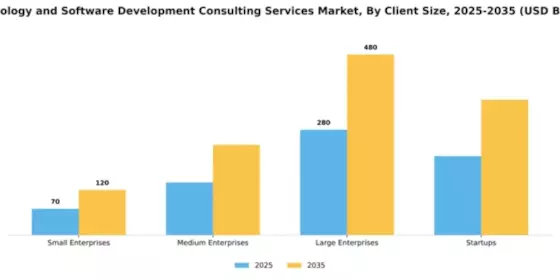
In the Technology and Software Development Consulting Services Market, the client size segment is characterized by a diverse distribution of enterprises. Small enterprises hold a significant share due to their increasing reliance on technology for operational efficiency. Conversely, startups, though smaller in overall size, are rapidly gaining traction, driven by innovation and agility in adopting new technologies. This trend indicates a shift in market dynamics, with small enterprises acting as the backbone while startups introduce disruptive solutions. Growth trends within the client size segment are shaped by various factors. Small enterprises are leveraging technological advancements to optimize costs and enhance competitiveness. Meanwhile, startups benefit from a robust ecosystem of venture capital and accelerators, enabling faster development cycles and market entry. The interplay between these segments defines the overall landscape, with small enterprises providing stability and startups injecting vibrancy into the market.
Small Enterprises (Dominant) vs. Large Enterprises (Emerging)
Small enterprises play a dominant role in the Technology and Software Development Consulting Services Market, typically characterized by their adaptability and grassroots approach to technology integration. They often face unique challenges such as limited resources and access to cutting-edge solutions. However, their ability to pivot and adopt new strategies allows them to remain competitive against larger counterparts. On the other hand, large enterprises, while accumulating significant experience and resources, are increasingly viewed as emerging players in this space. They are reevaluating their strategies to leverage consultancy services for enhanced digital transformation. This shift positions them as competitors capable of influencing market trends, showcasing how both segments can coexist and impact consumer choices in consulting services.
Get more detailed insights about Technology and Software Development Consulting Services Market Request Free Sample
North America continues to lead the Technology and Software Development Consulting Services market, holding a significant share of 420.0M in 2024. The region's growth is driven by rapid technological advancements, increased digital transformation initiatives, and a strong focus on cybersecurity. Regulatory support for innovation and investment in tech infrastructure further catalyzes demand, making it a hub for consulting services. The competitive landscape is characterized by major players such as IBM, Accenture, and Deloitte, which dominate the market. The U.S. remains the largest contributor, benefiting from a robust startup ecosystem and significant investments in R&D. The presence of leading firms ensures a continuous influx of innovative solutions, catering to diverse industries and enhancing overall market growth.
Europe's Technology and Software Development Consulting Services market is valued at 180.0M, showcasing a growing demand for digital solutions. The region is experiencing a shift towards cloud computing and AI integration, driven by regulatory frameworks that promote digitalization and sustainability. Initiatives like the EU Digital Strategy are pivotal in shaping the market, encouraging investments in technology and innovation. Leading countries such as Germany, the UK, and France are at the forefront, with key players like Capgemini and PwC enhancing their market presence. The competitive landscape is evolving, with a mix of established firms and emerging startups driving innovation. The focus on data privacy and compliance further influences service offerings, ensuring that consulting services align with regulatory standards.
The Asia-Pacific region, valued at 80.0M, is rapidly emerging as a significant player in the Technology and Software Development Consulting Services market. The growth is fueled by increasing investments in digital transformation, a rising middle class, and government initiatives aimed at enhancing technological capabilities. Countries are focusing on smart city projects and digital infrastructure, which are key drivers of demand in the consulting sector. India and China are leading the charge, with major firms like Tata Consultancy Services and Infosys expanding their global footprint. The competitive landscape is marked by a blend of local and international players, fostering innovation and collaboration. As the region continues to embrace technology, the consulting services market is expected to witness substantial growth, catering to diverse sectors and industries.
The Middle East and Africa region, with a market size of 20.0M, is gradually emerging in the Technology and Software Development Consulting Services sector. The growth is driven by increasing investments in technology infrastructure and a focus on digital transformation across various industries. Governments are implementing policies to enhance tech adoption, which is crucial for economic diversification and growth in the region. Countries like South Africa and the UAE are leading the way, with a growing number of consulting firms entering the market. The competitive landscape is characterized by both local and international players, creating opportunities for collaboration and innovation. As the region continues to develop its tech ecosystem, the demand for consulting services is expected to rise significantly, unlocking new avenues for growth.
The Technology and Software Development Consulting Services Market is currently characterized by a dynamic competitive landscape, driven by rapid technological advancements and an increasing demand for digital transformation across various sectors. Key players such as Accenture (IE), IBM (US), and Deloitte (GB) are strategically positioned to leverage their extensive expertise in innovation and consulting services. Accenture (IE) has focused on enhancing its capabilities in artificial intelligence and cloud services, which appears to be a significant growth driver. Meanwhile, IBM (US) emphasizes its hybrid cloud solutions and AI-driven analytics, indicating a strong commitment to integrating advanced technologies into its service offerings. Deloitte (GB) has been actively pursuing partnerships to bolster its digital transformation initiatives, suggesting a collaborative approach to addressing client needs in an evolving market.The market structure is moderately fragmented, with numerous players vying for market share. Key business tactics include localizing services to meet regional demands and optimizing supply chains to enhance efficiency. The collective influence of major companies shapes competitive dynamics, as they continuously adapt to emerging trends and client expectations. This competitive environment fosters innovation and encourages firms to differentiate themselves through specialized services and tailored solutions.In November Accenture (IE) announced a strategic partnership with a leading cloud provider to enhance its cloud migration services. This move is likely to strengthen Accenture's position in the market by expanding its service portfolio and enabling clients to transition more seamlessly to cloud-based solutions. The partnership underscores the importance of collaboration in driving technological advancements and meeting the growing demand for cloud services.In October IBM (US) launched a new AI-driven analytics platform aimed at improving operational efficiency for enterprises. This initiative reflects IBM's commitment to integrating AI into its consulting services, potentially providing clients with enhanced insights and decision-making capabilities. The introduction of this platform may position IBM as a leader in the AI consulting space, appealing to organizations seeking to leverage data for competitive advantage.In September Deloitte (GB) expanded its digital consulting practice by acquiring a boutique firm specializing in cybersecurity. This acquisition is indicative of Deloitte's strategy to enhance its service offerings in response to increasing cybersecurity threats faced by businesses. By integrating specialized expertise, Deloitte aims to provide comprehensive solutions that address both digital transformation and security concerns, thereby reinforcing its competitive edge in the market.As of December current trends in the Technology and Software Development Consulting Services Market include a pronounced focus on digitalization, sustainability, and AI integration. Strategic alliances are increasingly shaping the competitive landscape, as companies recognize the value of collaboration in driving innovation. The shift from price-based competition to a focus on technological differentiation and supply chain reliability is evident, suggesting that future competitive dynamics will hinge on the ability to deliver innovative solutions that meet evolving client needs.




The Technology and Software Development Consulting Services Market is projected to grow at a 5.02% CAGR from 2025 to 2035, driven by digital transformation, cloud adoption, and AI integration.
New opportunities lie in:
By 2035, the market is expected to be robust, reflecting substantial growth and innovation.
| MARKET SIZE 2024 | 700.0(USD Billion) |
| MARKET SIZE 2025 | 735.14(USD Billion) |
| MARKET SIZE 2035 | 1200.0(USD Billion) |
| COMPOUND ANNUAL GROWTH RATE (CAGR) | 5.02% (2025 - 2035) |
| REPORT COVERAGE | Revenue Forecast, Competitive Landscape, Growth Factors, and Trends |
| BASE YEAR | 2024 |
| Market Forecast Period | 2025 - 2035 |
| Historical Data | 2019 - 2024 |
| Market Forecast Units | USD Billion |
| Key Companies Profiled | Accenture (IE), IBM (US), Deloitte (GB), Capgemini (FR), Cognizant (US), Tata Consultancy Services (IN), Infosys (IN), Wipro (IN), HCL Technologies (IN), PwC (GB) |
| Segments Covered | Service Type, Industry Vertical, Technology Stack, Client Size |
| Key Market Opportunities | Integration of artificial intelligence and machine learning in software development consulting services. |
| Key Market Dynamics | Rising demand for agile methodologies drives innovation and competition in Technology and Software Development Consulting Services. |
| Countries Covered | North America, Europe, APAC, South America, MEA |
The projected market valuation for the Technology and Software Development Consulting Services Market in 2035 is 1200.0 USD Billion.
The overall market valuation for the Technology and Software Development Consulting Services Market was 700.0 USD Billion in 2024.
The expected CAGR for the Technology and Software Development Consulting Services Market during the forecast period 2025 - 2035 is 5.02%.
By 2035, the Custom Software Development segment is projected to reach a valuation of 350.0 USD Billion.
The Healthcare industry vertical is expected to grow from 140.0 USD Billion to 240.0 USD Billion by 2035.
The Cloud Computing segment is projected to reach a valuation of 420.0 USD Billion by 2035.
The Large Enterprises segment is anticipated to dominate the market, reaching a valuation of 480.0 USD Billion by 2035.
Key players such as Accenture and IBM are instrumental in shaping the market landscape through innovative solutions and extensive service offerings.
The Mobile Application Development segment is projected to grow from 90.0 USD Billion to 150.0 USD Billion by 2035.
The Finance industry vertical is projected to grow from 150.0 USD Billion to 250.0 USD Billion, indicating robust demand compared to other sectors.


Kindly complete the form below to receive a free sample of this Report

“This is really good guys. Excellent work on a tight deadline. I will continue to use you going forward and recommend you to others. Nice job”


“Thanks. It’s been a pleasure working with you, please use me as reference with any other Intel employees.”


“Thanks for sending the report it gives us a good global view of the Betaïne market.”


“Thank you, this will be very helpful for OQS.”


“We found the report very insightful! we found your research firm very helpful. I'm sending this email to secure our future business.”


“I am very pleased with how market segments have been defined in a relevant way for my purposes (such as "Portable Freezers & refrigerators" and "last-mile"). In general the report is well structured. Thanks very much for your efforts.”


“I have been reading the first document or the study, ,the Global HVAC and FP market report 2021 till 2026. Must say, good info! I have not gone in depth at all parts, but got a good indication of the data inside!”


“We got the report in time, we really thank you for your support in this process. I also thank to all of your team as they did a great job.”


“The Automotive 48V ECU Components Procurement Intelligence Study” was a complex project, but the Market Research Future (MRFR) team handled it with quality, agility, and customer-centricity. They delivered all requested data on time and within the agreed scope. The team, including Shubhendra Anand and Rahul Gotadki, was always readily available to clarify questions and swiftly implement necessary adjustments, driving the project to a successful conclusion within a very demanding timeframe.
I would also like to specifically commend Akshay Agarwal for his responsiveness and support at every stage—from our initial inquiry on May 6th through to final delivery on June 18th. His dedication made the entire process seamless.”



