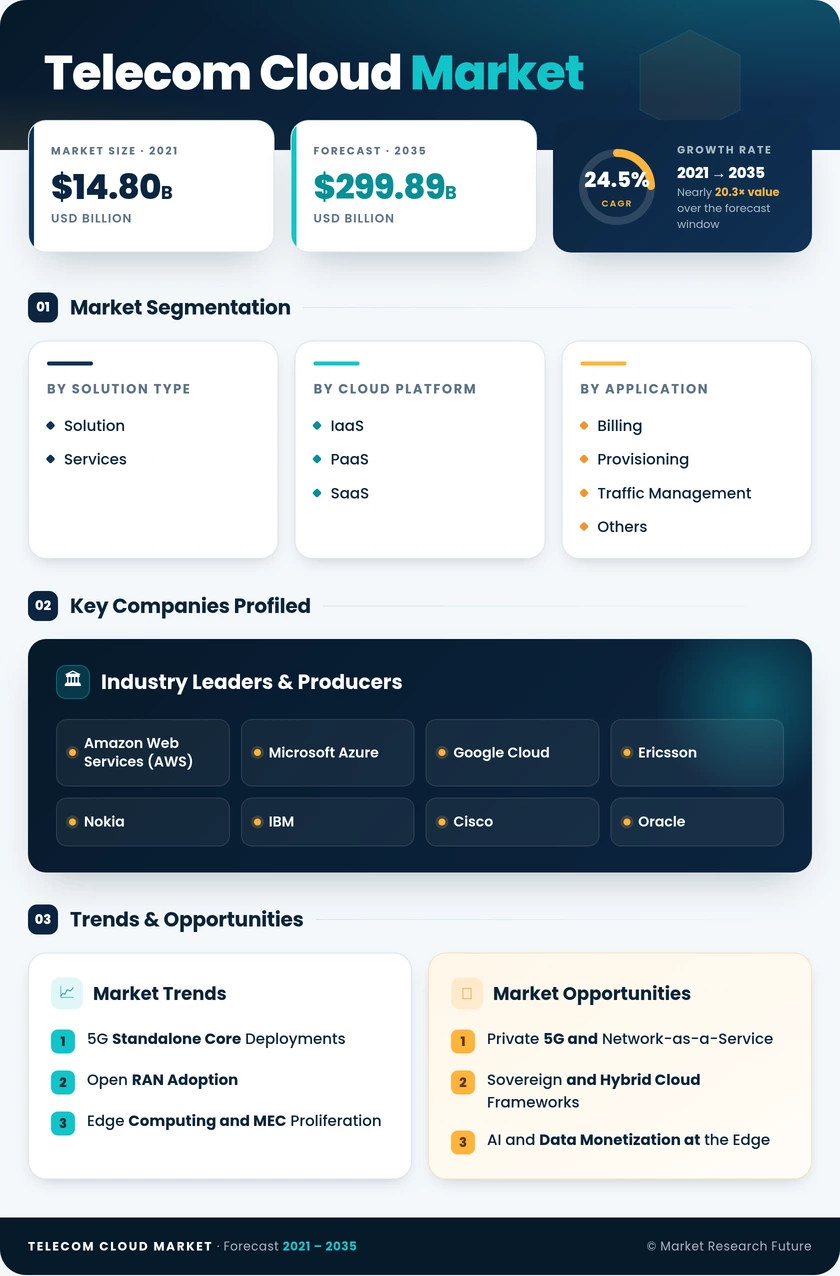
Telecom Cloud Market

ID: MRFR/ICT/1495-HCR
200 Pages
Aarti Dhapte
Last Updated: June 19, 2026
Telecom Cloud Market Size, Share and Research Report By Solution Type (Solution, Services), By Cloud Platform (Infrastructure-as-a-Service (IaaS), Platform-as-a-Service (PaaS), Software-as-a-Service (SaaS)), By Application (Billing and Provisioning, Traffic Management, Others), By End User (BFSI, Healthcare, Retail, Manufacturing, Others) and By Regional (North America, Europe, South America, Asia Pacific, Middle East and Africa) - Industry Forecast to 2035.
Download PDF ×

We do not share your information with anyone. However, we may send you emails based on your report interest from time to time. You may contact us at any time to opt-out.

  1. 1 Market Overview |
    1. 1.1 Study Assumptions & Market Definition |
    2. 1.2 Scope of the Study |
    3. 1.3 Research Methodology
  2. 2 Market Summary & Key Takeaways
  3. 3 Market Dynamics |
    1. 3.1 Market Drivers Analysis | |
      1. 3.1.1 5G Standalone Core Deployments | |
      2. 3.1.2 Open RAN Adoption | |
      3. 3.1.3 Edge Computing and MEC Proliferation | |
      4. 3.1.4 AI/ML-Driven Network Automation | |
      5. 3.1.5 Regulatory Push for Data Sovereignty | |
      6. 3.1.6 Carrier Cost-Reduction Imperatives | |
      7. 3.1.7 Enterprise Private 5G Demand |
    2. 3.2 Market Restraints Analysis | |
      1. 3.2.1 Legacy System Integration Complexity | |
      2. 3.2.2 Data Sovereignty and Compliance Fragmentation | |
      3. 3.2.3 Cybersecurity and Multi-Tenant Risk | |
      4. 3.2.4 Shortage of Cloud-Native Telecom Talent | |
      5. 3.2.5 Vendor Lock-In Concerns |
    3. 3.3 Market Opportunity Analysis | |
      1. 3.3.1 Private 5G and Network-as-a-Service | |
      2. 3.3.2 Sovereign and Hybrid Cloud Frameworks | |
      3. 3.3.3 AI and Data Monetization at the Edge | |
      4. 3.3.4 Emerging Markets Leapfrogging Legacy Infrastructure | |
      5. 3.3.5 Carrier-Neutral Edge and Multi-Cloud Orchestration |
    4. 3.4 Industry Value Chain Analysis |
    5. 3.5 Porter's Five Forces Analysis
  4. 4 Global Telecom Cloud Market Size & Forecast (2021–2035) |
    1. 4.1 Historical Market Size (2021–2025) |
    2. 4.2 Current & Forecast Market Size (2026–2035) |
    3. 4.3 Market Size by Revenue (USD Billion) |
    4. 4.4 Year-over-Year Growth Analysis
  5. 5 Segmentation Analysis |
    1. 5.1 By Solution Type | |
      1. 5.1.1 Solution | |
      2. 5.1.2 Services |
    2. 5.2 By Cloud Platform | |
      1. 5.2.1 Infrastructure-as-a-Service (IaaS) | |
      2. 5.2.2 Platform-as-a-Service (PaaS) | |
      3. 5.2.3 Software-as-a-Service (SaaS) |
    3. 5.3 By Application | |
      1. 5.3.1 Billing and Provisioning | |
      2. 5.3.2 Traffic Management | |
      3. 5.3.3 Others |
    4. 5.4 By End User | |
      1. 5.4.1 BFSI | |
      2. 5.4.2 Healthcare | |
      3. 5.4.3 Retail | |
      4. 5.4.4 Manufacturing | |
      5. 5.4.5 Others
  6. 6 Regional Analysis |
    1. 6.1 North America | |
      1. 6.1.1 United States | |
      2. 6.1.2 Canada | |
      3. 6.1.3 Mexico |
    2. 6.2 Europe | |
      1. 6.2.1 Germany | |
      2. 6.2.2 United Kingdom | |
      3. 6.2.3 France | |
      4. 6.2.4 Italy | |
      5. 6.2.5 Spain | |
      6. 6.2.6 Nordic Countries | |
      7. 6.2.7 Russia | |
      8. 6.2.8 Rest of Europe |
    3. 6.3 Asia-Pacific | |
      1. 6.3.1 China | |
      2. 6.3.2 India | |
      3. 6.3.3 Japan | |
      4. 6.3.4 South Korea | |
      5. 6.3.5 ASEAN | |
      6. 6.3.6 Rest of Asia-Pacific |
    4. 6.4 South America | |
      1. 6.4.1 Brazil | |
      2. 6.4.2 Argentina | |
      3. 6.4.3 Rest of South America |
    5. 6.5 Middle East & Africa | |
      1. 6.5.1 Saudi Arabia | |
      2. 6.5.2 UAE | |
      3. 6.5.3 South Africa | |
      4. 6.5.4 Egypt | |
      5. 6.5.5 Rest of MEA
  7. 7 Competitive Landscape |
    1. 7.1 Market Share Analysis (2025) |
    2. 7.2 Competitive Benchmarking Matrix |
    3. 7.3 Company Profiles | |
      1. 7.3.1 Amazon Web Services (AWS) | |
      2. 7.3.2 Microsoft Azure | |
      3. 7.3.3 Google Cloud | |
      4. 7.3.4 Ericsson | |
      5. 7.3.5 Nokia | |
      6. 7.3.6 IBM | |
      7. 7.3.7 Cisco | |
      8. 7.3.8 Oracle | |
      9. 7.3.9 Huawei | |
      10. 7.3.10 VMware (Broadcom)
  8. 8 Future Outlook & Strategic Recommendations (2026–2035) |
    1. 8.1 AI-Native Autonomous Networks |
    2. 8.2 Platform Economics and API Monetization |
    3. 8.3 Energy Efficiency and Sustainable Operations |
    4. 8.4 Satellite-Terrestrial Cloud Convergence
  9. 9 Recent Developments & News
  10. 10 Frequently Asked Questions (FAQs)
  11. 11 Report Scope & Methodology |
    1. 11.1 Study Period & Base Year |
    2. 11.2 Data Sources & Citations |
    3. 11.3 Abbreviations
  12. 12 LIST OF TABLES |
  13. TABLE 1 Global Telecom Cloud Market Size & Forecast, by Revenue (USD Billion), 2021–2035 |
  14. TABLE 2 Global Telecom Cloud Market – Year-over-Year Growth Analysis, 2021–2035 |
  15. TABLE 3 Global Telecom Cloud Market – Driver Impact Analysis |
  16. TABLE 4 Global Telecom Cloud Market – Restraints Impact Analysis |
  17. TABLE 5 Global Telecom Cloud Market Size, by Solution Type, 2021–2035 (USD Billion) |
  18. TABLE 6 Global Telecom Cloud Market Size, by Cloud Platform, 2021–2035 (USD Billion) |
  19. TABLE 7 Global Telecom Cloud Market Size, by Application, 2021–2035 (USD Billion) |
  20. TABLE 8 Global Telecom Cloud Market Size, by End User, 2021–2035 (USD Billion) |
  21. TABLE 9 Global Telecom Cloud Market Size, by Region, 2021–2035 (USD Billion) |
  22. TABLE 10 North America Telecom Cloud Market Size, by Country, 2021–2035 (USD Billion) |
  23. TABLE 11 Europe Telecom Cloud Market Size, by Country, 2021–2035 (USD Billion) |
  24. TABLE 12 Asia-Pacific Telecom Cloud Market Size, by Country, 2021–2035 (USD Billion) |
  25. TABLE 13 South America Telecom Cloud Market Size, by Country, 2021–2035 (USD Billion) |
  26. TABLE 14 Middle East & Africa Telecom Cloud Market Size, by Country, 2021–2035 (USD Billion) |
  27. TABLE 15 Competitive Benchmarking Matrix – Global Telecom Cloud Market, 2025 |
  28. TABLE 16 Company Profiles – Key Players, Global Telecom Cloud Market |
  29. TABLE 17 Recent Developments & Strategic Announcements, 2023–2025 |
  30. TABLE 18 Report Scope & Methodology Summary |
  31. TABLE 19 Detailed Sources and Citations |
  32. TABLE 20 North America Telecom Cloud Market Size, by Solution Type, 2021–2035 (USD Billion) |
  33. TABLE 21 North America Telecom Cloud Market Size, by Cloud Platform, 2021–2035 (USD Billion) |
  34. TABLE 22 North America Telecom Cloud Market Size, by Application, 2021–2035 (USD Billion) |
  35. TABLE 23 North America Telecom Cloud Market Size, by End User, 2021–2035 (USD Billion) |
  36. TABLE 24 Europe Telecom Cloud Market Size, by Solution Type, 2021–2035 (USD Billion) |
  37. TABLE 25 Europe Telecom Cloud Market Size, by Cloud Platform, 2021–2035 (USD Billion) |
  38. TABLE 26 Europe Telecom Cloud Market Size, by Application, 2021–2035 (USD Billion) |
  39. TABLE 27 Europe Telecom Cloud Market Size, by End User, 2021–2035 (USD Billion) |
  40. TABLE 28 Asia-Pacific Telecom Cloud Market Size, by Solution Type, 2021–2035 (USD Billion) |
  41. TABLE 29 Asia-Pacific Telecom Cloud Market Size, by Cloud Platform, 2021–2035 (USD Billion) |
  42. TABLE 30 Asia-Pacific Telecom Cloud Market Size, by Application, 2021–2035 (USD Billion) |
  43. TABLE 31 Asia-Pacific Telecom Cloud Market Size, by End User, 2021–2035 (USD Billion) |
  44. TABLE 32 South America Telecom Cloud Market Size, by Solution Type, 2021–2035 (USD Billion) |
  45. TABLE 33 South America Telecom Cloud Market Size, by Cloud Platform, 2021–2035 (USD Billion) |
  46. TABLE 34 South America Telecom Cloud Market Size, by Application, 2021–2035 (USD Billion) |
  47. TABLE 35 South America Telecom Cloud Market Size, by End User, 2021–2035 (USD Billion) |
  48. TABLE 36 Middle East & Africa Telecom Cloud Market Size, by Solution Type, 2021–2035 (USD Billion) |
  49. TABLE 37 Middle East & Africa Telecom Cloud Market Size, by Cloud Platform, 2021–2035 (USD Billion) |
  50. TABLE 38 Middle East & Africa Telecom Cloud Market Size, by Application, 2021–2035 (USD Billion) |
  51. TABLE 39 Middle East & Africa Telecom Cloud Market Size, by End User, 2021–2035 (USD Billion)
  52. 13 LIST OF FIGURES |
  53. FIGURE 1 Global Telecom Cloud Market Dynamics (Drivers, Restraints, Opportunities) |
  54. FIGURE 2 Industry Value Chain Analysis – Telecom Cloud Market |
  55. FIGURE 3 Porter's Five Forces Analysis – Telecom Cloud Market |
  56. FIGURE 4 Global Telecom Cloud Market Size Trend & Forecast, 2021–2035 (USD Billion) |
  57. FIGURE 5 Global Telecom Cloud Market Share, by Solution Type, 2025 (%) |
  58. FIGURE 6 Global Telecom Cloud Market Share, by Cloud Platform, 2025 (%) |
  59. FIGURE 7 Global Telecom Cloud Market Share, by Application, 2025 (%) |
  60. FIGURE 8 Global Telecom Cloud Market Share, by End User, 2025 (%) |
  61. FIGURE 9 Global Telecom Cloud Market Share, by Region, 2025 (%) |
  62. FIGURE 10 North America Telecom Cloud Market Size & Forecast, 2021–2035 (USD Billion) |
  63. FIGURE 11 Europe Telecom Cloud Market Size & Forecast, 2021–2035 (USD Billion) |
  64. FIGURE 12 Asia-Pacific Telecom Cloud Market Size & Forecast, 2021–2035 (USD Billion) |
  65. FIGURE 13 South America Telecom Cloud Market Size & Forecast, 2021–2035 (USD Billion) |
  66. FIGURE 14 Middle East & Africa Telecom Cloud Market Size & Forecast, 2021–2035 (USD Billion) |
  67. FIGURE 15 Competitive Landscape – Market Share Distribution, 2025

Segmentation Quick Reference

DimensionSub-SegmentsDominant SegmentFastest Growing Segment
By Solution TypeSolution, ServicesSolution (48.9% share, 2025)Services (29.2% CAGR)
By Cloud PlatformIaaS, PaaS, SaaSIaaS (45.4% share, 2025)PaaS (30.4% CAGR)
By ApplicationBilling and Provisioning, Traffic Management, OthersBilling and Provisioning (41.5% share, 2025)Traffic Management (29.8% CAGR)
By End UserBFSI, Healthcare, Retail, Manufacturing, OthersBFSI (34.4% share, 2025)Healthcare (26.1% CAGR)
By RegionNorth America, Europe, Asia-Pacific, South America, Middle East & AfricaNorth America (32.5% share, 2025)Asia-Pacific (28.7% CAGR)


Market Segmentation Overview

By Solution Type

Sub-SegmentKey Trend
SolutionIntegrated cloud-native platforms bundling VNFs, orchestration, and management layers for end-to-end carrier cloudification
ServicesManaged migration, systems integration, and optimization services are expanding as in-house cloud expertise remains scarce


Solution offerings remain dominant as operators prioritize turnkey platforms that reduce vendor complexity and accelerate time-to-deployment. Services are growing faster as multi-cloud environments demand ongoing optimization, security management, and performance tuning from specialized integrators.

By Cloud Platform

Sub-SegmentKey Trend
Infrastructure-as-a-Service (IaaS)Compute, storage, and networking resources for virtualized network functions and core workloads
Platform-as-a-Service (PaaS)Development toolchains enabling operators to build and deploy telecom-specific applications at cloud speed
Software-as-a-Service (SaaS)Fully hosted BSS/OSS applications, including billing, CRM, and subscriber management


IaaS captures the largest share because the first wave of telecom cloud adoption involves migrating compute-heavy workloads from proprietary hardware to elastic cloud infrastructure. PaaS is accelerating as carriers shift from consuming cloud to building on cloud, developing custom applications for network slicing and API monetization.

By Application

Sub-SegmentKey Trend
Billing and ProvisioningCloud-hosted BSS platforms enabling real-time charging, elastic scaling, and faster product launches
Traffic ManagementAI-powered traffic steering and analytics supporting 5G network slicing and quality-of-service guarantees
OthersCRM, workforce management, security operations, and additional operational workloads are migrating to the cloud


Billing and Provisioning was the natural first mover for cloud migration, given the maturity of hosted BSS solutions and the immediate ROI from elastic scaling during peak usage. Traffic Management is gaining momentum rapidly as 5G slicing demands real-time, cloud-native analytics capabilities.

By End User

Sub-SegmentKey Trend
BFSIDemand for ultra-low-latency, encrypted connectivity supporting algorithmic trading and digital banking
HealthcareTelemedicine expansion and connected medical devices are driving carrier-grade cloud connectivity requirements
RetailOmnichannel customer engagement requiring reliable, scalable cloud-based communication infrastructure
ManufacturingPrivate 5G and industrial IoT are creating demand for edge-cloud platforms in factory environments
OthersGovernment, education, media, and transportation verticals are adopting telecom cloud for specialized use cases


BFSI leads enterprise adoption because financial services operate under the most stringent latency and security requirements, making carrier-managed cloud a preferred option. Healthcare is accelerating fastest as post-pandemic telemedicine adoption created permanent demand for reliable, compliant telecom cloud connectivity.