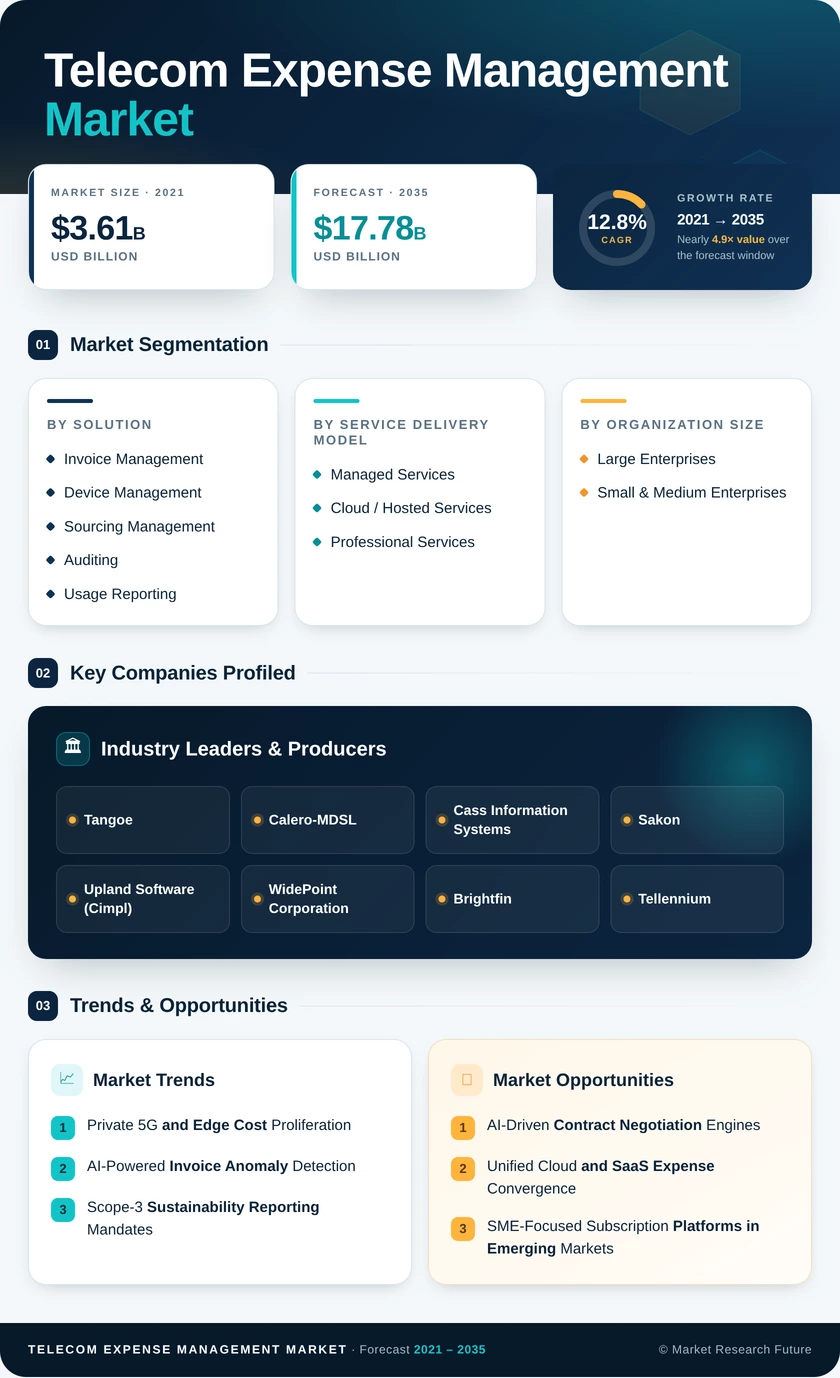
Telecom Expense Management Market

ID: MRFR/ICT/3345-HCR
100 Pages
Ankit Gupta
Last Updated: June 22, 2026
Telecom Expense Management Market Size, Share and Research Report By Solution (Invoice Management, Device Management, Sourcing Management, Auditing, Usage Reporting, Dispute Management, Other Solutions), By Service Delivery Model (Managed Services, Cloud / Hosted Services, Professional Services), By Organization Size (Large Enterprises, Small & Medium Enterprises), By End User (BFSI, Manufacturing, IT & Telecom, Healthcare, Government, Other End Users) and By Regional (North America, Europe, South America, Asia Pacific, Middle East and Africa) - Industry Forecast to 2035.
Download PDF ×

We do not share your information with anyone. However, we may send you emails based on your report interest from time to time. You may contact us at any time to opt-out.

  1. 1 Market Overview |
    1. 1.1 Study Assumptions & Market Definition |
    2. 1.2 Scope of the Study |
    3. 1.3 Research Methodology
  2. 2 Market Summary & Key Takeaways
  3. 3 Market Dynamics |
    1. 3.1 Market Drivers Analysis | |
      1. 3.1.1 Private 5G & Edge Cost Proliferation | |
      2. 3.1.2 AI-Powered Invoice Anomaly Detection | |
      3. 3.1.3 Scope-3 Sustainability Reporting Mandates | |
      4. 3.1.4 Hybrid Workforce Telecom Sprawl | |
      5. 3.1.5 SME Digital Transformation Wave | |
      6. 3.1.6 IoT/OT Device Explosion in Manufacturing | |
      7. 3.1.7 Vendor-Led Managed-Service Expansion |
    2. 3.2 Market Restraints Analysis | |
      1. 3.2.1 Data-Integration Complexity Across Legacy ERP Stacks | |
      2. 3.2.2 Carrier Billing-Format Fragmentation | |
      3. 3.2.3 Budget Constraints in the SME Segment | |
      4. 3.2.4 Vendor Lock-In Concerns | |
      5. 3.2.5 Regulatory Ambiguity Around Cross-Border Data Flows |
    3. 3.3 Market Opportunity Analysis | |
      1. 3.3.1 AI-Driven Contract Negotiation Engines | |
      2. 3.3.2 Unified Cloud and SaaS Expense Convergence | |
      3. 3.3.3 SME-Focused Subscription Platforms in Emerging Markets | |
      4. 3.3.4 Sustainability-Linked Data Monetization | |
      5. 3.3.5 Satellite and LEO Broadband Expense Management |
    4. 3.4 Industry Value Chain Analysis |
    5. 3.5 Porter's Five Forces Analysis
  4. 4 Global Telecom Expense Management Market Size & Forecast (2021–2035) |
    1. 4.1 Historical Market Size (2021–2025) |
    2. 4.2 Current & Forecast Market Size (2026–2035) |
    3. 4.3 Market Size by Revenue (USD Billion) |
    4. 4.4 Year-over-Year Growth Analysis
  5. 5 Segmentation Analysis |
    1. 5.1 By Solution | |
      1. 5.1.1 Invoice Management | |
      2. 5.1.2 Device Management | |
      3. 5.1.3 Sourcing Management | |
      4. 5.1.4 Auditing | |
      5. 5.1.5 Usage Reporting | |
      6. 5.1.6 Dispute Management | |
      7. 5.1.7 Other Solutions |
    2. 5.2 By Service Delivery Model | |
      1. 5.2.1 Managed Services | |
      2. 5.2.2 Cloud / Hosted Services | |
      3. 5.2.3 Professional Services |
    3. 5.3 By Organization Size | |
      1. 5.3.1 Large Enterprises | |
      2. 5.3.2 Small & Medium Enterprises |
    4. 5.4 By End User | |
      1. 5.4.1 BFSI | |
      2. 5.4.2 Manufacturing | |
      3. 5.4.3 IT & Telecom | |
      4. 5.4.4 Healthcare | |
      5. 5.4.5 Government | |
      6. 5.4.6 Other End Users
  6. 6 Regional Analysis |
    1. 6.1 North America | |
      1. 6.1.1 United States | |
      2. 6.1.2 Canada | |
      3. 6.1.3 Mexico |
    2. 6.2 Europe | |
      1. 6.2.1 Germany | |
      2. 6.2.2 United Kingdom | |
      3. 6.2.3 France | |
      4. 6.2.4 Italy | |
      5. 6.2.5 Spain | |
      6. 6.2.6 Nordic Countries | |
      7. 6.2.7 Russia | |
      8. 6.2.8 Rest of Europe |
    3. 6.3 Asia-Pacific | |
      1. 6.3.1 China | |
      2. 6.3.2 India | |
      3. 6.3.3 Japan | |
      4. 6.3.4 South Korea | |
      5. 6.3.5 ASEAN | |
      6. 6.3.6 Rest of Asia-Pacific |
    4. 6.4 South America | |
      1. 6.4.1 Brazil | |
      2. 6.4.2 Argentina | |
      3. 6.4.3 Rest of South America |
    5. 6.5 Middle East & Africa | |
      1. 6.5.1 Saudi Arabia | |
      2. 6.5.2 UAE | |
      3. 6.5.3 South Africa | |
      4. 6.5.4 Egypt | |
      5. 6.5.5 Rest of MEA
  7. 7 Competitive Landscape |
    1. 7.1 Market Share Analysis (2025) |
    2. 7.2 Competitive Benchmarking Matrix |
    3. 7.3 Company Profiles | |
      1. 7.3.1 Tangoe | |
      2. 7.3.2 Calero-MDSL | |
      3. 7.3.3 Cass Information Systems | |
      4. 7.3.4 Sakon | |
      5. 7.3.5 Upland Software (Cimpl) | |
      6. 7.3.6 WidePoint Corporation | |
      7. 7.3.7 Brightfin | |
      8. 7.3.8 Tellennium | |
      9. 7.3.9 Dimension Data (NTT) | |
      10. 7.3.10 Valicom
  8. 8 Future Outlook & Strategic Recommendations (2026–2035) |
    1. 8.1 Autonomous Telecom Financial Operations |
    2. 8.2 Platform Convergence with ITFM and FinOps |
    3. 8.3 ESG and Carbon-Aware Spend Optimization |
    4. 8.4 Satellite and Non-Terrestrial Network Integration
  9. 9 Recent Developments & News
  10. 10 Frequently Asked Questions (FAQs)
  11. 11 Report Scope & Methodology |
    1. 11.1 Study Period & Base Year |
    2. 11.2 Data Sources & Citations |
    3. 11.3 Abbreviations
  12. 12 LIST OF TABLES |
  13. TABLE 1 Global Telecom Expense Management Market Size & Forecast, by Revenue (USD Billion), 2021–2035 |
  14. TABLE 2 Global Telecom Expense Management Market – Year-over-Year Growth Analysis, 2021–2035 |
  15. TABLE 3 Global Telecom Expense Management Market – Driver Impact Analysis |
  16. TABLE 4 Global Telecom Expense Management Market – Restraint Impact Analysis |
  17. TABLE 5 Global Telecom Expense Management Market Size, by Solution, 2021–2035 (USD Billion) |
  18. TABLE 6 Global Telecom Expense Management Market Size, by Service Delivery Model, 2021–2035 (USD Billion) |
  19. TABLE 7 Global Telecom Expense Management Market Size, by Organization Size, 2021–2035 (USD Billion) |
  20. TABLE 8 Global Telecom Expense Management Market Size, by End User, 2021–2035 (USD Billion) |
  21. TABLE 9 Global Telecom Expense Management Market Size, by Region, 2021–2035 (USD Billion) |
  22. TABLE 10 North America Telecom Expense Management Market Size, by Country, 2021–2035 (USD Billion) |
  23. TABLE 11 Europe Telecom Expense Management Market Size, by Country, 2021–2035 (USD Billion) |
  24. TABLE 12 Asia-Pacific Telecom Expense Management Market Size, by Country, 2021–2035 (USD Billion) |
  25. TABLE 13 South America Telecom Expense Management Market Size, by Country, 2021–2035 (USD Billion) |
  26. TABLE 14 Middle East & Africa Telecom Expense Management Market Size, by Country, 2021–2035 (USD Billion) |
  27. TABLE 15 Competitive Benchmarking Matrix – Global Telecom Expense Management Market, 2025 |
  28. TABLE 16 Company Profiles – Key Players, Global Telecom Expense Management Market |
  29. TABLE 17 Recent Developments & Strategic Announcements, 2023–2025 |
  30. TABLE 18 Report Scope & Methodology Summary |
  31. TABLE 19 Detailed Sources and Citations
  32. 13 LIST OF FIGURES |
  33. FIGURE 1 Telecom Expense Management Market Dynamics Overview |
  34. FIGURE 2 Industry Value Chain Analysis – Telecom Expense Management Market |
  35. FIGURE 3 Porter's Five Forces Analysis – Telecom Expense Management Market |
  36. FIGURE 4 Global Telecom Expense Management Market Size Trend (USD Billion), 2021–2035 |
  37. FIGURE 5 Telecom Expense Management Market Share, by Solution, 2025 |
  38. FIGURE 6 Telecom Expense Management Market Share, by Service Delivery Model, 2025 |
  39. FIGURE 7 Telecom Expense Management Market Share, by Organization Size, 2025 |
  40. FIGURE 8 Telecom Expense Management Market Share, by End User, 2025 |
  41. FIGURE 9 Telecom Expense Management Market Share, by Region, 2025 |
  42. FIGURE 10 North America Telecom Expense Management Market Share, by Country, 2025 |
  43. FIGURE 11 Europe Telecom Expense Management Market Share, by Country, 2025 |
  44. FIGURE 12 Asia-Pacific Telecom Expense Management Market Share, by Country, 2025 |
  45. FIGURE 13 South America Telecom Expense Management Market Share, by Country, 2025 |
  46. FIGURE 14 Middle East & Africa Telecom Expense Management Market Share, by Country, 2025 |
  47. FIGURE 15 Competitive Landscape – Telecom Expense Management Market, 2025

Segmentation Quick Reference

DimensionSub-SegmentsDominant SegmentFastest Growing Segment
By SolutionInvoice Management, Device Management, Sourcing Management, Auditing, Usage Reporting, Dispute Management, Other SolutionsInvoice ManagementUsage Reporting
By Service Delivery ModelManaged Services, Cloud / Hosted Services, Professional ServicesManaged ServicesCloud / Hosted Services
By Organization SizeLarge Enterprises, Small & Medium EnterprisesLarge EnterprisesSmall & Medium Enterprises
By End UserBFSI, Manufacturing, IT & Telecom, Healthcare, Government, Other End UsersBFSIManufacturing


Market Segmentation Overview

By Solution

Sub-SegmentKey Trend
Invoice ManagementAI-driven three-way matching and automated error recovery
Device ManagementBYOD policy expansion and mobile-fleet lifecycle orchestration
Sourcing ManagementAutomated contract benchmarking and renewal optimization
AuditingRegulatory-driven audit-trail mandates across BFSI and government
Usage ReportingReal-time analytics dashboards enabling proactive spend reallocation
Dispute ManagementCarrier auto-dispute filing with machine-learning escalation triggers
Other SolutionsEmerging satellite, IoT, and edge-compute expense tracking


Invoice management and usage reporting together represent the operational core of the Telecom Expense Management Market, handling cost visibility from invoice ingestion through consumption-level optimization. Growth in usage reporting reflects a broader market shift from reactive auditing to predictive, continuous cost governance.

By Service Delivery Model

Sub-SegmentKey Trend
Managed ServicesFull-lifecycle outsourcing with SLA-backed cost-recovery guarantees
Cloud / Hosted ServicesSaaS-first delivery with sub-30-day deployment timelines
Professional ServicesSystem integration, customization, and end-user training


Managed services anchor enterprise procurement strategies where internal telecom-management resources are limited. Cloud delivery models are converting mid-market buyers who previously could not justify on-premise implementations.

By Organization Size

Sub-SegmentKey Trend
Large EnterprisesMulti-carrier, multi-country estate management with advanced analytics
Small & Medium EnterprisesAffordable per-user subscription platforms with self-service interfaces


Large enterprises generate the majority of platform revenue, but SME adoption is accelerating as vendors lower pricing thresholds and offer mobile-first deployment options.

By End User

Sub-SegmentKey Trend
BFSISOX/DORA compliance-driven, auditable telecom expense records
ManufacturingPrivate 5G and IoT billing complexity from Industry 4.0 deployments
IT & TelecomInternal consumption optimization and resale margin management
HealthcareTelehealth device proliferation and clinical mobility programs
GovernmentProcurement transparency mandates and FedRAMP-certified platforms
Other End UsersRetail, education, logistics, and energy-sector telecom management


BFSI and manufacturing together account for the largest share of enterprise demand, driven by distinct but equally compelling regulatory and operational complexity factors within the Telecom Expense Management Market.