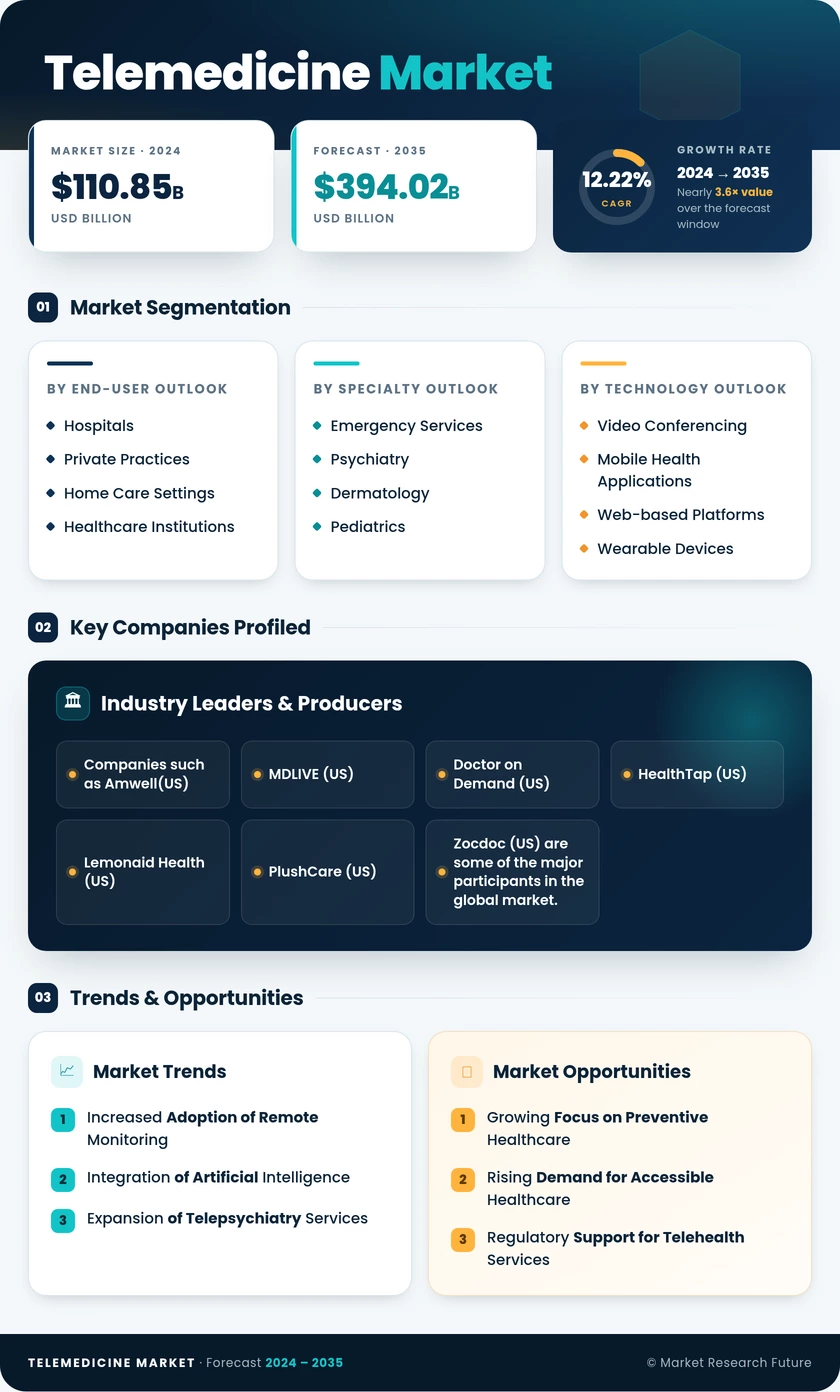
Segmentation Quick Reference
| Dimension | Sub-Segments | Dominant Segment | Fastest Growing Segment |
| By Modality | Synchronous; Asynchronous; Remote Patient Monitoring | Synchronous | Remote Patient Monitoring |
| By Component | Software Platforms; Hardware & Peripherals; Services | Services | Software Platforms |
| By End User | Healthcare Providers; Payers & Employers; Patients / Home Users; Government Agencies & NGOs | Healthcare Providers | Patients / Home Users |
| By Geography | North America; Europe; Asia-Pacific; Middle East & Africa; South America | North America | Asia-Pacific |
Market Segmentation Overview
By Modality
| Sub-Segment | Key Trend |
| Synchronous | Real-time encounters remain the reimbursement default, with behavioural health driving the largest single volume pool. |
| Asynchronous | Store-and-forward workflows expand in dermatology, radiology, and ophthalmology to clear specialist backlogs. |
| Remote Patient Monitoring | Continuous physiologic data collection scales on the back of chronic-care management billing codes |
Modality mix is shifting from episodic to continuous. Synchronous care keeps the largest revenue base through 2035. Still, remote monitoring absorbs the incremental growth because it aligns with how payers now want to purchase chronic disease management — by outcome over time rather than by encounter.
By Component
| Sub-Segment | Key Trend |
| Software Platforms | Consolidation of fragmented point solutions into unified, FHIR-native enterprise suites |
| Hardware & Peripherals | Connected diagnostic kits, cellular-enabled monitors, and examination carts for home and clinic settings |
| Services | Clinician staffing, integration engineering, managed operations, and specialty service lines |
Services carry the majority of spend because clinical labour and integration effort dominate total cost of ownership. Software grows faster as procurement teams retire duplicated tooling, and hardware follows monitoring enrolment rather than leading it.
By End User
| Sub-Segment | Key Trend |
| Healthcare Providers | Capacity extension, referral retention, and hospital-at-home programme build-out |
| Payers & Employers | Preferred-vendor arrangements and cost-avoidance contracting across large covered populations |
| Patients / Home Users | Direct-pay subscription models and consumer-brand distribution channels |
| Government Agencies & NGOs | Universal access mandates, rural coverage obligations, and donor-funded primary care networks |
Buyer power is redistributing. Providers still control the largest budget, yet payers and employers increasingly determine which platforms reach patients at all, making channel access — not clinical feature depth — the decisive competitive variable through 2035.
By Geography
| Sub-Segment | Key Trend |
| North America | Statutory reimbursement permanence underpins the deepest and most stable revenue pool. |
| Europe | Cross-border data and prescription frameworks unlock multi-country vendor economics. |
| Asia-Pacific | Sovereign platforms and insurer integration deliver the steepest growth trajectory. |
| South America | Permanent legalisation shifts volume toward private supplementary insurance networks. |
| Middle East & Africa | National virtual-hospital programmes function as tertiary referral backstops. |
Regional divergence is a reimbursement story. Mature payment systems reward clinical depth and outcome measurement, while emerging systems reward low unit cost and reach — two different product strategies that few vendors execute simultaneously.