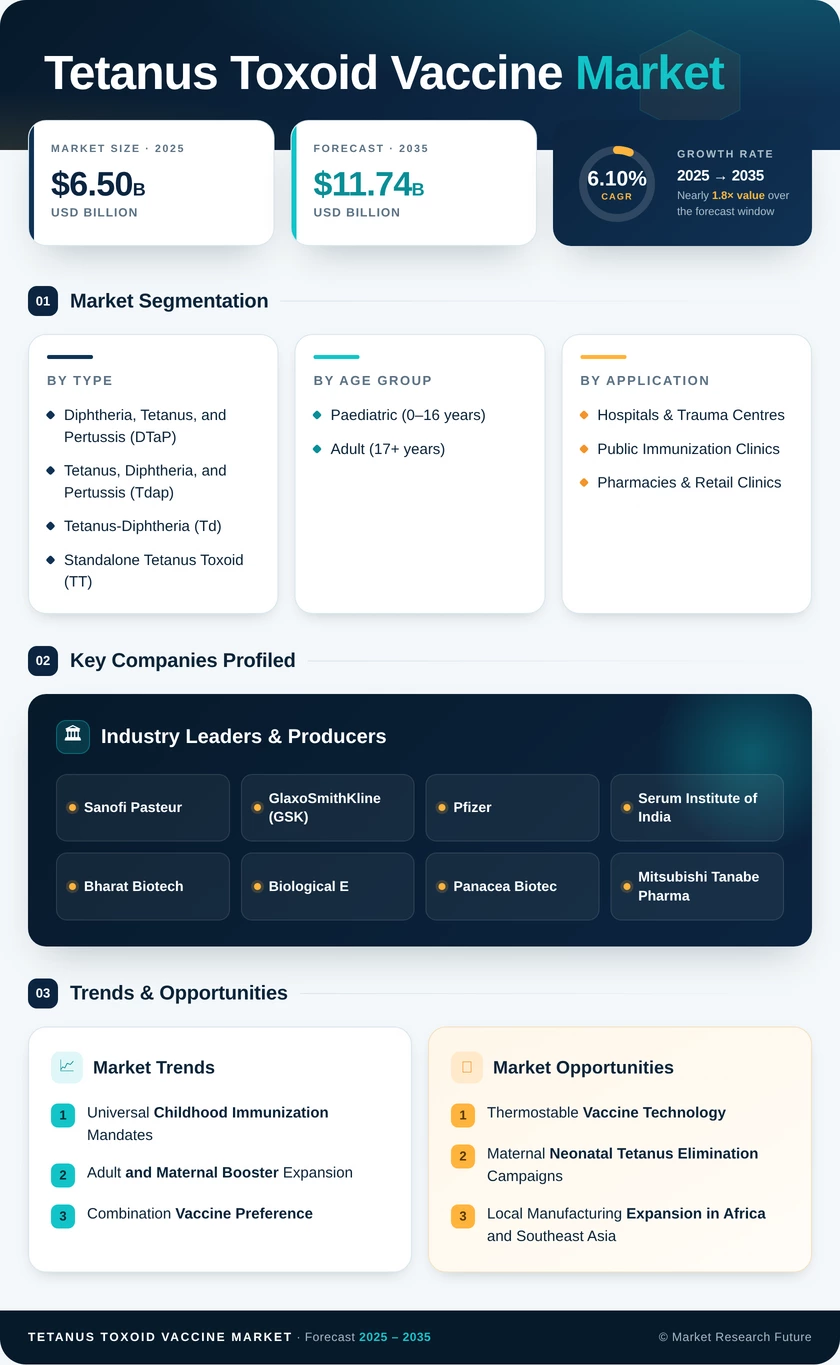
Segmentation Quick Reference
| Dimension | Sub-Segments | Dominant Segment | Fastest Growing Segment |
| Vaccine Type | DTaP, Tdap, Td, Standalone TT | DTaP (44.2% share, 2025) | Tdap (8.35% CAGR) |
| Age Group | Paediatric (0–16 Yrs), Adult (17+ Yrs) | Paediatric (78.5% share, 2025) | Adult (6.85% CAGR) |
| End User | Hospitals & Trauma Centres, Public Immunization Clinics, Pharmacies & Retail Clinics | Hospitals & Trauma Centres (72.0% share, 2025) | Public Immunization Clinics (7.35% CAGR) |
| Distribution Channel | Government Procurement, Private / Self-Pay | Government Procurement (66.5% share, 2025) | Private / Self-Pay (7.55% CAGR) |
| Region | North America, Europe, Asia-Pacific, South America, Middle East & Africa | North America (38.2% share, 2025) | Asia-Pacific (7.65% CAGR) |
Market Segmentation Overview
By Vaccine Type
| Sub-Segment | Key Trend |
| Diphtheria, Tetanus, and Pertussis (DTaP) | Remains the standard paediatric immunization backbone across 130+ national schedules |
| Tetanus, Diphtheria, and Pertussis (Tdap) | Fastest-growing segment driven by maternal and adult booster policy expansion |
| Tetanus-Diphtheria (Td) | Primary product for wound prophylaxis and post-exposure management in emergency settings |
| Standalone Tetanus Toxoid (TT) | Declining share as WHO guidance shifts toward Td for all primary and booster schedules |
DTaP anchors paediatric demand while Tdap captures the growing adult and maternal booster opportunity. WHO's 2025 position paper recommending Td over standalone TT is redirecting procurement pipelines, with standalone TT expected to retain relevance primarily in MNTE supplementary campaigns in low-income settings.
By Age Group
| Sub-Segment | Key Trend |
| Paediatric (0–16 Years) | Foundation of global demand through EPI/UIP childhood scheduling |
| Adult (17+ Years) | Expanding as decennial booster recommendations and occupational mandates widen the addressable cohort |
The paediatric segment provides volume stability, while the adult segment delivers above-average growth. Maternal Tdap immunization programmes represent the highest-value intersection of these two cohorts, as prenatal doses protect both mother and newborn.
By End User
| Sub-Segment | Key Trend |
| Hospitals & Trauma Centres | Dominant setting for both routine paediatric administration and emergency prophylaxis |
| Public Immunization Clinics | Fastest-growing channel as governments expand community-based outreach |
| Pharmacies & Retail Clinics | Emerging adult booster access point, particularly in the U.S. and the UK |
Hospital-based administration dominates due to the integration of tetanus vaccination with birth delivery services and emergency wound care. Public clinics are gaining share as government campaigns push immunization closer to underserved communities.
By Distribution Channel
| Sub-Segment | Key Trend |
| Government Procurement | Anchored by UNICEF/Gavi tenders and national EPI budgets, stable volumes at negotiated prices |
| Private / Self-Pay | Fastest-growing channel as pharmacy-based boosters and travel health demand increase in middle- and high-income settings |
Government procurement remains the dominant distribution pathway, but the private channel's higher per-dose margins make it an attractive growth vector for manufacturers seeking revenue diversification beyond public tenders.