×
Request Free Sample ×

Kindly complete the form below to receive a free sample of this Report

* Please use a valid business email

Leading companies partner with us for data-driven Insights

clients tt-cursor
Hero Background

Thermoplastic Polyolefins Market

ID: MRFR/CnM/3984-HCR
138 Pages
Anshula Mandaokar
October 2025

Thermoplastic Polyolefins Market Research Report- Information by Application (Automotive, Medical, Home Appliances, Building & Construction, Industrial, and Others) and Region - Forecast till 2035

Share:
Download PDF ×

We do not share your information with anyone. However, we may send you emails based on your report interest from time to time. You may contact us at any time to opt-out.

Thermoplastic Polyolefins Market Infographic
Purchase Options

Thermoplastic Polyolefins Market Summary

As per MRFR analysis, the Thermoplastic Polyolefins Market Size was estimated at 12.52 USD Million in 2024. The Thermoplastic Polyolefins industry is projected to grow from 14.19 in 2025 to 49.61 by 2035, exhibiting a compound annual growth rate (CAGR) of 13.33 during the forecast period 2025 - 2035.

Key Market Trends & Highlights

The Thermoplastic Polyolefins Market is poised for robust growth driven by sustainability and technological advancements.

  • North America remains the largest market for thermoplastic polyolefins, reflecting a strong demand across various applications.
  • The Asia-Pacific region is emerging as the fastest-growing market, fueled by increasing industrialization and urbanization.
  • The automotive segment leads in market share, while the building and construction segment is witnessing rapid growth due to infrastructure development.
  • Key market drivers include rising demand in the automotive sector and an increased focus on sustainability initiatives.

Market Size & Forecast

2024 Market Size 12.52 (USD Million)
2035 Market Size 49.61 (USD Million)
CAGR (2025 - 2035) 13.33%

Major Players

LyondellBasell Industries (US), ExxonMobil Chemical (US), SABIC (SA), Mitsui Chemicals (JP), BASF (DE), TotalEnergies (FR), Braskem (BR), Chevron Phillips Chemical (US), Reliance Industries (IN)

Thermoplastic Polyolefins Market Trends

The Thermoplastic Polyolefins Market is currently experiencing a dynamic evolution, driven by various factors that influence its growth trajectory. The increasing demand for lightweight and durable materials across multiple industries, including automotive, construction, and consumer goods, appears to be a primary catalyst. As manufacturers seek to enhance product performance while reducing overall weight, thermoplastic polyolefins are gaining traction due to their favorable properties such as flexibility, chemical resistance, and ease of processing. Furthermore, the ongoing shift towards sustainable practices is prompting companies to explore eco-friendly alternatives, which may further bolster the adoption of these materials. In addition to the demand for lightweight solutions, advancements in technology and manufacturing processes are likely to play a pivotal role in shaping the Thermoplastic Polyolefins Market. Innovations in polymer blending and compounding techniques could enhance the material properties, making them more appealing for specialized applications. Moreover, the growing emphasis on recycling and circular economy principles may lead to the development of new grades of thermoplastic polyolefins that incorporate recycled content. This trend not only aligns with environmental goals but also addresses the increasing consumer preference for sustainable products, suggesting a promising outlook for the market in the coming years.

Sustainability Initiatives

The Thermoplastic Polyolefins Market is witnessing a notable shift towards sustainability, as manufacturers increasingly prioritize eco-friendly practices. This trend encompasses the development of materials that incorporate recycled content, thereby reducing environmental impact. Companies are exploring innovative ways to enhance the recyclability of thermoplastic polyolefins, aligning with global efforts to promote a circular economy.

Technological Advancements

Technological progress is significantly influencing the Thermoplastic Polyolefins Market, with advancements in polymer processing techniques enhancing material performance. Innovations in blending and compounding are likely to yield thermoplastic polyolefins with superior properties, making them suitable for a broader range of applications. This evolution may lead to increased competitiveness within the market.

Growing Automotive Applications

The automotive sector is increasingly adopting thermoplastic polyolefins due to their lightweight characteristics and durability. As manufacturers strive to improve fuel efficiency and reduce emissions, the demand for these materials is expected to rise. This trend indicates a potential expansion of the Thermoplastic Polyolefins Market within the automotive industry, driven by the need for innovative solutions.

Thermoplastic Polyolefins Market Drivers

Emerging Markets and Economic Growth

Emerging markets are becoming increasingly significant for the Global Thermoplastic Polyolefins Market Industry, driven by rapid economic growth and urbanization. Countries in Asia-Pacific and Latin America are witnessing a surge in industrial activities, leading to heightened demand for thermoplastic polyolefins in construction, automotive, and consumer goods sectors. As these economies develop, the need for durable and cost-effective materials is expected to rise. This trend suggests that the market could experience substantial growth, with emerging markets playing a pivotal role in shaping the industry's future.

Rising Demand from Automotive Sector

The Global Thermoplastic Polyolefins Market Industry experiences a notable surge in demand driven by the automotive sector. The increasing adoption of lightweight materials in vehicle manufacturing is a key factor, as manufacturers seek to enhance fuel efficiency and reduce emissions. Thermoplastic polyolefins, known for their excellent mechanical properties and recyclability, are increasingly utilized in automotive applications such as bumpers, dashboards, and interior components. This trend is expected to contribute significantly to the market, with projections indicating that the market could reach 12.5 USD Billion by 2024, reflecting a robust growth trajectory.

Growth in Consumer Goods Applications

The Global Thermoplastic Polyolefins Market Industry is bolstered by the expanding use of thermoplastic polyolefins in consumer goods. These materials are favored for their versatility, durability, and aesthetic appeal, making them suitable for a wide range of applications, including packaging, household items, and electronics. As consumer preferences shift towards sustainable and recyclable materials, thermoplastic polyolefins are increasingly seen as a viable option. This shift is likely to drive market growth, with the industry projected to achieve a valuation of 25 USD Billion by 2035, indicating a sustained demand in the consumer goods sector.

Technological Advancements in Production

Technological advancements in the production of thermoplastic polyolefins play a crucial role in the Global Thermoplastic Polyolefins Market Industry. Innovations in processing techniques, such as improved extrusion and molding technologies, enhance the efficiency and quality of thermoplastic polyolefin products. These advancements not only reduce production costs but also enable the development of new grades with superior properties. As manufacturers adopt these technologies, the market is expected to witness a compound annual growth rate of 6.5% from 2025 to 2035, reflecting the industry's adaptability and commitment to innovation.

Regulatory Support for Sustainable Materials

The Global Thermoplastic Polyolefins Market Industry benefits from increasing regulatory support aimed at promoting sustainable materials. Governments worldwide are implementing policies that encourage the use of recyclable and environmentally friendly materials in various industries. This regulatory landscape fosters the adoption of thermoplastic polyolefins, which are recognized for their recyclability and lower environmental impact compared to traditional plastics. As sustainability becomes a priority for manufacturers, the market is likely to expand, aligning with global efforts to reduce plastic waste and promote circular economy practices.
Market Segment Insights

By Application: Automotive (Largest) vs. Building and Construction (Fastest-Growing)

In the Thermoplastic Polyolefins Market, the application segment is led predominantly by the automotive industry, which accounts for a significant share due to its extensive use in vehicle parts and components that require lightweight and durable materials. Following closely are sectors like building and construction, consumer goods, medical, and packaging, each contributing valuable market segments but with lesser shares than automotive. These industries are increasingly adopting thermoplastic polyolefins for their versatility and efficiency, although automotive remains the frontrunner.

Building and Construction: Automotive (Dominant) vs. Medical (Emerging)

The automotive sector remains the dominant application of thermoplastic polyolefins, known for its ability to enhance fuel efficiency through lightweight components while maintaining durability and resistance to extreme conditions. In contrast, the medical application sector is emerging with significant potential, leveraging the material's antimicrobial properties and ease of sterilization. As healthcare standards elevate, thermoplastic polyolefins are increasingly favored for medical devices and packaging, offering advanced functionality and compliance with strict regulations. The growth in the medical field, coupled with innovations in material properties, showcases how thermoplastic polyolefins are adapting to various application demands.

By End Use: Flexible Packaging (Largest) vs. Rigid Packaging (Fastest-Growing)

The Thermoplastic Polyolefins Market exhibits a diverse array of end-use applications. Among these, flexible packaging holds the largest market share, driven by its versatile applications across food, pharmaceutical, and consumer goods industries. In contrast, rigid packaging has emerged as the fastest-growing segment due to rising demand for durable and sustainable packing solutions, particularly in e-commerce and retail sectors. Other segments such as interior and exterior components and insulation are vital but contribute comparatively lesser to market dynamics.

Flexible Packaging (Dominant) vs. Rigid Packaging (Emerging)

Flexible packaging stands out as the dominant segment in the Thermoplastic Polyolefins Market, offering lightweight, adaptable solutions that enhance product preservation and brand visibility. Its characteristics of convenience, cost-effectiveness, and sustainability have driven numerous innovations, making it a preferred choice for manufacturers across various industries. Conversely, rigid packaging is gaining traction in the market, characterized by its strength and protective capabilities. As consumers increasingly seek sustainable packaging options, rigid solutions are evolving with new materials and designs, making them a critical focus for manufacturers aiming to capture the growing e-commerce sector.

By Material Type: Polypropylene (Largest) vs. Polyethylene Terephthalate (Fastest-Growing)

In the Thermoplastic Polyolefins Market, Polypropylene stands out as the dominant material, accounting for a significant portion of the market share. It is favored for its versatility and cost-effectiveness, making it a preferred choice across various applications, from automotive components to consumer goods. Conversely, Polyethylene Terephthalate is gaining traction rapidly, driven by the increasing demand for lightweight and recyclable materials, showcasing impressive growth trends that signal its rising importance in the market. The growth of Polypropylene is fueled by its extensive use in industries such as packaging and automotive, where its properties offer solutions for durability and flexibility. Meanwhile, the rapid expansion of Polyethylene Terephthalate in the market reflects a shift towards sustainability, as manufacturers and consumers alike prioritize environmentally friendly options. This trend is expected to drive innovation and investment in this segment, further enhancing its market position as a fast-growing alternative to traditional pololefins.

Polypropylene (Dominant) vs. Polyamide (Emerging)

Polypropylene is established as the dominant material in the Thermoplastic Polyolefins Market, recognized for its exceptional balance of performance and cost. Its lightweight nature, resistance to chemicals, and ease of processing make it highly sought-after in a range of applications, including automotive parts and packaging. On the other hand, Polyamide is emerging as a strong contender due to its superior mechanical properties and heat resistance, making it suitable for more demanding applications. While still a smaller segment, the growth of Polyamide is propelled by its capability to meet the needs of advanced manufacturing and the shift towards high-performance materials. As industries look for innovative solutions that combine strength and lightness, Polyamide's position continues to strengthen, positioning it as a key player in the evolving landscape of thermoplastic materials.

By Processing Technique: Injection Molding (Largest) vs. Blow Molding (Fastest-Growing)

The processing technique segment in the thermoplastic polyolefins market is predominantly represented by Injection Molding, which has established itself as the largest segment due to its versatile application across numerous industries including automotive and consumer goods. Following closely behind is Blow Molding, recognized for its rapid growth driven by the increasing demand for lightweight and durable packaging solutions. Other techniques like Extrusion, Thermoforming, and Compression Molding contribute to the market but possess smaller shares compared to these two leading methods.

Processing Techniques: Injection Molding (Dominant) vs. Blow Molding (Emerging)

Injection Molding continues to dominate the thermoplastic polyolefins market due to its efficiency in producing complex shapes with high precision, making it ideal for a wide range of applications. This technique allows for the production of robust and lightweight components that meet rigorous industry standards. On the other hand, Blow Molding is emerging swiftly as a favored option for packaging solutions thanks to its ability to create hollow parts efficiently. As companies focus on sustainability, Blow Molding's capacity to produce recyclable and lightweight products is increasingly appealing, aiding its rapid expansion within the market.

By Market Structure: Manufacturers (Largest) vs. Distributors (Fastest-Growing)

In the Thermoplastic Polyolefins Market, the distribution of market share among different players is primarily led by manufacturers, who dominate the supply chain. Manufacturers play a crucial role in the production process, contributing significantly to the overall market dynamics. Meanwhile, distributors, while holding a smaller share, are emerging as the fastest-growing segment due to the increasing demand for efficient supply chains. Their role in bridging manufacturers and end-users is becoming increasingly important, reflecting trends towards enhanced logistics and accessibility. The growth trends within the Thermoplastic Polyolefins Market are influenced by several factors, particularly the rising demand for lightweight materials across various industries such as automotive and packaging. As manufacturers innovate and optimize their production processes, they are likely to maintain their dominance. Concurrently, distributors are benefitting from the growing online sales channels and e-commerce platforms, aiding their rapid expansion. This dual growth signifies a shifting landscape where both segment values are adapting to meet evolving market needs.

Manufacturers (Dominant) vs. Distributors (Emerging)

Manufacturers in the Thermoplastic Polyolefins Market are characterized by their extensive capabilities in research, development, and large-scale production. They serve as the backbone of the industry, focusing on innovation to meet the diverse needs of various applications, including automotive, building, and consumer goods. Their established relationships with raw material suppliers ensure a consistent supply flow, positioning them effectively in the market. In contrast, distributors are increasingly recognized as key players in this segment, as they enhance market reach and efficiency in supplying thermoplastic polyolefins to end-users. They are adapting to changing market dynamics by partnering with manufacturers to streamline logistics and improve customer service. As the demand for thermoplastic polyolefins grows, distributors are emerging as vital facilitators in the supply chain, contributing to growth and innovation.

Get more detailed insights about Thermoplastic Polyolefins Market

Regional Insights

North America : Market Leader in Polyolefins

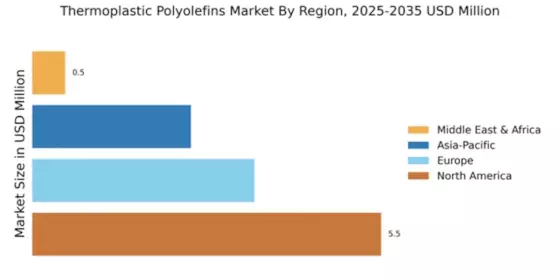
North America is poised to maintain its leadership in the Thermoplastic Polyolefins market, holding a significant market share of 5.5 in 2024. The region's growth is driven by robust demand from automotive, construction, and packaging sectors, alongside favorable regulatory frameworks promoting sustainable materials. The increasing focus on lightweight materials and recyclability is further propelling market expansion. The competitive landscape in North America is characterized by the presence of major players such as LyondellBasell Industries and ExxonMobil Chemical. These companies are investing heavily in R&D to innovate and enhance product offerings. The U.S. remains the largest market, supported by advanced manufacturing capabilities and a strong supply chain network, ensuring a steady supply of high-quality thermoplastic polyolefins.

Europe : Sustainable Innovation Hub

Europe's Thermoplastic Polyolefins market is projected to grow significantly, with a market size of 3.5 in 2024. The region is increasingly focusing on sustainability, driven by stringent regulations and consumer demand for eco-friendly products. Initiatives aimed at reducing carbon footprints and enhancing recyclability are key growth drivers, supported by government policies promoting green technologies and materials. Leading countries in this region include Germany, France, and the UK, where major players like BASF and TotalEnergies are actively engaged in developing innovative solutions. The competitive landscape is marked by collaborations and partnerships aimed at enhancing product performance and sustainability. The European market is expected to witness increased investments in R&D to meet evolving consumer preferences and regulatory requirements.

Asia-Pacific : Emerging Market Potential

The Asia-Pacific region is witnessing rapid growth in the Thermoplastic Polyolefins market, with a market size of 2.5 in 2024. This growth is fueled by increasing industrialization, urbanization, and rising demand from the automotive and construction sectors. Additionally, favorable government policies and investments in infrastructure are acting as catalysts for market expansion, making the region a key player in the global landscape. Countries like China, Japan, and India are leading the charge, with significant contributions from companies such as Mitsui Chemicals and Reliance Industries. The competitive environment is characterized by a mix of local and international players, all vying for market share. As the region continues to develop, the demand for innovative and sustainable thermoplastic solutions is expected to rise, further enhancing market dynamics.

Middle East and Africa : Resource-Rich Opportunities

The Middle East and Africa region is gradually emerging in the Thermoplastic Polyolefins market, with a market size of 0.52 in 2024. The growth is primarily driven by increasing demand in the construction and automotive sectors, alongside the region's rich natural resources. Government initiatives aimed at diversifying economies and promoting industrialization are also contributing to market development, creating opportunities for thermoplastic polyolefins. Key players in this region include SABIC and Braskem, which are leveraging local resources to enhance production capabilities. Countries like Saudi Arabia and South Africa are at the forefront of this growth, with investments in infrastructure and manufacturing. As the market matures, the focus on sustainable practices and innovative solutions is expected to shape the competitive landscape.

Key Players and Competitive Insights

The Thermoplastic Polyolefins Market is characterized by a dynamic competitive landscape, driven by increasing demand across various applications such as automotive, construction, and consumer goods. Key players are actively pursuing strategies that emphasize innovation, sustainability, and regional expansion to enhance their market positions. For instance, LyondellBasell Industries (US) has focused on developing advanced materials that cater to the growing need for lightweight and durable solutions, while ExxonMobil Chemical (US) has been investing in digital transformation initiatives to optimize production processes and improve supply chain efficiency. These strategic orientations collectively shape a competitive environment that is increasingly focused on technological advancements and sustainability.

In terms of business tactics, companies are localizing manufacturing to reduce lead times and enhance responsiveness to regional market demands. Supply chain optimization remains a critical focus, particularly in light of recent global disruptions. The market structure appears moderately fragmented, with several key players exerting considerable influence. This fragmentation allows for niche players to emerge, yet the collective strength of major companies like SABIC (SA) and BASF (DE) ensures that competition remains robust and innovation-driven.

In November 2025, SABIC (SA) announced a partnership with a leading automotive manufacturer to develop sustainable thermoplastic polyolefin solutions aimed at reducing the carbon footprint of vehicle production. This collaboration underscores SABIC's commitment to sustainability and positions the company as a frontrunner in eco-friendly materials, potentially setting new industry standards for environmental responsibility.

In October 2025, BASF (DE) unveiled a new production facility in Asia, aimed at increasing its capacity for thermoplastic polyolefins. This strategic move not only enhances BASF's operational capabilities but also reflects a broader trend of regional expansion to meet the surging demand in emerging markets. The facility is expected to leverage advanced manufacturing technologies, thereby improving efficiency and reducing costs.

In September 2025, TotalEnergies (FR) launched a new line of thermoplastic polyolefins designed specifically for the packaging industry, emphasizing recyclability and performance. This initiative aligns with the growing consumer demand for sustainable packaging solutions and positions TotalEnergies as a key player in the transition towards circular economy practices within the industry.

As of December 2025, the competitive trends in the Thermoplastic Polyolefins Market are increasingly defined by digitalization, sustainability, and the integration of AI technologies. Strategic alliances are becoming more prevalent, as companies recognize the need to collaborate in order to innovate and meet evolving consumer expectations. The competitive differentiation is likely to shift from traditional price-based competition to a focus on innovation, technological advancements, and supply chain reliability, suggesting a transformative phase for the market.

Key Companies in the Thermoplastic Polyolefins Market market include

Industry Developments

  • Q2 2024: Dow launches bio-based thermoplastic polyolefins (TPOs) in Europe, reducing emissions by 10% Dow introduced a new line of bio-based TPOs for automotive and construction applications, claiming a 10% reduction in carbon emissions compared to conventional TPOs. The launch aligns with EU circular economy policies and targets sustainability-focused customers.
  • Q1 2024: Mitsui Chemicals unveils new TPO formulation with enhanced impact resistance Mitsui Chemicals announced the commercial launch of a next-generation TPO formulation that improves impact resistance by 10%, targeting automotive and industrial customers seeking higher performance materials.
  • Q2 2024: ExxonMobil expands TPO production capacity at Baytown facility ExxonMobil completed a major expansion of its Baytown, Texas plant, increasing thermoplastic polyolefin output to meet rising demand from automotive and construction sectors in North America.
  • Q3 2024: LyondellBasell partners with European automaker for sustainable TPO supply LyondellBasell signed a multi-year supply agreement with a leading European automotive manufacturer to provide recycled-content TPOs for use in vehicle interiors and bumpers.
  • Q2 2024: Dow, Mitsui Chemicals, and ExxonMobil form consortium to advance bio-based TPOs Three major chemical companies announced a strategic consortium to accelerate research and commercialization of bio-based thermoplastic polyolefins, aiming to meet stricter EU sustainability regulations.
  • Q1 2025: ExxonMobil wins contract to supply TPOs for new electric vehicle platform ExxonMobil secured a multi-year contract to supply advanced TPO materials for a global automaker's upcoming electric vehicle line, focusing on lightweight and recyclable components.
  • Q2 2025: LyondellBasell announces executive appointment to lead TPO business unit LyondellBasell named a new Senior Vice President to oversee its global thermoplastic polyolefins division, signaling increased strategic focus on automotive and sustainable product lines.
  • Q2 2024: Dow opens new R&D center for thermoplastic polyolefins in Germany Dow inaugurated a research and development facility dedicated to TPO innovation, aiming to accelerate product development for European automotive and construction markets.
  • Q3 2024: Mitsui Chemicals receives regulatory approval for new TPO plant in Singapore Mitsui Chemicals obtained government clearance to build a new thermoplastic polyolefin manufacturing facility in Singapore, expanding its footprint in the Asia-Pacific region.
  • Q1 2025: ExxonMobil announces $200M investment in TPO recycling technology ExxonMobil committed $200 million to develop advanced recycling processes for thermoplastic polyolefins, aiming to increase the use of recycled materials in automotive and packaging applications.
  • Q2 2025: LyondellBasell acquires specialty TPO producer in Italy LyondellBasell completed the acquisition of an Italian specialty TPO manufacturer, expanding its portfolio of high-performance polyolefin products for European customers.
  • Q3 2024: Dow secures contract to supply TPOs for major infrastructure project in France Dow was awarded a contract to provide thermoplastic polyolefin materials for a large-scale infrastructure development in France, focusing on roofing and waterproofing applications.

Intended Audiences

    • Thermoplastic polyolefins manufacturers
    • Traders and Distributors of thermoplastic polyolefins
    • Production Process Industries
    • Potential Investors
    • Raw Material Suppliers
    • Nationalized Laboratory

Future Outlook

Thermoplastic Polyolefins Market Future Outlook

The Thermoplastic Polyolefins Market is projected to grow at a 13.33% CAGR from 2024 to 2035, driven by increasing demand in automotive and packaging applications.

New opportunities lie in:

  • Expansion into bio-based thermoplastic polyolefins for sustainable products.
  • Development of advanced TPO formulations for enhanced performance in automotive interiors.
  • Strategic partnerships with automotive manufacturers for tailored TPO solutions.

By 2035, the Thermoplastic Polyolefins Market is expected to achieve substantial growth and innovation.

Market Segmentation

Thermoplastic Polyolefins Market End Use Outlook

  • Interior Components
  • Exterior Components
  • Flexible Packaging
  • Rigid Packaging
  • Insulation

Thermoplastic Polyolefins Market Application Outlook

  • Automotive
  • Building and Construction
  • Consumer Goods
  • Medical
  • Packaging

Thermoplastic Polyolefins Market Material Type Outlook

  • Polypropylene
  • Polyethylene
  • Polybutylene
  • Polyethylene Terephthalate
  • Polyamide

Thermoplastic Polyolefins Market Market Structure Outlook

  • Raw Material Suppliers
  • Manufacturers
  • Distributors
  • Retailers
  • End Users

Thermoplastic Polyolefins Market Processing Technique Outlook

  • Injection Molding
  • Blow Molding
  • Extrusion
  • Thermoforming
  • Compression Molding

Report Scope

MARKET SIZE 202412.52(USD Million)
MARKET SIZE 202514.19(USD Million)
MARKET SIZE 203549.61(USD Million)
COMPOUND ANNUAL GROWTH RATE (CAGR)13.33% (2024 - 2035)
REPORT COVERAGERevenue Forecast, Competitive Landscape, Growth Factors, and Trends
BASE YEAR2024
Market Forecast Period2025 - 2035
Historical Data2019 - 2024
Market Forecast UnitsUSD Million
Key Companies ProfiledLyondellBasell Industries (US), ExxonMobil Chemical (US), SABIC (SA), Mitsui Chemicals (JP), BASF (DE), TotalEnergies (FR), Braskem (BR), Chevron Phillips Chemical (US), Reliance Industries (IN)
Segments CoveredApplication, End Use, Material Type, Processing Technique, Market Structure
Key Market OpportunitiesGrowing demand for lightweight materials in automotive applications drives Thermoplastic Polyolefins Market expansion.
Key Market DynamicsRising demand for lightweight materials drives innovation and competition in the Thermoplastic Polyolefins market.
Countries CoveredNorth America, Europe, APAC, South America, MEA

Market Highlights

Author
Anshula Mandaokar
Team Lead - Research

Anshula Mandaokar holds an academic degree in Chemical Engineering and has been contributing to the field for more than 5 years. She has expertise in Market Research and Business Consulting and serves as a Team Lead for a reputed Market Research firm under the Chemicals and Materials domain spectrum. She has worked on multiple projects, generating explicit results in a quick turnaround time. Her understanding of data interpretation justifies her role as a leader.

Leave a Comment

FAQs

At what CAGR is the Thermoplastic Polyolefins market predicted to grow during the forecast period?

Thermoplastic Polyolefins market is predicted to grow through forecast period of 2025-2035.

What is the forecast period of Thermoplastic Polyolefins market research report?

The forecast period for Thermoplastic Polyolefins market research report is 2025-2035.

Which region will lead the global Thermoplastic Polyolefins market?

Global Thermoplastic Polyolefins market is dominated by North America region.

Who are the key players in the Thermoplastic Polyolefins market?

Exxon Mobil Corporation (U.S.), S&E Specialty Polymers (U.S.), SABIC (Saudi Arabia), INEOS Olefins & Polymers (UK), Johns Manville. A Berkshire Hathaway Company (U.S.), Arkema SA (France), The Hexpol group of companies (U.S.), LyondellBasell (the Netherlands), Sumitomo Chemical Co., Ltd. (Japan), RTP Company (U.S.), Noble Polymers (U.S.) among others.

Download Free Sample

Kindly complete the form below to receive a free sample of this Report

Compare Licence

×
Features License Type
Single User Multiuser License Enterprise User
Price $4,950 $5,950 $7,250
Maximum User Access Limit 1 User Upto 10 Users Unrestricted Access Throughout the Organization
Free Customization
Direct Access to Analyst
Deliverable Format
Platform Access
Discount on Next Purchase 10% 15% 15%
Printable Versions