×
Request Free Sample ×

Kindly complete the form below to receive a free sample of this Report

* Please use a valid business email

Leading companies partner with us for data-driven Insights

clients tt-cursor
Hero Background

Thumb Arthritis Market

ID: MRFR/MED/3800-HCR
90 Pages
Kinjoll Dey
October 2025

Thumb Arthritis Market Research Report Information By Diagnosis (Physical Examinations, Imaging, FNA), By Type (Osteoarthritis, Rheumatoid), By Treatment (Thumb Exercise, Medication, Surgery), By End Users (Hospitals & Clinics, Retail Pharmacies), And By Region (North America, Europe, Asia-Pacific, And Rest Of The World) –Market Forecast Till 2035

Share:
Download PDF ×

We do not share your information with anyone. However, we may send you emails based on your report interest from time to time. You may contact us at any time to opt-out.

Thumb Arthritis Market Infographic
Purchase Options

Thumb Arthritis Market Summary

As per MRFR analysis, the Thumb Arthritis Market Size was estimated at 466.56 USD Million in 2024. The Thumb Arthritis industry is projected to grow from 506.23 USD Million in 2025 to 1144.78 USD Million by 2035, exhibiting a compound annual growth rate (CAGR) of 8.5 during the forecast period 2025 - 2035.

Key Market Trends & Highlights

The Thumb Arthritis Market is experiencing a shift towards non-invasive treatment options and increased patient awareness.

  • The demand for non-pharmacological treatments is rising, particularly in North America, which remains the largest market.
  • Technological advancements in treatment options are driving innovation, especially in the Asia-Pacific region, the fastest-growing market.
  • There is an increased focus on patient education and awareness, which is crucial for both osteoarthritis and rheumatoid arthritis segments.
  • The aging population and rising awareness initiatives are major drivers propelling market growth, alongside a growing demand for non-invasive treatment options.

Market Size & Forecast

2024 Market Size 466.56 (USD Million)
2035 Market Size 1144.78 (USD Million)
CAGR (2025 - 2035) 8.5%

Major Players

Johnson & Johnson (US), Medtronic (US), Stryker Corporation (US), Zimmer Biomet (US), Abbott Laboratories (US), Baxter International (US), Smith & Nephew (GB), Boston Scientific (US), DePuy Synthes (US)

Thumb Arthritis Market Trends

The Thumb Arthritis Market is currently experiencing notable transformations driven by various factors. An increasing prevalence of arthritis, particularly among the aging population, appears to be a primary catalyst for market growth. As individuals seek effective management solutions, the demand for innovative treatment options, including both pharmacological and non-pharmacological interventions, is on the rise. Furthermore, advancements in medical technology and a growing awareness of thumb arthritis are likely to enhance patient outcomes and improve quality of life. This evolving landscape suggests that stakeholders must remain vigilant to adapt to changing consumer needs and preferences. In addition, the Thumb Arthritis Market is witnessing a shift towards personalized medicine, where treatments are tailored to individual patient profiles. This trend may lead to more effective management strategies, as healthcare providers increasingly recognize the importance of addressing unique patient characteristics. Moreover, the integration of telehealth services is becoming more prevalent, allowing patients to access care remotely. Such developments indicate a promising future for the Thumb Arthritis Market, as it continues to evolve in response to emerging trends and patient demands.

Rising Demand for Non-Pharmacological Treatments

There is a growing interest in non-pharmacological approaches to managing thumb arthritis. Patients are increasingly seeking alternative therapies, such as physical therapy, occupational therapy, and lifestyle modifications, to alleviate symptoms and improve functionality. This trend reflects a broader shift towards holistic care, emphasizing the importance of comprehensive treatment plans.

Technological Advancements in Treatment Options

Innovations in medical technology are playing a crucial role in the Thumb Arthritis Market. New devices and treatment modalities, including minimally invasive surgical techniques and advanced imaging technologies, are enhancing diagnostic accuracy and treatment efficacy. These advancements may lead to improved patient outcomes and satisfaction.

Increased Focus on Patient Education and Awareness

There is a notable emphasis on educating patients about thumb arthritis and its management. Healthcare providers are prioritizing awareness campaigns to inform individuals about the condition, its symptoms, and available treatment options. This trend is likely to empower patients, enabling them to make informed decisions regarding their care.

Thumb Arthritis Market Drivers

Market Growth Projections

The Global Thumb Arthritis Market Industry is projected to experience substantial growth over the next decade. With a market value of 0.47 USD Billion in 2024, it is anticipated to reach 1.15 USD Billion by 2035, reflecting a compound annual growth rate (CAGR) of 8.48% from 2025 to 2035. This growth trajectory indicates a robust demand for treatment options and innovations in the field of thumb arthritis. Stakeholders in the industry must remain vigilant in adapting to changing market dynamics and consumer needs to capitalize on this promising growth opportunity.

Rising Geriatric Population

The aging population worldwide is a critical driver of the Global Thumb Arthritis Market Industry. As individuals age, the likelihood of developing osteoarthritis, including thumb arthritis, increases. This demographic shift is particularly pronounced in developed countries, where healthcare systems are increasingly focused on managing chronic conditions associated with aging. The growing geriatric population is expected to lead to a higher incidence of thumb arthritis, thereby driving demand for treatment options. With the market projected to reach 1.15 USD Billion by 2035, addressing the needs of this demographic will be essential for stakeholders in the industry.

Growing Awareness and Education

The Global Thumb Arthritis Market Industry benefits from increasing awareness and education regarding thumb arthritis. Public health campaigns and educational initiatives are helping to inform individuals about the symptoms, risk factors, and treatment options available. This heightened awareness encourages early diagnosis and intervention, which can significantly improve patient outcomes. As more people become informed about thumb arthritis, the demand for medical consultations and therapeutic interventions is likely to rise. Consequently, this trend may contribute to the market's growth, as healthcare systems adapt to meet the needs of a more informed patient population.

Advancements in Treatment Options

Innovations in the treatment landscape for thumb arthritis are significantly influencing the Global Thumb Arthritis Market Industry. The development of minimally invasive surgical techniques, biologics, and advanced pharmacological therapies is enhancing patient outcomes. These advancements not only improve the quality of life for patients but also expand the range of available treatment options. As healthcare providers adopt these new technologies, the market is likely to see increased investment and growth. The anticipated compound annual growth rate (CAGR) of 8.48% from 2025 to 2035 underscores the potential for continued expansion driven by these advancements.

Increasing Prevalence of Thumb Arthritis

The Global Thumb Arthritis Market Industry is experiencing growth due to the rising prevalence of thumb arthritis among various demographics. Factors such as aging populations and increased participation in activities that strain the thumb joint contribute to this trend. In 2024, the market is valued at approximately 0.47 USD Billion, reflecting the growing need for effective treatment options. As awareness of thumb arthritis increases, more individuals seek medical attention, thereby driving demand for innovative therapies and products. This trend is expected to continue, with projections indicating a market value of 1.15 USD Billion by 2035, suggesting a robust growth trajectory.

Increased Participation in Sports and Physical Activities

The Global Thumb Arthritis Market Industry is also influenced by the rising participation in sports and physical activities, which can lead to thumb injuries and subsequent arthritis. As more individuals engage in recreational and competitive sports, the incidence of thumb-related injuries may rise, contributing to the development of arthritis. This trend is particularly relevant among younger populations, who may experience long-term consequences from acute injuries. The market's growth is likely to be fueled by the need for preventive measures and treatments for thumb arthritis, as awareness of the connection between sports participation and joint health continues to grow.

Market Segment Insights

By Type of Arthritis: Osteoarthritis (Largest) vs. Rheumatoid Arthritis (Fastest-Growing)

The Thumb Arthritis Market is primarily driven by the prevalence of Osteoarthritis, which holds the largest market share among the various types of arthritis affecting the thumb. This segment is characterized by its high incidence rate, particularly in older demographics and those with prior injuries. Following Osteoarthritis, Rheumatoid Arthritis stands out as a significant concern, accounting for a notable portion of the market as well, while Post-Traumatic Arthritis and Gout contribute smaller shares. These distributions are influenced by factors such as demographic trends and increasing awareness of thumb-related arthritis conditions.

Osteoarthritis (Dominant) vs. Rheumatoid Arthritis (Emerging)

Osteoarthritis is recognized as the dominant type of arthritis in the thumb market, primarily affecting older individuals and those with previous joint injuries. It presents with pain and stiffness, impacting daily activities significantly. Conversely, Rheumatoid Arthritis is emerging as a critical segment due to its auto-inflammatory nature, leading to joint damage and deformity if left untreated. This form is increasingly recognized in younger populations, and its growing incidence rate emphasizes the need for effective treatment options. As awareness and diagnosis improve, Rheumatoid Arthritis is expected to gain more attention, highlighting the necessity of innovative therapies in this market.

By Treatment Type: Medication (Largest) vs. Physical Therapy (Fastest-Growing)

In the Thumb Arthritis Market, the treatment type segmentation reveals a diverse distribution among four main categories: Medication, Physical Therapy, Surgical Intervention, and Assistive Devices. Medication holds the largest portion of the market share, attributed to its widespread acceptance and usage in managing pain and inflammation associated with thumb arthritis. Following this, Assistive Devices play a significant role in aiding patients in daily tasks, while Surgical Intervention remains a critical option for severe cases, albeit with a smaller market presence. Physical Therapy is emerging as a popular choice due to its holistic approach to treatment, gaining increasing traction among patients seeking non-invasive options.

Medication (Dominant) vs. Physical Therapy (Emerging)

Medication is currently the dominant treatment option in the Thumb Arthritis Market, primarily due to its effectiveness in alleviating pain and improving function. It encompasses a range of formulations from over-the-counter NSAIDs to prescription drugs specifically targeting inflammation. On the other hand, Physical Therapy is an emerging segment, rapidly gaining recognition for its role in rehabilitating patients and improving mobility without invasive procedures. Tailored therapy sessions help patients strengthen thumb muscles and improve flexibility, presenting a patient-centric alternative. As healthcare trends shift towards conservative management of thumb arthritis, the demand for physical therapy is projected to rise, emphasizing preventive care and maintaining functional independence.

By Age Group: Adults (Largest) vs. Elderly (Fastest-Growing)

In the Thumb Arthritis Market, the age group segment reveals significant share distribution with adults commanding the largest market presence. This segment typically comprises individuals between the ages of 18 and 65, many of whom experience thumb arthritis due to lifestyle factors, repetitive strain, or prior injuries. The elderly segment, primarily those over 65 years, is showing a rapidly growing trend due to aging populations around the globe, leading to increased prevalence of thumb arthritis in older individuals. The growth trends for this segment are heavily influenced by several key factors. Adults continue to drive the overall market due to their higher engagement in activities that may lead to thumb arthritis, such as sports and manual labor. Conversely, the elderly population is becoming an emerging focus area for market growth, with increasing awareness and diagnosis of thumb arthritis, leading to heightened demand for treatment and interventions designed to ease their discomfort.

Adults (Dominant) vs. Elderly (Emerging)

The adult segment in the Thumb Arthritis Market is characterized by a large population experiencing thumb-related discomfort from various activities. As individuals in this age group balance work and recreational activities, the incidence of thumb arthritis is prevalent due to repetitive stress. On the other hand, the elderly segment is emerging as a crucial market, largely due to their vulnerability to joint-related ailments. This demographic often seeks innovative treatment options, reinforcing a shift in market dynamics. While adults currently dominate the overall market share, the elderly segment is on the rise, fueled by increasing health awareness and advancements in treatment efficacy. Therefore, both segments present distinct characteristics shaping consumer behavior and influencing the market landscape.

By Severity Level: Moderate (Largest) vs. Severe (Fastest-Growing)

In the Thumb Arthritis Market, the distribution of market share among the severity levels shows that Mild cases hold a significant share, but Moderate cases dominate the market. Moderate severity, representing the largest segment, highlights the substantial impact of arthritis on daily activities. Severe cases, while currently smaller in market share, are experiencing rapid growth due to increasing awareness and advancements in treatment options, reflecting a rising need for specialized therapeutic solutions.

Moderate (Dominant) vs. Severe (Emerging)

The Moderate severity level in Thumb Arthritis is characterized by a considerable prevalence among patients, making it the dominant segment. This level often requires interventions ranging from physical therapy to medication, catering to a broad user base. Conversely, the Severe severity level represents an emerging segment experiencing rapid growth propelled by improved diagnostic technologies and awareness of the condition. Patients in this segment typically face significant limitations in their daily lives, leading to a surge in demand for effective treatment options and supportive care.

Get more detailed insights about Thumb Arthritis Market

Regional Insights

North America : Market Leader in Innovation

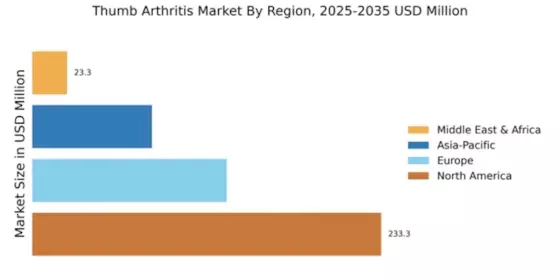
North America is poised to maintain its leadership in the Thumb Arthritis market, holding a significant market share of $233.28M in 2024. The region's growth is driven by increasing awareness of thumb arthritis, advancements in medical technology, and a robust healthcare infrastructure. Regulatory support for innovative treatments and devices further fuels demand, as healthcare providers seek effective solutions for patients. The competitive landscape is characterized by major players such as Johnson & Johnson, Medtronic, and Stryker Corporation, which are investing heavily in research and development. The U.S. leads the market, supported by a high prevalence of thumb arthritis and a growing aging population. The presence of established companies ensures a steady supply of innovative products, enhancing patient outcomes and driving market growth.

Europe : Emerging Market with Growth Potential

Europe's Thumb Arthritis market is projected to grow significantly, with a market size of €130.0M. The region benefits from a well-established healthcare system and increasing investments in orthopedic research. Regulatory bodies are actively promoting innovative treatments, which is expected to enhance patient access to advanced therapies. The rising prevalence of thumb arthritis among the aging population is a key driver of market growth. Leading countries such as Germany, France, and the UK are at the forefront of this market, supported by strong healthcare policies and a focus on patient-centered care. Key players like Smith & Nephew and Zimmer Biomet are expanding their product offerings to meet the growing demand. The competitive landscape is dynamic, with ongoing collaborations and partnerships aimed at enhancing treatment options for patients.

Asia-Pacific : Rapidly Growing Market Dynamics

The Asia-Pacific region is witnessing a burgeoning Thumb Arthritis market, valued at $80.0M. Factors such as increasing healthcare expenditure, rising awareness of orthopedic conditions, and a growing elderly population are driving demand. Regulatory frameworks are evolving to support the introduction of advanced medical technologies, which is expected to further stimulate market growth. Countries like Japan, China, and Australia are leading the market, with a focus on enhancing healthcare infrastructure and access to innovative treatments. The competitive landscape includes key players like Abbott Laboratories and Boston Scientific, who are actively expanding their presence in the region. The market is characterized by a mix of local and international companies, fostering a competitive environment that encourages innovation and improved patient care.

Middle East and Africa : Emerging Market with Challenges

The Middle East and Africa region is gradually developing its Thumb Arthritis market, currently valued at $23.28M. The growth is driven by increasing healthcare investments and a rising awareness of orthopedic conditions. However, challenges such as limited access to advanced medical technologies and varying healthcare standards across countries hinder rapid market expansion. Regulatory bodies are beginning to implement frameworks to support the introduction of innovative treatments. Countries like South Africa and the UAE are leading the market, focusing on improving healthcare infrastructure and access to quality care. The competitive landscape is evolving, with both local and international players, including Baxter International and DePuy Synthes, striving to enhance their market presence. Collaborative efforts are essential to address the unique challenges faced in this region and to improve patient outcomes.

Key Players and Competitive Insights

The Thumb Arthritis Market is currently characterized by a competitive landscape that is both dynamic and multifaceted. Key growth drivers include an aging population, increasing prevalence of arthritis, and advancements in treatment technologies. Major players such as Johnson & Johnson (US), Medtronic (US), and Stryker Corporation (US) are strategically positioned to leverage these trends. Johnson & Johnson (US) focuses on innovation through its extensive research and development initiatives, while Medtronic (US) emphasizes digital transformation and the integration of AI in its product offerings. Stryker Corporation (US) is actively pursuing mergers and acquisitions to enhance its portfolio, thereby shaping a competitive environment that is increasingly reliant on technological advancements and strategic partnerships.

In terms of business tactics, companies are localizing manufacturing to reduce costs and optimize supply chains, which is particularly crucial in a moderately fragmented market. The collective influence of these key players is significant, as they not only drive innovation but also set benchmarks for quality and service standards within the industry. This competitive structure allows for a diverse range of products and services, catering to various consumer needs and preferences.

In November 2025, Johnson & Johnson (US) announced a strategic partnership with a leading tech firm to develop a new digital platform aimed at enhancing patient engagement in arthritis management. This move is likely to bolster their market position by integrating technology into patient care, thereby improving treatment outcomes and fostering brand loyalty. The partnership underscores the importance of digital solutions in modern healthcare, particularly in chronic disease management.

In October 2025, Medtronic (US) launched a new AI-driven device designed to assist in the early diagnosis of thumb arthritis. This innovation not only positions Medtronic (US) as a leader in technological integration but also reflects a growing trend towards preventive care in the healthcare sector. The device's ability to provide real-time data could significantly enhance patient outcomes and streamline treatment protocols, thereby reinforcing Medtronic's competitive edge.

In September 2025, Stryker Corporation (US) completed the acquisition of a smaller firm specializing in orthopedic devices, which is expected to expand its product offerings in the Thumb Arthritis Market. This acquisition is strategically important as it allows Stryker to diversify its portfolio and enhance its market share. The integration of new technologies and products from the acquired firm could lead to innovative solutions that address unmet needs in the market.

As of December 2025, current competitive trends are increasingly defined by digitalization, sustainability, and the integration of AI technologies. Strategic alliances are becoming more prevalent, as companies recognize the need to collaborate in order to innovate and remain competitive. Looking ahead, it appears that competitive differentiation will evolve from traditional price-based competition to a focus on innovation, technological advancements, and supply chain reliability. This shift may redefine market dynamics, compelling companies to invest in R&D and strategic partnerships to maintain their competitive positions.

Key Companies in the Thumb Arthritis Market market include

Industry Developments

February 2023 In an announcement, Roche stated that it had intensified its partnership with Janssen Biotech Inc. (Janssen) to develop companion diagnostics for targeted treatments.

July 2018 A single injectable viscosupplement called MONOVISC is offered by Anika Therapeutics Inc. It contains cross-linked sodium hyaluronate in phosphate-buffered saline solution. This is employed in the treatment of osteoarthritis-related joint pain.

June 2020 One of the top businesses, Horizon Therapeutics Plc (UK), increased its market share in the US.

February 2020 Voltaren was introduced in the US by Glaxosmithkline Plc, the most well-known business.

Future Outlook

Thumb Arthritis Market Future Outlook

The Thumb Arthritis Market is projected to grow at an 8.5% CAGR from 2024 to 2035, driven by increasing prevalence, technological advancements, and rising awareness.

New opportunities lie in:

  • Development of telehealth platforms for remote consultations and treatment plans.
  • Investment in innovative biologics targeting inflammation and pain relief.
  • Expansion of ergonomic product lines tailored for daily thumb use.

By 2035, the Thumb Arthritis Market is expected to achieve substantial growth and innovation.

Market Segmentation

Thumb Arthritis Market Age Group Outlook

  • Children
  • Adults
  • Elderly

Thumb Arthritis Market Severity Level Outlook

  • Mild
  • Moderate
  • Severe

Thumb Arthritis Market Treatment Type Outlook

  • Medication
  • Physical Therapy
  • Surgical Intervention
  • Assistive Devices

Thumb Arthritis Market Type of Arthritis Outlook

  • Osteoarthritis
  • Rheumatoid Arthritis
  • Post-Traumatic Arthritis
  • Gout

Report Scope

MARKET SIZE 2024466.56(USD Million)
MARKET SIZE 2025506.23(USD Million)
MARKET SIZE 20351144.78(USD Million)
COMPOUND ANNUAL GROWTH RATE (CAGR)8.5% (2024 - 2035)
REPORT COVERAGERevenue Forecast, Competitive Landscape, Growth Factors, and Trends
BASE YEAR2024
Market Forecast Period2025 - 2035
Historical Data2019 - 2024
Market Forecast UnitsUSD Million
Key Companies ProfiledJohnson & Johnson (US), Medtronic (US), Stryker Corporation (US), Zimmer Biomet (US), Abbott Laboratories (US), Baxter International (US), Smith & Nephew (GB), Boston Scientific (US), DePuy Synthes (US)
Segments CoveredType of Arthritis, Treatment Type, Age Group, Severity Level
Key Market OpportunitiesAdvancements in minimally invasive treatments enhance patient outcomes in the Thumb Arthritis Market.
Key Market DynamicsRising demand for innovative treatment options drives competition and technological advancements in the Thumb Arthritis Market.
Countries CoveredNorth America, Europe, APAC, South America, MEA

Market Highlights

Author
Kinjoll Dey
Research Analyst Level I

He is an extremely curious individual currently working in Healthcare and Medical Devices Domain. Kinjoll is comfortably versed in data centric research backed by healthcare educational background. He leverages extensive data mining and analytics tools such as Primary and Secondary Research, Statistical Analysis, Machine Learning, Data Modelling. His key role also involves Technical Sales Support, Client Interaction and Project management within the Healthcare team. Lastly, he showcases extensive affinity towards learning new skills and remain fascinated in implementing them.

Leave a Comment

FAQs

What is the projected growth of the Thumb Arthritis market?

The Thumb Arthritis market is the expected increase in total market value of 1.14 USD billion over a defined forecast period 2025–2035. It is driven by factors such as demand trends, technological advances, regulatory changes, and geographic expansion.

What is the size of the Thumb Arthritis market?

Thumb Arthritis market size was valued at approximately 0.47 billion USD in 2024. This figure will reach 1.14 billion USD covering all regions (America, Europe, Asia, MEA and ROW), focusing its segments / services / distribution channels till 2035.

What is the CAGR of the Thumb Arthritis market?

Thumb Arthritis market is expected to grow at a CAGR of 8.5% between 2025 and 2035.

How much will the Thumb Arthritis market be worth by 2035?

Thumb Arthritis market is expected to be worth of 1.14 billion USD, reflecting growth driven by usage, technology and global demands by the end of 2035.

How will the Thumb Arthritis market perform over the next 10 years?

Over the next 10 years the Thumb Arthritis market is expected to shift from usd billion 0.47 to 1.14 billion USD, led by adoption of advanced tech, demographic trends, regulatory approvals, with potential headwinds from 2025 to 2035.

Which region held the largest market share in the thumb arthritis market?

North America had the largest share in the market

Download Free Sample

Kindly complete the form below to receive a free sample of this Report

Compare Licence

×
Features License Type
Single User Multiuser License Enterprise User
Price $4,950 $5,950 $7,250
Maximum User Access Limit 1 User Upto 10 Users Unrestricted Access Throughout the Organization
Free Customization
Direct Access to Analyst
Deliverable Format
Platform Access
Discount on Next Purchase 10% 15% 15%
Printable Versions