Transformer Oil Market

Key Players: Nynas AB, Ergon Refining, Calumet Specialty Products, Cargill (Envirotemp), Shell plc, Sinopec, APAR Industries, Savita Oil Technologies

Transformer Oil Market

Transformer Oils Market Research Report Information By Type (Naphthenic Oil, Paraffinic Oil, Bio-Based Oil, Silicone Oil), By Application (Large Transformers, Small Transformers, Utility & Others), And By Region (North America, Europe, Asia-Pacific, And Rest Of The World) – Market Forecast Till 2035
ID: MRFR/CnM/1237-CR
111 Pages
Chitranshi Jaiswal
Last Updated: June 12, 2026
 

Transformer Oil Market Summary

The Transformer Oil Market reached an estimated USD 3.82 Billion in 2025 and is projected to grow from USD 3.87 Billion in 2026 to USD 4.38 Billion by 2035, registering a CAGR of 1.42% during the forecast period (2026–2035). This steady expansion is anchored by grid-reinforcement programs across Asia-Pacific and mandated replacement of aging transformer fleets in North America and Europe. Governments in India and China alone have committed over USD 85 billion in transmission infrastructure upgrades through 2030, driving sustained demand for insulating oil and dielectric fluids [2][3].

A quiet but consequential shift is reshaping the Transformer Oil Market from the inside. While mineral insulating oil still accounts for the vast majority of global consumption, tightening Group-I base-oil supplies and rising disposal costs are eroding its traditional price advantage. Bio-based esters — backed by fire-safety codes, biodegradability mandates, and the growing footprint of urban substations and data centers — are carving out a meaningful share. The IEC 62770 standard for natural ester fluids has accelerated adoption in environmentally sensitive zones, and several European utilities now specify bio-based electrical transformer fluids for all new indoor installations [4][5].

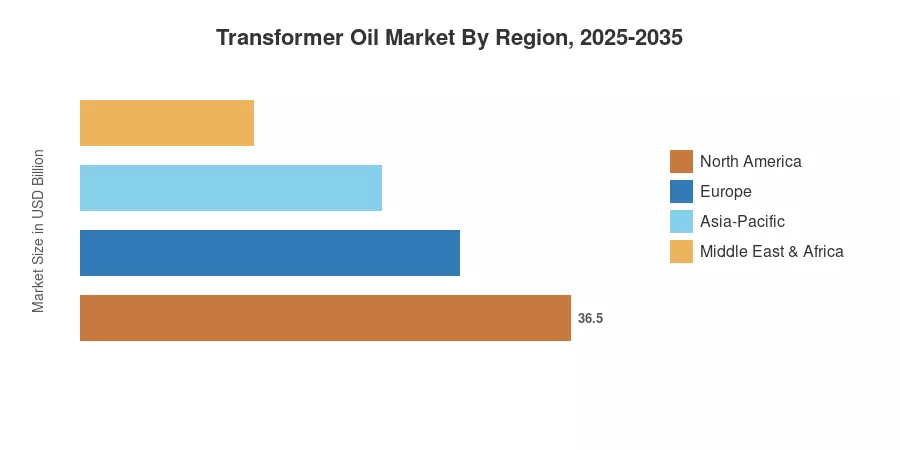
Asia-Pacific commands the largest regional share at roughly 51% of the global Transformer Oil Market, propelled by massive electrification in India and grid modernization in China. North America follows with approximately 22% share, where utility transformer fluids replacement cycles drive recurring demand. Europe is the fastest-maturing region for bio-based cooling oils for transformers, supported by EU sustainability directives. The next decade will see rising procurement from offshore-wind converter platforms and HVDC corridors, pushing the Transformer Oil Market into new technical territory


Key Report Takeaways

• By Type

  • Mineral-based insulating oil held the dominant position with approximately 95% of volume consumed in 2025, reflecting legacy fleet inertia and cost familiarity
  • Bio-based esters are projected to grow at a CAGR of 8.5% during 2026–2035, the fastest among all types in the Transformer Oil Market
  • Silicone-based dielectric fluids maintain a niche but stable share, primarily in high-temperature specialty applications

• By Application

  • Transformers accounted for approximately 78% of total volume in 2025, reinforcing their role as the primary consumption driver in the Transformer Oil Market
  • Switchgear and circuit breaker applications are expanding steadily as utilities replace aging high voltage insulation oil in distribution networks

• By Region

  • Asia-Pacific captured a CAGR of 1.95% — the fastest among all regions — driven by India's Revamped Distribution Sector Scheme and China's State Grid investments
  • North America contributed approximately USD 0.84 Billion in 2025, sustained by transformer maintenance oil demand across aging utility infrastructure
  • Europe is pioneering regulatory-driven adoption of bio-based electrical insulation fluids in urban substations


Market Size and Forecast (2021–2035)

The market sizing combines bottom-up volume tracking from transformer OEM shipment data, utility procurement records, and refinery output for naphthenic and paraffinic base oils, triangulated against top-down demand models anchored to installed transformer capacity and replacement cycles. Historical data (2021–2024) is derived from trade statistics, customs data, and annual reports from major power transformer oil suppliers. Forecast projections (2026–2035) apply the calibrated 1.42% CAGR with adjustments for policy-driven demand surges.
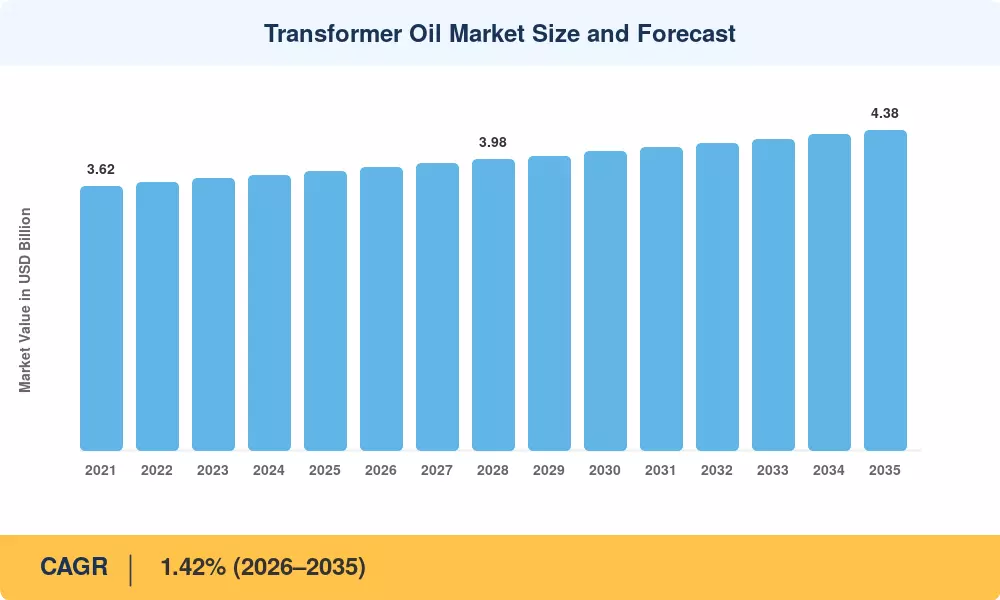
Transformer Oil Market Size and Forecast
Our Impact
Enabled $4.3B Revenue Impact for Fortune 500 and Leading Multinationals
Partnering with 2000+ Global Organizations Each Year
30K+ Citations by Top-Tier Firms in the Industry
 

Driver Impact Analysis

Driver ~% Impact on CAGR Geographic Relevance Impact Timeline
Grid reinforcement and T&D expansion ~28% Asia-Pacific, MEA Long-term (≥4 yr)
Aging transformer fleet replacement ~22% North America, Europe Medium-term (2–4 yr)
Offshore wind and HVDC growth ~15% Europe, Asia-Pacific Long-term (≥4 yr)
Data center proliferation ~12% North America, Asia-Pacific Short-term (≤2 yr)
Bio-based ester regulatory mandates ~10% Europe, North America Medium-term (2–4 yr)
Rural electrification programs ~8% South Asia, Sub-Saharan Africa Long-term (≥4 yr)
EV charging infrastructure buildout ~5% Global Medium-term (2–4 yr)


Grid Reinforcement and T&D Expansion

For electrical infrastructure, Asia-Pacific continues to be the key growth engine. With multi-year government backing totaling billions of dollars, India's Revamped Distribution Sector Scheme (RDSS) is currently pushing major capital expenditure to modernize distribution networks and reduce technical losses. In order to connect western renewable energy hubs with eastern consumption areas, China's State Grid Corporation is still actively constructing ultra-high-voltage (UHV) transmission routes. This area is the main driver of the volume consumption of both mineral and synthetic transformer oils since these enormous infrastructure projects require the initial filling of large-scale power transformers, which can require up to 80,000 liters of insulating fluid per unit.


Aging Transformer Fleet Replacement

Due to an aging fleet of distribution transformers, many of which are nearing or have surpassed their 30-year operational life, utilities in North America and Europe are facing a crucial replacement cycle. Utilities are being forced to retire legacy units in the United States due to the Department of Energy's (DOE) finalized, tougher efficiency criteria. In addition to pushing a shift toward higher-performance dielectric fluids that provide better thermal control, this replacement cycle is also raising the demand for new maintenance oil. In order to meet with strict European sustainability standards, national transmission system operators in Europe, including France's RTE, have committed to long-term multi-billion-euro grid renovation initiatives that prioritize equipment lifetime and the use of eco-friendly fluids.


Offshore Wind and HVDC Interconnectors

Despite recent inflationary pressures, the global offshore wind industry continues to be a major consumer of specialty insulating fluids. In order to connect remote offshore wind farms to the mainland grid, HVDC (High Voltage Direct Current) technology is necessary. The converter stations needed for these projects use large amounts of cooling and insulation oil that are made to withstand severe thermal cycling and environmental stress. The need for premium-grade, high-dielectric-strength fluids is growing along with the capacity of these offshore converter platforms as North Sea and other international offshore grid interconnections progress.


Data Center Proliferation

Hyperscale and edge data centers are emerging as a meaningful new demand channel for the Transformer Oil Market. The IEA projects global data center electricity consumption to reach 1,000 TWh by 2026 [12]. Each facility requires dedicated transformer capacity, and many operators in dense urban settings now specify bio-based electrical insulation fluids for fire safety and environmental compliance. This trend is particularly pronounced in North America and Singapore, where land-constrained deployments favor lower-risk dielectric fluids.


Restraints Impact Analysis

The restraint estimates below are directional indicators of headwinds dampening growth. They do not mathematically subtract from the CAGR and reflect qualitative-quantitative hybrid assessments of market friction.

Restraint ~% Negative Impact Geographic Relevance Impact Timeline
Volatile naphthenic base-oil pricing ~−0.25% Global Short-term (≤2 yr)
Environmental disposal liabilities ~−0.20% Europe, North America Medium-term (2–4 yr)
Dry-type transformer substitution ~−0.15% Europe, Japan Long-term (≥4 yr)
PCB contamination legacy costs ~−0.10% North America Medium-term (2–4 yr)
Supply-chain concentration risk ~−0.08% Global Short-term (≤2 yr)


Volatile Naphthenic Base-Oil Pricing

Naphthenic crude — the primary feedstock for mineral insulating oil — is sourced from a limited number of refineries globally, with Venezuela, the U.S. Gulf Coast, and Sweden accounting for the majority of supply. Refinery closures and feedstock redirection toward higher-margin petrochemical products have tightened supply, creating price volatility that compresses margins for transformer oil blenders. Between 2021 and 2024, naphthenic base-oil spot prices fluctuated by as much as 35%, forcing utilities to adopt hedging strategies and longer procurement cycles for electrical transformer fluids [6].

Dry-Type Transformer Substitution

Dry-type transformers eliminate the need for insulating oil entirely, using air or cast resin for cooling and insulation. While currently limited to lower-voltage indoor applications (typically ≤36 kV), ongoing R&D is expanding their voltage ceiling. Japan and several European markets have increased dry-type adoption for commercial buildings and renewable-energy interconnections, posing a structural headwind to liquid dielectric fluids demand at the distribution level [16]. However, dry-type units remain cost-prohibitive and technically constrained for high-voltage transmission, limiting their near-term impact on the broader Transformer Oil Market.

Environmental Disposal Liabilities

Spent mineral insulating oil is classified as hazardous waste in most jurisdictions due to dissolved metals, moisture contamination, and potential PCB traces. Disposal and re-refining costs in Europe have risen approximately 40% since 2020 under tightened EU Waste Framework Directive enforcement [15]. These escalating end-of-life costs are prompting some utilities to accelerate the switch to bio-based cooling oils for transformers, which carry lower disposal liabilities but higher upfront costs.


Transformer Oil Market Opportunities

Bio-Based Ester Expansion in Urban Substations

Municipal fire codes and environmental regulations are creating a pull market for natural and synthetic ester-based electrical insulation fluids. Cities including London, Singapore, and New York have imposed fire-performance mandates for indoor substations that mineral oil cannot meet without costly suppression systems. The bio-based segment of the Transformer Oil Market is projected to grow at more than 8% CAGR through 2035, representing the most dynamic sub-segment [5].

Transformer Oil Recycling and Re-Refining

Circular-economy mandates are opening a significant adjacent opportunity. Re-refined transformer maintenance oil can achieve performance parity with virgin mineral insulating oil at 30–40% lower cost, and several European utilities now specify re-refined product in procurement frameworks. The global re-refining capacity for used dielectric fluids is projected to expand by 25% through 2030, supported by extended producer responsibility legislation [11][15].

Offshore Wind and HVDC Converter Platforms

The accelerating buildout of offshore wind farms and cross-border HVDC interconnectors represents a high-value growth vector for the Transformer Oil Market. Converter transformers for these applications demand premium-grade power transformer oil with enhanced oxidation stability and dielectric strength, commanding price premiums of 20–30% over standard distribution-grade product [8].

Emerging Market Electrification

Sub-Saharan Africa and South Asia remain significantly under-electrified, with the IEA estimating that 760 million people lacked electricity access in 2024 [2]. National electrification programs in Nigeria, Kenya, Bangladesh, and Myanmar are deploying distribution transformers at scale, creating new volume demand for utility transformer fluids in regions where the installed base is expanding from a low baseline

Predictive Maintenance and Dissolved Gas Analytics

Digital oil monitoring — using dissolved gas analysis (DGA) sensors and AI-driven predictive algorithms — is creating new service-layer revenue streams for transformer oil suppliers. Vendors offering integrated oil-plus-monitoring packages can shift from commodity pricing to lifecycle-cost models, improving margins while extending oil service life. This data-monetization opportunity aligns with the broader utility digitalization trend [18].


Transformer Oil Market Future Outlook

Electrification Supercycle and Grid-Edge Demand

The global electrification supercycle — driven by EV adoption, heat-pump rollouts, and data center expansion — will compound demand for transformer capacity through 2035. The IEA's World Energy Outlook projects global electricity demand growing by 80% through 2050, with the majority of incremental load materializing in the 2026–2035 window [2]. Every additional MW of connected load requires upstream transformer capacity and, by extension, dielectric fluids. The Transformer Oil Market stands to benefit from this structural demand tailwind, particularly as distribution-level congestion forces utilities to deploy additional step-down transformers at the grid edge.

Bio-Based Transition and ESG-Driven Procurement

ESG reporting frameworks are migrating from voluntary disclosure to mandatory compliance across G20 economies. The ISSB's IFRS S2 climate standard, effective from 2025, requires scope-3 supply-chain emissions reporting that will spotlight the carbon footprint of mineral insulating oil production and disposal [15]. Utilities seeking to decarbonize their procurement are increasingly specifying bio-based electrical insulation fluids, creating a structural shift in the Transformer Oil Market that benefits ester manufacturers with certified sustainable supply chains.

AI-Enabled Oil Monitoring and Predictive Maintenance

Real-time dissolved gas analysis and AI-driven condition monitoring are transforming transformer maintenance oil from a consumable into a data-rich sensor medium. Online DGA sensors — deployed at fewer than 5% of power transformers today — are projected to reach 20% penetration by 2032, creating recurring analytics revenue for oil suppliers who integrate monitoring into their service offerings [18]. This shift toward lifecycle management models supports margin expansion and customer retention in an otherwise commodity-driven Transformer Oil Market.

HVDC and Offshore Converter Platform Growth

Cross-border HVDC interconnectors and offshore wind converter platforms represent the highest-value growth pocket for power transformer oil suppliers. IRENA projects over 250 GW of offshore wind capacity by 2035, with each GW requiring dedicated converter transformer infrastructure filled with premium-grade cooling oils for transformers [8]. Suppliers who develop specialized high-voltage ester formulations for HVDC applications will capture disproportionate value as this segment scales.


Transformer Oil Market Segmentation

By Type

Segment Key Metric Primary Demand Driver
Mineral-Based ~95% share (2025) Legacy fleet inertia; cost advantage
Silicone-Based CAGR ~2.1% (2026–2035) High-temperature specialty applications
Bio-Based CAGR ~8.5% (2026–2035) Fire-safety mandates; biodegradability rules


Mineral-based insulating oil dominates the Transformer Oil Market by an overwhelming margin, reflecting decades of installed-base lock-in and a well-established global supply chain for naphthenic and paraffinic base oils. Its cost per liter remains 40–60% below synthetic and bio-based alternatives, maintaining its default-specification status across most utility procurement frameworks. However, tightening Group-I base-oil refining capacity and escalating disposal costs are gradually narrowing this cost gap, creating an opening for alternative dielectric fluids.

Bio-based esters represent the most dynamic growth segment in the Transformer Oil Market. Natural esters derived from soybean, rapeseed, and palm oils deliver superior fire points (exceeding 300°C versus 170°C for mineral oil), higher moisture tolerance, and full biodegradability. Their adoption is concentrated in urban substations, data centers, and environmentally sensitive installations where fire-safety codes and spill-liability concerns justify the premium. The European market for bio-based electrical transformer fluids has grown at roughly double the global average rate, supported by REACH compliance requirements and municipal sustainability mandates [4][5].

By Application

Segment Key Metric Primary Demand Driver
Transformers ~78% share (2025) Power and distribution transformer fills
Switchgear ~USD 0.42 Billion (2025) Medium-voltage distribution upgrades
Circuit Breakers CAGR ~1.30% (2026–2035) HV circuit breaker maintenance cycles
Other Applications ~4% share (2025) Reactors, bushings, capacitors


Transformers consume the bulk of global insulating oil volume, split roughly 60/40 between power transformers (≥100 MVA) and distribution transformers (<100 MVA). Power transformers require larger initial oil fills and less frequent replacement, while distribution units — numbering in the hundreds of millions globally — generate steady recurring demand for utility transformer fluids. The switchgear segment is growing as utilities replace aging medium-voltage switchgear with sealed, maintenance-reduced designs that nonetheless require high-performance dielectric fluids for arc quenching.

By End-User Industry

Segment Key Metric Primary Demand Driver
Power Generation ~24% share (2025) Generator step-up transformers
Transmission & Distribution CAGR ~1.88% (2026–2035) Grid expansion and fleet replacement
Railways & Metros ~USD 0.18 Billion (2025) Traction transformer demand; electrification
Other End Users ~6% share (2025) Industrial plants, mining, OEMs


Transmission and distribution utilities represent the largest and fastest-growing end-user category in the Transformer Oil Market. T&D operators manage the overwhelming majority of installed transformer capacity and drive procurement cycles for both initial fills and maintenance-driven oil replacement. Railways and metros are an emerging end-user segment, as rail electrification programs in India, the EU, and Southeast Asia deploy thousands of traction transformers that require specialized cooling oils for transformers with enhanced thermal stability [3][14].


Regional Market Share Analysis

Region Key Metric Primary Investment Themes
Asia-Pacific ~51% share (2025) Grid buildout, UHV corridors, rural electrification
North America ~USD 0.84 Billion (2025) Fleet replacement, data centers, EV infrastructure
Europe CAGR ~1.65% (2026–2035) Bio-based mandates, offshore wind, and substation renewal
South America ~5% share (2025) Hydro-grid expansion, mining electrification
Middle East & Africa CAGR ~2.10% (2026–2035) Greenfield T&D, solar integration, urban growth
Total USD 3.82 Billion (2025)

The Transformer Oil Market exhibits a regionally concentrated demand profile, with Asia-Pacific and North America collectively accounting for over 73% of global consumption. Regional dynamics are shaped by fleet age, electrification stage, and regulatory posture toward bio-based dielectric fluids.


North America

Country Key Metric Key Driver
US ~76% of regional share DOE efficiency standards; aging fleet replacement
Canada CAGR ~1.35% Hydro corridor upgrades; cold-climate oil specs
Mexico ~USD 0.06 Billion (2025) CFE grid modernization; industrial expansion


The U.S. dominates North American demand for insulating oil, driven by the country's massive installed base of aging distribution transformers and new DOE efficiency mandates. Canada's demand is shaped by long-distance hydro transmission corridors that require cold-pour-point mineral insulating oil, while Mexico's state utility CFE is expanding its transmission backbone to support industrial reshoring [9][13].

Europe

Country Key Metric Key Driver
Germany ~22% of regional share Energiewende grid reinforcement
UK CAGR ~1.80% Offshore wind interconnectors
France ~USD 0.08 Billion (2025) RTE substation modernization
Italy ~13% of regional share Terna grid upgrades
Spain CAGR ~1.55% Renewable integration corridors
Nordic Countries ~10% of regional share Cross-border HVDC links
Russia ~USD 0.05 Billion (2025) Domestic grid maintenance
Rest of Europe CAGR ~1.40% General fleet replacement


Europe's Transformer Oil Market is distinguished by the fastest adoption of bio-based electrical transformer fluids globally. The EU's Corporate Sustainability Reporting Directive (CSRD) and updated REACH regulations are pressuring utilities to document supply-chain environmental impact, favoring biodegradable cooling oils for transformers. The UK's offshore wind targets — 50 GW by 2030 — are generating incremental demand for high-performance power transformer oil in converter stations [8][14].

Asia-Pacific

Country Key Metric Key Driver
China ~48% of regional share State Grid UHV investments
India CAGR ~2.25% RDSS distribution buildout
Japan ~USD 0.11 Billion (2025) Fleet replacement; dry-type substitution
South Korea ~7% of regional share KEPCO grid modernization
ASEAN CAGR ~2.10% Electrification, industrial growth
Rest of Asia-Pacific ~5% of regional share Mining, emerging infrastructure


China and India together account for over 70% of Asia-Pacific consumption of utility transformer fluids. China's 14th Five-Year Plan targets over 40 UHV transmission lines by 2030, each requiring massive volumes of high-voltage insulation oil. India's RDSS program is deploying smart distribution transformers at unprecedented scale, with an estimated 30 million new transformer units targeted across rural networks by 2027 [2][3].

South America

Country Key Metric Key Driver
Brazil ~62% of regional share Hydro transmission; Eletrobras expansion
Argentina CAGR ~1.60% Grid reliability investments
Rest of South America ~USD 0.03 Billion (2025) Mining electrification; copper belt growth


Brazil's expansive hydro-generation network drives the majority of South American demand for transformer maintenance oil. Long-distance transmission from northern hydro plants to southern load centers requires frequent oil replenishment and monitoring, while mining-sector electrification in Chile and Peru is adding incremental demand for dielectric fluids [10].

Middle East & Africa

Country Key Metric Key Driver
Saudi Arabia ~28% of regional share Vision 2030 grid buildout
UAE CAGR ~2.30% Data center and urban expansion
South Africa ~USD 0.04 Billion (2025) Eskom grid rehabilitation
Egypt ~15% of regional share New Administrative Capital grid
Rest of MEA CAGR ~1.90% Greenfield electrification


The Middle East & Africa region represents the fastest-growing frontier for the Transformer Oil Market. Saudi Arabia's Vision 2030 infrastructure program includes massive T&D network expansion to support new industrial cities and entertainment districts. Sub-Saharan Africa's electrification gap creates a structural demand runway for insulating oil, although procurement challenges and logistics constraints temper near-term growth [2][10].


Transformer Oil Market By Region, 2025-2035
 

Competitive Benchmarking

The Transformer Oil Market exhibits medium concentration, with the top five players collectively holding an estimated 35–45% of global revenue. The competitive landscape is characterized by a mix of integrated petrochemical companies with captive base-oil refining, specialty chemical firms with bio-based portfolios, and regional blenders serving local utility markets. Differentiation increasingly hinges on supply-chain reliability, bio-based portfolio breadth, and the ability to bundle oil supply with condition-monitoring services.

Company Est. Revenue Share Range Key Offerings Strategic Positioning
Nynas AB ~8–11% Naphthenic base oils, NYTRO series mineral insulating oil Vertically integrated naphthenic refiner; European market leader
Ergon Refining ~7–10% HyVolt naphthenic oils, specialty dielectric fluids Leading U.S. naphthenic refiner; strong utility relationships
Calumet Specialty Products ~5–8% Naphthenic transformer oils, custom blends U.S.-focused; deep refining integration
Cargill (Envirotemp) ~4–7% Envirotemp FR3 natural ester fluid Bio-based pioneer; fire-safety positioning
Shell plc ~4–6% Shell Diala mineral insulating oil range Global distribution network; brand recognition
Sinopec ~4–6% Mineral transformer oils, paraffinic grades Dominant China supplier; state-backed scale
APAR Industries ~3–5% PowerOil mineral and synthetic transformer oils Leading Indian manufacturer; export footprint
Savita Oil Technologies ~2–4% Savinol transformer oils, re-refined grades India-focused; growing re-refining capacity
Gandhar Oil Refinery ~2–4% Mineral transformer oils, white oils Indian mid-tier player; competitive pricing
M&I Materials (Midel) ~2–3% Midel synthetic and natural ester fluids UK-based ester specialist; premium positioning


Recent News & Developments

  • Nynas AB (March 2025): Completed commissioning of its expanded naphthenic refinery unit in Nynäshamn, Sweden, adding approximately 150,000 metric tons of annual insulating oil capacity to address tightening global supply [6].
  • Cargill (January 2025): Announced expansion of Envirotemp FR3 natural ester production capacity at its U.S. facility by 30%, citing growing demand from data center operators for bio-based dielectric fluids [5].
  • APAR Industries (November 2024): Secured a five-year supply contract with India's Power Grid Corporation for transformer maintenance oil across 25 interstate substations, valued at approximately USD 45 Million [3].
  • U.S. Department of Energy (October 2024): Issued final rule updating energy efficiency standards for liquid-immersed distribution transformers under 10 CFR 431, effective January 2027, accelerating fleet replacement and associated insulating oil demand [9].
  • Shell plc (August 2024): Launched Shell Diala S4 ZX-IG, a gas-to-liquid (GTL) based electrical transformer fluid with enhanced oxidation stability for HVDC converter applications [7].
  • M&I Materials (May 2024): Partnered with Siemens Energy to qualify Midel 7131 synthetic ester for use in Siemens' portfolio of large power transformers rated up to 420 kV [4].
  • European Commission (March 2024): Published updated REACH Annex XVII restrictions on polycyclic aromatic hydrocarbons in mineral insulating oil, tightening limits effective 2026 and favoring bio-based alternatives [15].
  • Sinopec (January 2024): Inaugurated a new transformer oil blending facility in Guangdong Province with 200,000 metric tons annual capacity to serve State Grid's UHV corridor expansion [3].
  • NYNAS AB (November 2025): NYTRO BIO 300X, a bio-based transformer fluid from NYNAS AB, was used to fill KONõAR's 630 kVA distribution transformer in Zagreb. This is the first time the completely renewable insulating liquid has been used. The national Distribution System Operator of Croatia, HEP ODS, KONcéAR-D&ST, and Nynas worked together successfully to reach the milestone.
  • Hitachi Energy (May 2025): Hitachi Energy successfully tested a ground-breaking 765 kV/400 kV single-phase transformer in May 2025. This transformer is the first in the world at its voltage and power level, with a capacity of 250 megavolt-amperes (MVA). Its revolutionary edge is highlighted by the usage of natural ester oil.


Transformer Oil Market Report Scope

Parameter Detail
Market Scope Global Transformer Oil Market — mineral-based, silicone-based, and bio-based insulating oil for electrical transformers, switchgear, circuit breakers, and related equipment
Study Period 2021–2035
CAGR 1.42% (2026–2035)
Market Size (2025) USD 3.82 Billion
Market Size (2035) USD 4.38 Billion
Fastest Growing Segment Bio-based esters (by type); Asia-Pacific (by geography)
Companies Profiled 10 (Nynas, Ergon, Calumet, Cargill, Shell, Sinopec, APAR, Savita, Gandhar, M&I Materials)
Valuation Currency USD Billion


FAQs

How do natural ester fluids compare to mineral oil in terms of transformer lifespan?

Natural esters absorb and tolerate higher moisture levels than mineral insulating oil, reducing cellulose insulation degradation and extending transformer paper life by 5–8 times under equivalent thermal loading [4]. This lifespan extension can offset the 2–3x price premium at initial fill.

What testing standards should procurement teams require when sourcing transformer oil?

Buyers should mandate compliance with IEC 60296 for mineral oil and IEC 62770 for natural esters, covering breakdown voltage, dissipation factor, and oxidation stability [4]. Third-party lab certification from agencies such as KEMA or Doble Engineering adds supply-chain assurance.

How does dissolved gas analysis affect oil replacement intervals?

Online DGA sensors detect incipient faults — arcing, partial discharge, overheating — before they degrade oil quality, enabling condition-based replacement instead of fixed schedules [18]. Utilities using continuous DGA have reported 20–30% reductions in unnecessary oil changeouts.

What are the key logistics challenges in transporting transformer oil to remote sites?

Bulk transformer oil requires nitrogen-blanketed ISO tank containers to prevent moisture ingress and oxidation during transit [6]. Remote or offshore installations face additional costs for vessel chartering and on-site vacuum filling equipment.

Can mineral and bio-based transformer oils be mixed in existing equipment?

Retrofilling a mineral-oil transformer with natural esters requires complete draining, flushing, and gasket compatibility verification per IEEE C57.147 [5]. Mixing the two fluids without proper procedures degrades dielectric performance and voids warranties.

How are PCB-contamination regulations affecting the Transformer Oil Market in developing countries?

The Stockholm Convention mandates elimination of PCB-containing equipment by 2028, requiring developing nations to test, decontaminate, or replace older transformers — driving incremental demand for fresh dielectric fluids [17]. Compliance funding remains a constraint in Sub-Saharan Africa and parts of Southeast Asia.

What role does transformer oil play in EV fast-charging infrastructure?

High-power EV charging stations (350 kW+) require dedicated distribution transformers with oil-immersed cooling to handle sustained thermal loads [13]. Each fast-charging corridor of 10–15 stations can consume 50,000–100,000 liters of power transformer oil.


Author
Author
Author Profile
Chitranshi Jaiswal LinkedIn
Team Lead - Research
Chitranshi is a Team Leader in the Chemicals & Materials (CnM) and Energy & Power (EnP) domains, with 6+ years of experience in market research. She leads and mentors teams to deliver cross-domain projects that equip clients with actionable insights and growth strategies. She is skilled in market estimation, forecasting, competitive benchmarking, and both primary & secondary research, enabling her to turn complex data into decision-ready insights. An engineer and MBA professional, she combines technical expertise with strategic acumen to solve dynamic market challenges. Chitranshi has successfully managed projects that support market entry, investment planning, and competitive positioning, while building strong client relationships. Certified in Advanced Excel & Power BI she leverages data-driven approaches to ensure accuracy, clarity, and impactful outcomes.

Research Approach

Research Methodology on Transformer Oil Market

Introduction

This research study on the global transformer oil market focuses on the quantitative analysis of the market along with qualitative analysis of different regions. In this context, various sources for data collection and assessment were taken into consideration, with primary research playing an important role in the report. In order to generate an accurate assessment of the market opportunities and trends, primary analysis comprised interviews with senior industry personnel, such as Chief Executive Officers (CEOs), Chief Technical Officers (CTOs), Vice Presidents (Vps), Product Managers, and related experts. This primary team was also accompanied by experienced strategists and analysts of the business in order to gain a comprehensive view of the current and emerging trends in the global transformer oil market.

Secondary data sources used to gather information and insights included government regulations, trade journals, white papers, and other secondary sources of information such as corporate websites. In addition, government databases, reports published by the stock exchanges, and presentations featuring financial notes were also considered.

Market Structure and Definitions

The transformer oil market has been segmented on the basis of technology, end-use industry, and region. The technology segment has been further divided into mineral oil and synthetic oil. The end-user industries segment includes utilities, industrial, and others. The region segment comprises North America, Europe, Asia-Pacific, and the Rest of the World (RoW).

Market Estimation

The approach adopted for market estimation uses both the top-down and bottom-up approaches. Secondary research among the top manufacturers of transformer oil, such as Germany-based Chevron Phillips Chemical Company, was used to understand the size of the overall global market. The estimated size of the transformer oil market was used as the base to understand and estimate the overall size as well as its subsegments for different regions. To validate the overall size of the global transformer oil market, primary research was conducted.

Top-Down and Bottom-Up Approach

For the forecasting of the global transformer oil market, a top-down approach was used to identify the number of companies using transformer oil, in the different end-use industries. This exercise was part of the overall market collection to collect the data points used in the model.

In order to estimate the size of the transformer oil market in different regions and the different end-use industries, primary research of the secondary sources of information was also conducted. Through interviews with industry experts and validation of the secondary data collected, a market size was arrived at for the global transformer oil market for the forthcoming years.

Data Triangulation

Data triangulation involves the series of steps taken to confirm both the data and the analysis of the market. Data triangulation involves a comparison between basic assumptions & market forecasts and the data points collected through primary research. Data points suggest deductions taken from qualitative and quantitative analysis which was used for market estimation.

Market Forecasting

Market forecasting was done for each segment through extrapolation of both consensus views and assumptions given in the study made by the panel of industry experts. We also weighted the statistical models to calculate the market size. The forecasts given in the report have been based upon the expected demand and criteria like past trends, current market-changing scenarios and government policies around the world and regional regulations.

Primary Work

Primary research comprised interviews with experts based in different locations, including North America, Europe, Asia-Pacific, Latin America, and Middle East & Africa (MEA). The objective of the primary research was to collect information and insights into the transformer oil market that could not be obtained due to the limitation of secondary sources.

The primary participants included senior professionals, such as C-level executives and experts specializing in transformer oil. Key opinion leaders from leading market players and specialists from government, research, and other institutions were also interviewed.

The primary research process was designed to obtain information about the market trends, industrial policies, and regulations, details about manufacturers, pricing of products and services, and other important key aspects of the global transformer oil market.

Data Collection and Quality Backing

The data sources used to collect information and estimates for the market, include interviews with industry personnel, corporate websites, research papers, and trade websites. The data collection sources were systematically and considerately used to ensure they are of the highest quality and accuracy. Secondary data sources were also studied to understand the overall size of the market and articulate the market dynamics.

The quality backing of the report is based on the following steps taken during the process:

  • Designing a comprehensive methodology for arriving at the size of the market and its subsegments
  • Identification of key players operating in the market
  • Estimation of the current market scenario and the trend in various countries
  • Interviews through various sources such as C-level executives from primary respondents, industry consultants, and other knowledgeable people
  • Validation of the data points collected from different sources
  • Collating and aggregating data
  • Analysis of the overall market using several market models
  • Representation of the overall market in a triangulated manner

Market Dynamics

The global transformer oil market is characterized by the presence of several regional and international players, who compete in terms of product specification, regional inputs, pricing, and other such factors.

The market is expected to grow during the forecast period, owing to the rising demand from the power sector and growing investments in the electric industry. In addition, advancements in the field of renewable energy such as solar, wind, and hydrogen power, have further contributed to the growth of the transformer oil market.

Download Free Sample

Kindly complete the form below to receive a free sample of this Report

Download PDF ×

We do not share your information with anyone. However, we may send you emails based on your report interest from time to time. You may contact us at any time to opt-out.