×
Request Free Sample ×

Kindly complete the form below to receive a free sample of this Report

* Please use a valid business email

Leading companies partner with us for data-driven Insights

clients tt-cursor
Hero Background

UAV Market

ID: MRFR/AD/0625-CR
134 Pages
Swapnil Palwe
February 2021

UAV Market Research Report Information by Type (Fixed Wing and Multi Rotor), Component (Airframe, Payload, Guidance Navigation Control and Propulsion System), Application (Military UAVs and Commercial UAVs) and Region (North America, Europe, Asia-Pacific, Middle East Africa and Latin America) - Forecast till 2035

Share:
Download PDF ×

We do not share your information with anyone. However, we may send you emails based on your report interest from time to time. You may contact us at any time to opt-out.

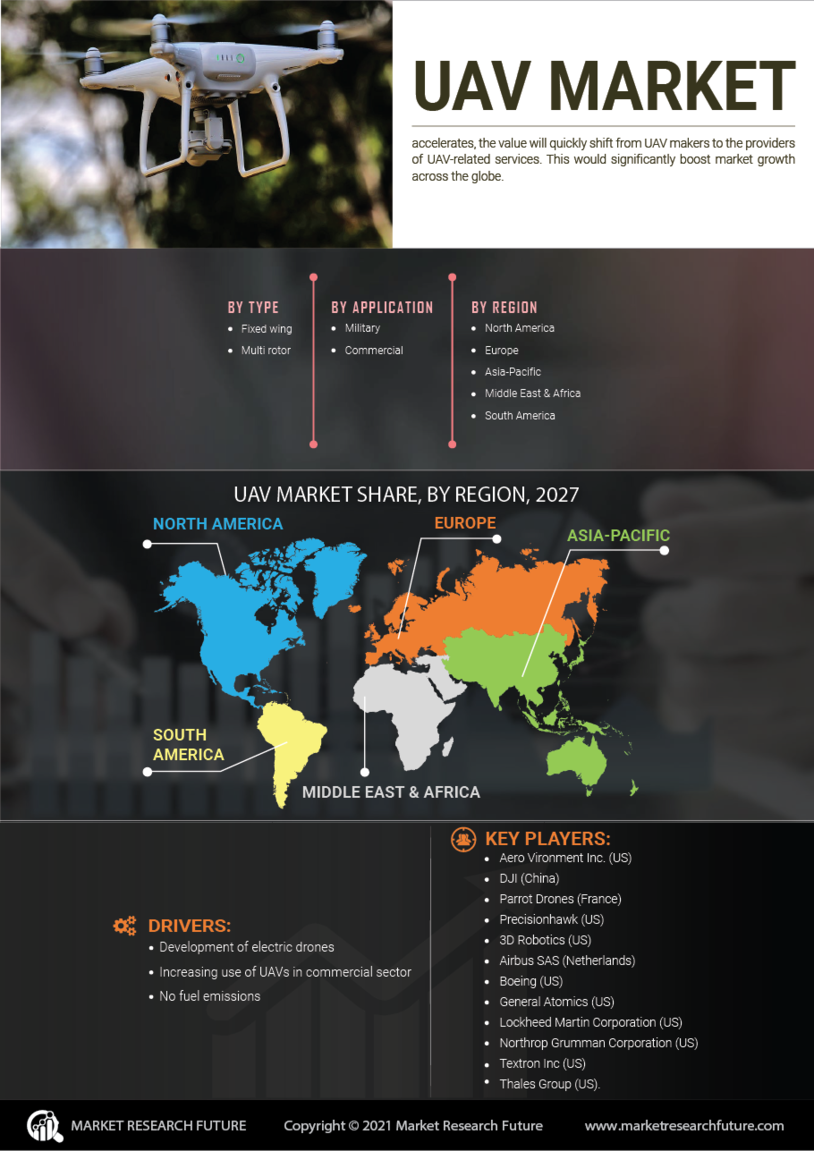
UAV Market Infographic
Purchase Options

UAV Market Summary

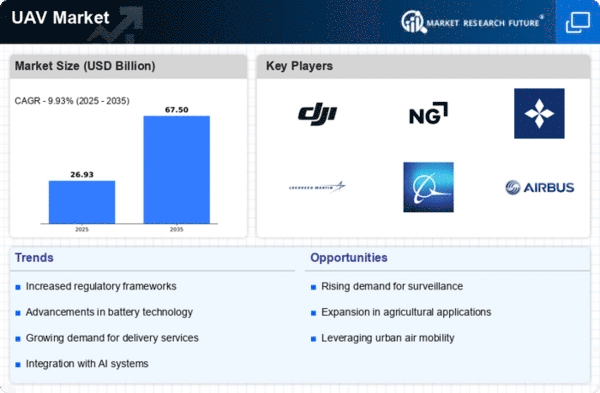
As per MRFR analysis, the UAV Market Size was estimated at 24.5 USD Billion in 2024. The UAV industry is projected to grow from 26.2 in 2025 to 67.5 by 2035, exhibiting a compound annual growth rate (CAGR) of 9.93 during the forecast period 2025 - 2035.

Key Market Trends & Highlights

The UAV market is experiencing robust growth driven by technological advancements and evolving regulatory frameworks.

  • North America remains the largest market for UAVs, driven by diverse applications across various sectors.
  • The Asia-Pacific region is emerging as the fastest-growing market, fueled by increasing investments in UAV technology.
  • Aerial photography continues to dominate the market, while agriculture is rapidly gaining traction as a key segment.
  • Major drivers include the rising demand for delivery services and advancements in UAV technology, particularly in military and defense applications.

Market Size & Forecast

2024 Market Size 24.5 (USD Billion)
2035 Market Size 67.5 (USD Billion)
CAGR (2025 - 2035) 9.93%

Major Players

DJI (CN), Northrop Grumman (US), General Atomics (US), (US), Boeing (US), Airbus (FR), Textron (US), Parrot (FR), Elbit Systems (IL), Thales Group (FR)

UAV Market Trends

The UAV Market is currently experiencing a transformative phase characterized by rapid technological advancements and increasing applications across various sectors. The integration of artificial intelligence and machine learning into UAV systems is enhancing their capabilities, enabling more autonomous operations and improved data analysis. This evolution is not only expanding the operational scope of UAVs but also attracting investments from diverse industries, including agriculture, logistics, and surveillance. As regulatory frameworks evolve to accommodate these innovations, the UAV Market is poised for substantial growth, driven by the demand for efficient and cost-effective solutions. Moreover, the growing emphasis on environmental sustainability is influencing the UAV Market. Companies are increasingly exploring eco-friendly alternatives, such as electric-powered drones, which align with global efforts to reduce carbon footprints. This shift towards greener technologies is likely to reshape market dynamics, encouraging manufacturers to innovate and adapt to changing consumer preferences. The convergence of these trends suggests a promising future for the UAV Market, where technological prowess and sustainability coexist, potentially leading to new opportunities and challenges for stakeholders across the industry.

Technological Integration

The incorporation of advanced technologies, such as artificial intelligence and machine learning, is revolutionizing the UAV Market. These innovations enhance operational efficiency, enabling drones to perform complex tasks autonomously and analyze data in real-time.

Sustainability Focus

A growing commitment to environmental sustainability is driving the development of eco-friendly UAV solutions. Manufacturers are increasingly investing in electric-powered drones, reflecting a shift towards reducing carbon emissions and promoting greener practices.

Regulatory Evolution

As the UAV Market expands, regulatory frameworks are adapting to accommodate new technologies and applications. This evolution is crucial for ensuring safety and fostering innovation, ultimately shaping the future landscape of the industry.

Market Segment Insights

By Application: Aerial Photography (Largest) vs. Agriculture (Fastest-Growing)

The UAV market is experiencing a diverse distribution among its various application segments. Aerial photography holds the largest market share, driven by its extensive use in media, real estate, and tourism. Following closely is the agriculture sector, which is rapidly adopting UAV technology for precision farming, pest control, and crop monitoring, reflecting a notable shift in agricultural practices. Other segments like surveillance and delivery services also contribute significantly, but they are not yet at the same level of market penetration.

Aerial Photography: Dominant vs. Agriculture: Emerging

Aerial photography remains the dominant segment of the UAV market, primarily due to its widespread applications in capturing high-resolution images for various industries including film, advertising, and land surveying. This segment benefits from advancements in camera technology and drone capabilities, providing stunning visuals that traditional methods cannot match. In contrast, agriculture is the fastest-growing segment as farmers increasingly recognize the value of drones in enhancing yield through data collection, analysis, and monitoring. This emerging sector is characterized by innovation in agricultural practices, supported by government initiatives and the increasing demand for sustainable farming solutions.

By End Use: Commercial (Largest) vs. Military (Fastest-Growing)

The UAV market reveals a diversified distribution across its end-use segments, with the commercial sector dominating significantly. The high adoption rates in industries such as agriculture, logistics, and aerial photography contribute to its large market share. On the other hand, military applications are witnessing substantial investments, driven by the need for advanced surveillance and combat capabilities, marking it as a key player in the UAV landscape.

Commercial (Dominant) vs. Military (Emerging)

The commercial end-use segment of the UAV market is characterized by its extensive applications, catering to sectors like agriculture, real estate, and delivery services. This segment benefits from the growing demand for efficiency and innovation in various industries, enabling businesses to enhance operational efficiency. Conversely, the military segment, although currently smaller, is rapidly evolving thanks to increasing defense budgets and technological advancements. As nations prioritize unmanned systems for reconnaissance and tactical operations, the military UAV sector is projected to become a crucial player in the market, making its presence felt as an emerging force.

By Type: Fixed Wing (Largest) vs. Rotary Wing (Fastest-Growing)

In the UAV market, Fixed Wing drones currently hold the largest market share due to their superior endurance and range capabilities, making them ideal for applications such as surveillance and mapping. They are preferred for large area coverage, especially in agricultural, military, and environmental monitoring sectors. In contrast, Rotary Wing drones are rapidly expanding their market share. Their adaptability and maneuverability allow them to be used in diverse settings including photography, infrastructure inspection, and emergency services, thus appealing to a wider range of users.

Fixed Wing (Dominant) vs. Rotary Wing (Emerging)

Fixed Wing UAVs are renowned for their efficiency in covering large distances, which has cemented their dominance in sectors requiring extensive mapping and monitoring capabilities. These drones are characterized by their aerodynamic design, which allows for greater flight time and lower operational costs. On the other hand, Rotary Wing UAVs are emerging as versatile tools favored for their agility and ability to hover. Their growing popularity can be attributed to advancements in battery technology and drone design, which enhance their functionality in areas such as real-time data collection and aerial photography. Both segments address specific needs within the UAV market, creating a dynamic landscape for technological innovations.

By Payload Capacity: 5 to 25 Kilograms (Largest) vs. Above 50 Kilograms (Fastest-Growing)

In the UAV market, the payload capacity segment exhibits a diverse range of demand, with the '5 to 25 Kilograms' category commanding the largest share. This segment caters primarily to commercial delivery applications, agricultural monitoring, and cinematography, making it a preferred choice for various businesses. Meanwhile, the 'Above 50 Kilograms' segment is witnessing surging interest, especially in industrial applications like surveying and infrastructure inspection, indicating a significant shift towards heavier payloads. Growth trends in the payload capacity segment are driven by evolving technology and increasing operational efficiencies. The '5 to 25 Kilograms' category continues to dominate due to its versatility and cost-effectiveness, enabling companies to adopt UAV solutions with lower entry barriers. Conversely, the 'Above 50 Kilograms' segment is rapidly emerging as industries look to leverage drones for transporting heavier loads, further enhancing efficiency and expanding potential applications in logistics and agriculture.

5 to 25 Kilograms (Dominant) vs. Above 50 Kilograms (Emerging)

The '5 to 25 Kilograms' payload capacity range in the UAV market is characterized by its significant versatility and adaptability to numerous applications including goods delivery, film production, and agricultural services. This segment dominates market share, driven by the need for efficient and cost-effective UAV solutions in various commercial sectors. On the other hand, the 'Above 50 Kilograms' segment is gaining traction as emerging technology allows for larger drones capable of carrying greater payloads. This segment is poised for substantial growth, especially within industrial and logistics sectors, as companies look to utilize drones for heavy lifting tasks that were traditionally reliant on ground transportation.

By Control System: Remote Control (Largest) vs. Autonomous (Fastest-Growing)

In the UAV market, the control system segment has seen a dynamic distribution in market share among its various categories. Remote control systems remain the largest segment, primarily due to their wide adoption in commercial and recreational applications. Autonomous systems, however, are rapidly gaining traction and hold significant promise as they cater to the rising demand for advanced, fully automated UAVs. This juxtaposition highlights an intriguing shift where traditional control methods coexist with innovative technologies.

Remote Control (Dominant) vs. Autonomous (Emerging)

Remote control UAVs play a pivotal role in the drone ecosystem, offering operators an intuitive, hands-on experience which is crucial for hobbyists and certain commercial use cases. Their dominance stems from ease of use and immediate operator feedback, making them a preferred choice for many users. Conversely, autonomous UAVs are emerging as the technology of the future, driven by advancements in AI and machine learning. They offer enhanced operational efficiency, the ability to perform complex missions without human intervention, and are increasingly being integrated into various sectors, such as agriculture and surveillance, providing a significant competitive edge.

Get more detailed insights about UAV Market

Regional Insights

North America : Market Leader in UAV Technology

North America continues to lead the UAV market, holding a significant share of 12.25 in 2024. The growth is driven by advancements in technology, increasing defense budgets, and a rising demand for commercial applications. Regulatory support from agencies like the FAA has also catalyzed market expansion, enabling more widespread use of UAVs across various sectors, including agriculture, logistics, and surveillance. The United States is the primary player in this region, with key companies such as Northrop Grumman, General Atomics, and Boeing leading the charge. The competitive landscape is characterized by continuous innovation and investment in R&D. The presence of major manufacturers and a robust supply chain further solidify North America's position as a global UAV powerhouse.

Europe : Emerging UAV Market Dynamics

Europe is witnessing a burgeoning UAV market, with a size of 6.5 in 2024. The growth is fueled by increasing applications in agriculture, infrastructure inspection, and public safety. Regulatory frameworks, such as the European Union's U-Space initiative, are paving the way for safe and efficient UAV operations, enhancing market attractiveness and investment opportunities. Leading countries like the UK, Germany, and France are at the forefront of this growth, with companies such as Airbus and Thales Group making significant contributions. The competitive landscape is evolving, with a mix of established players and startups innovating in UAV technology. The region's focus on sustainability and environmental monitoring is also driving demand for UAV solutions.

Asia-Pacific : Rapidly Growing UAV Market

The Asia-Pacific region is emerging as a significant player in the UAV market, with a size of 4.5 in 2024. The growth is driven by increasing investments in defense and surveillance, coupled with a rising demand for commercial applications in sectors like agriculture and logistics. Countries are also enhancing their regulatory frameworks to facilitate UAV operations, contributing to market expansion. China, Japan, and Australia are leading the charge in this region, with companies like DJI and Parrot making notable impacts. The competitive landscape is characterized by rapid technological advancements and a focus on integrating UAVs into existing infrastructures. The region's diverse applications and growing acceptance of UAV technology are key factors propelling its growth.

Middle East and Africa : Emerging UAV Opportunities

The Middle East and Africa region is gradually developing its UAV market, currently valued at 1.25 in 2024. The growth is primarily driven by increasing defense expenditures and the need for surveillance and reconnaissance capabilities. Additionally, the region is witnessing a rise in commercial applications, particularly in agriculture and logistics, supported by evolving regulatory frameworks. Countries like the UAE and South Africa are leading the UAV initiatives, with investments in technology and infrastructure. The competitive landscape is still in its nascent stages, but the presence of key players like Elbit Systems is beginning to shape the market. As the region continues to embrace UAV technology, opportunities for growth and innovation are expanding.

Key Players and Competitive Insights

The UAV Market is currently characterized by a dynamic competitive landscape, driven by technological advancements and increasing demand across various sectors, including defense, agriculture, and logistics. Major players such as DJI (CN), Northrop Grumman (US), and General Atomics (US) are strategically positioned to leverage innovation and partnerships to enhance their market presence. DJI (CN) focuses on consumer and commercial applications, emphasizing product innovation and user-friendly technology, while Northrop Grumman (US) and General Atomics (US) concentrate on defense and military applications, investing heavily in R&D to develop advanced UAV systems that meet evolving security needs. Collectively, these strategies contribute to a competitive environment that is increasingly defined by technological prowess and strategic collaborations.

Key business tactics within the UAV Market include localizing manufacturing and optimizing supply chains to enhance operational efficiency. The market structure appears moderately fragmented, with a mix of established players and emerging startups. This fragmentation allows for diverse offerings and innovation, yet the influence of key players remains substantial, as they set industry standards and drive technological advancements.

In November 2025, Northrop Grumman (US) announced a partnership with a leading AI firm to integrate advanced machine learning capabilities into its UAV systems. This strategic move is likely to enhance the operational efficiency and decision-making capabilities of their drones, positioning Northrop Grumman as a frontrunner in the defense UAV segment. The integration of AI is expected to streamline operations and improve mission outcomes, reflecting a broader trend towards automation in the UAV sector.

In October 2025, General Atomics (US) unveiled a new line of UAVs designed specifically for maritime surveillance. This launch is significant as it addresses the growing need for advanced surveillance capabilities in maritime environments, particularly in light of increasing geopolitical tensions. By expanding its product offerings, General Atomics aims to capture a larger share of the defense market, indicating a strategic focus on niche applications that require specialized UAV solutions.

In September 2025, Airbus (FR) announced the successful completion of a trial for its new hybrid UAV technology, which combines electric and fuel-based propulsion systems. This innovation is poised to enhance flight endurance and reduce operational costs, aligning with the industry's shift towards sustainability. Airbus's commitment to developing eco-friendly UAV solutions reflects a growing trend among manufacturers to prioritize environmental considerations in their product development strategies.

As of December 2025, the UAV Market is witnessing trends that emphasize digitalization, sustainability, and AI integration. Strategic alliances are increasingly shaping the competitive landscape, enabling companies to pool resources and expertise to drive innovation. The shift from price-based competition to a focus on technological differentiation and supply chain reliability is evident, suggesting that future competitive advantages will hinge on the ability to innovate and adapt to changing market demands.

Key Companies in the UAV Market market include

Industry Developments

  • Q2 2024: Northrop Grumman wins $1.2 billion U.S. Army contract for new tactical UAVs Northrop Grumman secured a $1.2 billion contract from the U.S. Army to develop and deliver next-generation tactical unmanned aerial vehicles, aiming to enhance battlefield intelligence and surveillance capabilities.
  • Q2 2024: DJI launches Matrice 400 series, targeting industrial drone market DJI unveiled its Matrice 400 series, a new line of industrial UAVs designed for infrastructure inspection, mapping, and emergency response, featuring advanced AI-powered flight and imaging systems.
  • Q2 2024: Parrot announces partnership with Thales for secure military drone communications French drone maker Parrot entered a strategic partnership with Thales to integrate encrypted communications technology into its UAVs, targeting defense and government clients.
  • Q3 2024: Skydio raises $230 million in Series E funding to expand autonomous drone production U.S.-based Skydio closed a $230 million Series E funding round led by prominent venture capital firms, with plans to scale up manufacturing and accelerate R&D for fully autonomous UAVs.
  • Q3 2024: Elbit Systems opens new UAV Market manufacturing facility in Brazil Israeli defense company Elbit Systems inaugurated a new UAV Market production plant in Brazil to serve Latin American defense and security markets, marking a significant expansion of its global manufacturing footprint.
  • Q3 2024: Zipline receives FAA approval for long-range drone deliveries in the U.S. Zipline, a leader in drone delivery, obtained Federal Aviation Administration (FAA) approval to operate long-range, beyond-visual-line-of-sight (BVLOS) UAV Market deliveries across several U.S. states.
  • Q4 2024: AeroVironment acquires small drone startup Planck Aerosystems AeroVironment, a major U.S. UAV Market manufacturer, acquired Planck Aerosystems, a startup specializing in autonomous navigation for small drones, to enhance its product portfolio and autonomous capabilities.
  • Q4 2024: BAE Systems wins UK Ministry of Defence contract for new combat UAV Market program BAE Systems secured a multi-year contract from the UK Ministry of Defence to develop and supply a new generation of combat UAVs, focusing on advanced stealth and AI-driven mission systems.
  • Q1 2025: DroneDeploy acquires Agremo to boost AI-powered agricultural drone analytics DroneDeploy, a leading drone software company, acquired Serbian agri-tech firm Agremo to integrate advanced crop analytics and AI-driven insights into its UAV Market platform for precision agriculture.
  • Q1 2025: EHang receives first European certification for passenger-carrying autonomous UAV Market Chinese drone maker EHang obtained the first European Union Aviation Safety Agency (EASA) certification for its autonomous passenger UAV Market, paving the way for commercial urban air mobility services in Europe.
  • Q2 2025: General Atomics signs $500 million deal to supply MQ-9B drones to India General Atomics Aeronautical Systems finalized a $500 million agreement to deliver MQ-9B SkyGuardian UAVs to the Indian government, strengthening defense ties and expanding its international customer base.
  • Q2 2025: Volocopter announces partnership with Singapore’s Changi Airport for cargo drone trials Urban air mobility company Volocopter partnered with Changi Airport Group to conduct cargo drone trials, aiming to demonstrate the feasibility of UAVs for airport logistics and last-mile delivery.

Regional Analysis

According to this market report, the worldwide UAV Market Revenue is projected to be developing by North America during the review time frame. Under significant applications in the military and guard area, North America has the most appeal. Due to its utilization of city government assistance, territorial control is projected to endure over the estimated time. Due to the association of prominent players, the US is relied upon to make the most important commitment to extending the territorial market. The US is the greatest supplier of UAVs around the world.

Because of the hearty sending of the framework in the safeguard business, the Region is relied upon to lead. Hence, the area is relied upon to earn the biggest UAV Market portion in the estimated time frameFor instance August 2022Edge Autonomy, the California-based manufacturer of unmanned aerial vehicles (UAVs) for the US military will be purchasing Adaptive Energy. The company will acquire the Michigan producer of solid oxide fuel cells (SOFCs) for an undisclosed sum.

Those fuel cells can be used to power UAVs.Edge Autonomy plans to employ Adaptive Energy’s fuel cell products across its line of unmanned technologies and tools. The company says the merger will strengthen its ability to serve clients’ intelligence, surveillance and reconnaissance (ISR) needs. 


Future Outlook

UAV Market Future Outlook

The UAV market is projected to grow at a 9.93% CAGR from 2024 to 2035, driven by advancements in technology, regulatory support, and increasing applications across various sectors.

New opportunities lie in:

  • Development of autonomous delivery drone networks
  • Integration of UAVs in precision agriculture solutions
  • Expansion of UAV services in urban air mobility initiatives

By 2035, the UAV market is expected to be robust, driven by innovation and diverse applications.

Market Segmentation

UAV Market Type Outlook

  • Fixed Wing
  • Rotary Wing
  • Hybrid
  • Nano
  • Micro

UAV Market End Use Outlook

  • Commercial
  • Military
  • Government
  • Civil
  • Research

UAV Market Application Outlook

  • Aerial Photography
  • Agriculture
  • Surveillance
  • Delivery Services
  • Infrastructure Inspection

UAV Market Control System Outlook

  • Remote Control
  • Autonomous
  • Semi-Autonomous
  • Swarm Technology

UAV Market Payload Capacity Outlook

  • Less than 5 Kilograms
  • 5 to 25 Kilograms
  • 25 to 50 Kilograms
  • Above 50 Kilograms

Report Scope

MARKET SIZE 2024 24.5(USD Billion)
MARKET SIZE 2025 26.2(USD Billion)
MARKET SIZE 2035 67.5(USD Billion)
COMPOUND ANNUAL GROWTH RATE (CAGR) 9.93% (2024 - 2035)
REPORT COVERAGE Revenue Forecast, Competitive Landscape, Growth Factors, and Trends
BASE YEAR 2024
Market Forecast Period 2025 - 2035
Historical Data 2019 - 2024
Market Forecast Units USD Billion
Key Companies Profiled DJI (CN), Northrop Grumman (US), General Atomics (US), Lockheed Martin (US), Boeing (US), Airbus (FR), Textron (US), Parrot (FR), Elbit Systems (IL), Thales Group (FR)
Segments Covered Application, End Use, Type, Payload Capacity, Control System
Key Market Opportunities Integration of artificial intelligence in UAV systems enhances operational efficiency and expands application potential.
Key Market Dynamics Technological advancements and regulatory changes drive competitive dynamics in the unmanned aerial vehicle market.
Countries Covered North America, Europe, APAC, South America, MEA

Market Highlights

Author
Swapnil Palwe
Team Lead - Research

With a technical background as Bachelor's in Mechanical Engineering, with MBA in Operations Management , Swapnil has 6+ years of experience in market research, consulting and analytics with the tasks of data mining, analysis, and project execution. He is the POC for our clients, for their consulting projects running under the Automotive/A&D domain. Swapnil has worked on major projects in verticals such as Aerospace & Defense, Automotive and many other domain projects. He has worked on projects for fortune 500 companies' syndicate and consulting projects along with several government projects.

Leave a Comment

FAQs

What is the growth rate of UAV Market?

UAV Market Size is Anticiptef to reach USD 24.62 Billion by 2030, Grow at a CAGR of 10.01 % during 2023-2030

What are the major key players of this market?

Aero Vironment Inc. (US), DJI (China), Parrot Drones (France), Precisionhawk (US), 3D Robotics (US), Airbus SAS (Netherlands), Boeing (US), General Atomics (US), Lockheed Martin Corporation (US), Northrop Grumman Corporation (US), Textron Inc (US), and Thales Group (US).

What are the factors driving the growth of the UAV market?

Rising interest in UAVs in military applications is driving the UAV market growth and development

Download Free Sample

Kindly complete the form below to receive a free sample of this Report

Compare Licence

×
Features License Type
Single User Multiuser License Enterprise User
Price $4,950 $5,950 $7,250
Maximum User Access Limit 1 User Upto 10 Users Unrestricted Access Throughout the Organization
Free Customization
Direct Access to Analyst
Deliverable Format
Platform Access
Discount on Next Purchase 10% 15% 15%
Printable Versions