×
Request Free Sample ×

Kindly complete the form below to receive a free sample of this Report

* Please use a valid business email

Leading companies partner with us for data-driven Insights

clients tt-cursor
Hero Background

UAV Navigation System Market

ID: MRFR/AD/34110-HCR
100 Pages
Swapnil Palwe
October 2025

UAV Navigation System Market Research Report By Application (Military, Commercial, Agriculture, Search and Rescue, Surveying), By Component (GPS, IMU, Software, Transmitter, Receiver), By Platform (Fixed Wing, Rotary Wing, Hybrid, Nano UAVs, Tactical UAVs), By End Use (Defense, Civil Aviation, Logistics, Infrastructure Inspection, Environmental Monitoring) and By Regional (North America, Europe, South America, Asia Pacific, Middle East and Africa) - Forecast to 2035

Share:
Download PDF ×

We do not share your information with anyone. However, we may send you emails based on your report interest from time to time. You may contact us at any time to opt-out.

UAV Navigation System Market Infographic
Purchase Options

UAV Navigation System Market Summary

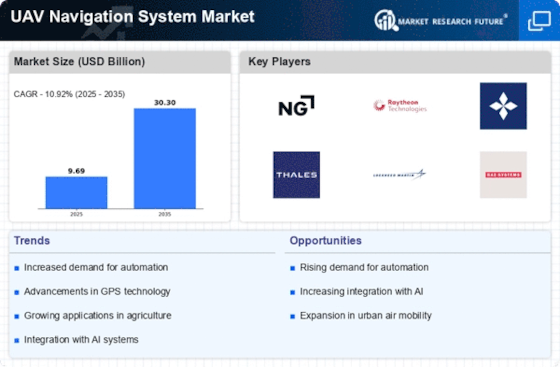
As per MRFR analysis, the UAV Navigation System Market was estimated at 9.69 USD Billion in 2024. The UAV Navigation System industry is projected to grow from 10.75 USD Billion in 2025 to 30.3 USD Billion by 2035, exhibiting a compound annual growth rate (CAGR) of 10.92 during the forecast period 2025 - 2035.

Key Market Trends & Highlights

The UAV Navigation System Market is poised for substantial growth driven by technological advancements and increasing applications across various sectors.

  • The integration of AI and machine learning is transforming UAV navigation systems, enhancing their operational efficiency.
  • North America remains the largest market for UAV navigation systems, while Asia-Pacific is emerging as the fastest-growing region.
  • The military segment continues to dominate the market, whereas the agriculture segment is experiencing rapid growth due to increased UAV adoption.
  • Technological advancements and rising demand for UAVs in various industries are key drivers propelling market expansion.

Market Size & Forecast

2024 Market Size 9.69 (USD Billion)
2035 Market Size 30.3 (USD Billion)
CAGR (2025 - 2035) 10.92%

Major Players

Northrop Grumman (US), Raytheon Technologies (US), General Atomics (US), Thales Group (FR), Lockheed Martin (US), BAE Systems (GB), Elbit Systems (IL), Leonardo (IT), AeroVironment (US)
UAV Navigation System Market Trends

The UAV Navigation System Market is currently experiencing a transformative phase, driven by advancements in technology and increasing applications across various sectors. The integration of artificial intelligence and machine learning into navigation systems appears to enhance the accuracy and reliability of UAV operations. This evolution is likely to facilitate the deployment of drones in complex environments, such as urban areas and disaster zones, where precise navigation is crucial. Furthermore, the growing demand for autonomous systems in industries like agriculture, logistics, and surveillance suggests a robust future for UAV navigation technologies. As regulatory frameworks evolve, the market may witness a surge in adoption, particularly in commercial applications. In addition, the emphasis on safety and security in UAV operations is becoming more pronounced. Stakeholders are increasingly focusing on developing navigation systems that incorporate advanced features such as obstacle detection and collision avoidance. This trend indicates a shift towards more sophisticated solutions that not only meet operational requirements but also adhere to safety standards. The UAV Navigation System Market, therefore, stands at a pivotal juncture, where innovation and regulatory compliance are likely to shape its trajectory in the coming years.

Integration of AI and Machine Learning

The incorporation of artificial intelligence and machine learning into UAV navigation systems is transforming operational capabilities. These technologies enhance decision-making processes, enabling drones to navigate complex environments with greater precision.

Focus on Safety and Security

There is a growing emphasis on safety features within UAV navigation systems. Innovations such as obstacle detection and collision avoidance are becoming essential, reflecting a broader commitment to secure and reliable drone operations.

Expansion in Commercial Applications

The UAV Navigation System Market is witnessing increased adoption in commercial sectors, including agriculture and logistics. This trend suggests a shift towards more widespread use of drones for various practical applications, driven by evolving regulatory frameworks.

UAV Navigation System Market Drivers

Government Initiatives and Regulations

Government initiatives and regulations are playing a pivotal role in shaping the UAV Navigation System Market. Many countries are implementing policies to promote the safe integration of UAVs into national airspace, which includes establishing standards for navigation systems. For instance, regulatory bodies are increasingly mandating the use of advanced navigation technologies to ensure safety and compliance. This regulatory environment is fostering growth in the market, as manufacturers are compelled to innovate and enhance their navigation systems to meet these standards. The anticipated increase in regulatory frameworks is expected to create a more structured market, potentially leading to a market growth rate of around 12% annually.

Growing Interest in Environmental Monitoring

The UAV Navigation System Market is increasingly influenced by the growing interest in environmental monitoring and conservation efforts. UAVs equipped with advanced navigation systems are being utilized for tasks such as wildlife tracking, forest management, and pollution assessment. The ability to gather precise data over large areas makes UAVs an invaluable tool for environmental scientists and conservationists. Recent studies indicate that the use of UAVs in environmental monitoring could reduce costs by up to 30% compared to traditional methods. This trend is likely to drive further adoption of UAV navigation systems, as organizations seek efficient and effective solutions for environmental challenges.

Rising Demand for UAVs in Various Industries

The UAV Navigation System Market is witnessing a surge in demand for unmanned aerial vehicles across diverse sectors, including agriculture, construction, and logistics. The increasing adoption of UAVs for tasks such as crop monitoring, infrastructure inspection, and delivery services is propelling the need for sophisticated navigation systems. According to recent data, the agricultural sector alone is expected to account for a substantial share of the UAV market, with projections indicating that UAVs could enhance crop yields by up to 20%. This rising demand is likely to drive innovation and investment in navigation technologies, further expanding the UAV Navigation System Market.

Increased Investment in Research and Development

Investment in research and development is a critical driver for the UAV Navigation System Market. Companies are allocating significant resources to develop cutting-edge navigation technologies that enhance the performance and reliability of UAVs. This focus on R&D is not only improving existing systems but also paving the way for the introduction of novel solutions, such as autonomous navigation and swarm technology. The market is likely to benefit from these advancements, as they can lead to more efficient and versatile UAV applications. Analysts suggest that the R&D expenditure in this sector could reach billions of dollars in the next few years, indicating a robust commitment to innovation.

Technological Advancements in UAV Navigation Systems

The UAV Navigation System Market is experiencing rapid technological advancements, particularly in the areas of GPS accuracy and sensor integration. Enhanced GPS technologies, such as multi-frequency and multi-constellation systems, are improving navigation precision, which is crucial for various applications, including agriculture and surveillance. The integration of advanced sensors, such as LiDAR and computer vision, is also transforming navigation capabilities, allowing for real-time data processing and obstacle avoidance. As a result, the market is projected to grow significantly, with estimates suggesting a compound annual growth rate of over 15% in the coming years. This growth is driven by the increasing demand for high-precision navigation solutions across multiple sectors.

Market Segment Insights

By Application: Military (Largest) vs. Agriculture (Fastest-Growing)

The UAV Navigation System Market is segmented into various applications, with military usage holding the largest share. Military applications dominate the market due to extensive investments and the growing need for surveillance and reconnaissance. Following closely, commercial applications are also significant as businesses increasingly adopt UAV technologies for various purposes, such as logistics and inspection. Agriculture has emerged as a notable segment, with its share rapidly increasing as farmers leverage drones for precision farming. The growth trends for UAV navigation systems across these applications reveal interesting dynamics. The military sector's demand is driven by advancements in technology and the strategic necessity for enhanced operational capabilities. In contrast, the agricultural sector's rapid growth is fueled by the rising adoption of precision agriculture and the need for efficient resource management. The commercial sector is driven by the increasing demand for drone delivery and aerial inspections, further contributing to overall market expansion.

Military (Dominant) vs. Agriculture (Emerging)

In the UAV Navigation System Market, the military segment stands as the dominant force, characterized by robust funding and advanced technological integration allowing for a wide array of applications, including surveillance, reconnaissance, and combat support. Military UAVs are often equipped with advanced navigation systems that enhance operational capabilities, ensuring precision in critical missions. Conversely, the agriculture segment is rapidly emerging, leveraging UAV navigation systems for tasks like crop monitoring, field mapping, and livestock management. Farmers are increasingly adopting UAV technology to optimize productivity and resource management. This segment's growth is further driven by technological advances that enable real-time data collection and analysis, making agricultural drones an essential tool for modern farming and farming sustainability.

By Component: GPS (Largest) vs. IMU (Fastest-Growing)

In the UAV Navigation System Market, GPS technology holds the largest market share among the various components. This is mainly due to its essential role in providing accurate positioning and navigation capabilities, which are crucial for the effective operation of UAVs. Following GPS is the IMU, which, while currently commanding a smaller share, is rapidly gaining traction as manufacturers and users are becoming increasingly aware of its importance to enhance stability and control in response to dynamic conditions.

GPS (Dominant) vs. IMU (Emerging)

GPS technology continues to dominate the UAV Navigation System Market due to its essential functions in navigation and its ability to operate effectively in various environments. The accuracy and reliability of GPS systems make them indispensable for many UAV applications, including surveillance, delivery, and agricultural monitoring. In contrast, the Inertial Measurement Unit (IMU) is considered an emerging technology that plays a critical role in improving UAV performance. IMUs complement GPS by providing data on acceleration and angular velocity, allowing for better navigation during GPS signal loss or interference. As UAVs advance toward more autonomous operations, the demand for IMUs is expected to grow significantly, highlighting their importance in enhancing UAV capabilities.

By Platform: Fixed Wing (Largest) vs. Rotary Wing (Fastest-Growing)

In the UAV Navigation System Market, the 'Fixed Wing' segment currently holds the largest market share, primarily due to its widespread applications in agricultural monitoring, infrastructure inspection, and surveillance activities. The capability of fixed-wing UAVs to cover large areas efficiently makes them a go-to choice for many businesses and governmental agencies. On the other hand, the 'Rotary Wing' segment is observing rapid expansion, particularly in sectors requiring flexibility and maneuverability, such as search and rescue, and logistics. The growth trends within this segment are driven by technological advancements and an increasing emphasis on automation in businesses. The demand for tactical and innovative UAVs has surged, leading to enhanced capabilities that are appealing to various industries. Factors such as improved battery life, enhanced navigation systems, and regulatory support are contributing to the growth of rotary wing UAVs, indicating a shift towards more versatile applications.

Fixed Wing (Dominant) vs. Tactical UAVs (Emerging)

The Fixed Wing segment of the UAV Navigation System Market is characterized by its ability to deliver long endurance and stable flight, making it suitable for large-scale operations. Companies investing in this space benefit from established technologies, making fixed-wing UAVs a preferred choice for aerographies and sustained surveillance missions. In contrast, Tactical UAVs present an emerging segment that emphasizes short-range versatility and advanced payload capabilities. They are primarily designed for tactical military operations and intelligence gathering, using real-time data transmission capabilities to enhance operational effectiveness. As defense budgets increase globally, tactical UAVs are becoming vital for national security, thereby gaining traction in both defense and commercial sectors.

By End Use: Defense (Largest) vs. Civil Aviation (Fastest-Growing)

The UAV Navigation System Market exhibits varied distribution across its end-use segments, with the Defense sector commanding the largest share. The military utilizes unmanned aerial vehicles for surveillance, tactical operations, and reconnaissance, significantly impacting market dynamics. In contrast, the Civil Aviation segment is witnessing rapid growth, driven by increased societal acceptance and regulatory support for drone operations across urban air mobility and passenger transport, identifying it as a prominent emerging segment in the industry.

Defense (Dominant) vs. Civil Aviation (Emerging)

The Defense end-use segment of the UAV Navigation System Market is characterized by its extensive application in national security and military operations. This segment leverages advanced navigation systems to ensure mission success in surveillance, reconnaissance, and combat scenarios. The integration of sophisticated navigation technology enhances operational precision and effectiveness for defense applications. Meanwhile, the Civil Aviation segment is quickly emerging, fueled by advancements in UAV technology and favorable regulations that facilitate commercial applications such as air transport and logistics. As urban air mobility grows, the Civil Aviation segment is likely to capture a significant market share, potentially redefining aerial transport.

Get more detailed insights about UAV Navigation System Market

Regional Insights

North America : Leading Innovation and Development

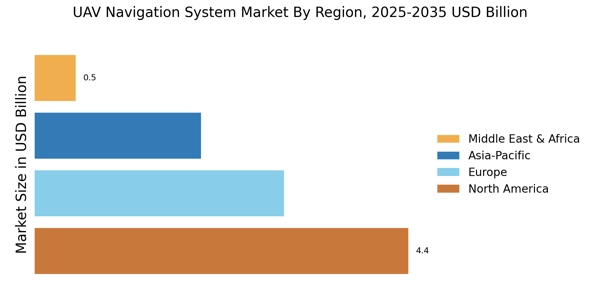
North America is the largest market for UAV navigation systems, holding approximately 45% of the global share. The region's growth is driven by increasing defense budgets, technological advancements, and a rising demand for commercial applications. Regulatory support from the FAA and other agencies has catalyzed the integration of UAVs into national airspace, further boosting market potential. The United States is the primary player in this market, with key companies like Northrop Grumman, Raytheon Technologies, and Lockheed Martin leading the charge. The competitive landscape is characterized by significant investments in R&D and partnerships with government entities. Canada also plays a vital role, focusing on UAV applications in agriculture and surveillance, contributing to the overall market growth.

Europe : Emerging Market with Strong Growth

Europe is witnessing significant growth in the UAV navigation system market, accounting for about 30% of the global share. The region benefits from increasing investments in defense and security, alongside a growing interest in commercial UAV applications. Regulatory frameworks, such as the European Union Aviation Safety Agency (EASA) regulations, are facilitating the safe integration of UAVs into European airspace, driving demand further. Leading countries include the United Kingdom, France, and Germany, where companies like Thales Group and BAE Systems are prominent. The competitive landscape is marked by collaborations between private firms and government agencies to enhance UAV capabilities. The focus on environmental monitoring and disaster management is also propelling market growth, making Europe a key player in the UAV navigation system sector.

Asia-Pacific : Rapidly Growing UAV Market

Asia-Pacific is emerging as a significant player in the UAV navigation system market, holding around 20% of the global share. The region's growth is fueled by increasing military expenditures, advancements in technology, and a burgeoning commercial sector. Countries like China and India are investing heavily in UAV technology for defense and surveillance, supported by favorable government policies and regulations that encourage innovation and development. China is the largest market in the region, with companies like DJI leading in commercial UAV applications. India is also making strides, focusing on agricultural and logistics applications. The competitive landscape is characterized by a mix of local and international players, with a strong emphasis on R&D to enhance UAV capabilities and meet diverse market needs.

Middle East and Africa : Emerging Market with Unique Challenges

The Middle East and Africa region is gradually developing its UAV navigation system market, accounting for approximately 5% of the global share. The growth is driven by increasing defense spending, particularly in countries like the UAE and Saudi Arabia, alongside a rising interest in commercial applications such as agriculture and surveillance. Regulatory frameworks are evolving, with governments recognizing the potential of UAVs for various sectors, which is expected to boost market demand. The UAE is at the forefront, with significant investments in UAV technology and partnerships with global players. South Africa is also emerging as a key market, focusing on UAV applications in wildlife conservation and monitoring. The competitive landscape is characterized by collaborations between local firms and international companies, aiming to enhance UAV capabilities and address regional challenges.

UAV Navigation System Market Regional Image

Key Players and Competitive Insights

The UAV Navigation System Market has seen significant growth in recent years, driven by the increasing demand for advanced technology in various sectors such as defense, agriculture, and transportation. This market is characterized by rapid advancements in technology, changes in regulatory frameworks, and a rising number of applications for unmanned aerial vehicles.

Competitive insights indicate a diverse landscape where established players and emerging startups are vying for market share. Companies are focusing on strategic partnerships, mergers and acquisitions, and continuous innovation in products and services to gain a competitive edge.

This dynamic environment is attracting investments that aim to enhance technological capabilities and expand service portfolios, reflecting a trend toward improved operational efficiency. Trimble has established a strong presence in the UAV Navigation System Market, recognized for its expertise in precision navigation and positioning technology.

The company's strengths lie in its commitment to innovation and the development of user-friendly navigation solutions that cater to various airborne platforms. Trimble is known for integrating state-of-the-art GPS technology into its UAV systems, which enhances accuracy and reliability for end-users.

Moreover, the company has diversified its offerings to include software solutions that complement its hardware, allowing it to optimize workflows across sectors such as construction, agriculture, and surveying.

The robust support and training programs provided by Trimble further amplify its reputation as a trusted partner in the UAV navigation segment, enabling operators to maximize the efficiency of their UAV applications.

AeroVironment has emerged as a key player in the UAV Navigation System Market, demonstrating significant expertise in the development of unmanned aerial systems tailored for military and commercial applications.

The company's navigation systems are designed with cutting-edge technology to ensure high performance in various operational environments. AeroVironment distinguishes itself through its extensive investment in research and development, which fosters innovation and enables the company to maintain a competitive advantage through unique product offerings.

The focus on providing integrated solutions that enhance situational awareness and mission effectiveness resonates well with defense contractors and commercial clients alike.

With an impressive portfolio of UAVs that employ advanced navigation systems, AeroVironment has positioned itself as a leader in delivering high-precision and reliable systems, thereby playing a crucial role in shaping the future of UAV navigation technology.

Key Companies in the UAV Navigation System Market market include

Industry Developments

The UAV Navigation System Market is witnessing significant developments, particularly in technological advancements and partnerships among key players such as Trimble, Boeing, and Northrop Grumman.

Recent initiatives have focused on enhancing GPS accuracy and integrating advanced sensor technologies to improve UAV autonomy and navigational precision. Noteworthy is Thales Group's collaboration with Garmin to develop next-gen navigation solutions aimed at the military sector, which aims to enhance operational efficiency.

AeroVironment and DJI are reportedly expanding their product lines, targeting both commercial and government applications, which is indicative of growing investments in UAV technologies.

In terms of mergers and acquisitions, Raytheon Technologies has announced the acquisition of a small aerospace firm to enhance its UAV systems capabilities, with multiple sources confirming the strategic move to strengthen its market position.

This expansion is reflective of increasing investments in unmanned systems driven by applications in aerial surveillance, agriculture, and logistics. The market's valuation continues to rise, stemming from the necessity for reliable navigation systems, positively impacting the growth and innovation pace across the industry.

Each of these efforts underscores the dynamic nature of the UAV navigation sector and its role in future technological advancements in unmanned vehicles.

Future Outlook

UAV Navigation System Market Future Outlook

The UAV Navigation System Market is projected to grow at a 10.92% CAGR from 2024 to 2035, driven by advancements in technology, increased demand for automation, and regulatory support.

New opportunities lie in:

  • Development of AI-driven navigation algorithms for enhanced accuracy.
  • Integration of UAV navigation systems with smart city infrastructure.
  • Expansion into emerging markets with tailored UAV solutions.

By 2035, the UAV Navigation System Market is expected to be robust, reflecting substantial growth and innovation.

Market Segmentation

UAV Navigation System Market End Use Outlook

  • Defense
  • Civil Aviation
  • Logistics
  • Infrastructure Inspection
  • Environmental Monitoring

UAV Navigation System Market Platform Outlook

  • Fixed Wing
  • Rotary Wing
  • Hybrid
  • Nano UAVs
  • Tactical UAVs

UAV Navigation System Market Component Outlook

  • GPS
  • IMU
  • Software
  • Transmitter
  • Receiver

UAV Navigation System Market Application Outlook

  • Military
  • Commercial
  • Agriculture
  • Search and Rescue
  • Surveying

Report Scope

MARKET SIZE 20249.69(USD Billion)
MARKET SIZE 202510.75(USD Billion)
MARKET SIZE 203530.3(USD Billion)
COMPOUND ANNUAL GROWTH RATE (CAGR)10.92% (2024 - 2035)
REPORT COVERAGERevenue Forecast, Competitive Landscape, Growth Factors, and Trends
BASE YEAR2024
Market Forecast Period2025 - 2035
Historical Data2019 - 2024
Market Forecast UnitsUSD Billion
Key Companies ProfiledMarket analysis in progress
Segments CoveredMarket segmentation analysis in progress
Key Market OpportunitiesIntegration of advanced artificial intelligence for enhanced UAV Navigation System accuracy and efficiency.
Key Market DynamicsTechnological advancements and regulatory changes drive innovation and competition in the UAV Navigation System market.
Countries CoveredNorth America, Europe, APAC, South America, MEA

Leave a Comment

FAQs

What is the projected market valuation of the UAV Navigation System Market by 2035?

The UAV Navigation System Market is projected to reach a valuation of 30.3 USD Billion by 2035.

What was the market valuation of the UAV Navigation System Market in 2024?

In 2024, the UAV Navigation System Market was valued at 9.69 USD Billion.

What is the expected CAGR for the UAV Navigation System Market during the forecast period 2025 - 2035?

The expected CAGR for the UAV Navigation System Market during the forecast period 2025 - 2035 is 10.92%.

Which companies are considered key players in the UAV Navigation System Market?

Key players in the UAV Navigation System Market include Northrop Grumman, Raytheon Technologies, General Atomics, Thales Group, Lockheed Martin, BAE Systems, Elbit Systems, Leonardo, and AeroVironment.

What are the projected valuations for the military segment of the UAV Navigation System Market by 2035?

The military segment of the UAV Navigation System Market is projected to reach valuations between 2.5 and 8.5 USD Billion by 2035.

How does the commercial segment of the UAV Navigation System Market compare to the agriculture segment in 2035?

By 2035, the commercial segment is expected to reach valuations between 3.0 and 10.0 USD Billion, while the agriculture segment is projected to be between 1.5 and 5.0 USD Billion.

What is the anticipated growth for the GPS component in the UAV Navigation System Market by 2035?

The GPS component is projected to grow to valuations between 2.5 and 8.5 USD Billion by 2035.

What are the expected valuations for the tactical UAVs platform segment by 2035?

The tactical UAVs platform segment is anticipated to reach valuations between 3.69 and 8.0 USD Billion by 2035.

What is the projected valuation for the environmental monitoring end-use segment by 2035?

The environmental monitoring end-use segment is projected to reach valuations between 2.69 and 6.8 USD Billion by 2035.

How does the infrastructure inspection end-use segment compare to the logistics segment in 2035?

By 2035, the infrastructure inspection segment is expected to reach valuations between 1.0 and 3.0 USD Billion, whereas the logistics segment is projected to be between 1.5 and 4.5 USD Billion.

Download Free Sample

Kindly complete the form below to receive a free sample of this Report

Compare Licence

×
Features License Type
Single User Multiuser License Enterprise User
Price $4,950 $5,950 $7,250
Maximum User Access Limit 1 User Upto 10 Users Unrestricted Access Throughout the Organization
Free Customization
Direct Access to Analyst
Deliverable Format
Platform Access
Discount on Next Purchase 10% 15% 15%
Printable Versions