×
Request Free Sample ×

Kindly complete the form below to receive a free sample of this Report

* Please use a valid business email

Leading companies partner with us for data-driven Insights

clients tt-cursor
Hero Background

UAV Sense Avoid System Market

ID: MRFR/AD/38315-HCR
100 Pages
Swapnil Palwe
October 2025

UAV Sense and Avoid System Market Research Report By Technology (Radar Systems, Lidar Systems, Computer Vision Systems, Acoustic Sensors), By Application (Civil Aviation, Military, Commercial Delivery, Surveillance), By End Use (Public Safety, Logistics, Agriculture, Environmental Monitoring), By Platform (Fixed-Wing UAV, Rotary-Wing UAV, Hybrid UAV) and By Regional (North America, Europe, South America, Asia Pacific, Middle East and Africa) - Forecast to 2035

Share:
Download PDF ×

We do not share your information with anyone. However, we may send you emails based on your report interest from time to time. You may contact us at any time to opt-out.

UAV Sense Avoid System Market Infographic
Purchase Options

UAV Sense Avoid System Market Summary

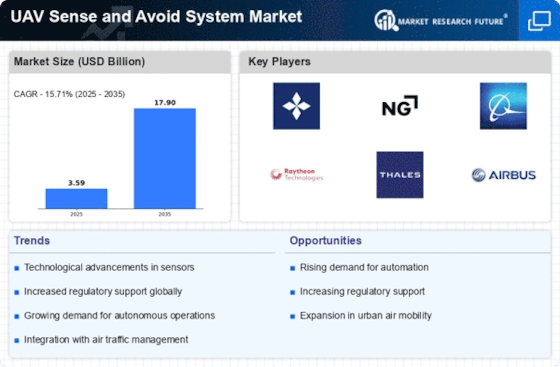
As per MRFR analysis, the UAV Sense and Avoid System Market Size was estimated at 3.594 USD Billion in 2024. The UAV Sense and Avoid System industry is projected to grow from 4.159 USD Billion in 2025 to 17.9 USD Billion by 2035, exhibiting a compound annual growth rate (CAGR) of 15.71 during the forecast period 2025 - 2035.

Key Market Trends & Highlights

The UAV Sense and Avoid System Market is poised for substantial growth driven by technological advancements and increasing demand for autonomous solutions.

  • North America remains the largest market for UAV Sense and Avoid Systems, reflecting robust investment in UAV technologies.
  • Asia-Pacific is emerging as the fastest-growing region, driven by rapid advancements in UAV applications and regulatory support.
  • Radar Systems dominate the market as the largest segment, while Lidar Systems are gaining traction as the fastest-growing segment.
  • Key market drivers include technological advancements in UAV systems and rising applications across various industries.

Market Size & Forecast

2024 Market Size 3.594 (USD Billion)
2035 Market Size 17.9 (USD Billion)
CAGR (2025 - 2035) 15.71%

Major Players

General Atomics (US), Northrop Grumman (US), Boeing (US), Raytheon Technologies (US), Thales Group (FR), Airbus (DE), Lockheed Martin (US), Elbit Systems (IL), Leonardo (IT)

UAV Sense Avoid System Market Trends

The UAV Sense and Avoid System Market is currently experiencing a transformative phase, driven by advancements in technology and increasing demand for unmanned aerial vehicles across various sectors. The integration of sophisticated sensors and algorithms enhances the ability of UAVs to detect and avoid obstacles, thereby improving safety and operational efficiency. As regulatory frameworks evolve, the market is likely to witness a surge in adoption, particularly in commercial applications such as delivery services, agriculture, and surveillance. Furthermore, the growing emphasis on airspace management and the need for seamless integration of UAVs into existing air traffic systems are pivotal factors influencing market dynamics. In addition, the UAV Sense and Avoid System Market appears to be shaped by the rising interest in autonomous systems. Stakeholders are increasingly investing in research and development to create more reliable and efficient solutions. This trend is further supported by collaborations between technology firms and regulatory bodies, aiming to establish standards that ensure safe UAV operations. As the market matures, it may also see the emergence of innovative business models, potentially reshaping how UAV services are delivered and monetized. Overall, the future of the UAV Sense and Avoid System Market seems promising, with numerous opportunities for growth and development on the horizon.

Technological Advancements

Recent innovations in sensor technology and artificial intelligence are significantly enhancing the capabilities of UAVs. These advancements enable more accurate detection of obstacles and improved decision-making processes, which are crucial for safe operations.

Regulatory Developments

The evolving regulatory landscape is playing a critical role in shaping the UAV Sense and Avoid System Market. As governments establish clearer guidelines for UAV operations, the market is likely to see increased adoption and integration into various sectors.

Growing Demand for Autonomous Solutions

There is a noticeable shift towards autonomous UAV systems, driven by the need for efficiency and safety. This trend suggests that stakeholders are prioritizing the development of systems that require minimal human intervention, thereby streamlining operations.

UAV Sense Avoid System Market Drivers

Regulatory Developments and Compliance

The UAV Sense and Avoid System Market is heavily influenced by regulatory developments aimed at ensuring safe UAV operations. Governments and aviation authorities are establishing stringent regulations that mandate the implementation of sense and avoid systems in UAVs. These regulations are designed to mitigate risks associated with mid-air collisions and enhance airspace safety. For instance, the Federal Aviation Administration (FAA) has been actively working on frameworks that require UAV operators to comply with specific safety standards. This regulatory push is likely to drive the demand for advanced sense and avoid technologies, as manufacturers seek to meet compliance requirements. The market is expected to witness a surge in investments as companies strive to develop systems that align with evolving regulations, potentially leading to a market valuation exceeding USD 2 billion by 2027.

Growing Demand for Autonomous Solutions

The UAV Sense and Avoid System Market is witnessing a growing demand for autonomous solutions across various sectors. Industries such as agriculture, construction, and delivery services are increasingly adopting UAVs for their operational efficiency and cost-effectiveness. The need for autonomous UAVs that can navigate complex environments without human intervention is driving the development of sophisticated sense and avoid systems. This trend is further supported by the rising interest in urban air mobility and drone delivery services, which require reliable and safe UAV operations. Market analysts project that the demand for autonomous UAV solutions will continue to rise, potentially leading to a market expansion that could reach USD 3 billion by 2028. This growth reflects the broader shift towards automation in various industries, highlighting the critical role of sense and avoid technologies.

Increased Investment in UAV Technologies

The UAV Sense and Avoid System Market is benefiting from increased investment in UAV technologies by both private and public sectors. Venture capital firms and government agencies are recognizing the potential of UAVs in various applications, leading to substantial funding for research and development. This influx of capital is facilitating the advancement of sense and avoid systems, enabling manufacturers to innovate and enhance their product offerings. Furthermore, partnerships between technology companies and UAV manufacturers are becoming more common, fostering collaboration that accelerates the development of cutting-edge solutions. As a result, the market is expected to experience robust growth, with projections indicating a potential market size of USD 4 billion by 2029. This investment trend underscores the increasing recognition of UAVs as vital tools for future technological advancements.

Rising Applications in Various Industries

The UAV Sense and Avoid System Market is expanding due to the rising applications of UAVs in diverse industries. Sectors such as agriculture, construction, and emergency services are increasingly utilizing UAVs for tasks ranging from crop monitoring to infrastructure inspection. The need for reliable sense and avoid systems is paramount in these applications to ensure safety and operational efficiency. For instance, in agriculture, UAVs equipped with advanced sense and avoid technologies can navigate fields autonomously, avoiding obstacles while collecting valuable data. This trend is likely to drive market growth, with estimates suggesting that the UAV sense and avoid system market could reach USD 5 billion by 2030. The versatility of UAVs across various sectors highlights the critical importance of developing robust sense and avoid systems to support their widespread adoption.

Technological Advancements in UAV Systems

The UAV Sense and Avoid System Market is experiencing rapid technological advancements that enhance the capabilities of unmanned aerial vehicles. Innovations in sensor technology, such as LiDAR and advanced radar systems, are improving the detection and tracking of obstacles in real-time. These advancements are crucial for ensuring the safety and reliability of UAV operations, particularly in complex environments. The integration of artificial intelligence and machine learning algorithms is also playing a pivotal role in enhancing decision-making processes for UAVs. As a result, the market is projected to grow significantly, with estimates suggesting a compound annual growth rate of over 15% in the coming years. This growth is driven by the increasing adoption of UAVs across various sectors, including agriculture, logistics, and surveillance.

Market Segment Insights

By Technology: Radar Systems (Largest) vs. Lidar Systems (Fastest-Growing)

The UAV Sense and Avoid System market shows a diverse distribution of technological solutions, with Radar Systems leading the pack as the most significant contributor. Following closely are Lidar Systems, which have garnered attention due to their advanced capabilities. Computer Vision Systems and Acoustic Sensors round out the category, although they hold smaller market shares compared to Radar and Lidar systems. Overall, these technologies play vital roles in ensuring safe navigation and collision avoidance for UAVs in various applications.

Technology: Radar Systems (Dominant) vs. Lidar Systems (Emerging)

Radar Systems are recognized as the dominant technology in the UAV Sense and Avoid system market, largely due to their proven reliability, long-range detection capabilities, and effectiveness in various weather conditions. They provide robust performance in all environments, making them a preferred choice for many UAV applications. In contrast, Lidar Systems represent an emerging segment in this market, utilizing laser technology for high-resolution scanning and obstacle detection. Their rapid growth stems from the increasing demand for precision in navigation and obstacle avoidance, especially in urban environments where complex landscapes challenge UAV operations. This combination of robustness and precision positions both systems uniquely, catering to different operational needs.

By Application: Civil Aviation (Largest) vs. Surveillance (Fastest-Growing)

The UAV Sense and Avoid System Market exhibits a diverse share distribution across various applications, with Civil Aviation leading as the largest segment. Military and Commercial Delivery applications hold significant shares as well, each contributing to the overall market landscape. Surveillance, while smaller in share, is rapidly gaining traction among users who require advanced monitoring capabilities, indicating a shift in preferences toward automation in this field.

Civil Aviation (Dominant) vs. Surveillance (Emerging)

Civil Aviation represents the dominant application in the UAV Sense and Avoid System Market, primarily driven by regulatory compliance and safety requirements for drones operating in controlled airspace. This segment's growth is supported by the increasing integration of UAVs into everyday air travel, alongside heightened investments in technology to enhance collision avoidance systems. In contrast, Surveillance is emerging as a noteworthy application, fueled by advancements in UAV technology and the rising demand for real-time data collection in security and environmental monitoring. This application’s versatility enables it to cater to diverse sectors, from law enforcement to wildlife protection, thereby establishing itself as a crucial player in the future landscape of UAV deployments.

By End Use: Public Safety (Largest) vs. Logistics (Fastest-Growing)

In the UAV Sense and Avoid System Market, the end-use segment shows a diverse application landscape, with Public Safety capturing the largest market share. This segment includes law enforcement and disaster management which rely heavily on UAV technology for surveillance and monitoring operations. Following closely is the Logistics segment, which is rapidly gaining traction, driven by the need for efficient delivery solutions within urban and rural areas. Looking ahead, the growth trends in the UAV Sense and Avoid System Market are primarily driven by advancements in technology and increased demand from various sectors. The Public Safety segment is fortified by government initiatives promoting UAV usage for public security. Conversely, the Logistics sector is propelled by e-commerce expansion, where UAVs offer innovative solutions for last-mile delivery challenges, indicating a robust growth trajectory for this segment.

Public Safety (Dominant) vs. Logistics (Emerging)

The Public Safety segment remains dominant in the UAV Sense and Avoid System Market, characterized by highly regulated operations and reliance on advanced technology for mission-critical applications. UAVs are utilized for surveillance, emergency response, and crowd control, benefiting significantly from government funding and public safety mandates. In contrast, the Logistics segment is emerging rapidly, characterized by innovative delivery methods and companies leveraging UAVs to enhance supply chain efficiency. Logistics players are increasingly adopting UAV technologies to meet consumer demands for fast and reliable service, making it a vibrant area of investment and growth within the market.

By Platform: Fixed-Wing UAV (Largest) vs. Rotary-Wing UAV (Fastest-Growing)

The UAV Sense and Avoid System Market displays diverse platforms with Fixed-Wing UAVs leading in market share. Their longer endurance and ability to cover vast areas make them the preferred choice for many commercial and military applications. In contrast, Rotary-Wing UAVs hold a smaller share but show rapid growth due to increasing demand for agile formats in applications like surveillance and logistics. Hybrid UAVs, while significant, play a niche role in blending advantages from both fixed and rotary platforms.

Fixed-Wing UAV (Dominant) vs. Rotary-Wing UAV (Emerging)

Fixed-Wing UAVs dominate the UAV Sense and Avoid System Market, leveraging their efficiency and endurance for various applications such as agricultural monitoring and border surveillance. Their conventional design allows for longer flights at higher speeds, appealing to sectors needing extensive coverage. Conversely, Rotary-Wing UAVs are gaining momentum as an emerging choice, particularly for operations requiring flexibility and rapid deployment in confined spaces. Their capabilities in vertical take-off and landing create a new avenue for applications in urban environments and disaster response, making them a compelling choice for operators seeking versatility.

Get more detailed insights about UAV Sense Avoid System Market

Regional Insights

North America : Innovation Hub for UAVs

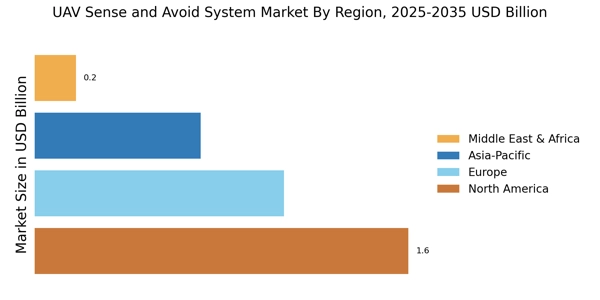
North America is the largest market for UAV Sense and Avoid Systems, holding approximately 45% of the global market share. The region's growth is driven by advancements in technology, increasing defense budgets, and a strong focus on safety regulations. The Federal Aviation Administration (FAA) has been pivotal in establishing guidelines that promote the integration of UAVs into national airspace, further fueling demand. The United States is the dominant player in this market, with key companies like General Atomics, Northrop Grumman, and Boeing leading the charge. The competitive landscape is characterized by significant investments in R&D and partnerships between government and private sectors. This collaboration enhances innovation and accelerates the deployment of advanced UAV systems, ensuring that North America remains at the forefront of UAV technology.

Europe : Emerging Powerhouse in UAVs

Europe is rapidly emerging as a significant player in the UAV Sense and Avoid Systems market, accounting for approximately 30% of the global share. The region's growth is propelled by stringent safety regulations and a push for sustainable aviation solutions. The European Union Aviation Safety Agency (EASA) has been instrumental in creating a regulatory framework that encourages the development and integration of UAV technologies into commercial airspace. Leading countries in this market include the United Kingdom, Germany, and France, where companies like Airbus and Thales Group are making substantial contributions. The competitive landscape is marked by collaborations between industry leaders and government agencies, fostering innovation and enhancing the capabilities of UAV systems. This synergy is crucial for meeting the increasing demand for safe and efficient UAV operations across Europe.

Asia-Pacific : Rapidly Growing UAV Market

Asia-Pacific is witnessing rapid growth in the UAV Sense and Avoid Systems market, holding around 20% of the global share. The region's expansion is driven by increasing investments in defense and security, coupled with a rising demand for commercial UAV applications. Countries like China and India are leading this growth, supported by favorable government policies and initiatives aimed at enhancing UAV technology and infrastructure. China is at the forefront, with significant contributions from companies like DJI and AVIC. The competitive landscape is evolving, with both established players and startups vying for market share. The presence of key players is fostering innovation, while collaborations with government bodies are essential for navigating regulatory challenges and ensuring the safe integration of UAVs into airspace.

Middle East and Africa : Resource-Rich Frontier for UAVs

The Middle East and Africa region is an emerging market for UAV Sense and Avoid Systems, accounting for approximately 5% of the global share. The growth in this region is driven by increasing defense expenditures and a growing interest in UAV applications for various sectors, including agriculture and surveillance. Countries like the UAE and South Africa are leading the charge, supported by government initiatives aimed at enhancing UAV capabilities and infrastructure. The competitive landscape is characterized by a mix of local and international players, with companies like Elbit Systems and Leonardo making significant inroads. The region's unique challenges, such as regulatory hurdles and varying levels of technological adoption, present both opportunities and obstacles for market players. As the demand for UAV solutions continues to rise, the Middle East and Africa are poised for substantial growth in the coming years.

UAV Sense Avoid System Market Regional Image

Key Players and Competitive Insights

The UAV Sense and Avoid System Market is characterized by rapid technological advancements and increasing demand for unmanned aerial vehicles, which are becoming integral to various sectors, including defense, agriculture, and logistics.

This market is marked by the constant emergence of innovative solutions to enhance the safety and operational capabilities of UAVs, with a focus on developing systems that enable these vehicles to autonomously detect and avoid obstacles in real time.

The competitive landscape is defined by a range of key players that are vying to capture market share through partnerships, advancements in technology, and strategic investments aimed at improving the performance and reliability of sense and avoid systems.

Collaborations between stakeholders often lead to the development of comprehensive safety solutions necessary for the integration of UAVs into increasingly crowded airspaces.

Textron has established a robust presence in the UAV Sense and Avoid System Market, leveraging its extensive expertise in aviation and defense technology. The company places a strong emphasis on innovation, consistently investing in research and development to enhance the capabilities of its UAV products.

Textron's focus on creating advanced systems that incorporate artificial intelligence and machine learning provides significant competitive advantages, allowing for improved obstacle detection and obstacle avoidance in complex environments.

The strength of Textron lies not only in its technological capabilities but also in its dedication to meeting regulatory requirements, which enhances the marketability of its offerings. The company also benefits from a solid reputation within the industry, having established successful strategic partnerships that further augment its market influence.

Thales Group, a prominent player in the UAV Sense and Avoid System Market, is recognized for its comprehensive portfolio of safety-critical systems and technologies designed for unmanned platforms. Thales invests heavily in the development of cutting-edge sensing technologies, offering solutions that ensure UAVs can safely navigate airspace while minimizing the risk of collisions.

The company's strengths lie in its ability to integrate various sensor modalities, including radar and optical systems, to deliver a holistic sense and avoid solutions. Thales Group's strong emphasis on security and data reliability further enhances its competitive position, making it a preferred choice for clients in both military and civilian sectors.

Additionally, the company's global reach and established customer relationships provide significant opportunities for growth as demand for advanced UAV capabilities continues to rise across various industries.


Key Companies in the UAV Sense Avoid System Market market include

Industry Developments

The UAV Sense and Avoid System Market has seen notable recent developments, particularly with advancements in technology and increased demand for unmanned aerial systems in various applications. Companies such as Lockheed Martin and Northrop Grumman have been investing in research and development to enhance their sense and avoid capabilities to meet regulatory requirements and ensure safe integration into airspace.

Textron has also been exploring partnerships to strengthen its position in this sector. On the mergers and acquisitions front, Thales Group and BAE Systems have been actively seeking strategic partnerships to expand their technological offerings in a sense and avoid arena, fostering growth in the UAV market.

The recent focus on military and commercial applications has heightened investment interest from AeroVironment and General Atomics, propelling market valuation. The trend towards automation and the growing emphasis on safety in unmanned operations are key drivers impacting the growth of this sector, with further collaborations anticipated among industry leaders like FLIR Systems and Raytheon Technologies to enhance capabilities and broaden market reach.

Overall, the dynamics of the UAV Sense and Avoid System Market continue to evolve, influenced by technological advancements and strategic industry maneuvers.

Future Outlook

UAV Sense Avoid System Market Future Outlook

The UAV Sense and Avoid System Market is projected to grow at a 15.71% CAGR from 2024 to 2035, driven by technological advancements and regulatory support.

New opportunities lie in:

  • Development of AI-driven collision avoidance algorithms
  • Integration of UAVs with urban air mobility systems
  • Expansion of training programs for UAV operators and maintenance personnel

By 2035, the market is expected to be robust, driven by innovation and increased adoption.

Market Segmentation

UAV Sense Avoid System Market End Use Outlook

  • Public Safety
  • Logistics
  • Agriculture
  • Environmental Monitoring

UAV Sense Avoid System Market Platform Outlook

  • Fixed-Wing UAV
  • Rotary-Wing UAV
  • Hybrid UAV

UAV Sense Avoid System Market Technology Outlook

  • Radar Systems
  • Lidar Systems
  • Computer Vision Systems
  • Acoustic Sensors

UAV Sense Avoid System Market Application Outlook

  • Civil Aviation
  • Military
  • Commercial Delivery
  • Surveillance

Report Scope

MARKET SIZE 20243.594(USD Billion)
MARKET SIZE 20254.159(USD Billion)
MARKET SIZE 203517.9(USD Billion)
COMPOUND ANNUAL GROWTH RATE (CAGR)15.71% (2024 - 2035)
REPORT COVERAGERevenue Forecast, Competitive Landscape, Growth Factors, and Trends
BASE YEAR2024
Market Forecast Period2025 - 2035
Historical Data2019 - 2024
Market Forecast UnitsUSD Billion
Key Companies ProfiledMarket analysis in progress
Segments CoveredMarket segmentation analysis in progress
Key Market OpportunitiesAdvancements in artificial intelligence enhance safety and efficiency in the UAV Sense and Avoid System Market.
Key Market DynamicsTechnological advancements and regulatory changes drive the evolution of UAV Sense and Avoid Systems in diverse applications.
Countries CoveredNorth America, Europe, APAC, South America, MEA

Leave a Comment

FAQs

What is the projected market valuation for the UAV Sense and Avoid System by 2035?

The UAV Sense and Avoid System market is projected to reach a valuation of 17.9 USD Billion by 2035.

What was the market valuation for the UAV Sense and Avoid System in 2024?

In 2024, the UAV Sense and Avoid System market was valued at 3.594 USD Billion.

What is the expected CAGR for the UAV Sense and Avoid System market during the forecast period 2025 - 2035?

The expected CAGR for the UAV Sense and Avoid System market during the forecast period 2025 - 2035 is 15.71%.

Which technology segment is projected to have the highest valuation by 2035?

The Acoustic Sensors segment is projected to reach a valuation of 5.0 USD Billion by 2035.

How does the military application segment perform in terms of market valuation?

The military application segment is expected to grow from 1.5 USD Billion in 2024 to 7.5 USD Billion by 2035.

What are the key players in the UAV Sense and Avoid System market?

Key players in the UAV Sense and Avoid System market include General Atomics, Northrop Grumman, Boeing, and Raytheon Technologies.

Which end-use segment is anticipated to show significant growth by 2035?

The Environmental Monitoring end-use segment is anticipated to grow from 1.438 USD Billion in 2024 to 7.5 USD Billion by 2035.

What is the projected valuation for the Fixed-Wing UAV platform by 2035?

The Fixed-Wing UAV platform is projected to reach a valuation of 7.5 USD Billion by 2035.

How does the commercial delivery application segment compare to others in terms of growth?

The commercial delivery application segment is expected to grow from 0.9 USD Billion in 2024 to 4.5 USD Billion by 2035.

What trends are influencing the growth of the UAV Sense and Avoid System market?

Trends such as advancements in sensor technology and increasing demand for UAVs in various sectors are influencing market growth.

Download Free Sample

Kindly complete the form below to receive a free sample of this Report

Compare Licence

×
Features License Type
Single User Multiuser License Enterprise User
Price $4,950 $5,950 $7,250
Maximum User Access Limit 1 User Upto 10 Users Unrestricted Access Throughout the Organization
Free Customization
Direct Access to Analyst
Deliverable Format
Platform Access
Discount on Next Purchase 10% 15% 15%
Printable Versions