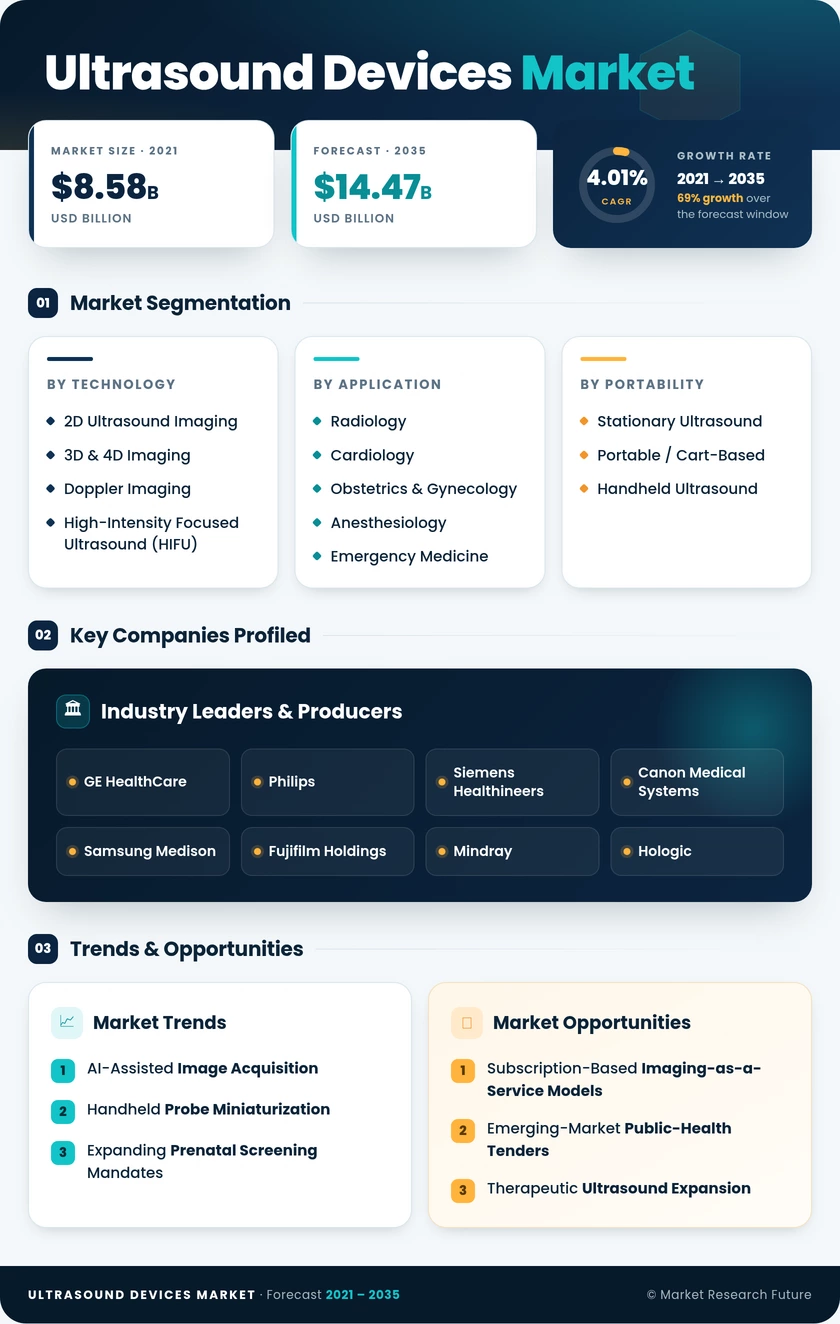
Segmentation Quick Reference
| Dimension | Sub-Segments | Dominant Segment | Fastest Growing Segment |
| Ultrasound Devices Market | 2D Ultrasound Imaging, 3D & 4D Imaging, Doppler Imaging, High-Intensity Focused Ultrasound (HIFU) | 3D & 4D Imaging | HIFU |
| Application | Radiology, Cardiology, Obstetrics & Gynecology, Anesthesiology, Emergency Medicine, Others | Radiology | Anesthesiology |
| Portability | Stationary Ultrasound, Portable / Cart-Based, Handheld Ultrasound | Stationary Ultrasound | Handheld Ultrasound |
| End User | Hospitals, Diagnostic Imaging Centers, Ambulatory Surgical Centers, Home-Care Settings, Others | Hospitals | Home-Care Settings |
Market Segmentation Overview
By Ultrasound Devices Market
| Sub-Segment | Key Trend |
| 2D Ultrasound Imaging | Sustained baseline demand in emergency and primary-care screening |
| 3D & 4D Imaging | AI-enhanced volumetric rendering is driving premium system upgrades. |
| Doppler Imaging | Growing use in vascular diagnostics and fetal hemodynamic monitoring |
| High-Intensity Focused Ultrasound (HIFU) | Expanding therapeutic indications beyond fibroids into oncology and neurology |
The technology landscape is splitting into a high-growth premium tier (3D/4D and HIFU) and a volume-driven commodity tier (2D and basic Doppler). Vendors are increasingly bundling AI software licenses with hardware to differentiate within the premium tier and defend margins.
By Application
| Sub-Segment | Key Trend |
| Radiology | Workflow automation reduces scan-to-report turnaround |
| Cardiology | Structural heart assessment fueling the echocardiography console refresh. |
| Obstetrics & Gynecology | Government prenatal mandates are expanding global screening coverage. |
| Anesthesiology | Ultrasound-guided nerve blocks are becoming standard perioperative protocol. |
| Emergency Medicine | FAST and eFAST protocols embedded in trauma training curricula |
| Others | Musculoskeletal, urological, and point-of-care applications are gaining traction. |
Application-level growth is increasingly shaped by procedural guidelines that mandate ultrasound use rather than recommend it. Anesthesiology and emergency medicine benefit most directly from these mandates.
By Portability
| Sub-Segment | Key Trend |
| Stationary Ultrasound | Premium consoles remain the gold standard for departmental imaging |
| Portable / Cart-Based | Mid-tier platforms are gaining share in ambulatory surgical settings. |
| Handheld Ultrasound | Probe-on-chip miniaturization and subscription pricing are driving mass adoption. |
The portability spectrum is expanding at both ends: stationary consoles are adding more processing power for AI workloads, while handheld devices are closing the image-quality gap through advanced beamforming and cloud-based post-processing.
By End User
| Sub-Segment | Key Trend |
| Hospitals | Multi-departmental fleet purchases sustaining dominant share |
| Diagnostic Imaging Centers | Outpatient shift increasing referral-based ultrasound volumes. |
| Ambulatory Surgical Centers | Procedural-use growth in pain management and vascular access |
| Home-Care Settings | Remote-monitoring platforms integrating handheld ultrasound for chronic care |
| Others | Veterinary, military, and academic research applications |
End-user diversification is the defining structural trend. Hospital procurement still anchors the installed base, but the fastest incremental growth is migrating toward decentralized care settings where portable and handheld form factors align with lower-acuity, higher-frequency use cases.