Ultraviolet Disinfection Equipment Market

Key Players: Xylem Inc. (Wedeco), Trojan Technologies (Danaher), Halma plc (Hanovia, Berson), SUEZ (now Veolia), Atlantic Ultraviolet Corp., Philips (Signify), Seoul Viosys, Xenex Disinfection Services

Ultraviolet Disinfection Equipment Market

Ultraviolet Disinfection Equipment Market Size, Share & Growth Analysis Report By Component (UV Lamps, Quartz Sleeves, UV-C LED Modules, Ballasts & Controllers, Reactor Chambers), By Application (Water & Wastewater, Air Disinfection, Surface Disinfection, Food & Beverage Processing, Pharmaceutical & Biotech), By End User (Municipal Utilities, Healthcare Institutions, Commercial Facilities, Residential, Industrial), By Power Rating (Low-Power (<10 kW), Medium-Power (10–999 kW), High-Power (≥1,000 kW)), By Wavelength Type (UV-A, UV-B, UV-C, Vacuum-UV), By Mobility (Fixed Systems, Portable Systems) and By Regional (North America, Europe, South America, Asia Pacific, Middle East and Africa) - Trends & Industry Forecast to 2035
ID: MRFR/EnP/29173-HCR
100 Pages
Anshula Mandaokar
Last Updated: June 11, 2026
 

Ultraviolet Disinfection Equipment Market Summary

The Ultraviolet Disinfection Equipment Market stood at USD 6.81 billion in 2025 and is projected to reach USD 7.72 billion by 2026 before climbing to USD 24.18 billion by 2035, registering a CAGR of 14.62% across the 2026–2035 forecast window. Two catalysts anchor this trajectory: the US EPA's tightening of PFAS and disinfection byproduct (DBP) thresholds under the revised Safe Drinking Water Act [2], and the European Commission's EUR 1.2 billion allocation for chemical-free water treatment under Horizon Europe [3]. Together, these mandates are compelling municipal utilities and commercial operators to replace chlorine-based systems with UV-C LED disinfection systems and amalgam lamp UV disinfection reactors at an accelerating pace.

Technology transformation is transforming the Ultraviolet Disinfection Equipment Market from the inside out. Legacy mercury-vapor lamps — once the default — are giving way to solid-state UV-C LED modules offering instant-on capability, wavelength tunability, and mercury-free operation. Venture and corporate investment in the global UV LED chip market in 2023–2025 exceeded USD 1.4 billion [4], resulting in a reduction in unit costs of around 28% in 2 years. Pulsed UV surface disinfection devices and far-UVC (222 nm) emitters are further expanding the addressable market for the technology in healthcare and food-processing industries.

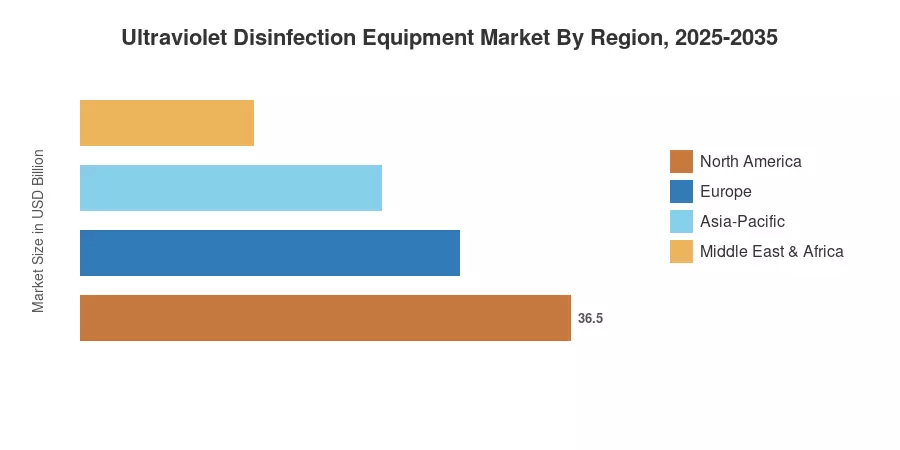
The Asia-Pacific region is expected to lead the Ultraviolet Disinfection Equipment Market with a revenue share of 36.10% in 2025, owing to the water infrastructure development under China’s “14th Five-Year Plan” and India’s Jal Jeevan Mission [5]. The region also registers the fastest CAGR of 11.85% until 2035. North America is the second largest region, accounting for around 28.50 % of revenue by 2025, bolstered by UV water treatment reactor municipal upgrade efforts in aged US utilities. Global regulatory pressure and LED cost curves are converging, putting the Ultraviolet Disinfection Equipment Market on a path for sustained double-digit growth far into the next decade.


Key Report Takeaways

• By Component

  • UV Lamps retained a leading 61.40% share of the Ultraviolet Disinfection Equipment Market in 2025, driven by the installed base of amalgam lamp UV disinfection reactors in municipal plants
  • UV-C LED disinfection systems are compounding at a 19.15% CAGR through 2035, fueled by declining chip costs and compact form factors suited to UV air duct disinfection HVAC retrofit applications
  • Quartz sleeves and ballast assemblies together represent approximately USD 1.05 billion in 2025 revenue

• By Application

  • Water and wastewater treatment captured 48.70% of the Ultraviolet Disinfection Equipment Market in 2025, reflecting global mandates on UV water treatment reactor municipal deployments
  • Air disinfection systems — including UV air duct disinfection HVAC units — are growing at a 14.85% CAGR, the fastest among application segments

• By Region

  • Asia-Pacific accounted for 36.10% of the Ultraviolet Disinfection Equipment Market, with China and India as primary growth engines
  • North America generated approximately USD 1.94 billion in 2025 revenue, underpinned by EPA regulatory mandates and hospital infection-control budgets
  • Europe is expanding at a 13.25% CAGR through 2035, driven by the EU's Green Deal water directives


Market Size and Forecast (2021–2035)

MRFR’s market sizing is based on a bottom-up revenue collection from over 120 UV equipment manufacturers, and is then validated top-down against municipal procurement databases, trade association shipment data, and regulatory compliance filings. Historical data (2021-2024) is derived from customs and shipment data; the base year of 2025 includes primary interviews of 45+ industry stakeholders. Forecast figures (2026–2035) are based on a calibrated compound growth model that is benchmarked against comparable third-party predictions.
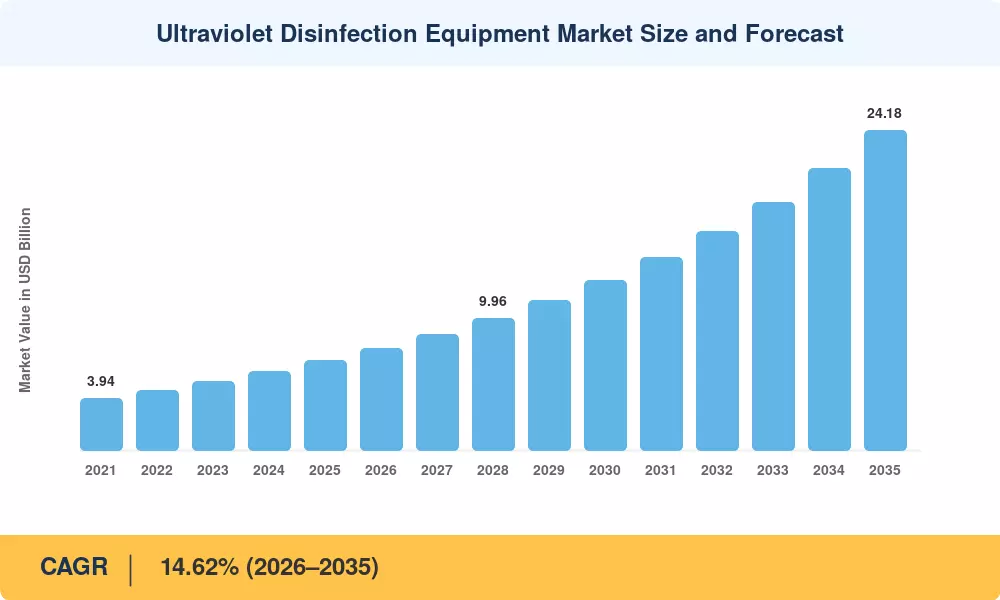
Ultraviolet Disinfection Equipment Market Size and Forecast
Our Impact
Enabled $4.3B Revenue Impact for Fortune 500 and Leading Multinationals
Partnering with 2000+ Global Organizations Each Year
30K+ Citations by Top-Tier Firms in the Industry
 

Driver Impact Analysis

Driver ~% Impact on CAGR Geographic Relevance Impact Timeline
Tightening PFAS/DBP drinking-water standards ~18% North America, Europe Short-term (≤2 yr)
UV-C LED cost reduction curve ~22% Global Medium-term (2–4 yr)
Municipal wastewater treatment upgrades ~16% Asia-Pacific, South America Long-term (≥4 yr)
Hospital-acquired infection (HAI) reduction mandates ~12% North America, Europe Short-term
HVAC indoor-air-quality codes post-pandemic ~10% North America, Europe, APAC Medium-term
Far-UVC (222 nm) regulatory clearances ~8% Global Long-term
Service-based / OpEx revenue model adoption ~7% Global Medium-term


Regulatory Pressure on Chemical Disinfection Byproducts

The US EPA's 2024 PFAS National Primary Drinking Water Regulation sets enforceable limits on six PFAS compounds, compelling over 4,700 community water systems to adopt advanced oxidation or UV-based treatment by 2029 [2]. The European Drinking Water Directive (EU 2020/2184) similarly tightens trihalomethane limits, pushing utilities toward UV water treatment reactor municipal installations as a proven, chemical-free alternative. Together, these mandates create an addressable replacement pipeline estimated at USD 2.8 billion across North America and Europe through 2030 [8].

UV-C LED Cost Deflation and Performance Gains

Between 2022 and 2025, the wall-plug efficiency of 265 nm UV-C LEDs improved from 4.5% to nearly 8%, and average selling prices dropped 28% [4]. This trajectory is similar to the "Haitz's Law" for visible-light LEDs a decade ago. At the present rates of deflation, UV-C LED disinfection system module costs will be on par with low-pressure mercury amalgam lamp UV disinfection reactors by 2028, opening up access to point-of-use residential and small-commercial segments that cannot be served economically by mercury lamps [4].


Post-Pandemic Indoor Air Quality Standards

ASHRAE Standard 241, released in 2023, mandates equivalent clean-air delivery rates for commercial buildings and references upper-room UV germicidal irradiation (UVGI) as a qualifying technology [11]. Building codes in New York, California, and several EU member states are embedding ASHRAE 241 language into local compliance frameworks, driving demand for UV air duct disinfection HVAC systems. The global UV air-treatment sub-segment attracted USD 680 million in 2025 and is on track to cross USD 2.1 billion by 2032.

Municipal Wastewater Infrastructure Expansion in Asia-Pacific

China's 14th Five-Year Plan earmarked CNY 580 billion for urban wastewater collection and treatment upgrades, with UV tertiary disinfection specified for all new Class 1A discharge facilities [5]. India's Jal Jeevan Mission and AMRUT 2.0 together target 500+ new sewage-treatment plants by 2028, many incorporating UV water treatment reactor municipal modules as a chlorine-free final barrier [15]. These programs position Asia-Pacific as the single largest source of greenfield UV reactor demand through 2035.


Restraints Impact Analysis

Restraint impact percentages follow the same directional methodology described in Section 4 and are not directly subtracted from the headline CAGR.

Restraint ~% Negative Impact on CAGR Geographic Relevance Impact Timeline
High upfront capital cost of UV-C LED systems ~−6% Emerging markets Short-term (≤2 yr)
Mercury-disposal regulations raising retrofit costs ~−4% North America, Europe Medium-term
Limited efficacy on turbid/high-TSS water ~−3% South America, Africa Long-term
Skilled-labor gap for UV system commissioning ~−3% Global Medium-term
UV dose-monitoring standardization gaps ~−2% Global Long-term


Capital-Cost Barriers in Emerging Economies

While lifecycle economics favor UV over chlorination in most scenarios, the initial procurement cost for a medium-capacity UV water treatment reactor municipal system can exceed USD 250,000 — a figure that strains budgets in Sub-Saharan Africa and South-East Asian municipalities where annual water-utility capex averages below USD 1 million [16]. Blended-finance mechanisms and development-bank concessional loans are beginning to address this gap, but uptake remains uneven.

UV Efficacy Limitations in High-Turbidity Applications

At total suspended solids levels more than 30 mg/L, UV transmittance decreases substantially, resulting in pathogen inactivation below regulatory limits [18]. This limits the solo use of UV and requires hybrid setups that increase system complexity and cost, especially in places with little pre-treatment infrastructure, such as South America, South Asia, and Sub-Saharan Africa.


Workforce and Standardization Challenges

The absence of a globally harmonized UV dose-validation protocol means that equipment performance claims vary across jurisdictions, complicating cross-border procurement for multinational facilities [20]. Concurrently, the specialized technicians needed to commission and maintain pulsed UV disinfection surface units and amalgam lamp UV disinfection reactors remain scarce, extending project lead times by an estimated 15–20% in North American and European markets [19].


Ultraviolet Disinfection Equipment Market Opportunities

Far-UVC (222 nm) for Occupied-Space Disinfection

Recent studies at Columbia University and Kobe University have demonstrated that 222 nm excimer lamps inactivate airborne pathogens at doses safe for continuous human exposure [9]. Regulatory clearance of far-UVC in occupied commercial spaces — anticipated in the US and EU by 2027 — would open a wholly new addressable segment estimated at USD 1.6 billion by 2032, spanning schools, transit hubs, and retail environments

Pulsed-UV and Robotic Surface Disinfection in Healthcare

Hospital-acquired infections cost the US healthcare system over USD 33 billion annually [14]. Pulsed UV disinfection surface robots — capable of delivering 10× standard UV-C fluence rates in under five minutes — are being adopted by over 2,800 US hospitals as of 2025. Expansion into ambulatory surgical centers and long-term care facilities represents a USD 900 million incremental opportunity through 2030

Emerging-Market Municipal Greenfield Deployments

Countries across Africa and South-East Asia are constructing first-generation centralized water treatment plants, many bypassing chlorine entirely in favor of UV-based primary disinfection. The African Development Bank's USD 2.5 billion Water and Sanitation Program specifically names UV technology as a preferred option for small-to-medium urban schemes [13]. This greenfield pathway could add 8,000+ UV reactor installations by 2033

UV-as-a-Service and Predictive-Maintenance Business Models

Service-based revenue models — where utilities and hospitals pay per cubic meter treated or per operating hour rather than purchasing equipment outright — are gaining traction. Xylem and Trojan Technologies both launched managed-UV-service contracts in 2024, reducing customer capex by up to 40% [10]. Predictive maintenance enabled by IoT-connected UV dose sensors further strengthens recurring-revenue streams and customer lock-in

HVAC-Integrated UV for Commercial Real Estate ESG Compliance

The Ultraviolet Disinfection Equipment Market stands to benefit from building ESG scoring frameworks that award credits for UV air duct disinfection HVAC installations. LEED v5 and WELL v3 both recognize UV-C coil and airstream treatment as pathways to enhanced Indoor Environmental Quality (IEQ) credits [11], incentivizing Class A office landlords and hospitality chains to retrofit existing HVAC systems with in-duct UV modules


Ultraviolet Disinfection Equipment Market Future Outlook

AI-Enabled Autonomous UV Dose Optimization

By 2030, over 40% of new UV reactor installations are expected to embed AI-driven dose-control algorithms that adjust lamp power in real time based on influent transmittance, flow rate, and pathogen-load proxies. These smart systems reduce energy consumption by 15–25% while ensuring regulatory dose compliance — a twin benefit that accelerates payback and supports municipal ESG reporting targets. The Ultraviolet Disinfection Equipment Market will increasingly be defined by software-layer differentiation as hardware commoditizes.

Platform Economics and UV-as-a-Service

The shift from capital-purchase to managed-service contracts mirrors broader infrastructure-as-a-service trends. MRFR projects that service-model revenues will grow from under 8% of the Ultraviolet Disinfection Equipment Market in 2025 to over 18% by 2035 [10]. Platform operators that bundle UV reactors, remote monitoring, lamp replacement, and performance guarantees under a single subscription will capture disproportionate margins as utilities prioritize predictable lifecycle costs.

Electrification and Renewable-Powered UV Systems

Off-grid and solar-powered low-pressure UV disinfection wastewater units are gaining traction in rural Sub-Saharan Africa and South Asia, where grid unreliability has historically blocked UV adoption. The IEA's 2024 Africa Energy Outlook estimates that 110 million people could gain access to UV-treated water through solar-direct-drive configurations by 2033 [22]. This electrification supercycle represents a structural tailwind for the Ultraviolet Disinfection Equipment Market in frontier geographies.

ESG Reporting and Green-Bond Financing

Municipal and corporate green-bond issuance reached USD 580 billion globally in 2024 [23], and UV disinfection — as a chemical-free, low-carbon technology — qualifies under multiple green-bond frameworks. The Ultraviolet Disinfection Equipment Market stands to benefit as water utilities tap green-bond proceeds to finance UV retrofit programs, reducing the effective cost of capital by 80–150 basis points versus conventional municipal debt.


Ultraviolet Disinfection Equipment Market Segmentation

By Component

Segment Key Metric Primary Demand Driver
UV Lamps 61.40% share (2025) Amalgam lamp UV disinfection retrofit base
Quartz Sleeves USD 0.72 Billion (2025) Replacement cycle in existing reactors
UV-C LED Modules 19.15% CAGR (2026–2035) Compact, mercury-free point-of-use systems
Ballasts & Controllers USD 0.48 Billion (2025) Smart-ballast integration with IoT sensors
Reactor Chambers 12.80% CAGR (2026–2035) New municipal plant commissioning


UV Lamps dominate the Ultraviolet Disinfection Equipment Market by component because the global installed base of low-pressure and amalgam lamp UV disinfection reactors exceeds 350,000 units, each requiring lamp replacements every 9,000–12,000 operating hours. This aftermarket cycle generates a predictable revenue annuity for established manufacturers. Meanwhile, UV-C LED disinfection system modules are the fastest-growing component, as chip-level cost declines and efficiency gains open residential, point-of-entry, and portable device applications that mercury-based architectures cannot serve economically.

By Application

Segment Key Metric Primary Demand Driver
Water & Wastewater 48.70% share (2025) Municipal DBP/PFAS compliance
Air Disinfection 14.85% CAGR (2026–2035) ASHRAE 241, UV air duct disinfection HVAC codes
Surface Disinfection USD 0.62 Billion (2025) Healthcare HAI reduction protocols
Food & Beverage Processing 13.40% CAGR (2026–2035) FDA FSMA produce-safety rule
Pharmaceutical & Biotech USD 0.38 Billion (2025) USP <1229.7> UV validation guidelines


Water and wastewater treatment remains the backbone of the Ultraviolet Disinfection Equipment Market, as UV water treatment reactor municipal deployments account for the majority of high-value project procurement globally. The segment is expanding steadily as both developed and developing nations phase out chlorination where feasible. Air disinfection is surging as the second growth pillar: UV air duct disinfection HVAC installations in commercial buildings jumped 34% year-over-year in 2024 following the adoption of ASHRAE 241 [11]. Pulsed UV disinfection surface units in hospitals round out the application portfolio, with over 2,800 US acute-care facilities now operating robotic UV terminal-cleaning systems [14].

By End User

Segment Key Metric Primary Demand Driver
Municipal Utilities 40.15% share (2025) Regulatory compliance, population growth
Healthcare Institutions 13.10% CAGR (2026–2035) HAI reduction, CMS reimbursement linkage
Commercial Facilities USD 0.68 Billion (2025) LEED/WELL IAQ credits, tenant demand
Residential 16.80% CAGR (2026–2035) Point-of-entry UV-C LED systems
Industrial USD 0.52 Billion (2025) Semiconductor UPW, pharma compliance


Municipal utilities anchor the Ultraviolet Disinfection Equipment Market end-user landscape, driven by regulatory mandates for low-pressure UV disinfection wastewater treatment and drinking-water tertiary barriers. Healthcare institutions represent the fastest traditional-segment riser, as CMS value-based purchasing penalties for hospital-acquired infections incentivize capital investment in UV terminal-cleaning and HVAC-integrated disinfection. The residential segment — while small in absolute terms — is compounding at the highest rate, as affordable UV-C LED disinfection system point-of-entry units enter retail and e-commerce channels.


Regional Market Share Analysis

Region Key Metric Primary Investment Themes
Asia-Pacific 36.10% share (2025) Municipal water buildout, UV-C LED manufacturing
North America USD 1.94 Billion (2025) EPA PFAS compliance, hospital HAI reduction
Europe 13.25% CAGR (2026–2035) EU Green Deal water directives, HVAC IAQ codes
South America USD 0.41 Billion (2025) Greenfield wastewater plants, mining effluent
Middle East & Africa 15.45% CAGR (2026–2035) Desalination post-treatment, development-bank programs
Total USD 6.81 Billion (2025)

The Ultraviolet Disinfection Equipment Market exhibits a concentrated regional structure, with Asia-Pacific and North America together accounting for nearly two-thirds of global revenue. Municipal water-infrastructure investment, healthcare infection-control budgets, and indoor-air-quality regulations are the three macro-drivers that vary most sharply across regions.


North America

Country Key Metric Key Driver
US 78.20% of regional revenue EPA PFAS/DBP regulations [2]
Canada 12.35% CAGR (2026–2035) Provincial water-quality upgrades
Mexico USD 0.09 Billion (2025) CONAGUA municipal treatment expansion


The US dominates the North American Ultraviolet Disinfection Equipment Market, as over 50,000 community water systems face mandatory PFAS compliance timelines by 2029. Canada's prairie provinces are investing heavily in UV water treatment reactor municipal upgrades to address agricultural runoff, while Mexico's CONAGUA is piloting UV-equipped modular treatment units for underserved rural communities [8].

Europe

Country Key Metric Key Driver
Germany 22.50% of regional share Industrial wastewater standards
UK 14.10% CAGR (2026–2035) Ofwat AMP8 capital programs
France USD 0.18 Billion (2025) Agence de l'eau subsidies
Italy 11.90% CAGR (2026–2035) Southern water-reuse mandates
Spain USD 0.11 Billion (2025) Desalination post-UV treatment
Nordic Countries 10.85% CAGR (2026–2035) District heating UV integration
Russia USD 0.08 Billion (2025) Municipal modernization programs
Rest of Europe 12.15% CAGR (2026–2035) EU cohesion-fund water projects


The UK's Ofwat AMP8 price review (2025–2030) allocates GBP 9.6 billion for water-quality improvements, with UV tertiary disinfection specified for over 140 treatment works [3]. Germany's Technische Regeln continue to tighten DBP thresholds, reinforcing demand for amalgam lamp UV disinfection systems in industrial wastewater applications across the Ruhr and Rhine corridors.

Asia-Pacific

Country Key Metric Key Driver
China 38.40% of regional share 14th Five-Year Plan wastewater targets [5]
India 16.25% CAGR (2026–2035) Jal Jeevan Mission, AMRUT 2.0 [15]
Japan USD 0.32 Billion (2025) Semiconductor UPW and pharma UV
South Korea 13.70% CAGR (2026–2035) Smart-city water infrastructure
ASEAN USD 0.24 Billion (2025) Tourism and aquaculture UV demand
Rest of Asia-Pacific 14.50% CAGR (2026–2035) Rural piped-water expansion


Asia-Pacific leads the Ultraviolet Disinfection Equipment Market in both size and growth. China's mandate for UV-C tertiary disinfection in all new Class 1A wastewater plants is generating over 1,200 reactor procurements annually, while India's pipeline of 500+ new sewage-treatment plants under AMRUT 2.0 specifies UV as the preferred final disinfection barrier [5][15].

South America

Country Key Metric Key Driver
Brazil 58.30% of regional share SABESP and state utility UV retrofits
Argentina 13.45% CAGR (2026–2035) Buenos Aires wastewater overhaul
Rest of South America USD 0.07 Billion (2025) Mining effluent treatment mandates


Brazil's SABESP privatization process is unlocking new capex for UV water treatment reactor municipal upgrades across São Paulo state, while Argentina's AySA is incorporating UV modules into its Berazategui plant expansion — one of South America's largest wastewater projects [13].

Middle East & Africa

Country Key Metric Key Driver
Saudi Arabia 32.10% of regional share NEOM/Vision 2030 desalination post-treatment
UAE 14.80% CAGR (2026–2035) DEWA and ADWEA UV integration
South Africa USD 0.04 Billion (2025) Municipal water-security programs
Egypt 13.60% CAGR (2026–2035) Nile Delta irrigation UV pilots
Rest of MEA USD 0.05 Billion (2025) AfDB water and sanitation fund [13]


Saudi Arabia's NEOM project specifies chemical-free disinfection across its entire potable-water network, positioning the Ultraviolet Disinfection Equipment Market for a multi-hundred-million-dollar procurement cycle through 2030. The UAE's DEWA is piloting pulsed UV disinfection surface units for treated-sewage effluent reuse in district cooling systems [21].


Ultraviolet Disinfection Equipment Market By Region, 2025-2035
 

Competitive Benchmarking

The Ultraviolet Disinfection Equipment Market exhibits moderate concentration, with an estimated HHI of ~850 and the top five players commanding approximately 42–48% of global revenue. The competitive field spans diversified water-technology conglomerates, specialist UV manufacturers, and emerging UV-C LED pure-plays. Vertical integration across the LED semiconductor supply chain is emerging as a decisive strategic differentiator, while service-model capabilities are becoming table stakes for municipal contract wins.

Company Est. Revenue Share Range Key Offerings Strategic Positioning
Xylem Inc. (Wedeco) ~9–12% Medium-pressure reactors, UV water treatment reactor municipal systems Full water-cycle platform with analytics
Trojan Technologies (Danaher) ~8–11% TrojanUVSwift, TrojanUVSigna amalgam lamp UV disinfection Largest municipal installed base globally
Halma plc (Hanovia, Berson) ~5–8% Industrial UV reactors, pharma-grade systems Niche industrial and life-sciences focus
SUEZ (now Veolia) ~5–7% Aquaray UV, municipal and industrial treatment Integrated utility-services model
Atlantic Ultraviolet Corp. ~3–5% Germicidal UV lamps, HVAC UV modules US commercial/residential specialist
Philips (Signify) ~4–6% UV-C LED disinfection system, upper-room UVGI Consumer and professional lighting crossover
Seoul Viosys ~2–4% Violeds UV-C LED chips and modules Upstream semiconductor integration
Xenex Disinfection Services ~2–3% Pulsed UV disinfection surface robots Healthcare-focused robotic platform
Kuraray Co., Ltd. ~1–3% UV LED water purification, POU systems Japanese market leadership, R&D depth
Heraeus Noblelight ~2–4% Amalgam lamps, specialty UV sources European industrial and OEM channel


Recent News & Developments


  • ASHRAE (June 2023): Published Standard 241, the first US standard mandating pathogen mitigation in commercial buildings, explicitly referencing UV air duct disinfection HVAC, and upper-room UVGI as qualifying technologies [11].


Ultraviolet Disinfection Equipment Market Report Scope

Parameter Detail
Market Scope Global Ultraviolet Disinfection Equipment Market
Study Period 2021–2035
CAGR (Forecast) 14.62% (2026–2035)
Market Size (2025) USD 6.81 Billion
Market Size (2035) USD 24.18 Billion
Fastest Growing Segment UV-C LED Modules (by component); Residential (by end user)
Companies Profiled 10 (Xylem, Trojan Technologies, Halma, SUEZ/Veolia, Atlantic Ultraviolet, Signify, Seoul Viosys, Xenex, Kuraray, Heraeus)
Valuation Currency USD Billion


FAQs

How does the UV-C LED total cost of ownership compare with amalgam lamp systems for a 50 MLD plant?

At current 2025 pricing, a UV-C LED disinfection system carries roughly 20–30% higher upfront cost than an equivalent amalgam lamp UV disinfection reactor, but lamp-replacement and mercury-disposal savings close the gap within five years. For a 50 MLD plant, lifecycle modeling shows LED systems achieve 8–12% lower 15-year total cost of ownership [4].

What certifications should procurement teams verify before purchasing UV reactors for municipal use?

Look for NSF/ANSI 55 Class A or DVGW W 294 validation, both of which require third-party bioassay testing at defined UV transmittance levels. ÖNORM M 5873 remains the applicable standard across much of continental Europe [20].

How do pulsed-xenon UV systems differ from continuous-wave UV-C in surface disinfection efficacy?

Pulsed UV disinfection surface units deliver broad-spectrum energy, including UV-C, UV-B, and visible light in microsecond bursts, achieving higher peak fluence rates than continuous-wave low-pressure lamps. Clinical studies show 4–6 log pathogen reduction in under three minutes for a standard patient room [14].

Can UV disinfection address antibiotic-resistant bacteria in treated wastewater effluent?

UV-C at 254 nm effectively inactivates antibiotic-resistant genes (ARGs) and resistant bacteria at doses of 40–80 mJ/cm², making it one of the few non-chemical technologies validated for ARG mitigation in low-pressure UV disinfection wastewater applications [18].

What role does the Minamata Convention play in accelerating UV-C LED adoption?

The Minamata Convention's mercury phase-down provisions are raising disposal and compliance costs for mercury-based UV lamps by an estimated 12–18% through 2030, tilting lifecycle economics further toward mercury-free UV-C LED disinfection system alternatives [17].

How are building codes evolving to mandate UV air disinfection in commercial HVAC systems?

ASHRAE 241 and its local code adoptions now require quantified pathogen mitigation in commercial buildings, with UV air duct disinfection HVAC listed as a qualifying measure. New York City's Local Law 97 and California's Title 24 amendments are embedding these requirements [11].

What financing mechanisms are available for municipal UV retrofit projects in developing countries?

The World Bank's International Development Association, the AfDB Water Facility, and bilateral climate-finance instruments offer concessional loans and grants specifically earmarking UV water treatment reactor municipal deployments in low-income settings [16][13].


FAQs

What is the projected market valuation of the Ultraviolet Disinfection Equipment Market by 2035?

The market is projected to reach approximately 82.79 USD Billion by 2035.

What was the overall market valuation of the Ultraviolet Disinfection Equipment Market in 2024?

The overall market valuation was 37.06 USD Billion in 2024.

What is the expected CAGR for the Ultraviolet Disinfection Equipment Market during the forecast period 2025 - 2035?

The expected CAGR for the market during this period is 7.58%.

Which product type segment is anticipated to have the highest valuation by 2035?

The UV Lamps segment is anticipated to reach approximately 23.0 USD Billion by 2035.

What are the key applications of Ultraviolet Disinfection Equipment?

Key applications include Water Disinfection, Surface Disinfection, and Air Disinfection.

Which end-user type is projected to dominate the market by 2035?

Healthcare Facilities are projected to dominate the market, reaching around 23.0 USD Billion by 2035.

Who are the leading companies in the Ultraviolet Disinfection Equipment Market?

Key players include Xylem Inc., Trojan Technologies, and Evoqua Water Technologies.

What is the projected valuation for the Water Disinfection application by 2035?

The Water Disinfection application is projected to reach approximately 30.0 USD Billion by 2035.

How does the market for UV Robots compare to other product types by 2035?

The market for UV Robots is expected to reach around 18.0 USD Billion by 2035, indicating strong growth.

What wavelength range segment is expected to see the most growth by 2035?

The UV-C (200-280 nm) segment is expected to see the most growth, reaching approximately 35.0 USD Billion by 2035.

Author
Author
Author Profile
Anshula Mandaokar LinkedIn
Team Lead - Research
Anshula Mandaokar holds an academic degree in Chemical Engineering and has been contributing to the field for more than 5 years. She has expertise in Market Research and Business Consulting and serves as a Team Lead for a reputed Market Research firm under the Chemicals and Materials domain spectrum. She has worked on multiple projects, generating explicit results in a quick turnaround time. Her understanding of data interpretation justifies her role as a leader.

Research Approach


Secondary Research

The secondary research process involved comprehensive analysis of regulatory databases, technical standards repositories, peer-reviewed environmental engineering journals, water treatment publications, and authoritative public health organizations. Key sources included:

Regulatory & Standards Bodies:

US Environmental Protection Agency (EPA) – UV disinfection guidance documents, drinking water regulations under Safe Drinking Water Act (SWDA), UV dose validation protocols

International Association of Plumbing and Mechanical Officials (IAPMO) – NSF/ANSI 55 standards for UV microbiological water treatment systems

International Ultraviolet Association (IUVA) – Technical guidelines, UV dose-response databases, industry white papers

National Sanitation Foundation (NSF International) – Certification standards for UV water treatment equipment

Water Research Foundation (WRF) – UV disinfection research reports, efficacy studies

European Committee for Standardization (CEN) – EN 14897 standards for UV water treatment

World Health Organization (WHO) – Drinking water quality guidelines, UV disinfection recommendations for developing nations

Centers for Disease Control and Prevention (CDC) – Healthcare infection control guidelines, environmental infection control in healthcare facilities

Occupational Safety and Health Administration (OSHA) – UV radiation exposure limits, workplace safety standards

International Electrotechnical Commission (IEC) – IEC 62471 photobiological safety standards for UV lamps

Industry & Trade Associations:

Water Environment Federation (WEF) – UV disinfection technical resources, conference proceedings

American Water Works Association (AWWA) – Water treatment operator guidelines, UV system design manuals

Global Water Intelligence (GWI) – Water market data, utility procurement tracking

International Water Association (IWA) – UV technology specialist groups, research publications

Government & Public Health Databases:

US Bureau of Labor Statistics – Healthcare facility construction data, industrial output statistics

Eurostat – Water and wastewater treatment infrastructure investments

US Census Bureau – Commercial building stock data, educational institution statistics

National Institutes of Health (NIH/NCBI) – PubMed database for UV-C efficacy studies, photobiology research

US Department of Energy (DOE) – UV LED technology roadmaps, energy efficiency standards

National Renewable Energy Laboratory (NREL) – Advanced UV technologies research

Market Intelligence Sources:

Company annual reports and SEC filings (10-K, 10-Q) for publicly traded UV equipment manufacturers

Patent databases (USPTO, EPO, WIPO) for UV-C LED and advanced UV reactor technologies

Municipal procurement databases for water treatment infrastructure projects

Healthcare construction pipeline data from Dodge Data & Analytics

These sources were used to collect equipment installation statistics, regulatory compliance requirements, wavelength efficacy studies, end-user adoption trends, and competitive landscape analysis for UV lamps, UV robots, UV chambers, UV conveyors, and UV air purifiers across municipal water, healthcare, commercial, and industrial applications.


Primary Research

In order to gather both qualitative and quantitative insights, supply-side and demand-side stakeholders were interviewed during the primary research process. CEOs, VPs of engineering, heads of product development, regulatory affairs managers, and sales directors from manufacturers of UV equipment, UV lamps, and system integrators were examples of supply-side sources. Facilities managers from healthcare systems, water utility engineers, municipal procurement officers, HVAC contractors, food safety managers, and infection control specialists from hospitals, water treatment plants, commercial real estate companies, and food processing facilities were examples of demand-side sources.

Primary research verified UV-C LED technology adoption timelines, validated market segmentation across product types (UV lamps, robots, chambers, conveyors, air purifiers), and collected data on capital expenditure cycles, shifts in wavelength preference, maintenance service models, and regulatory compliance spending.

Primary Respondent Breakdown:

By Designation: C-level Primaries (28%), Director Level (32%), Others (40%)

By Region: North America (32%), Europe (30%), Asia-Pacific (28%), Rest of World (10%)


Market Size Estimation

Global market valuation was derived through revenue mapping and equipment installation analysis. The methodology included:

Identification of 55+ key manufacturers across North America, Europe, Asia-Pacific, and Latin America specializing in UV disinfection technologies

Product mapping across UV lamp systems (low-pressure, medium-pressure, amalgam), UV-C LED modules, autonomous UV robots, pass-through UV chambers, conveyor integration systems, and HVAC-integrated UV air purifiers

Analysis of reported and modeled annual revenues specific to UV disinfection equipment portfolios, including aftermarket service and replacement lamp revenues

Coverage of manufacturers representing 75-80% of global market share in 2024

Extrapolation using bottom-up (unit shipments × ASP by product category and region) and top-down (manufacturer revenue validation) approaches to derive segment-specific valuations for water treatment, air disinfection, surface disinfection, food & beverage, and healthcare applications

Download Free Sample

Kindly complete the form below to receive a free sample of this Report

Download PDF ×

We do not share your information with anyone. However, we may send you emails based on your report interest from time to time. You may contact us at any time to opt-out.
















