Underwater Lighting Market (2026 - 2035)

Underwater Lighting Market Size, Share and Research Report: By Application (Aquarium Lighting, Underwater Infrastructure Lighting, Marine Park Lighting, Theatrical Lighting), By Type (LED Underwater Lights, Halogen Underwater Lights, Fluorescent Underwater Lights), By Installation Type (Permanent Installation, Temporary Installation), By End Use (Residential, Commercial, Industrial) and By Regional (North America, Europe, South America, Asia Pacific, Middle East and Africa) – Industry Forecast Till 2035
ID: MRFR/SEM/6917-HCR
200 Pages
Ankit Gupta
Last Updated: July 22, 2026
Underwater Lighting Market
Market Size
Forecast Period2026-2035
CAGR (2026-2035)3.95%
2025 Market SizeUSD 435.00 Million
2035 Market SizeUSD 640.86 Million
Key Players
Hayward Industries
Pentair
Fluidra
Philips Lumileds
Lumishore
OceanLED
Opportunities
  • Aquaculture Spectral-Tuning Applications
  • Offshore Wind and Subsea Energy Inspection Lighting
  • Lighting-as-a-Service and Subscription Models

Underwater Lighting Market Summary

The Underwater Lighting Market reached an estimated USD 435.00 Million in 2025 and is projected to grow from USD 452.19 Million in 2026 to USD 640.86 Million by 2035, registering a CAGR of 3.95% during the forecast period. Two forces anchor that trajectory: coastal infrastructure investment programs—particularly marina expansions funded under the EU's Sustainable Blue Economy agenda—and tightening energy-efficiency mandates that compel facility operators to retire halogen and metal-halide systems in favor of solid-state alternatives [1].

The technology shift defining the Underwater Lighting Market is the transition from traditional incandescent and halogen lamps to high-efficacy LED arrays. LED luminaires account for more than 84% of income in pools, marinas and aquaculture projects, owing to 60–70% energy savings and operating lifespans of over 50,000 hours [2]. Global LED chip prices declined by 12% from 2022 to 2024, boosting adoption even in price-sensitive retrofit applications. The fastest growing sub-category is RGB and smart-enabled LED systems that link with building-management software, creating recurring income streams through subscription-based lighting control platforms.


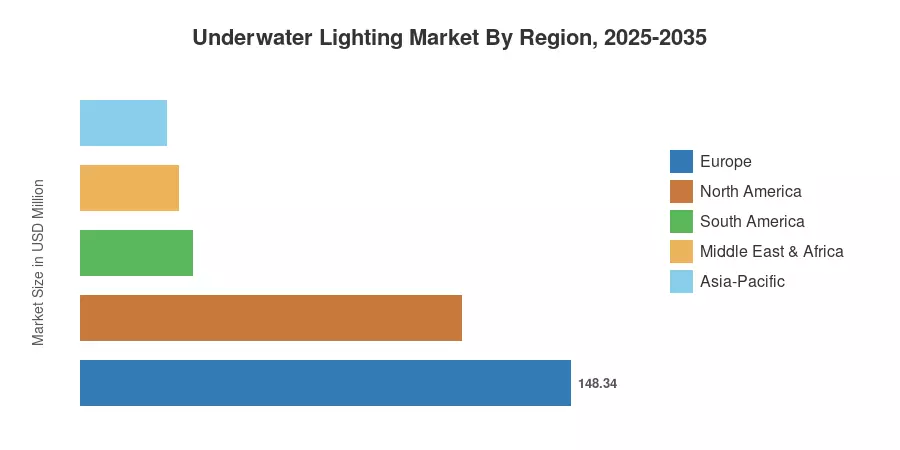
Europe dominates the Underwater Lighting Market, holding around 34.1% of the worldwide revenue, driven by the fluorescent phase-out deadlines and mature pool-renovation cycles. Asia-Pacific is projected to be the fastest expanding region at an anticipated CAGR of 6.0%, supported by coastline tourist booms in Southeast Asia and Australia. North America maintains the second-highest share at 26.5% with demand in residential pool lighting and in recreational boating corridors along the U.S. Gulf and Atlantic coastlines. Over the next decade, demand for smart integration and spectrum tuning for aquaculture and the undersea energy sector will change competitive dynamics in all regions.


Key Report Takeaways

• By Lighting Source

  • LED technology captured approximately 84.2% of the Underwater Lighting Market revenue in 2025, reflecting accelerated displacement of halogen incumbents across residential and commercial installations.
  • RGB and smart-enabled LED systems are projected to advance at a 5.7% CAGR through 2035, driven by integration with IoT control platforms and aquaculture monitoring systems.

• By Application

  • Swimming pools represented the largest application segment of the Underwater Lighting Market in 2025, accounting for 59.2% of total revenue.
  • The boats and yachts segment is forecast to register a 6.65% CAGR as recreational marine spending expands in Asia-Pacific and North America.

• By Geography

  • Europe maintained regional leadership with 34.1% revenue share in 2025, backed by stringent energy-efficiency regulations and robust retrofit activity.
  • Asia-Pacific is set to record the highest regional CAGR of 6.0%, with coastal tourism megaprojects accelerating demand across China, India, and ASEAN nations.


Underwater Lighting Market Size and Forecast (2021–2035)

Historical estimates were created by MRFR using corporate financial data, import-export databases, and regional pool and marina construction permits. Forecast forecasts are based on bottom-up demand modeling on five segmentation dimensions, calibrated with macroeconomic indicators and energy-regulation timeframes.
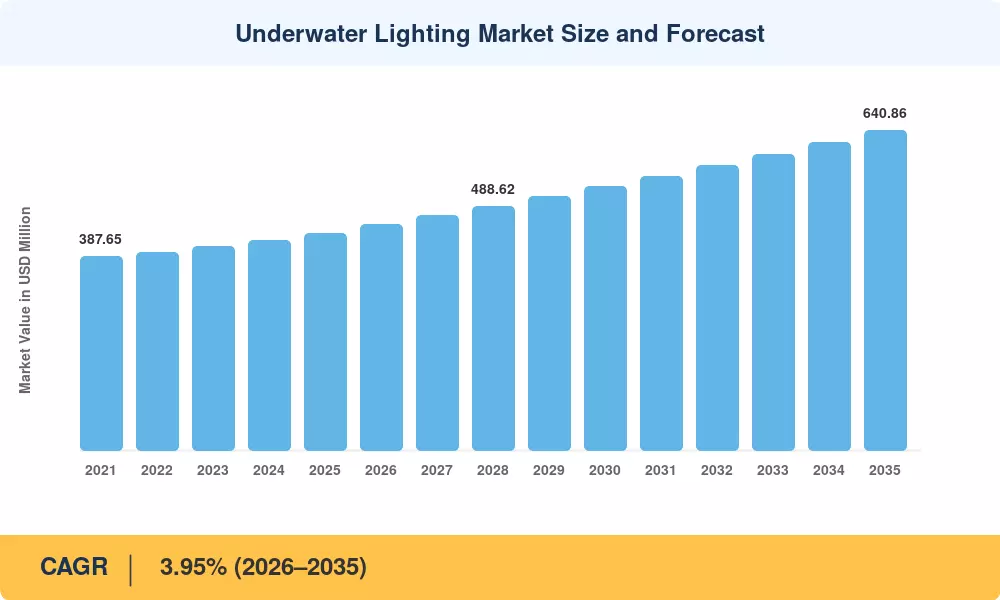
Underwater Lighting Market Size and Forecast
Our Impact
Enabled $4.3B Revenue Impact for Fortune 500 and Leading Multinationals
Partnering with 2000+ Global Organizations Each Year
30K+ Citations by Top-Tier Firms in the Industry

Driver Impact Analysis

Driver ~% Impact on CAGR Geographic Relevance Impact Timeline
LED price erosion and efficacy gains +0.85% Global Short-term (≤2 yr)
Coastal tourism infrastructure investment +0.70% Asia-Pacific, Europe Medium-term (2–4 yr)
Energy-efficiency mandates and fluorescent phase-outs +0.65% Europe, North America Short-term (≤2 yr)
Smart-LED and IoT platform integration +0.55% North America, Europe Medium-term (2–4 yr)
Aquaculture spectral-lighting R&D +0.40% Europe, Asia-Pacific Long-term (≥4 yr)
Offshore energy subsea inspection demand +0.35% Middle East, Europe Long-term (≥4 yr)
Recreational boating market expansion +0.30% North America, Asia-Pacific Medium-term (2–4 yr)


LED Price Erosion and Efficacy Gains

Average LED package prices dropped roughly 12% between 2022 and 2024, according to the U.S. Department of Energy's Solid-State Lighting R&D Plan, while luminous efficacy for submersible-rated packages surpassed 180 lm/W [2]. That cost-performance improvement collapses the payback period for pool and marina operators, replacing halogen fixtures with under 18 months, converting what was once a premium upgrade into a default specification on new builds.

Coastal Tourism Infrastructure Investment

The Asian Development Bank committed over USD 2.4 billion in coastal resilience and tourism infrastructure funding between 2023 and 2026, with marina lighting cited in multiple project scopes across the Philippines, Vietnam, and Indonesia [7]. This pipeline directly channels public capital into underwater luminaire procurement, benefiting manufacturers with ASEAN distribution networks.

Energy-Efficiency Mandates and Fluorescent Phase-Outs

The European Commission's Ecodesign for Sustainable Products Regulation, effective from 2024, phases out fluorescent lighting across all applications, including underwater installations [5]. Pool operators and municipal fountain authorities face compliance deadlines that translate into captive retrofit demand, estimated to generate over USD 30 million in incremental European revenue between 2025 and 2028 [10].

Smart-LED and IoT Integration

Connected lighting platforms—where underwater fixtures sync with chartplotters, building-management software, or aquaculture monitoring dashboards—create subscription revenue layers atop hardware sales [6]. Lumishore and OceanLED both launched cloud-connected product lines in 2024, signaling a broader shift in the Underwater Lighting Market toward software-augmented value propositions.


Restraints Impact Analysis

Restraint ~% Impact on CAGR Geographic Relevance Impact Timeline
High upfront cost of marine-grade LED fixtures −0.40% Emerging markets Short-term (≤2 yr)
Corrosion and water-pressure durability challenges −0.35% Global Medium-term (2–4 yr)
Fragmented regional certification requirements −0.25% Global Long-term (≥4 yr)
Limited skilled installation labor for thru-hull systems −0.20% North America, Europe Medium-term (2–4 yr)
Environmental concerns over light pollution in aquatic ecosystems −0.15% Europe, North America Long-term (≥4 yr)


High Upfront Cost of Marine-Grade Fixtures

Marine-rated LED fixtures carry price premiums of 40–60% over their terrestrial equivalents due to titanium or 316L stainless-steel housings and potted electronics [15]. In price-sensitive markets across South America and parts of Southeast Asia, this cost gap steers buyers toward lower-cost halogen alternatives, compressing addressable demand for LED upgrades.

Corrosion and Water-Pressure Durability

Saltwater environments accelerate galvanic corrosion, and fixtures rated beyond 30 meters depth require pressure compensation that adds design complexity and cost [16]. Warranty claim rates for marine underwater fixtures remain two to three times higher than for pool-rated products, discouraging some OEM boat-builders from specifying premium luminaires.

Fragmented Regional Certification

Underwater electrical equipment must satisfy UL 676 in North America, IEC 60598-2-18 in Europe, and varying national standards across Asia, creating compliance burdens that disproportionately affect smaller manufacturers seeking multi-region distribution [17].


Underwater Lighting Market Opportunities

Aquaculture Spectral-Tuning Applications

Research from Norway's Institute of Marine Research shows that spectrally tuned blue-green LEDs reduce sea-lice infestations in salmon farms by up to 40%, creating a biologically validated value proposition that justifies premium pricing [9]. Aquaculture operators spending an estimated USD 1.2 billion annually on pest management represent a high-margin addressable segment for the Underwater Lighting Market.

Offshore Wind and Subsea Energy Inspection Lighting

The global offshore wind pipeline exceeds 380 GW of planned capacity through 2035, and every turbine foundation requires subsea inspection lighting for remotely operated vehicles [12]. Fixture manufacturers that develop ROV-mountable, pressure-rated luminaires can access an emerging niche with limited incumbent competition.

Lighting-as-a-Service and Subscription Models

Connected smart-LED platforms enable recurring revenue through firmware updates, color-scene libraries, and energy-analytics dashboards [6]. Converting one-time hardware transactions into subscription streams could lift manufacturer gross margins by five to eight percentage points, reshaping competitive positioning in the Underwater Lighting Market.

Emerging-Market Pool and Resort Construction

Rapid urbanization in India, Brazil, and the Gulf Cooperation Council states is driving a construction boom in resort and residential swimming facilities [7]. India alone added over 12,000 registered swimming pools between 2022 and 2024, and code requirements increasingly mandate LED illumination, creating a volume growth corridor for competitively priced fixtures.

Smart-City Waterfront and Public Fountain Programs

Municipal smart-city initiatives from Singapore to Barcelona are allocating budgets for programmable fountains and waterfront lighting controlled through centralized management platforms [14]. These public-sector projects favor long-lifecycle LED fixtures with remote diagnostics, aligning procurement criteria with the capabilities of leading Underwater Lighting Market suppliers.


Underwater Lighting Market Future Outlook

Smart Integration and Autonomous Lighting Control

The proliferation of IoT-connected building-management systems will make autonomous lighting scheduling—where underwater fixtures adjust intensity and spectrum based on ambient light sensors and occupancy data—a baseline expectation by 2030. The IEA projects global connected lighting penetration will reach 45% of all installed commercial fixtures by 2032, and underwater installations will follow that trajectory with a two- to three-year lag [6].

Spectral Biology and Aquaculture-Driven Innovation

Aquaculture production must increase by 30% to meet 2035 global protein demand, according to the FAO [9]. Spectrally optimized lighting that improves fish growth rates, reduces disease incidence, and synchronizes breeding cycles positions the Underwater Lighting Market as a functional input to food production rather than a purely aesthetic product category.

Offshore Energy and Deep-Water Applications

The global offshore energy sector—spanning oil, gas, and wind—will deploy an estimated 15,000 additional subsea structures by 2035, each requiring inspection-grade and permanent navigational lighting [12]. Pressure-rated LED fixtures capable of operating at depths exceeding 300 meters represent a high-value engineering niche with limited competitive overlap from pool-focused manufacturers.

Sustainability Reporting and ESG Compliance

Growing corporate ESG disclosure requirements, including the EU Corporate Sustainability Reporting Directive, will push commercial and hospitality operators to document lighting energy consumption and lifecycle impacts [10]. LED luminaires with lower embodied carbon and recyclable housings gain procurement advantage, reinforcing the technology's share trajectory in the Underwater Lighting Market through the end of the forecast period.


Underwater Lighting Market Segmentation

By Lighting Source

Segment Key Metric Primary Demand Driver
LED 84.2% revenue share (2025) Energy efficiency, longevity and regulatory mandates
Halogen 3.18% CAGR (2026–2035) Declining; limited to legacy replacement


LED dominance in the Underwater Lighting Market is structural rather than cyclical. Pool operators replacing end-of-life halogen systems overwhelmingly select LED alternatives because the lifecycle cost advantage now exceeds 55% over a ten-year horizon [2]. Smart-enabled and RGB LED sub-segments are accelerating fastest, projecting a 5.7% CAGR as color-programmable systems become standard in hospitality and yacht applications.

Halogen fixtures retain a shrinking niche in price-sensitive replacement cycles, primarily in regions without regulatory phase-out mandates. Their share is expected to contract steadily as LED price premiums narrow further.

By Mounting Type

Segment Key Metric Primary Demand Driver
Surface-Mounted 68.5% revenue share (2025) Retrofit ease; universal pool compatibility
Flush/Thru-Hull 6.45% CAGR (2026–2035) New-build vessel integration; hydrodynamic benefits
Portable USD 22.15 Million (2025) Dive, inspection, and temporary event applications


Surface-mounted fixtures dominate the Underwater Lighting Market due to their compatibility with existing pool niches and boat transoms, making them the default choice for retrofit projects. Flush and thru-hull systems, while holding a smaller current share, are growing rapidly because boat builders increasingly integrate lighting during hull fabrication to improve aesthetics and reduce drag.

By Application

Segment Key Metric Primary Demand Driver
Swimming Pools 59.2% revenue share (2025) Installed base volume; renovation cycles
Boats and Yachts 6.65% CAGR (2026–2035) Recreational marine spending growth
Fountains and Water Features USD 48.72 Million (2025) Municipal and hospitality aesthetics
Others (Aquaculture, Docks, Aquariums) 4.85% CAGR Diversified industrial and institutional use


Swimming pools anchor the Underwater Lighting Market in absolute volume, with renovation-driven demand creating a predictable replacement cycle averaging seven to ten years. Boats and yachts represent the fastest-growing application as recreational boating participation rates climb in Asia-Pacific and North America, and vessel owners increasingly treat underwater lighting as a standard rather than an optional feature.

By End User

Segment Key Metric Primary Demand Driver
Residential 52.7% revenue share (2025) Private pool ownership; smart-home integration
Commercial and Hospitality 5.95% CAGR (2026–2035) Hotel, resort, and public-venue expansion
Industrial / Marine Infrastructure USD 43.50 Million (2025) Offshore inspection; port and dock lighting
Others 3.50% CAGR Aquariums, theme parks, institutional facilities


By Sales Channel

Segment Key Metric Primary Demand Driver
Aftermarket 57.8% revenue share (2025) Replacement and retrofit dominance
OEM 4.52% CAGR (2026–2035) New-build pool and vessel integration


Aftermarket channels lead the Underwater Lighting Market because the installed base of pools, boats, and fountains vastly exceeds annual new-build volumes. Online storefronts within the aftermarket channel are expanding as distributors digitize catalogs and offer direct-to-consumer shipping, simplifying procurement for residential buyers and small contractors.


Regional Market Share Analysis

Region Key Metric Primary Investment Themes
North America 26.5% revenue share (2025) Residential pool retrofit; recreational boating
Europe 34.1% revenue share (2025) Energy-efficiency mandates; fluorescent phase-out
Asia-Pacific 6.0% CAGR (2026–2035) Coastal tourism; resort and marina construction
South America USD 33.93 Million (2025) Urban resort growth; municipal fountain projects
Middle East & Africa USD 29.58 Million (2025) Luxury hospitality; oil and gas subsea lighting
Total USD 435.00 Million (2025)

The Underwater Lighting Market exhibits a geographically diversified demand base, with Europe leading in revenue share and Asia-Pacific posting the fastest growth. Regional dynamics reflect differing maturity levels in pool infrastructure, marine recreation, and regulatory environments.


North America

Country Key Metric Key Driver
US 78.2% of regional revenue Residential pool density; NEC code updates
Canada 12.5% of regional revenue Cottage and lakefront recreational demand
Mexico 4.18% CAGR Resort and hotel construction along the Riviera Maya


The United States dominates North American demand, with an installed pool base exceeding 5.7 million residential units requiring periodic fixture replacement [4]. Recent National Electrical Code updates referencing LED-only specifications for new pool installations reinforce conversion momentum through 2030.

Europe

Country Key Metric Key Driver
Germany 18.4% of regional revenue Municipal pool energy-efficiency programs
UK 14.7% of regional revenue Marina expansion along the south coast
France 13.9% of regional revenue Second-largest residential pool market globally
Italy USD 15.20 Million Tourism-driven hotel pool lighting
Spain 4.62% CAGR Coastal resort construction acceleration
Nordic Countries USD 8.45 Million Aquaculture spectral-lighting leadership
Russia 3.15% CAGR Municipal infrastructure modernization
Rest of Europe USD 12.30 Million Mixed retrofit and new-build demand


Europe's leadership stems from the EU Ecodesign Regulation and a mature pool renovation cycle in France and Germany. Nordic countries represent a specialized niche where aquaculture farms deploy spectrally tuned LEDs to manage fish welfare, generating disproportionate per-capita demand [5].

Asia-Pacific

Country Key Metric Key Driver
China 32.5% of regional revenue Municipal and commercial pool expansion
India 6.85% CAGR Resort construction and urbanization
Japan 16.8% of regional revenue Marine technology leadership; aquarium sector
South Korea USD 7.60 Million Shipbuilding integration; smart marinas
ASEAN 7.10% CAGR Coastal tourism megaprojects in Vietnam, Thailand
Rest of Asia-Pacific USD 5.90 Million Emerging market diversification


Asia-Pacific growth is propelled by a dual engine: coastal tourism infrastructure in ASEAN states and expanding commercial pool stock in China and India [7]. Japan contributes a stable demand from its technologically advanced aquarium and marine-recreation sectors.

South America

Country Key Metric Key Driver
Brazil 58.3% of regional revenue Largest regional pool installed base
Argentina 4.25% CAGR Urban residential swimming facility growth
Rest of South America USD 5.80 Million Hotel and resort development


Brazil's residential pool market—the second largest globally after the United States—anchors South American demand, with LED retrofit cycles accelerating as municipalities adopt energy-efficiency standards modeled on European precedents [15].

Middle East & Africa

Country Key Metric Key Driver
Saudi Arabia 28.9% of regional revenue Vision 2030 tourism and entertainment projects
UAE 32.1% of regional revenue Luxury hospitality; iconic fountain installations
South Africa 3.95% CAGR Residential and commercial pool markets
Egypt USD 2.10 Million Red Sea resort development corridor
Rest of MEA USD 3.85 Million Oil and gas subsea applications


The UAE and Saudi Arabia drive Middle Eastern demand through flagship hospitality projects and programmable fountain installations. Saudi Arabia's Vision 2030 pipeline includes multiple waterfront entertainment districts requiring large-scale underwater illumination systems [14].


Underwater Lighting Market By Region, 2025-2035

Competitive Benchmarking

The underwater lighting market is moderately concentrated, with the top five players accounting for around 35-42% of the total revenue. Below the top tier, the competitive industry splinters into dozens of regional specialists, specialized marine brands and private-label pool suppliers. The leaders are distinguished from the commodity competitors by innovation in smart connection, corrosion-resistant materials and spectral-tuning capability [20].

Company Est. Revenue Share Range Key Offerings for the Underwater Lighting Market Strategic Positioning
Hayward Industries ~7–10% ColorLogic LED pool lighting systems Pool-ecosystem integration; residential dominance
Pentair ~6–9% IntelliBrite and MicroBrite LED fixtures Broad pool and spa portfolio; IoT-ready platforms
Fluidra (Zodiac/Jandy) ~5–8% WaterColors LED and nicheless pool lights Global distribution; residential and commercial
Philips Lumileds ~4–7% High-efficacy LED chip supply; OEM partnerships Upstream component supply; technology licensing
Lumishore ~3–6% Smart-connected marine LED lighting; EOS series Premium marine and superyacht segment
OceanLED ~3–5% Explore and Sport series; dock lighting Recreational boating and marina specialization
Aqualuma ~2–4% Gen Series LED marine and pool lights OEM supply to boat builders; Australian marine market
Hella Marine ~2–4% Underwater LED strips and pond lights Industrial, marine and commercial vessel focus
Shadow-Caster Marine ~2–3% SCM series color-change underwater lights Value-oriented marine aftermarket
Underwater Lights USA ~1–3% Custom submersible and dock LED systems Direct-to-consumer e-commerce specialization


Recent News & Developments

  • Signify (January 2025): Signify secured the lighting package for Salmon Evolution’s phase-two expansion, cementing its aquaculture foothold.
  • Hella Marine (January 2025): Hella Marine launched the new “Apelo Light Controller” (featuring Bluetooth Mesh), alongside RGB and RGB-W underwater lights and lamps showcasing the advancement of smart, app-managed marine lighting.


Underwater Lighting Market Report Scope

Parameter Detail
Market Scope Global Underwater Lighting Market across all lighting sources, mounting types, applications, end users, and sales channels
Study Period 2021–2035
CAGR (Forecast) 3.95% (2026–2035)
Market Size (2025) USD 435.00 Million
Market Size (2035) USD 640.86 Million
Fastest Growing Segment Boats and Yachts (by application); Asia-Pacific (by region)
Companies Profiled 10 (Hayward, Pentair, Fluidra, Philips Lumileds, Lumishore, OceanLED, Aqualuma, Hella Marine, Shadow-Caster, Underwater Lights USA)
Valuation Currency USD Million


FAQs

What IP protection rating should buyers specify for saltwater underwater fixtures?
Buyers should require a minimum IP68/IP69K rating with marine-grade 316L stainless-steel or titanium housings. These ratings ensure long-term performance in corrosive saltwater at depth [16].
How do warranty structures differ between pool-rated and marine-rated underwater luminaires?
Pool-rated fixtures typically carry three- to five-year warranties, while marine-rated units often limit coverage to two years due to harsher operating conditions. Buyers should negotiate extended-warranty packages tied to corrosion-specific failure modes [17].
What role does spectral wavelength selection play in aquaculture lighting procurement?
Wavelength choice directly affects fish behavior, growth, and parasite management. Blue-green spectra (450–520 nm) show the strongest evidence for reducing sea-lice attachment in salmonid species [9].
How does the Underwater Lighting Market address light pollution concerns in sensitive ecosystems?
Leading manufacturers now offer shielded and directional optics that minimize upward light spill. Regulatory bodies in parts of Europe and Australia are developing aquatic light-pollution thresholds [19].
What procurement considerations apply when integrating underwater lighting into smart building platforms?
Buyers should verify protocol compatibility (DALI-2, DMX512, or Bluetooth mesh) and confirm that the fixture firmware supports OTA updates. Proprietary ecosystems risk vendor lock-in [6].
Are fiber-optic underwater lighting systems still competitive against LED in any applications?
Fiber-optic systems retain niche relevance in explosive-atmosphere zones and heritage fountain installations where electrical isolation at the fixture point is mandatory [17].
How does the Underwater Lighting Market's competitive landscape differ between the pool and marine segments?
Pool lighting is dominated by integrated pool-equipment conglomerates like Hayward and Pentair, while marine lighting features specialized brands such as Lumishore and OceanLED competing on connectivity and durability [20].    
Author
Author
Author Profile
Ankit Gupta LinkedIn
Team Lead - Research
Ankit Gupta is a seasoned market intelligence and strategic research professional with over six plus years of experience in the ICT and Semiconductor industries. With academic roots in Telecom, Marketing, and Electronics, he blends technical insight with business strategy. Ankit has led 200+ projects, including work for Fortune 500 clients like Microsoft and Rio Tinto, covering market sizing, tech forecasting, and go-to-market strategies. Known for bridging engineering and enterprise decision-making, his insights support growth, innovation, and investment planning across diverse technology markets.

Research Approach


Secondary Research

The secondary research process involved comprehensive analysis of regulatory databases, industry standards, maritime safety publications, energy efficiency reports, and authoritative marine & lighting organizations. Key sources included the US Department of Energy (DOE), US Environmental Protection Agency (EPA), US Coast Guard (USCG), International Maritime Organization (IMO), International Electrotechnical Commission (IEC), National Electrical Manufacturers Association (NEMA), Illuminating Engineering Society (IES), European Commission - Energy Efficiency Directive, EU Ecodesign and Energy Labelling Regulations, International Association of Marine Insurers (IUMI), National Oceanic and Atmospheric Administration (NOAA), Marine Stewardship Council (MSC), World Aquaculture Society (WAS), UNESCO Intergovernmental Oceanographic Commission, and national maritime authority reports from key markets. These sources were used to collect safety compliance data, energy efficiency standards, marine infrastructure investment statistics, aquaculture lighting requirements, LED adoption trends, and market landscape analysis for LED underwater lights, halogen underwater lights, fluorescent underwater lights, and other illumination technologies across aquarium, underwater infrastructure, marine park, and theatrical lighting applications.


Primary Research

Qualitative and quantitative insights were obtained by interviewing supply-side and demand-side stakeholders during the primary research process. The supply-side sources consisted of CEOs, VPs of Product Development, engineering heads, maritime certification specialists, and commercial directors from LED component suppliers, marine electronics OEMs, and underwater lighting manufacturers. In addition to procurement leads from marine parks, resorts, municipal infrastructure departments, and industrial diving contractors, demand-side sources included marine architects, aquaculture facility managers, aquarium curators, marina operators, underwater construction project managers, and marine architects. Market segmentation was validated, product pipeline timelines were confirmed, and insights regarding installation adoption patterns, pricing strategies, regulatory compliance costs, and replacement cycle dynamics were obtained through primary research.

Primary Respondent Breakdown:

By Designation: C-level Primaries (32%), Director Level (31%), Others (37%)

By Region: North America (32%), Europe (30%), Asia-Pacific (28%), Rest of World (10%)


Market Size Estimation

Global market valuation was derived through revenue mapping and installation volume analysis. The methodology included:

The identification of over 50 key manufacturers in North America, Europe, Asia-Pacific, and Latin America

Product mapping across LED underwater lights, halogen underwater lights, fluorescent underwater lights, and other lighting categories

Analysis of reported and modeled annual revenues specific to underwater lighting portfolios

Coverage of manufacturers representing 65-70% of global market share in 2024

Extrapolation using bottom-up (installation volume × ASP by country/application) and top-down (manufacturer revenue validation) approaches to derive segment-specific valuations across aquarium lighting, underwater infrastructure lighting, marine park lighting, and theatrical lighting applications

Download Free Sample

Kindly complete the form below to receive a free sample of this Report

Download PDF ×

We do not share your information with anyone. However, we may send you emails based on your report interest from time to time. You may contact us at any time to opt-out.














