×
Request Free Sample ×

Kindly complete the form below to receive a free sample of this Report

* Please use a valid business email

Leading companies partner with us for data-driven Insights

clients tt-cursor
Hero Background

US Aerospace Robotics Market

ID: MRFR/AD/17516-HCR
100 Pages
Garvit Vyas
October 2025

US Aerospace Robotics Market

Share:
Download PDF ×

We do not share your information with anyone. However, we may send you emails based on your report interest from time to time. You may contact us at any time to opt-out.

US Aerospace Robotics Market Infographic
Purchase Options

US Aerospace Robotics Market Summary

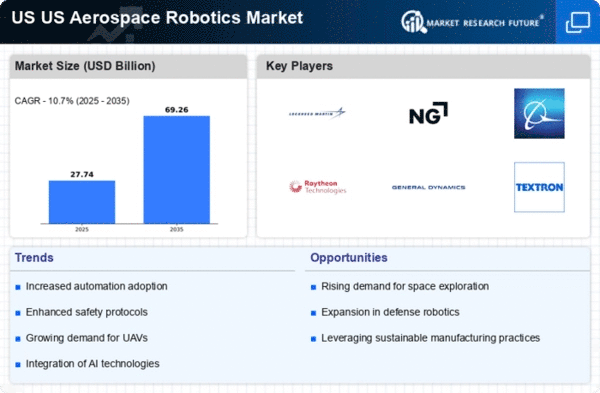
As per analysis, the US aerospace robotics market is projected to grow from USD 25.06 Billion in 2024 to USD 27.72 Billion in 2025, exhibiting a compound annual growth rate (CAGR) of 10.7% during the forecast period (2025 - 2035).

Key Market Trends & Highlights

The US aerospace robotics market is poised for substantial growth driven by automation and technological advancements.

  • The manufacturing segment remains the largest contributor to the aerospace robotics market, reflecting a trend towards increased automation in production processes.
  • Unmanned Aerial Vehicles are emerging as the fastest-growing segment, indicating a shift towards innovative aerial solutions.
  • Sustainable practices are gaining traction, as companies prioritize environmentally friendly technologies in aerospace robotics.
  • Key market drivers include growing demand for precision engineering and advancements in robotics technology, which are shaping the industry's future.

Market Size & Forecast

2024 Market Size 25.06 (USD Billion)
2035 Market Size 76.64 (USD Billion)
CAGR (2025 - 2035) 10.7%

Major Players

Northrop Grumman (US), Lockheed Martin (US), Boeing (US), Raytheon Technologies (US), General Dynamics (US), Textron (US), Honeywell (US), L3Harris Technologies (US), Rockwell Collins (US)

US Aerospace Robotics Market Trends

The US aerospace robotics market is currently experiencing a transformative phase, driven by advancements in automation and artificial intelligence. As the aerospace sector increasingly embraces robotics, manufacturers are integrating these technologies to enhance production efficiency and precision. This shift not only streamlines operations but also reduces human error, thereby improving overall safety standards. Furthermore, the demand for unmanned aerial vehicles (UAVs) is on the rise, prompting companies to invest in robotic systems that can support various applications, from surveillance to cargo transport. The collaboration between robotics and aerospace is fostering innovation, leading to the development of sophisticated systems that can operate in complex environments. In addition to production enhancements, the US aerospace robotics market is witnessing a growing emphasis on sustainability. Companies are exploring eco-friendly robotic solutions that minimize waste and energy consumption. This trend aligns with broader industry goals to reduce the environmental impact of aerospace operations. As regulatory frameworks evolve, there is a potential for increased government support for research and development in this field. Overall, the US aerospace robotics market appears poised for significant growth, driven by technological advancements and a commitment to sustainable practices.

Increased Automation in Manufacturing

The US aerospace robotics market is seeing a notable shift towards automation in manufacturing processes. This trend is characterized by the integration of robotic systems that enhance production capabilities, reduce labor costs, and improve product quality. As manufacturers adopt these technologies, they are likely to experience greater operational efficiency and flexibility.

Rise of Unmanned Aerial Systems

The demand for unmanned aerial systems is expanding within the US aerospace robotics market. These systems are being utilized for various applications, including surveillance, logistics, and environmental monitoring. The increasing reliance on UAVs suggests a growing recognition of their potential to revolutionize traditional aerospace operations.

Focus on Sustainable Practices

Sustainability is becoming a central theme in the US aerospace robotics market. Companies are increasingly prioritizing eco-friendly robotic solutions that aim to reduce waste and energy consumption. This focus on sustainability not only aligns with regulatory expectations but also reflects a broader commitment to environmental stewardship within the aerospace sector.

Market Segment Insights

By Application: Manufacturing (Largest) vs. Inspection (Fastest-Growing)

In the US aerospace robotics market, the application segment is primarily dominated by manufacturing, which holds the largest share due to its integral role in the production of aerospace components. Robotics in manufacturing enhances precision and efficiency, making it indispensable for companies striving to improve productivity. Following manufacturing are inspection and maintenance applications, both key in ensuring compliance with stringent safety standards and operational efficiency as the industry evolves. Growth trends within the application segment highlight the surge in inspection robotics, recognized as the fastest-growing domain. As the aerospace industry prioritizes safety and reliability, the adoption of advanced robotic systems for inspection is crucial. High demand for automated solutions that ensure quality control drives technological advancements, creating new opportunities for inspection robotics to thrive in the market.

Manufacturing: Robotics (Dominant) vs. Inspection Robotics (Emerging)

Manufacturing robotics stands as the dominant force in the US aerospace robotics market, characterized by its extensive application in fabricating intricate aircraft components with high precision. These systems enable manufacturers to automate repetitive tasks, ensuring speed and consistency while minimizing human error. The emphasis on lean manufacturing processes further augments this segment's relevance. On the other hand, inspection robotics is an emerging area that plays a crucial role in enhancing safety and compliance within the sector. Leveraging state-of-the-art technologies such as machine learning and computer vision, inspection robotics assist in the thorough examination of aircraft structures and systems, ensuring they meet regulatory standards. As industries adopt more rigorous inspection protocols, the need for specialized robotics in this space is expected to escalate.

By End Use: Commercial Aviation (Largest) vs. Unmanned Aerial Vehicles (Fastest-Growing)

In the US aerospace robotics market, the distribution of market share among different end use segments highlights the dominance of commercial aviation, which stands as the largest segment. This can be attributed to the increasing demand for automation in air travel and the ongoing advancements in robotic technologies that enhance operational efficiency. Conversely, unmanned aerial vehicles are emerging rapidly in popularity, catering to diverse applications including surveillance, delivery, and precision agriculture, marking a significant shift in aerospace robotics usage patterns.

Commercial Aviation: Dominant vs. Unmanned Aerial Vehicles: Emerging

Commercial aviation remains the dominant segment in the US aerospace robotics market, characterized by robust demand for automation solutions that streamline processes and ensure safety. The integration of robotic systems into aircraft manufacturing and maintenance is revolutionizing operational capabilities. On the other hand, unmanned aerial vehicles are regarded as an emerging segment, driven by advancements in drone technology and increasing adoption in various sectors such as logistics and environmental monitoring. This segment is gaining traction due to its potential for cost savings and the ability to perform tasks that are either too dangerous or impractical for human operators.

By Technology: Artificial Intelligence (Largest) vs. Automation (Fastest-Growing)

In the US aerospace robotics market, the technology segment is dominated by Artificial Intelligence, which takes the largest share due to its extensive applications in optimizing operations, enhancing decision-making, and improving overall efficiency. Following AI, Automation is rapidly gaining traction, especially as industries seek to streamline processes and reduce operational costs. Both Machine Learning and Sensor Technology also show significant contributions, but they currently play more supportive roles in enhancing the functionalities of primary systems like AI and Automation. The growth trends within the technology segment are primarily driven by innovation and the increasing demand for more efficient and autonomous systems. Factory automation and the integration of AI into robotics have become pivotal in responding to labor shortages and operational inefficiencies. Moreover, the expanding capabilities of Machine Learning and Computer Vision are opening new avenues for advanced applications, positioning Automation as the fastest-growing aspect within the sector, addressing the urgent need for smart manufacturing solutions in aerospace operations.

Technology: Artificial Intelligence (Dominant) vs. Automation (Emerging)

Artificial Intelligence is positioned as the dominant force in the US aerospace robotics market, leveraging advanced algorithms to enhance predictive analytics and streamline operations. Its integration fosters superior decision-making capabilities, enabling companies to optimize maintenance schedules and enhance performance metrics. On the other hand, Automation is emerging as a vital segment focused on mechanizing repetitive tasks, thus improving efficiency and accuracy in manufacturing processes. As businesses increasingly prioritize operational efficiency and cost reductions, Automation technologies, such as robotic process automation and autonomous vehicles, gain prominence. Together, these technologies are shaping the future of aerospace by driving innovation and improving production scales.

By Type: Collaborative Robots (Largest) vs. Drones (Fastest-Growing)

The US aerospace robotics market is characterized by a diverse range of types, with collaborative robots holding the largest market share due to their versatility and ease of integration into existing workflows. Following closely are drones, which are rapidly gaining traction. Their innovative applications and advancements in technology are enabling them to play an increasingly crucial role in aerospace operations, from surveillance to delivery services. In terms of growth trends, the market is witnessing a significant uptick in the adoption of drones driven by their expanding applications in logistics and inspection tasks. Collaborative robots also benefit from increasing demand for automation in aerospace manufacturing, enhancing operational efficiency, and reducing labor costs. These trends underscore a dynamic shift towards integrating advanced robotics across various aerospace functionalities.

Technology: Collaborative Robots (Dominant) vs. Drones (Emerging)

Collaborative robots are revolutionizing the aerospace sector by complementing human workers, enhancing productivity, and boosting safety in manufacturing processes. Their ability to work alongside humans without safety cages allows for flexible production lines, making them a dominant force in the aerospace robotics market. Meanwhile, drones represent an emerging segment that is transforming inspection, surveillance, and cargo delivery in aerospace. With advancements in AI and automation, drones are becoming more autonomous and capable, thereby increasing their market potential. Their ability to gather real-time data and perform tasks from above is making them an attractive option for various aerospace applications.

Get more detailed insights about US Aerospace Robotics Market

Key Players and Competitive Insights

The aerospace robotics market is characterized by a dynamic competitive landscape, driven by technological advancements and increasing demand for automation in various aerospace applications. Key players such as Northrop Grumman (US), Lockheed Martin (US), and Boeing (US) are at the forefront, each adopting distinct strategies to enhance their market positioning. Northrop Grumman (US) emphasizes innovation through its investment in autonomous systems, while Lockheed Martin (US) focuses on strategic partnerships to bolster its robotics capabilities. Boeing (US), on the other hand, is actively pursuing digital transformation initiatives to streamline operations and improve efficiency, collectively shaping a competitive environment that prioritizes technological prowess and operational excellence.

In terms of business tactics, companies are increasingly localizing manufacturing and optimizing supply chains to enhance responsiveness and reduce costs. The market appears moderately fragmented, with several key players exerting substantial influence. This competitive structure allows for a diverse range of offerings, fostering innovation and collaboration among industry participants.

In November 2025, Northrop Grumman (US) announced a partnership with a leading AI firm to develop advanced robotic systems for unmanned aerial vehicles (UAVs). This strategic move is likely to enhance Northrop Grumman's capabilities in autonomous flight, positioning the company to capture a larger share of the UAV market. The integration of AI into their robotics systems may also lead to improved operational efficiencies and reduced costs, aligning with current industry trends towards automation.

In October 2025, Lockheed Martin (US) unveiled a new robotics platform designed for space exploration missions. This initiative underscores Lockheed Martin's commitment to expanding its robotics portfolio and leveraging cutting-edge technology to support NASA's Artemis program. The strategic importance of this development lies in its potential to enhance the company's competitive edge in the burgeoning space robotics sector, which is expected to grow significantly in the coming years.

In September 2025, Boeing (US) launched a new initiative aimed at integrating robotics into its manufacturing processes. This initiative is expected to streamline production and improve quality control, reflecting Boeing's focus on digital transformation. The strategic significance of this move is profound, as it not only enhances operational efficiency but also positions Boeing as a leader in the adoption of advanced manufacturing technologies within the aerospace sector.

As of December 2025, current competitive trends in the aerospace robotics market are heavily influenced by digitalization, sustainability, and AI integration. Strategic alliances are increasingly shaping the landscape, enabling companies to pool resources and expertise to drive innovation. Looking ahead, competitive differentiation is likely to evolve from traditional price-based competition to a focus on technological innovation, reliability in supply chains, and the ability to deliver sustainable solutions. This shift indicates a transformative phase in the aerospace robotics market, where companies that prioritize innovation and adaptability will likely emerge as leaders.

Key Companies in the US Aerospace Robotics Market market include

Future Outlook

US Aerospace Robotics Market Future Outlook

The US aerospace robotics market is poised for growth at a 10.7% CAGR from 2024 to 2035, driven by advancements in automation, demand for efficiency, and increased defense spending.

New opportunities lie in:

  • Development of autonomous inspection drones for aircraft maintenance.
  • Integration of AI-driven robotics in manufacturing processes.
  • Expansion of robotic systems for cargo handling in aerospace logistics.

By 2035, the aerospace robotics market is expected to be robust, reflecting substantial advancements and increased adoption.

Market Segmentation

US Aerospace Robotics Market Type Outlook

  • Collaborative Robots
  • Autonomous Robots
  • Industrial Robots
  • Drones
  • Mobile Robots

US Aerospace Robotics Market End Use Outlook

  • Commercial Aviation
  • Military Aviation
  • Space Exploration
  • Unmanned Aerial Vehicles
  • Cargo Transport

US Aerospace Robotics Market Technology Outlook

  • Artificial Intelligence
  • Machine Learning
  • Computer Vision
  • Automation
  • Sensor Technology

US Aerospace Robotics Market Application Outlook

  • Manufacturing
  • Inspection
  • Maintenance
  • Assembly
  • Testing

Report Scope

MARKET SIZE 202425.06(USD Billion)
MARKET SIZE 202527.72(USD Billion)
MARKET SIZE 203576.64(USD Billion)
COMPOUND ANNUAL GROWTH RATE (CAGR)10.7% (2024 - 2035)
REPORT COVERAGERevenue Forecast, Competitive Landscape, Growth Factors, and Trends
BASE YEAR2024
Market Forecast Period2025 - 2035
Historical Data2019 - 2024
Market Forecast UnitsUSD Billion
Key Companies ProfiledNorthrop Grumman (US), Lockheed Martin (US), Boeing (US), Raytheon Technologies (US), General Dynamics (US), Textron (US), Honeywell (US), L3Harris Technologies (US), Rockwell Collins (US)
Segments CoveredApplication, End Use, Technology, Type
Key Market OpportunitiesIntegration of artificial intelligence in aerospace robotics enhances operational efficiency and safety in the US aerospace sector.
Key Market DynamicsTechnological advancements drive competitive dynamics in the US aerospace robotics market, enhancing efficiency and innovation.
Countries CoveredUS

Leave a Comment

Download Free Sample

Kindly complete the form below to receive a free sample of this Report

Compare Licence

×
Features License Type
Single User Multiuser License Enterprise User
Price $4,950 $5,950 $7,250
Maximum User Access Limit 1 User Upto 10 Users Unrestricted Access Throughout the Organization
Free Customization
Direct Access to Analyst
Deliverable Format
Platform Access
Discount on Next Purchase 10% 15% 15%
Printable Versions