Automotive Robotics Market

Key Players: FANUC Corporation, ABB Ltd, KUKA AG (Midea Group), Yaskawa Electric Corporation, Kawasaki Heavy Industries, Denso Corporation, Nachi-Fujikoshi Corporation, Comau S.p.A.

Automotive Robotics Market

Automotive Robotics Market Size, Share & Growth Analysis Report By Product Type (Articulated Robots, SCARA Robots, Collaborative Robots, Cartesian Robots), By Function Type (Welding Robots, Painting Robots, Assembly Robots, Material-Handling Robots, Inspection & Quality-Testing), By Component Type (Robotic Arms, Controllers, End-Effectors, Software & Services), By End-User Type (Vehicle Manufacturers (OEMs), Component Manufacturers (Tier-1 and Tier-2), Service Centers) and By Regional (North America, Europe, South America, Asia Pacific, Middle East and Africa) - Industry Growth & Forecast to 2035
ID: MRFR/AT/1457-HCR
200 Pages
Shubham Munde, Sejal Akre
Last Updated: June 22, 2026

Automotive Robotics Market Summary

The Automotive Robotics Market reached a valuation of USD 17.42 billion in 2025 and is projected to climb from USD 19.67 billion in 2026 to USD 58.16 billion by 2035, expanding at a CAGR of 12.8% across the forecast window. The Automotive Robotics Market growth trajectory is anchored by two converging forces: the global push toward vehicle electrification — with over 40 countries committing to zero-emission vehicle mandates by 2035 [1] — and a structural shortage of skilled manufacturing labor that has made automation an operational necessity rather than a strategic luxury.

A generational technology shift is reshaping production floors worldwide. Legacy fixed-sequence robotic cells designed for internal-combustion drivetrain assembly are giving way to reprogrammable articulated and collaborative platforms capable of handling EV battery module stacking, e-powertrain mating, and full-body dimensional verification. The International Federation of Robotics recorded 136,000 new industrial robot installations in the automotive sector in 2023 alone, a 9% year-over-year jump that signals broadening adoption beyond premium OEMs into mass-market assembly [2].

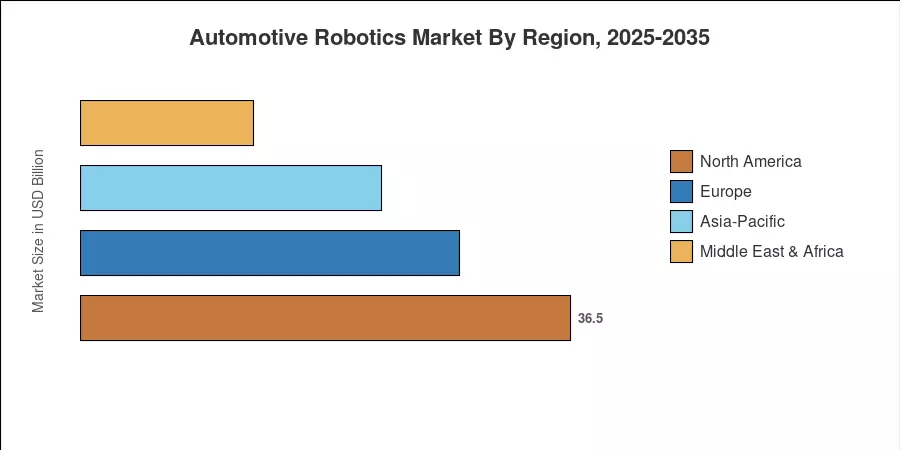
Asia-Pacific dominates the Automotive Robotics Market with an estimated 42.9% revenue share in 2025, driven by China's aggressive factory modernization programs and Japan's robotics export ecosystem. North America holds the second-largest position at roughly 24% share, buoyed by reshoring incentives under the U.S. Inflation Reduction Act. South America emerges as the fastest-growing region at a 15.6% CAGR through 2035, fueled by greenfield EV assembly plants in Brazil and Argentina. The next decade will see robotics density in automotive plants double from current levels, fundamentally redefining what a competitive production line looks like.


Key Report Takeaways

• By Product Type

  • Articulated robots captured a 52.9% revenue share within the Automotive Robotics Market in 2025, reflecting their versatility across body welding, painting, and heavy-payload handling tasks.
  • Collaborative robots are projected to register a 15.1% CAGR through 2035, as OEMs embed them in flexible final-assembly and quality-inspection stations alongside human operators.

• By Function Type

  • Welding robots accounted for the largest functional segment in 2025, underpinned by rising body-in-white complexity in multi-material EV architectures.
  • Inspection and quality-testing systems post the fastest functional growth, reflecting OEM mandates for 100% inline dimensional verification.

• By Region

  • Asia-Pacific commanded the dominant position in the Automotive Robotics Market in 2025, with China alone representing over half of regional robot deployments.
  • South America is the fastest-growing geography through 2035, propelled by new EV assembly capacity in Brazil.


Automotive Robotics Market Size and Forecast (2021–2035)

Market Research Future's sizing model integrates bottom-up shipment data from robot OEMs, top-down macroeconomic indicators (automotive capex, EV production ramp curves), and qualitative input from 45+ industry interviews conducted in 2024–2025. Historical figures (2021–2024) rely on audited company filings and customs-trade databases; forecast values (2026–2035) apply a calibrated compound growth framework validated against regional manufacturing census data.
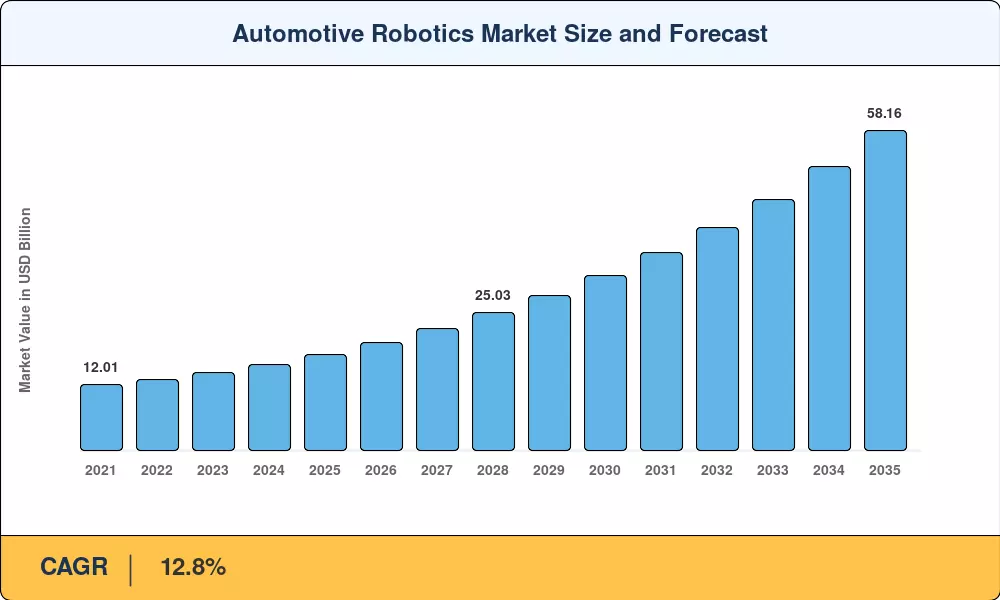
Automotive Robotics Market Size and Forecast
Our Impact
Enabled $4.3B Revenue Impact for Fortune 500 and Leading Multinationals
Partnering with 2000+ Global Organizations Each Year
30K+ Citations by Top-Tier Firms in the Industry

Driver Impact Analysis

Driver ~% Impact on CAGR Geographic Relevance Impact Timeline
EV platform proliferation ~22% Global Short-term (≤2 yr)
Skilled-labor shortages ~18% N. America, Europe Medium-term (2–4 yr)
Inline quality-inspection mandates ~15% Global Short-term (≤2 yr)
Government reshoring & localization incentives ~14% N. America, Europe, India Medium-term (2–4 yr)
AI and machine-vision integration ~13% Asia-Pacific, N. America Long-term (≥4 yr)
Collaborative-robot cost reduction ~10% Global Medium-term (2–4 yr)
Digital-twin & OTA programming adoption ~8% Asia-Pacific, Europe Long-term (≥4 yr)


EV Platform Proliferation

Battery-electric vehicle production is expected to surpass 30 million units annually by 2030, according to BloombergNEF projections [1]. Every new EV platform requires dedicated robotic cells for battery-pack insertion, busbar welding, and thermal-management assembly — tasks that did not exist in legacy ICE lines. Volkswagen's USD 2.3 billion retooling of its Emden plant illustrates the capital intensity: the facility added over 1,200 new robots to handle mixed BEV and plug-in hybrid output on a single flexible line [5]. This platform-level overhaul is repeating across every major OEM, injecting sustained demand into the Automotive Robotics Market through at least the early 2030s.

Structural Labor Shortages

Automotive assembly was one of the most severely affected verticals in the U.S. manufacturing industry, which reported almost 600,000 open positions in 2024 [4]. A similar disparity exists in Europe: according to Germany's VDMA, 42% of automakers will be unable to fill skilled-operator positions by 2024 [14]. Because there are simply not enough skilled operators in many facilities to staff second and third shifts, robots are no longer competing with human labour just on the basis of cost. What was formerly a discretionary capital expenditure choice is becoming a production-continuity need due to this structural imbalance.

Inline Quality-Inspection Mandates

OEMs increasingly demand 100% inline inspection — every weld seam scanned, every panel gap measured — rather than statistical sampling at end-of-line. Tesla's iterative manufacturing approach popularized the concept, and legacy automakers have followed with similar mandates to their Tier-1 suppliers [7]. Vision-guided inspection robots equipped with 3D laser scanners can evaluate up to 5,000 measurement points per vehicle body in under 60 seconds, a throughput impossible to match manually. This requirement is a primary demand catalyst for the Automotive Robotics Market inspection segment.

Government Reshoring Incentives

The U.S. Inflation Reduction Act earmarks over USD 7 billion in advanced-manufacturing tax credits applicable to EV component production, directly subsidizing robotic cell deployment at qualifying facilities [5]. The European Union's Net-Zero Industry Act similarly targets 40% domestic manufacturing share for clean-energy technologies by 2030, compelling automakers to invest in high-automation local plants rather than importing from lower-cost regions [15].


Restraints Impact Analysis

Market Research Future's restraint-impact percentages indicate the estimated drag each factor exerts on the Automotive Robotics Market growth rate. These are directional indicators, not precise subtractive offsets to the headline CAGR.

Restraint ~% Negative Impact on CAGR Geographic Relevance Impact Timeline
High upfront capital expenditure ~–20% Emerging markets Short-term (≤2 yr)
Integration complexity with legacy lines ~–18% Europe, N. America Medium-term (2–4 yr)
Cybersecurity risks in connected cells ~–12% Global Long-term (≥4 yr)
Skilled robotics engineer shortage ~–10% S. America, MEA Medium-term (2–4 yr)
Regulatory fragmentation on safety standards ~–8% Global Long-term (≥4 yr)


High Upfront Capital Requirements

A single articulated welding cell — including the robot, tooling, safety enclosure, and integration services — can cost USD 250,000–500,000, and a full body-shop retrofit may exceed USD 50 million [16]. For smaller OEMs and Tier-2 suppliers operating on thin margins, this capital barrier delays adoption even when the productivity case is clear. Leasing and Robot-as-a-Service models are beginning to lower the entry threshold, but penetration remains below 8% of total robotic deployments in the Automotive Robotics Market as of 2025.

Integration Complexity with Legacy Production Lines

Brownfield plants built for single-platform ICE production present significant reprogramming and layout challenges when integrating flexible robotic cells. A 2024 VDMA survey found that 37% of German automotive suppliers cited "integration with existing infrastructure" as the top barrier to further automation [14]. Retrofitting conveyor systems, upgrading power distribution, and re-certifying safety zones can extend project timelines by 12–18 months beyond the robot procurement lead time alone.

Cybersecurity Vulnerabilities

New attack surfaces are introduced by connected robotic cells that depend on real-time production statistics and cloud-based programming changes. In 2024, the car manufacturing industry's industrial control systems were identified by the U.S. Cybersecurity and Infrastructure Security Agency as a priority sector for vulnerability disclosure [17]. An OEM would lose an estimated USD 2 million every hour of downtime at a high-volume factory if a ransomware event immobilizes a body-shop robotic line, stopping output for days.


Automotive Robotics Market Opportunities

Robot-as-a-Service (RaaS) Business Models

Subscription-based robotic deployment eliminates the upfront capital barrier that restrains adoption among smaller manufacturers. RaaS providers bundle hardware, programming, maintenance, and performance guarantees into a monthly fee indexed to throughput. Early programs by FANUC and ABB have demonstrated 25–30% faster time-to-production compared with traditional capex procurement [9]. As leasing infrastructure matures, RaaS could unlock a latent mid-market segment worth an estimated USD 4–6 billion within the Automotive Robotics Market by 2032.

Emerging-Market Greenfield Plants

Brazil, India, and Indonesia are constructing greenfield EV assembly facilities that are purpose-designed for high-automation from the outset. India's Production-Linked Incentive scheme has attracted over USD 8 billion in committed automotive investment since 2022, much of it earmarked for automated powertrain and battery-pack assembly [8]. These plants bypass the legacy-integration challenges of brownfield retrofits, offering robot OEMs an opportunity to deploy complete turnkey solutions.

AI-Powered Predictive Maintenance and Data Monetization

Each facility produces gigabytes of operating data annually thanks to robotic cells with torque, vibration, and heat sensors. A recurring-revenue software layer is created on top of hardware sales by packaging that data into quality analytics platforms and predictive-maintenance dashboards [10]. Among component categories, the Automotive Robotics Market software-and-services category is already seeing the quickest CAGR. OEMs that monetize cell-level data will earn a disproportionate profit in comparison to their hardware-only rivals.

Collaborative Robots in Final Assembly and Aftermarket Service

Unlike heavy industrial arms confined behind safety cages, collaborative robots work alongside human operators in tasks such as windshield installation, interior trim fitting, and torque verification. The falling price point of cobots — average system cost dropped below USD 40,000 in 2024 [6] — opens adoption pathways not only in OEM final assembly but also in independent service centers performing complex EV battery diagnostics.

Digital-Twin Orchestration for Multi-Plant Networks

Automakers operating 10+ global plants are piloting digital-twin platforms that simulate production scenarios across their entire robotic fleet before deploying changes physically [13]. Siemens and Rockwell Automation reported that twin-enabled program changes reduce commissioning time by up to 40%. This opportunity extends the Automotive Robotics Market beyond unit sales into high-value orchestration software and consulting services.


Automotive Robotics Market Future Outlook

AI-Augmented Robotic Intelligence

Machine-learning algorithms embedded at the cell controller level will shift robots from executing pre-programmed paths to autonomously adapting weld parameters, paint thickness, and inspection thresholds in real time. NVIDIA's Isaac platform and Siemens' Industrial Copilot have already demonstrated 15–20% scrap-rate reductions in pilot deployments [7]. By 2030, AI-augmented cells could account for over 40% of new Automotive Robotics Market installations globally.

Electrification Supercycle and Battery Automation

The IEA projects global EV sales will surpass 45 million units per year by 2035, requiring an estimated 200+ gigafactories worldwide [1]. Each facility demands specialized robotic systems for electrode stacking, electrolyte filling, module assembly, and pack-level testing — applications where precision and repeatability are non-negotiable. This supercycle will sustain double-digit growth in the Automotive Robotics Market well beyond the current forecast window.

Platform Economics and Software-Defined Manufacturing

The transition toward software-defined vehicles is mirrored by software-defined production, where over-the-air robot reprogramming replaces physical retooling. Automakers piloting this approach report 30% faster model-changeover times and a 25% reduction in integration engineering costs [13]. The economics favor robot OEMs that build open-architecture controllers and cloud-connected analytics, positioning software as the primary margin driver within the Automotive Robotics Market by the early 2030s.

ESG Compliance and Sustainable Manufacturing

Automakers are being forced to record and lower energy use at the cell level under the EU's Corporate Sustainability Reporting Directive, which now requires scope 3 emissions reporting [15]. Regenerative braking in articulated arms recovers kinetic energy during deceleration cycles, and contemporary servo-driven robots use up to 30% less energy than their hydraulic counterparts. Energy-efficiency scores will be given more weight by OEMs when choosing robotic systems, in addition to cycle-time and payload parameters.


Automotive Robotics Market Segmentation

By Product Type

Segment Key Metric Primary Demand Driver
Articulated Robots 52.9% share (2025) Versatile payload range for body welding, painting, and material handling
SCARA Robots USD 1.92 Billion (2025) High-speed pick-and-place in electronics and small-component assembly
Collaborative Robots 15.1% CAGR (2026–2035) Safe human–robot coexistence in final assembly and inspection
Cartesian Robots USD 1.04 Billion (2025) CNC-style precision in dispensing and sealing applications


Articulated robots dominate the Automotive Robotics Market by product type because their six-axis kinematics accommodate everything from 200 kg body-panel transfers to delicate adhesive dispensing along curved surfaces. Collaborative robots, while smaller in absolute revenue, represent the fastest-growing product category. Their sub-USD-40,000 average system cost and force-limited operation mode allow Tier-1 suppliers to deploy them alongside existing manual workstations without major facility redesign [6].

By Function Type

Segment Key Metric Primary Demand Driver
Welding Robots 43.1% share (2025) Multi-material joining for EV body-in-white structures
Painting Robots USD 2.53 Billion (2025) Electrostatic atomization and VOC-reduction compliance
Assembly Robots 13.5% CAGR (2026–2035) Battery-module stacking and e-powertrain integration
Material-Handling Robots USD 1.85 Billion (2025) Heavy-payload logistics between the press shop and the body shop
Inspection & Quality-Testing 13.1% CAGR (2026–2035) 100% inline dimensional and surface-defect verification


Welding robots remain the single largest functional segment within the Automotive Robotics Market, a position reinforced by the shift to multi-material BEV body structures that combine high-strength steel, aluminum, and composite panels requiring varied joining techniques. Inspection and quality-testing robots are gaining ground as automakers move from statistical sampling to full-vehicle inline measurement, driven by consumer expectations and recall-cost avoidance [7].

By Component Type

Segment Key Metric Primary Demand Driver
Robotic Arms 38.5% share (2025) Core hardware element across all robot types
Controllers 12.2% CAGR (2026–2035) Edge-AI processing for adaptive motion planning
End-Effectors USD 1.61 Billion (2025) Application-specific tooling for gripping, welding, and spraying
Software & Services 13.4% CAGR (2026–2035) Simulation, analytics, and RaaS subscription platforms


By End-User Type

Segment Key Metric Primary Demand Driver
Vehicle Manufacturers (OEMs) 56.5% share (2025) High-volume production line automation
Component Manufacturers (Tier-1 and 2) 12.7% CAGR (2026–2035) OEM flow-down automation requirements
Service Centers 13.0% CAGR (2026–2035) EV battery diagnostics and high-voltage repair automation


Regional Market Share Analysis

Region Key Metric Primary Investment Themes
Asia-Pacific 42.9% revenue share (2025) EV gigafactory ramp; domestic robot manufacturing
North America USD 4.18 Billion (2025) IRA-driven reshoring; Tier-1 automation upgrades
Europe 15.3% CAGR (2026–2035) Net-Zero Industry Act compliance; cobot adoption
South America 15.6% CAGR (2026–2035) Greenfield EV plants; government localization incentives
Middle East & Africa USD 0.89 Billion (2025) Saudi Vision 2030 industrial diversification

The Automotive Robotics Market exhibits a pronounced regional tilt toward Asia-Pacific, where automotive production volumes, government automation subsidies, and domestic robot manufacturing converge. North America and Europe follow as established but maturing automation hubs, while South America and the Middle East & Africa represent high-growth frontiers driven by greenfield investment.


North America

Country Key Metric Key Driver
United States 68% of regional share IRA manufacturing tax credits [5]
Canada 12.4% CAGR (2026–2035) Ontario EV corridor investment [19]
Mexico USD 0.87 Billion (2025) Nearshoring by Asian and European OEMs [20]


The United States remains the regional anchor, with automakers such as GM, Ford, and Stellantis committing over USD 100 billion collectively to EV manufacturing through 2030 — capital plans that embed substantial robotic cell procurement [5]. Canada's Ontario province has attracted battery gigafactory investments from LG Energy Solution and Stellantis, while Mexico's cost-competitive labor force is being augmented with welding robot automotive plant installations as OEMs seek a balance between automation and cost control.

Europe

Country Key Metric Key Driver
Germany 34% of the regional share OEM retooling for BEV platforms [14]
United Kingdom 13.1% CAGR (2026–2035) Gigafactory and battery cell investment [15]
France USD 0.61 Billion (2025) Renault Group re-industrialization strategy
Italy 11.8% CAGR (2026–2035) Stellantis and Ferrari automation upgrades
Spain USD 0.39 Billion (2025) SEAT/CUPRA EV platform launches
Nordic Countries 12.5% CAGR (2026–2035) Volvo and Northvolt supply-chain automation
Russia USD 0.18 Billion (2025) Domestic brand substitution programs
Rest of Europe 12.0% CAGR (2026–2035) EU Cohesion Fund manufacturing support


Germany's automotive sector installed more than 26,000 industrial robots in 2023, maintaining the country's position as Europe's largest Automotive Robotics Market by a wide margin [2]. The EU's Net-Zero Industry Act and carbon-border adjustment mechanism are accelerating factory-level investments in energy-efficient robotic systems across the bloc [15].

Asia-Pacific

Country Key Metric Key Driver
China 56% of regional share NEV mandate and Made in China 2025 robotics targets [8]
Japan USD 1.78 Billion (2025) Robot OEM home market; Toyota production system upgrades
India 16.2% CAGR (2026–2035) PLI scheme for automotive and battery manufacturing [8]
South Korea USD 1.15 Billion (2025) Hyundai-Kia and Samsung SDI automation investment
ASEAN 14.9% CAGR (2026–2035) Thailand and Indonesia EV hub strategies
Rest of Asia-Pacific USD 0.42 Billion (2025) Emerging OEM capacity in Vietnam and Bangladesh


China alone accounts for over half of Asia-Pacific demand, driven by aggressive new-energy vehicle production targets and government subsidies for domestically manufactured robots [8]. The Automotive Robotics Market in India is accelerating rapidly as Tata Motors, Mahindra, and international entrants build dedicated EV lines under the Production-Linked Incentive framework.

South America

Country Key Metric Key Driver
Brazil 62% of regional share BYD and Stellantis greenfield EV assembly [12]
Argentina 13.8% CAGR (2026–2035) Lithium supply chain and battery-pack assembly
Rest of South America USD 0.11 Billion (2025) Early-stage CKD assembly automation


Brazil's decision to attract Chinese EV manufacturers — BYD's Bahia plant alone will deploy over 300 robots at full capacity — positions the country as South America's automation growth engine [12]. Argentina's lithium reserves and emerging battery value chain add a complementary demand vector for the Automotive Robotics Market in the region.

Middle East & Africa

Country Key Metric Key Driver
Saudi Arabia 38% of regional share Vision 2030 automotive localization program [21]
UAE 14.0% CAGR (2026–2035) Free-zone manufacturing and logistics automation
South Africa USD 0.19 Billion (2025) BMW and Toyota local assembly upgrades
Egypt 13.2% CAGR (2026–2035) Government import-substitution incentives
Rest of MEA USD 0.08 Billion (2025) Early-stage assembly operations


Saudi Arabia's Lucid Motors partnership and Ceer joint venture with Foxconn represent flagship investments that will install state-of-the-art robotic lines in a region historically reliant on CKD assembly [21]. The broader MEA market remains nascent but is benefiting from Gulf sovereign-wealth fund diversification into advanced manufacturing.


Automotive Robotics Market By Region, 2025-2035

Competitive Benchmarking

The Automotive Robotics Market exhibits medium concentration, with the top five players accounting for an estimated 45–52% of global revenue. The competitive field spans Japanese and European incumbents with decades of automotive-line expertise, alongside newer entrants — particularly collaborative-robot specialists and Chinese domestic manufacturers — that are compressing price points and expanding addressable applications. Mergers, strategic partnerships, and software-platform investments are the primary competitive levers in the current cycle.

Company Est. Revenue Share Range Key Offerings for the Automotive Robotics Market Strategic Positioning
FANUC Corporation ~10–14% CRX cobots; R-2000 heavy-payload arms; FIELD IoT platform Largest installed base; vertically integrated servo and CNC manufacturing
ABB Ltd ~9–12% IRB series articulated robots; OmniCore controllers; RobotStudio simulation Broad portfolio across welding, painting, and assembly; strong European OEM relationships
KUKA AG (Midea Group) ~8–11% KR QUANTEC series; ready2_pilot programming; KUKA.Sim Deep Volkswagen Group partnership; growing Chinese domestic share via Midea ownership
Yaskawa Electric Corporation ~7–10% MOTOMAN GP/HC series; MotoSim simulation; Smart Pendant interface Price-competitive articulated arms; strong in arc welding and material handling
Kawasaki Heavy Industries ~5–8% BX/RS series; duAro dual-arm cobot; Successor remote-control system Heavy-payload specialists for press tending and body transfer applications
Denso Corporation ~4–6% VS/VM compact robots; HSR cobots; integrated vision systems OEM subsidiary with deep Toyota supply-chain integration
Nachi-Fujikoshi Corporation ~3–5% SRA/MZ series; spot-welding guns; bearing and hydraulic cross-selling Vertically integrated bearing-to-robot manufacturing
Comau S.p.A. ~3–5% AURA cobot; NJ series; Mate exoskeletons; in.Grid digital platform Stellantis captive supplier expanding third-party automation services
Stäubli International AG ~2–4% TX2-series 6-axis arms; CS9 controller; VAL3 programming language High-speed, cleanroom-grade robots for precision assembly and painting
Universal Robots (Teradyne) ~2–4% UR20/UR30 cobots; UR+ ecosystem; PolyScope programming interface Market-leading cobot brand; expanding from general industry into automotive final assembly


Recent News & Developments

  • FANUC Corporation (March 2025): Launched the CRX-25iA collaborative robot with a 25 kg payload, targeting EV battery-module handling in automotive final assembly [22].
  • ABB Ltd (January 2025): Opened a USD 280 million robotics mega-factory in Västerås, Sweden, doubling European production capacity for articulated and collaborative arms [23].
  • KUKA AG (October 2024): Secured a multi-year contract with a leading German OEM to supply over 2,000 KR QUANTEC robots for a new BEV-dedicated body shop in Lower Saxony [24].
  • Hyundai Motor Group (August 2024): Partnered with Boston Dynamics to pilot autonomous mobile robots for material conveyance between the body shop and paint shop at its Ulsan complex [11].
  • Universal Robots (June 2024): Released the UR30 cobot — its highest-payload model — enabling automotive Tier-1 suppliers to automate machine tending and palletizing without safety fencing [6].
  • European Commission (April 2024): Published revised Machinery Regulation (EU) 2023/1230 implementation guidance, establishing harmonized safety requirements for collaborative robotic cells effective January 2027 [18].
  • Tesla, Inc. (February 2024): Deployed FANUC-built vision-guided inspection cells across its Austin Gigafactory, enabling full-body gap-and-flush measurement at line speed [7].
  • BYD Company (December 2023): Announced a USD 620 million greenfield EV assembly plant in Bahia, Brazil, specifying over 300 robotic stations for welding, sealing, and painting [12].


Automotive Robotics Market Report Scope

Parameter Detail
Market Scope Global Automotive Robotics Market — hardware, software, and services for robotic systems deployed in vehicle and component manufacturing
Study Period 2021–2035
Historical Period 2021–2024
Base Year 2025
Forecast Period 2026–2035
CAGR (2026–2035) 12.8%
Market Size (2025) USD 17.42 Billion
Market Size (2035) USD 58.16 Billion
Fastest Growing Segment Collaborative Robots (by Product Type); South America (by Geography)
Companies Profiled FANUC, ABB, KUKA, Yaskawa, Kawasaki, Denso, Nachi-Fujikoshi, Comau, Stäubli, Universal Robots
Valuation Currency USD Billion


FAQs

How long does a typical automotive robotic cell take to reach positive ROI?

Most articulated welding or assembly cells achieve payback within 18–30 months at two-shift utilization, though collaborative-robot stations often break even in under 14 months due to lower integration costs [16].

What safety certifications should procurement teams require for collaborative robots in automotive settings?

Buyers should verify ISO 10218-1/2 and ISO/TS 15066 compliance, plus CE or NRTL markings as applicable. The 2027 EU Machinery Regulation update will add new force-limiting documentation requirements [18].

How does the Automotive Robotics Market differ for Tier-1 suppliers compared with OEMs?

Tier-1 plants favor smaller-footprint cobots and SCARA units for component sub-assembly, while OEM body shops deploy high-payload articulated arms. Budget cycles and integration complexity also vary significantly.

What role do simulation platforms play in reducing robotic-cell commissioning time?

Digital-twin tools such as RobotStudio and KUKA.Sim allows engineers to validate reach, cycle time, and collision paths offline, cutting on-site commissioning by 30–40% [13].

Are Chinese robot manufacturers gaining share in the Automotive Robotics Market?

Domestic Chinese brands have grown from roughly 15% to 25% of China's automotive robot installations since 2020, led by Estun, STEP Electric, and Inovance [8].

How does the shift to 800V EV architectures affect robotic welding requirements?

Higher-voltage battery packs demand tighter weld tolerances on copper busbars, pushing OEMs toward laser-welding robotic cells with real-time seam-tracking vision [7].

What workforce reskilling investments typically accompany a robotic-cell deployment in the Automotive Robotics Market?

Industry benchmarks suggest USD 8,000–12,000 per operator in robotics programming and maintenance training, often delivered via OEM-certified academies over a 6–12 month rollout [4].    
Author
Author
Author Profile
Shubham Munde LinkedIn
Team Lead - Research
Shubham brings over 7 years of expertise in Market Intelligence and Strategic Consulting, with a strong focus on the Automotive, Aerospace, and Defense sectors. Backed by a solid foundation in semiconductors, electronics, and software, he has successfully delivered high-impact syndicated and custom research on a global scale. His core strengths include market sizing, forecasting, competitive intelligence, consumer insights, and supply chain mapping. Widely recognized for developing scalable growth strategies, Shubham empowers clients to navigate complex markets and achieve a lasting competitive edge. Trusted by start-ups and Fortune 500 companies alike, he consistently converts challenges into strategic opportunities that drive sustainable growth.
Co-Author
Co-Author Profile
Sejal Akre LinkedIn
Senior Research Analyst
She has over 5 years of rich experience, in market research and consulting providing valuable market insights to client. Hands on expertise in management consulting, and extensive knowledge in domain including ICT, Automotive & Transportation and Aerospace & Defense. She is skilled in Go-to market strategy, industry analysis, market sizing, in depth company profiling, competitive intelligence & benchmarking and value chain amongst others.

Research Approach


Secondary Research

The secondary research process involved comprehensive analysis of technical standards databases, peer-reviewed engineering journals, industry automation publications, and authoritative manufacturing organizations. Key sources included the International Organization for Standardization (ISO) for robotics safety standards (ISO 10218, ISO/TS 15066 for collaborative robots), Occupational Safety and Health Administration (OSHA) for workplace automation guidelines, National Highway Traffic Safety Administration (NHTSA) for autonomous vehicle integration standards, European Commission's Machinery Directive (2006/42/EC) for CE marking requirements, and NIST (National Institute of Standards and Technology) Advanced Manufacturing Series reports. Industry data was gathered from the International Federation of Robotics (IFR) World Robotics annual reports, Association for Advancing Automation (A3) formerly Robotics Industries Association (RIA), Society of Automotive Engineers (SAE International) technical papers database, OICA (International Organization of Motor Vehicle Manufacturers) production statistics, VDMA (German Engineering Federation) Robotics and Automation association reports, and EUROSTAT industrial production indices. Academic sources included IEEE Xplore Digital Library for automation engineering research, ScienceDirect and SpringerLink for manufacturing technology publications, and SAE Mobilus for automotive engineering literature. Market and financial data were sourced from Bloomberg Terminal, Thomson Reuters Eikon, company 10-K and annual reports, and Statista industrial automation databases.

These sources supplied data on robotics installation, safety compliance requirements, patent filings, automotive production capacity trends, and technology adoption curves for articulated robots, SCARA systems, Cartesian robots, and collaborative robots (cobots) that are used in welding, painting, assembly, and material handling applications.


Primary Research

In order to acquire qualitative and quantitative insights that were unique to automotive manufacturing automation, interviews were conducted with supply-side and demand-side stakeholders during the primary research process. CEOs, VPs of Industrial Automation, Heads of Robotics Divisions, and Chief Technology Officers from industrial robot manufacturers, end-effector producers, and vision system providers comprised supply-side sources. Global Directors of Manufacturing Engineering, Plant Managers, Heads of Advanced Production, and Automation Procurement Leads from passenger vehicle OEMs, commercial vehicle manufacturers, and Tier 1 component suppliers operating final assembly lines were the demand-side sources. Our primary research has confirmed the implementation timelines for next-generation production lines, validated market segmentation across robot types (Articulated, Cartesian, SCARA, Cylindrical, Collaborative), and gathered insights on the ROI payback periods for automation investments, retrofit versus greenfield facility dynamics, and human-robot collaboration adoption patterns.

Primary Respondent Breakdown:

By Designation: C-suite Executives (30%), Senior Management/Director Level (32%), Technical Experts/Plant Managers (38%)

By Region: Asia-Pacific (42%), North America (30%), Europe (23%), Rest of World (5%)


Market Size Estimation

Unit shipment analysis and revenue mapping throughout the industrial automation value chain were implemented to determine the global market valuation. The methodology comprised the following:

Identification of over 50 main manufacturers in North America, Europe, Asia-Pacific, and Latin America, including robot OEMs, peripheral equipment suppliers, and software providers

Product mapping for Articulated Robots, SCARA Robots, Cartesian/Gantry Robots, Cylindrical Robots, Polar/Spherical Robots, and Collaborative Robots (Cobots) that are specifically deployed in automotive manufacturing environments.

Examination of the annual revenues that have been reported and modeled for the automotive sector robotics portfolios, which include hardware, software, services, and integration components

Coverage of manufacturers and integrators that account for 75-80% of the global market share in 2024

Derive segment-specific valuations for welding, painting, cutting, material handling, assembly, and inspection applications across passenger vehicle and commercial vehicle production lines through extrapolation using bottom-up (robot installation volume × Average Selling Price by country and application type) and top-down (manufacturer revenue validation and supply chain bill-of-materials analysis) approaches.

Download Free Sample

Kindly complete the form below to receive a free sample of this Report

Download PDF ×

We do not share your information with anyone. However, we may send you emails based on your report interest from time to time. You may contact us at any time to opt-out.
















