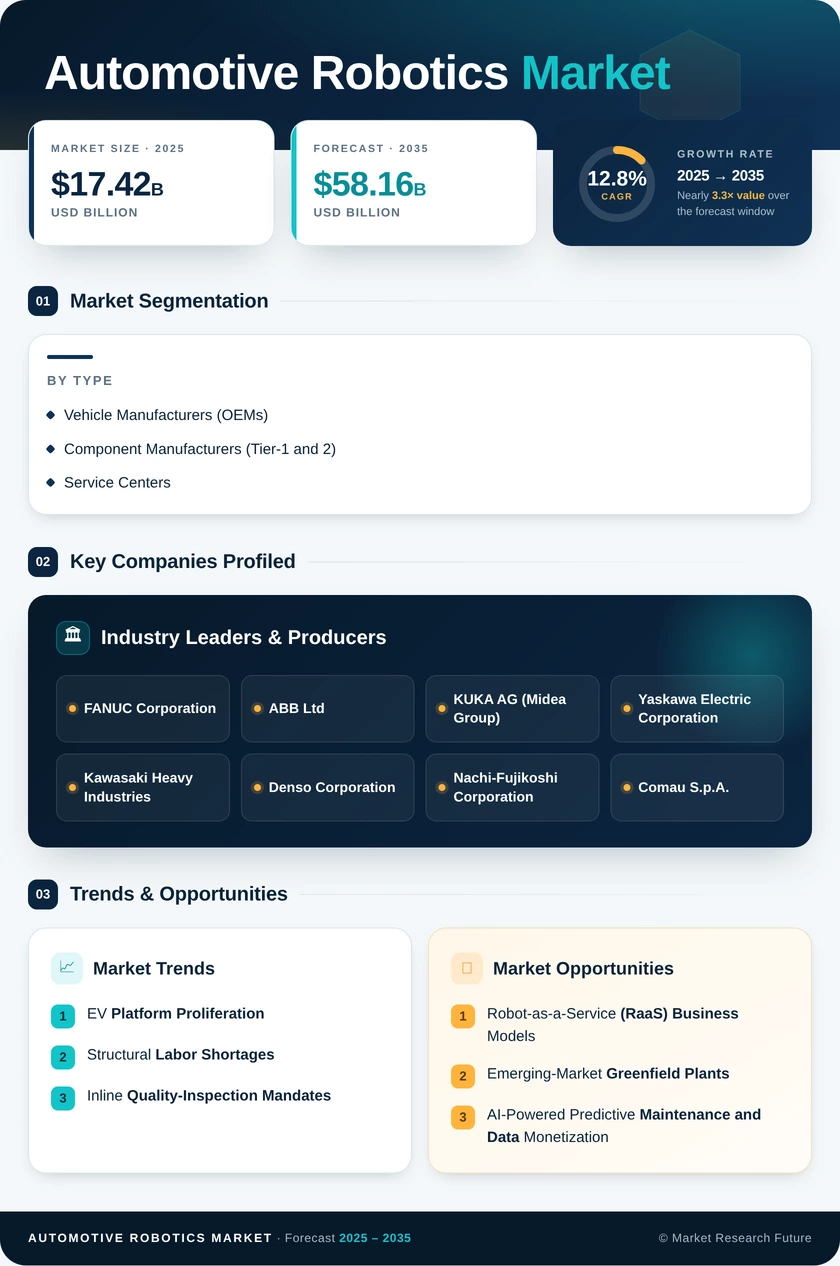
Automotive Robotics Market

ID: MRFR/AT/1457-HCR
200 Pages
Shubham Munde
Last Updated: June 22, 2026
Automotive Robotics Market Size, Share & Growth Analysis Report By Product Type (Articulated Robots, SCARA Robots, Collaborative Robots, Cartesian Robots), By Function Type (Welding Robots, Painting Robots, Assembly Robots, Material-Handling Robots, Inspection & Quality-Testing), By Component Type (Robotic Arms, Controllers, End-Effectors, Software & Services), By End-User Type (Vehicle Manufacturers (OEMs), Component Manufacturers (Tier-1 and Tier-2), Service Centers) and By Regional (North America, Europe, South America, Asia Pacific, Middle East and Africa) - Industry Growth & Forecast to 2035
Download PDF ×

We do not share your information with anyone. However, we may send you emails based on your report interest from time to time. You may contact us at any time to opt-out.

  1. 1 Market Overview
  2. 1 Study Assumptions & Market Definition
  3. 2 Scope of the Study
  4. 3 Research Methodology
  5. 2 Market Summary & Key Takeaways
  6. 3 Market Dynamics
  7. 1 Market Drivers Analysis | |
  8. 3.1.1 EV Platform Proliferation | |
  9. 3.1.2 Structural Labor Shortages | |
  10. 3.1.3 Inline Quality-Inspection Mandates | |
  11. 3.1.4 Government Reshoring & Localization Incentives | |
  12. 3.1.5 AI and Machine-Vision Integration | |
  13. 3.1.6 Collaborative-Robot Cost Reduction | |
  14. 3.1.7 Digital-Twin & OTA Programming Adoption
  15. 2 Market Restraints Analysis | |
  16. 3.2.1 High Upfront Capital Expenditure | |
  17. 3.2.2 Integration Complexity with Legacy Lines | |
  18. 3.2.3 Cybersecurity Risks in Connected Cells | |
  19. 3.2.4 Skilled Robotics-Engineer Shortage | |
  20. 3.2.5 Regulatory Fragmentation on Safety Standards
  21. 3 Market Opportunity Analysis | |
  22. 3.3.1 Robot-as-a-Service (RaaS) Business Models | |
  23. 3.3.2 Emerging-Market Greenfield Plants | |
  24. 3.3.3 AI-Powered Predictive Maintenance and Data Monetization | |
  25. 3.3.4 Collaborative Robots in Final Assembly and Aftermarket Service | |
  26. 3.3.5 Digital-Twin Orchestration for Multi-Plant Networks
  27. 4 Industry Value Chain Analysis
  28. 5 Porter's Five Forces Analysis
  29. 4 Global Automotive Robotics Market Size & Forecast (2021–2035)
  30. 1 Historical Market Size (2021–2025)
  31. 2 Current & Forecast Market Size (2026–2035)
  32. 3 Market Size by Revenue (USD Billion)
  33. 4 Year-over-Year Growth Analysis
  34. 5 Segmentation Analysis
  35. 1 By Product Type | |
  36. 5.1.1 Articulated Robots | |
  37. 5.1.2 SCARA Robots | |
  38. 5.1.3 Collaborative Robots | |
  39. 5.1.4 Cartesian Robots
  40. 2 By Function Type | |
  41. 5.2.1 Welding Robots | |
  42. 5.2.2 Painting Robots | |
  43. 5.2.3 Assembly Robots | |
  44. 5.2.4 Material-Handling Robots | |
  45. 5.2.5 Inspection & Quality-Testing
  46. 3 By Component Type | |
  47. 5.3.1 Robotic Arms | |
  48. 5.3.2 Controllers | |
  49. 5.3.3 End-Effectors | |
  50. 5.3.4 Software & Services
  51. 4 By End-User Type | |
  52. 5.4.1 Vehicle Manufacturers (OEMs) | |
  53. 5.4.2 Component Manufacturers (Tier-1 and 2) | |
  54. 5.4.3 Service Centers
  55. 6 Regional Analysis
  56. 1 North America | |
  57. 6.1.1 United States | |
  58. 6.1.2 Canada | |
  59. 6.1.3 Mexico
  60. 2 Europe | |
  61. 6.2.1 Germany | |
  62. 6.2.2 United Kingdom | |
  63. 6.2.3 France | |
  64. 6.2.4 Italy | |
  65. 6.2.5 Spain | |
  66. 6.2.6 Nordic Countries | |
  67. 6.2.7 Russia | |
  68. 6.2.8 Rest of Europe
  69. 3 Asia-Pacific | |
  70. 6.3.1 China | |
  71. 6.3.2 Japan | |
  72. 6.3.3 India | |
  73. 6.3.4 South Korea | |
  74. 6.3.5 ASEAN | |
  75. 6.3.6 Rest of Asia-Pacific
  76. 4 South America | |
  77. 6.4.1 Brazil | |
  78. 6.4.2 Argentina | |
  79. 6.4.3 Rest of South America
  80. 5 Middle East & Africa | |
  81. 6.5.1 Saudi Arabia | |
  82. 6.5.2 UAE | |
  83. 6.5.3 South Africa | |
  84. 6.5.4 Egypt | |
  85. 6.5.5 Rest of MEA
  86. 7 Competitive Landscape
  87. 1 Market Share Analysis (2025)
  88. 2 Competitive Benchmarking Matrix
  89. 3 Company Profiles | |
  90. 7.3.1 FANUC Corporation | |
  91. 7.3.2 ABB Ltd | |
  92. 7.3.3 KUKA AG (Midea Group) | |
  93. 7.3.4 Yaskawa Electric Corporation | |
  94. 7.3.5 Kawasaki Heavy Industries | |
  95. 7.3.6 Denso Corporation | |
  96. 7.3.7 Nachi-Fujikoshi Corporation | |
  97. 7.3.8 Comau S.p.A. | |
  98. 7.3.9 Stäubli International AG | |
  99. 7.3.10 Universal Robots (Teradyne)
  100. 8 Future Outlook & Strategic Recommendations (2026–2035)
  101. 1 AI-Augmented Robotic Intelligence
  102. 2 Electrification Supercycle and Battery Automation
  103. 3 Platform Economics and Software-Defined Manufacturing
  104. 4 ESG Compliance and Sustainable Manufacturing
  105. 9 Recent Developments & News
  106. 10 Frequently Asked Questions (FAQs)
  107. 11 Report Scope & Methodology
  108. 1 Study Period & Base Year
  109. 2 Data Sources & Citations
  110. 3 Abbreviations
  111. 4 LIST OF TABLES |
  112. TABLE 1 Global Automotive Robotics Market Size & Forecast, by Revenue (USD Billion), 2021–2035 |
  113. TABLE 2 Global Automotive Robotics Market — Year-over-Year Growth Analysis, 2021–2035 |
  114. TABLE 3 Global Automotive Robotics Market — Driver Impact Analysis |
  115. TABLE 4 Global Automotive Robotics Market — Restraint Impact Analysis |
  116. TABLE 5 Global Automotive Robotics Market Size, by Product Type, 2021–2035 (USD Billion) |
  117. TABLE 6 Global Automotive Robotics Market Size, by Function Type, 2021–2035 (USD Billion) |
  118. TABLE 7 Global Automotive Robotics Market Size, by Component Type, 2021–2035 (USD Billion) |
  119. TABLE 8 Global Automotive Robotics Market Size, by End-User Type, 2021–2035 (USD Billion) |
  120. TABLE 9 Global Automotive Robotics Market Size, by Region, 2021–2035 (USD Billion) |
  121. TABLE 10 North America Automotive Robotics Market Size, by Country, 2021–2035 (USD Billion) |
  122. TABLE 11 Europe Automotive Robotics Market Size, by Country, 2021–2035 (USD Billion) |
  123. TABLE 12 Asia-Pacific Automotive Robotics Market Size, by Country, 2021–2035 (USD Billion) |
  124. TABLE 13 South America Automotive Robotics Market Size, by Country, 2021–2035 (USD Billion) |
  125. TABLE 14 Middle East & Africa Automotive Robotics Market Size, by Country, 2021–2035 (USD Billion) |
  126. TABLE 15 Competitive Benchmarking Matrix — Global Automotive Robotics Market, 2025 |
  127. TABLE 16 Company Profiles — Key Players, Global Automotive Robotics Market |
  128. TABLE 17 Recent Developments & Strategic Announcements, 2023–2025 |
  129. TABLE 18 Report Scope & Methodology Summary |
  130. TABLE 19 Detailed Sources and Citations
  131. 5 LIST OF FIGURES |
  132. FIGURE 1 Automotive Robotics Market Dynamics — Drivers, Restraints, and Opportunities |
  133. FIGURE 2 Industry Value Chain Analysis — Automotive Robotics Ecosystem |
  134. FIGURE 3 Porter's Five Forces Analysis — Automotive Robotics Market |
  135. FIGURE 4 Global Automotive Robotics Market Size Trend (USD Billion), 2021–2035 |
  136. FIGURE 5 Automotive Robotics Market Share, by Product Type, 2025 |
  137. FIGURE 6 Automotive Robotics Market Share, by Function Type, 2025 |
  138. FIGURE 7 Automotive Robotics Market Share, by Component Type, 2025 |
  139. FIGURE 8 Automotive Robotics Market Share, by End-User Type, 2025 |
  140. FIGURE 9 Automotive Robotics Market Share, by Region, 2025 |
  141. FIGURE 10 North America Automotive Robotics Market — Country Breakdown, 2025 |
  142. FIGURE 11 Europe Automotive Robotics Market — Country Breakdown, 2025 |
  143. FIGURE 12 Asia-Pacific Automotive Robotics Market — Country Breakdown, 2025 |
  144. FIGURE 13 South America Automotive Robotics Market — Country Breakdown, 2025 |
  145. FIGURE 14 Middle East & Africa Automotive Robotics Market — Country Breakdown, 2025 |
  146. FIGURE 15 Competitive Landscape — Market Share Distribution, 2025

Segmentation Quick Reference

DimensionSub-SegmentsDominant SegmentFastest Growing Segment
By Product TypeArticulated Robots, SCARA Robots, Collaborative Robots, Cartesian RobotsArticulated Robots (52.9% share, 2025)Collaborative Robots (15.1% CAGR)
By Function TypeWelding Robots, Painting Robots, Assembly Robots, Material-Handling Robots, Inspection & Quality-TestingWelding Robots (43.1% share, 2025)Inspection & Quality-Testing (13.1% CAGR)
By Component TypeRobotic Arms, Controllers, End-Effectors, Software & ServicesRobotic Arms (38.5% share, 2025)Software & Services (13.4% CAGR)
By End-User TypeVehicle Manufacturers (OEMs), Component Manufacturers (Tier-1 and 2), Service CentersVehicle Manufacturers (56.5% share, 2025)Service Centers (13.0% CAGR)
By GeographyNorth America, Europe, Asia-Pacific, South America, Middle East & AfricaAsia-Pacific (42.9% share, 2025)South America (15.6% CAGR)


Market Segmentation Overview

By Product Type

Sub-SegmentKey Trend
Articulated RobotsSix-axis platforms are gaining AI-enabled adaptive path planning for multi-material BEV body assembly
SCARA RobotsHigh-speed pick-and-place expanding into EV power-electronics module insertion
Collaborative RobotsPrice erosion below USD 40,000 per unit, opening Tier-1 and aftermarket service adoption
Cartesian RobotsLinear-motion dispensing and sealing systems integrating vision-guided bead inspection


Articulated robots remain the backbone of automotive body shops globally, prized for their reach, payload capacity, and kinematic flexibility. Collaborative robots represent the most dynamic growth vector, steadily moving from pilot programs into series-production roles across final assembly and quality verification.

By Function Type

Sub-SegmentKey Trend
Welding RobotsLaser and friction-stir welding cells replacing resistance spot welding for mixed-material BEV bodies
Painting RobotsElectrostatic bell-cup atomizers improve transfer efficiency above 90%
Assembly RobotsBattery-pack and e-axle mating tasks requiring sub-millimeter repeatability
Material-Handling RobotsHeavy-payload transfer systems integrating with autonomous mobile robot fleets
Inspection & Quality-Testing3D laser scanning and AI defect classification enabling 100% inline verification


Welding remains the highest-revenue function owing to the structural volume of body-in-white operations across the global vehicle fleet. Inspection and quality-testing cells are closing the gap as OEM mandates for zero-defect output push adoption across all production tiers.

By Component Type

Sub-SegmentKey Trend
Robotic ArmsLightweight carbon-fiber-reinforced arm designs reduce energy consumption
ControllersEdge-AI chipsets enabling real-time adaptive motion control at the cell level
End-EffectorsQuick-change tooling systems supporting mixed-model production flexibility
Software & ServicesCloud-based simulation, OTA updates, and Robot-as-a-Service subscriptions


Robotic arms account for the largest hardware share, but software and services are capturing an increasing proportion of total spend as OEMs prioritize digital-twin simulation, predictive analytics, and subscription-based deployment models.

By End-User Type

Sub-SegmentKey Trend
Vehicle Manufacturers (OEMs)Full-line automation from stamping through final assembly for BEV-dedicated plants
Component Manufacturers (Tier-1 and 2)OEM-mandated automation thresholds flowing down to supplier operations
Service CentersHigh-voltage EV battery diagnostic and repair cells are entering early adoption


Vehicle manufacturers remain the dominant end-user, deploying robots across the full manufacturing value chain. Service centers represent a nascent but rapidly emerging segment as the growing EV parc creates demand for automated high-voltage battery servicing and recalibration.

By Geography

Sub-SegmentKey Trend
Asia-PacificChina's NEV mandate and Japan's robot-export ecosystem sustain regional dominance
North AmericaIRA credits and OEM reshoring investment drive double-digit growth
EuropeNet-Zero Industry Act and OEM BEV platform transitions accelerate adoption
South AmericaBrazilian greenfield EV plants position the region as the fastest-growing geography
Middle East & AfricaSaudi Vision 2030 and UAE free-zone strategies establish early automation footholds


Asia-Pacific's leadership reflects both the world's largest vehicle production base and a mature domestic robotics supply chain anchored by FANUC, Yaskawa, and an expanding cohort of Chinese manufacturers. South America's greenfield advantage — building automation-native plants without legacy infrastructure constraints — underpins its status as the fastest-growing regional market through 2035.