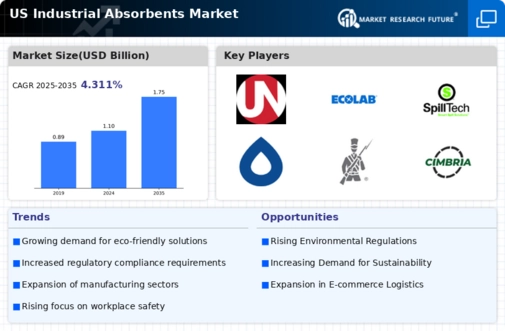
The industrial absorbents market is characterized by a competitive landscape that is increasingly shaped by innovation, sustainability, and strategic partnerships. Key players such as 3M (US), Honeywell (US), and BASF (US) are actively pursuing strategies that emphasize product development and market expansion. 3M (US) has focused on enhancing its product portfolio through advanced materials, while Honeywell (US) has been investing in digital transformation to optimize its supply chain and improve customer engagement. BASF (US) appears to be leveraging its extensive research capabilities to develop eco-friendly absorbent solutions, thereby aligning with the growing demand for sustainable products. Collectively, these strategies contribute to a dynamic competitive environment where differentiation is increasingly based on technological innovation and sustainability initiatives.
In terms of business tactics, companies are localizing manufacturing to reduce lead times and enhance responsiveness to market demands. Supply chain optimization remains a critical focus, particularly in light of recent global disruptions. The market structure is moderately fragmented, with several players vying for market share, yet the influence of major companies is substantial. This competitive structure allows for a diverse range of products and solutions, catering to various industrial needs while fostering innovation through competition.
In November 2025, 3M (US) announced the launch of a new line of biodegradable absorbents designed to meet the increasing regulatory pressures for environmentally friendly products. This strategic move not only positions 3M (US) as a leader in sustainable solutions but also reflects a broader industry trend towards eco-conscious product development. The introduction of these biodegradable options is likely to attract environmentally aware customers and enhance brand loyalty.
In October 2025, Honeywell (US) unveiled a new digital platform aimed at streamlining the procurement process for industrial absorbents. This platform integrates AI-driven analytics to provide customers with real-time insights into inventory levels and usage patterns. By enhancing operational efficiency and customer experience, Honeywell (US) is likely to strengthen its market position and foster long-term relationships with clients.
In September 2025, BASF (US) entered into a strategic partnership with a leading waste management company to develop a closed-loop system for absorbent materials. This collaboration aims to recycle used absorbents, thereby reducing waste and promoting circular economy principles. Such initiatives not only enhance BASF's sustainability credentials but also align with the increasing regulatory focus on waste reduction in the industrial sector.
As of December 2025, the competitive trends in the industrial absorbents market are heavily influenced by digitalization, sustainability, and the integration of AI technologies. Strategic alliances are becoming more prevalent, as companies seek to enhance their capabilities and market reach. The shift from price-based competition to a focus on innovation and supply chain reliability is evident, suggesting that future competitive differentiation will hinge on the ability to deliver advanced, sustainable solutions that meet evolving customer needs.




















Leave a Comment