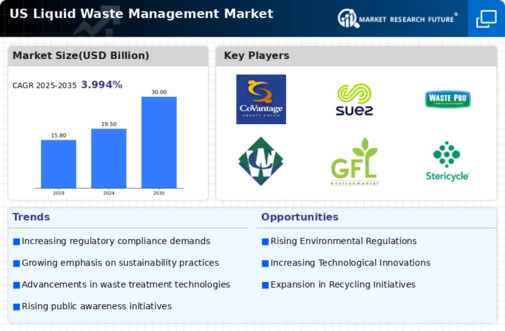
The liquid waste management market in the US is characterized by a competitive landscape that is increasingly shaped by sustainability initiatives, technological advancements, and regulatory pressures. Key players such as Waste Management Inc (US), Republic Services Inc (US), and Veolia North America (US) are actively pursuing strategies that emphasize innovation and operational efficiency. Waste Management Inc (US) has focused on enhancing its recycling capabilities, while Republic Services Inc (US) has invested in digital transformation to optimize waste collection routes. Veolia North America (US) appears to be leveraging its global expertise to implement advanced waste treatment technologies, thereby positioning itself as a leader in environmentally responsible waste management solutions.
The market structure is moderately fragmented, with several players competing for market share. Key business tactics include localizing operations to reduce transportation costs and optimizing supply chains to enhance service delivery. The collective influence of these major companies fosters a competitive environment where efficiency and sustainability are paramount. As these companies adapt to changing regulations and consumer expectations, their strategies are likely to converge towards more sustainable practices, further intensifying competition.
In November 2025, Waste Management Inc (US) announced a partnership with a leading technology firm to develop an AI-driven waste sorting system. This strategic move is expected to enhance operational efficiency and improve recycling rates, aligning with the growing demand for sustainable waste management solutions. The integration of AI technology could potentially revolutionize the sorting process, reducing contamination and increasing the quality of recyclables.
In October 2025, Republic Services Inc (US) launched a new initiative aimed at expanding its organic waste collection services across several states. This initiative reflects a broader trend towards composting and organic waste management, which is gaining traction among municipalities. By diversifying its service offerings, Republic Services Inc (US) positions itself to capture a growing segment of the market that prioritizes sustainability and waste diversion.
In September 2025, Veolia North America (US) completed the acquisition of a regional waste management company, enhancing its operational footprint in the Northeast. This acquisition is strategically significant as it allows Veolia to expand its service capabilities and leverage synergies in waste processing. The move underscores the importance of consolidation in a fragmented market, enabling companies to achieve economies of scale and improve service delivery.
As of December 2025, current trends in the liquid waste management market include a pronounced shift towards digitalization, sustainability, and the integration of AI technologies. Strategic alliances are increasingly shaping the competitive landscape, as companies seek to enhance their service offerings and operational efficiencies. Looking ahead, competitive differentiation is likely to evolve from traditional price-based competition to a focus on innovation, technology adoption, and supply chain reliability. This shift may redefine how companies engage with customers and manage waste, ultimately leading to a more sustainable and efficient industry.



















Leave a Comment