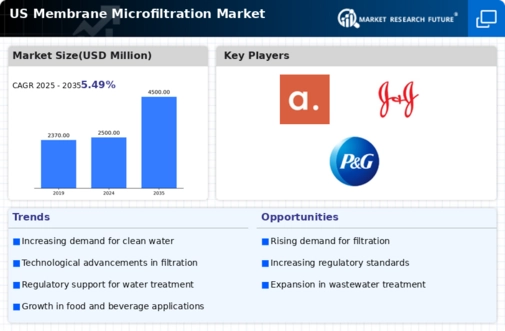
The membrane microfiltration market is currently characterized by a dynamic competitive landscape, driven by increasing demand for water treatment solutions and advancements in filtration technologies. Key players such as Pall Corporation (US), Merck KGaA (Germany), and Sartorius AG (Germany) are strategically positioned to leverage innovation and expand their market presence. Pall Corporation (US) focuses on enhancing its product portfolio through continuous innovation, while Merck KGaA (Germany) emphasizes strategic partnerships to bolster its technological capabilities. Sartorius AG (Germany) is actively pursuing regional expansion, particularly in North America, to capitalize on the growing demand for efficient filtration solutions. Collectively, these strategies contribute to a competitive environment that is increasingly focused on technological advancement and market responsiveness.
In terms of business tactics, companies are localizing manufacturing and optimizing supply chains to enhance operational efficiency. The market structure appears moderately fragmented, with several key players exerting influence over various segments. This fragmentation allows for a diverse range of offerings, catering to specific customer needs while fostering competition among established and emerging players.
In November 2025, Pall Corporation (US) announced the launch of a new line of advanced microfiltration membranes designed to improve water quality in industrial applications. This strategic move is significant as it not only enhances Pall's product offerings but also positions the company to meet the increasing regulatory demands for water quality, thereby potentially increasing its market share in the industrial sector.
In October 2025, Merck KGaA (Germany) entered into a collaboration with a leading technology firm to develop AI-driven filtration solutions. This partnership is indicative of the growing trend towards digitalization in the membrane microfiltration market, as it aims to enhance operational efficiency and reduce costs through predictive maintenance and real-time monitoring. Such innovations may provide Merck with a competitive edge in a rapidly evolving market.
In September 2025, Sartorius AG (Germany) expanded its manufacturing capabilities in the US by investing in a new facility dedicated to producing microfiltration products. This expansion is likely to enhance Sartorius's ability to meet local demand and reduce lead times, thereby strengthening its competitive position in the North American market. The investment reflects a broader trend of companies seeking to localize production to improve supply chain reliability.
As of December 2025, current competitive trends in the membrane microfiltration market are increasingly defined by digitalization, sustainability, and AI integration. Strategic alliances are shaping the landscape, enabling companies to pool resources and expertise to drive innovation. Looking ahead, competitive differentiation is expected to evolve, with a shift from price-based competition towards a focus on technological innovation, sustainability, and supply chain resilience. This transition underscores the importance of adaptability and forward-thinking strategies in maintaining a competitive edge.




















Leave a Comment