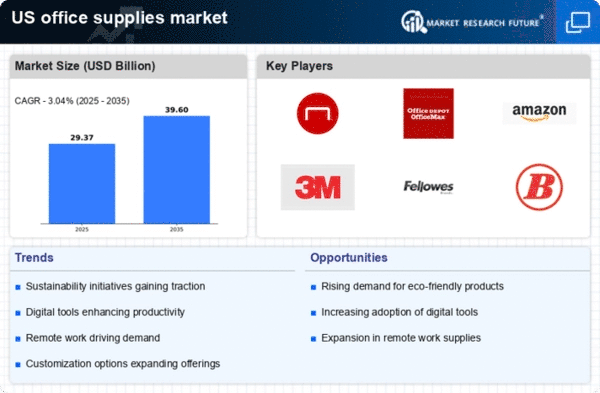
The office supplies market in the US is characterized by a competitive landscape that is both dynamic and multifaceted. Key growth drivers include the increasing demand for sustainable products, the rise of remote work, and the ongoing digital transformation of traditional office supply businesses. Major players such as Staples (US), Office Depot (US), and Amazon (US) are strategically positioned to leverage these trends. Staples (US) focuses on enhancing its e-commerce capabilities and expanding its product range to include eco-friendly options, while Office Depot (US) emphasizes partnerships with technology firms to integrate digital solutions into its offerings. Amazon (US), with its vast logistics network, continues to dominate through aggressive pricing and rapid delivery services, collectively shaping a competitive environment that is increasingly reliant on innovation and customer-centric strategies.
In terms of business tactics, companies are localizing manufacturing and optimizing supply chains to enhance efficiency and responsiveness. The market structure appears moderately fragmented, with several key players exerting significant influence. This fragmentation allows for niche players to thrive, while larger companies leverage economies of scale to maintain competitive pricing. The collective influence of these key players fosters a competitive atmosphere where agility and adaptability are paramount.
In October 2025, Staples (US) announced a partnership with a leading tech firm to develop a new line of smart office products aimed at enhancing workplace productivity. This strategic move is likely to position Staples (US) as a frontrunner in the integration of technology within office supplies, potentially attracting a tech-savvy customer base and reinforcing its market presence. The emphasis on smart products aligns with broader trends towards automation and efficiency in office environments.
In September 2025, Office Depot (US) launched a new sustainability initiative aimed at reducing its carbon footprint by 30% by 2030. This initiative underscores the company's commitment to environmental responsibility and may resonate well with increasingly eco-conscious consumers. By prioritizing sustainability, Office Depot (US) not only enhances its brand image but also positions itself competitively against rivals who may not yet fully embrace such initiatives.
In August 2025, Amazon (US) expanded its office supplies category by introducing a subscription service for businesses, allowing for automated reordering of essential supplies. This strategic action is indicative of Amazon's focus on customer convenience and retention, potentially disrupting traditional purchasing behaviors in the office supplies market. The subscription model may also provide Amazon (US) with valuable data insights, further refining its offerings and enhancing customer loyalty.
As of November 2025, current competitive trends are heavily influenced by digitalization, sustainability, and the integration of artificial intelligence (AI) into product offerings. Strategic alliances are increasingly shaping the landscape, enabling companies to pool resources and expertise to innovate more effectively. Looking ahead, competitive differentiation is likely to evolve from traditional price-based competition towards a focus on innovation, technology integration, and supply chain reliability. Companies that can successfully navigate these trends will likely secure a more robust market position in the years to come.



















Leave a Comment