×
Request Free Sample ×

Kindly complete the form below to receive a free sample of this Report

* Please use a valid business email

Leading companies partner with us for data-driven Insights

clients tt-cursor
Hero Background

US Packaging Adhesives Market

ID: MRFR/CnM/18981-HCR
111 Pages
Chitranshi Jaiswal
October 2025

US Packaging Adhesives Market Research Report By Technology (Water-based, Solvent-based, Hot-melt) and By Application (Flexible Packaging, Folding Boxes and Cartons, Sealing, Labels and Tapes, Other Applications) - Forecast to 2035

Share:
Download PDF ×

We do not share your information with anyone. However, we may send you emails based on your report interest from time to time. You may contact us at any time to opt-out.

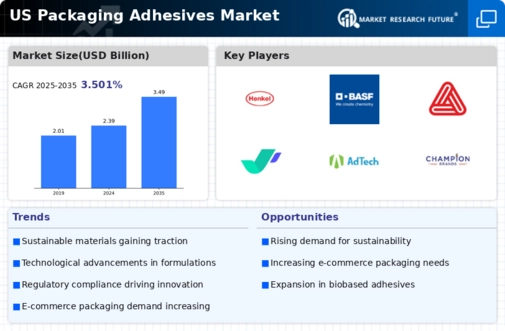
US Packaging Adhesives Market Infographic
Purchase Options

US Packaging Adhesives Market Summary

As per analysis, the US packaging adhesives market is projected to grow from USD 3.46 Billion in 2025 to USD 4.89 Billion by 2035, exhibiting a compound annual growth rate (CAGR) of 3.5% during the forecast period (2025 - 2035).

Key Market Trends & Highlights

The US packaging adhesives market is currently experiencing a transformative shift towards sustainability and innovation.

  • The flexible packaging segment remains the largest contributor to the market, driven by its versatility and consumer demand.
  • Label adhesives are emerging as the fastest-growing segment, reflecting the increasing importance of branding and product information.
  • In the food and beverage sector, packaging adhesives are crucial for maintaining product integrity and safety, while pharmaceuticals are witnessing rapid growth due to stringent regulatory requirements.
  • Sustainability initiatives and e-commerce growth are significant drivers, influencing the development of eco-friendly adhesive solutions.

Market Size & Forecast

2024 Market Size 3.35 (USD Billion)
2035 Market Size 4.89 (USD Billion)
CAGR (2025 - 2035) 3.5%

Major Players

Henkel (US), 3M (US), BASF (US), H.B. Fuller (US), Avery Dennison (US), Sika (US), Dow (US), Eastman Chemical (US)

US Packaging Adhesives Market Trends

The US packaging adhesives market is currently experiencing a dynamic evolution, driven by various factors including technological advancements and changing consumer preferences. The demand for sustainable packaging solutions is on the rise, as manufacturers increasingly seek eco-friendly adhesives that align with environmental regulations and consumer expectations. This shift towards sustainability is not merely a trend but appears to be a fundamental change in how products are packaged and delivered. Additionally, the growth of e-commerce has necessitated the development of adhesives that can withstand the rigors of shipping and handling, further influencing the market landscape. Moreover, innovations in adhesive formulations are likely to enhance performance characteristics, such as bond strength and curing times, which could lead to broader applications across different sectors. The increasing focus on lightweight packaging solutions may also drive the demand for specialized adhesives that cater to these requirements. As the market continues to adapt to these evolving needs, it seems poised for further growth, with opportunities for manufacturers to differentiate their products through advanced adhesive technologies and sustainable practices.

Sustainability Focus

The US packaging adhesives market is witnessing a pronounced shift towards sustainable practices. Manufacturers are increasingly adopting eco-friendly adhesives that minimize environmental impact, aligning with consumer demand for greener products. This trend is likely to influence product development and regulatory compliance.

E-commerce Influence

The rise of e-commerce is reshaping the US packaging adhesives market. As online shopping continues to grow, there is a heightened need for adhesives that ensure product integrity during transit. This demand is prompting innovations in adhesive formulations to enhance durability and performance.

Technological Advancements

Technological progress in adhesive formulations is significantly impacting the US packaging adhesives market. Innovations are leading to improved bond strength, faster curing times, and enhanced versatility, allowing manufacturers to cater to diverse packaging needs across various industries.

Market Segment Insights

By Application: Flexible Packaging (Largest) vs. Labels (Fastest-Growing)

In the US packaging adhesives market, flexible packaging holds the largest market share, driven by its versatility and convenience for a wide range of products. This segment caters to various sectors, including food and beverages, where its lightweight and malleable nature enhances product shelf life while appealing to consumer preferences for convenience. Labels also represent a significant segment, growing rapidly due to the increasing demand for branding and product information, making them essential for attracting consumer attention on retail shelves.

Flexible Packaging (Dominant) vs. Labels (Emerging)

Flexible packaging is characterized by its adaptability and ease of use, making it a dominant choice in the US packaging adhesives market. This segment is widely used for packaging perishable goods, personal care items, and other consumer products, benefiting from the push towards sustainable and lightweight materials. Conversely, the labels segment, while still emerging, is gaining traction with the rise in e-commerce and a focus on product transparency. Label adhesives must meet the demand for high performance and durability while maintaining aesthetic appeal, leading manufacturers to innovate to cater to this growing need.

By End Use: Food and Beverage (Largest) vs. Pharmaceuticals (Fastest-Growing)

In the US packaging adhesives market, the Food and Beverage sector holds the largest share among end-use segments, dominating overall consumption due to the growing demand for packaged foods and beverages. This sector significantly influences the development of specialized adhesives that ensure product safety and freshness, further solidifying its market leadership. The Pharmaceuticals segment, while smaller in comparison to Food and Beverage, is emerging rapidly as a crucial market, driven by the increasing demand for efficient packaging that ensures product integrity and safety.

Food and Beverage (Dominant) vs. Pharmaceuticals (Emerging)

The Food and Beverage segment is characterized by its extensive use of adhesives in packaging various consumables where safety and shelf-life are paramount. This segment benefits from innovations in adhesive technology, catering to diverse packaging needs, including flexible and rigid formats. On the other hand, the Pharmaceuticals segment is gaining traction, supported by rising regulatory standards and a focus on patient safety. The adhesives used here must meet stringent compliance requirements, making them a specialized and evolving market. As the healthcare industry grows, so does the need for advanced packaging solutions, positioning Pharmaceuticals as a key emerging player in the adhesives landscape.

By Technology: Hot Melt Adhesives (Largest) vs. Water-Based Adhesives (Fastest-Growing)

In the US packaging adhesives market, the technology segment is characterized by a diverse range of adhesive types, including hot melt, water-based, solvent-based, and pressure sensitive adhesives. Hot melt adhesives have established themselves as the largest segment due to their versatility and strong performance in various applications, while water-based adhesives are rapidly growing as industries increasingly adopt more environmentally friendly solutions. Solvent-based and pressure sensitive adhesives, while still relevant, hold smaller market shares compared to the leading segments.

Technology: Hot Melt Adhesives (Dominant) vs. Water-Based Adhesives (Emerging)

Hot melt adhesives are widely recognized for their strong bonding capabilities, fast curing times, and ease of use, making them a dominant choice in the packaging industry. These adhesives are particularly favored in high-speed production environments due to their efficiency and reliability across various substrates. Conversely, water-based adhesives have emerged as a preferred solution for many manufacturers seeking sustainable options, leading to significant demand growth. Their lower environmental impact, coupled with advancements in formulation technology, enhances their appeal for diverse packaging applications, positioning them as an effective alternative in a market increasingly focused on sustainability.

By Formulation Type: Polyurethane Adhesives (Largest) vs. Acrylic Adhesives (Fastest-Growing)

In the US packaging adhesives market, Polyurethane Adhesives lead in market share, primarily due to their versatile applications and exceptional bonding capabilities in various packaging solutions. Acrylic Adhesives, while holding a smaller portion of the market, are rapidly gaining traction due to their excellent clarity and weather resistance, making them valuable for specialized applications. Growth trends indicate that the demand for Acrylic Adhesives is accelerated by the increasing need for sustainable packaging and lightweight solutions. Meanwhile, Polyurethane Adhesives continue to benefit from advancements in technology that enhance their performance, ensuring their status as a preferred choice for durable and efficient packaging solutions.

Acrylic Adhesives (Dominant) vs. Natural Adhesives (Emerging)

Acrylic Adhesives are recognized for their robust bonding properties and versatility in various environmental conditions, making them a staple in the US packaging adhesives market. They provide excellent adhesion to numerous substrates, including plastic and metal, and are particularly valued in the packaging of consumer goods. In contrast, Natural Adhesives, derived from renewable sources, are emerging as an eco-friendly alternative due to the growing consumer preference for sustainable products. While still a smaller share of the market, Natural Adhesives are increasingly sought after for their biodegradability and lower environmental impact, appealing to environmentally conscious brands and consumers.

By Curing Mechanism: UV Curing (Largest) vs. Thermal Curing (Fastest-Growing)

In the US packaging adhesives market, the curing mechanism segment demonstrates a diverse distribution among various technologies. UV curing leads this category, significantly outperforming other methods in usage, with its quick curing capabilities appealing to numerous packaging applications. Following UV curing, thermal curing also holds a notable share but is growing at a rapid pace, driven by the increasing demand for eco-friendly solutions that thermal curing processes often provide. The growth trends within these curing mechanisms are largely influenced by advancements in technology and evolving consumer preferences. The rising focus on sustainability prompts manufacturers to innovate in thermal curing methods, while UV curing continues to thrive due to its efficiency and speed, catering to the fast-paced demands of the packaging sector. Consequently, both segments are poised for ongoing development, driven by shifting market needs and technological evolution.

UV Curing (Dominant) vs. Chemical Curing (Emerging)

UV curing represents the dominant force in the curing mechanism segment of the US packaging adhesives market. This method's ability to provide rapid bonding and hardening makes it preferred across many applications, especially in industries requiring fast production speeds. As manufacturers aim for efficiency and efficacy, UV curing becomes synonymous with high-performance standards. On the other hand, chemical curing is emerging as a viable alternative, catering to niche markets and specific adhesive applications where heat-sensitive materials are used. While not as widely adopted as UV curing, it offers unique benefits such as versatility in substrate compatibility, which can appeal to specific segments of packaging needs. As both methods continue to evolve, their competitive positioning will be essential in the years ahead.

Get more detailed insights about US Packaging Adhesives Market

Key Players and Competitive Insights

The packaging adhesives market is characterized by a dynamic competitive landscape, driven by innovation, sustainability, and technological advancements. Key players such as Henkel (Germany), 3M (US), and H.B. Fuller (US) are actively shaping the market through strategic initiatives. Henkel (Germany) emphasizes sustainability in its product offerings, focusing on eco-friendly adhesives that cater to the growing demand for environmentally responsible packaging solutions. Meanwhile, 3M (US) leverages its extensive research and development capabilities to introduce innovative adhesive technologies, enhancing performance and efficiency in packaging applications. H.B. Fuller (US) adopts a customer-centric approach, tailoring solutions to meet specific industry needs, thereby strengthening its market position.

The competitive structure of the packaging adhesives market appears moderately fragmented, with several players vying for market share. Companies are increasingly localizing manufacturing and optimizing supply chains to enhance operational efficiency and reduce costs. This trend is indicative of a broader strategy among key players to respond swiftly to market demands while maintaining competitive pricing. The collective influence of these companies fosters a competitive environment where innovation and customer service are paramount.

In November 2025, Henkel (Germany) announced the launch of a new line of bio-based adhesives aimed at reducing carbon footprints in packaging applications. This strategic move underscores Henkel's commitment to sustainability and positions the company favorably in a market increasingly focused on eco-friendly solutions. By investing in bio-based technologies, Henkel (Germany) not only addresses regulatory pressures but also aligns with consumer preferences for sustainable products.

In October 2025, 3M (US) unveiled a breakthrough adhesive technology that enhances the recyclability of packaging materials. This innovation is significant as it addresses the growing concern over plastic waste and aligns with global sustainability goals. By enhancing recyclability, 3M (US) strengthens its competitive edge and responds to the increasing demand for sustainable packaging solutions, potentially capturing a larger market share.

In September 2025, H.B. Fuller (US) expanded its manufacturing capabilities in the Midwest, investing $10 million to enhance production efficiency. This expansion is strategically important as it allows H.B. Fuller (US) to better serve its North American customers while optimizing supply chain logistics. The investment reflects a broader trend among key players to bolster local production capabilities in response to fluctuating market demands.

As of December 2025, the competitive trends in the packaging adhesives market are increasingly defined by digitalization, sustainability, and the integration of artificial intelligence (AI) in production processes. Strategic alliances among companies are becoming more prevalent, facilitating knowledge sharing and resource optimization. The shift from price-based competition to a focus on innovation and technology is evident, as companies strive to differentiate themselves through advanced product offerings and reliable supply chains. This evolution suggests that future competitive differentiation will hinge on the ability to innovate and adapt to changing market dynamics.


Key Companies in the US Packaging Adhesives Market market include

Industry Developments

Recent developments in the US Packaging Adhesives Market indicate robust growth driven by increased demand for sustainable packaging solutions. The market valuation continues to rise, as companies like Henkel and 3M expand their product portfolios to include eco-friendly adhesive options. Additionally, the ongoing trend toward e-commerce has propelled innovation in adhesive products, enhancing convenience and efficiency for end-users. Notably, in July 2023, LORD Corporation announced a strategic acquisition to broaden its capabilities within the packaging sector, aiming to enhance market competitiveness.

Similarly, HB Fuller reported growth in Q3 2023 by launching a new line of adhesives focused on food packaging applications, showcasing its commitment to innovation. Furthermore, BASF's recent investments in R&D in the US are aimed at developing high-performance adhesives that meet the increasing regulatory requirements for food safety. Over the past couple of years, the market has witnessed an increasing focus on reducing carbon footprints, with Avery Dennison leading initiatives in sustainable adhesive solutions since 2021.

These transformative actions reflect the dynamic environment of the US Packaging Adhesives Market, emphasizing sustainability, innovation, and strategic expansions as critical drivers of growth.

Future Outlook

US Packaging Adhesives Market Future Outlook

The US packaging adhesives market is projected to grow at a 3.5% CAGR from 2024 to 2035, driven by e-commerce expansion, sustainable packaging trends, and technological advancements.

New opportunities lie in:

  • Development of bio-based adhesive formulations
  • Integration of smart adhesive technologies
  • Expansion into emerging markets with tailored solutions

By 2035, the market is expected to achieve robust growth, driven by innovation and sustainability.

Market Segmentation

US Packaging Adhesives Market End Use Outlook

  • Food and Beverage
  • Pharmaceuticals
  • Cosmetics
  • Consumer Goods
  • Industrial

US Packaging Adhesives Market Technology Outlook

  • Water-Based Adhesives
  • Solvent-Based Adhesives
  • Hot Melt Adhesives
  • Pressure Sensitive Adhesives

US Packaging Adhesives Market Application Outlook

  • Flexible Packaging
  • Rigid Packaging
  • Labels
  • Cartons
  • Pouches

US Packaging Adhesives Market Curing Mechanism Outlook

  • Thermal Curing
  • UV Curing
  • Moisture Curing
  • Chemical Curing

US Packaging Adhesives Market Formulation Type Outlook

  • Polyurethane Adhesives
  • Acrylic Adhesives
  • Epoxy Adhesives
  • Natural Adhesives

Report Scope

MARKET SIZE 20243.35(USD Billion)
MARKET SIZE 20253.46(USD Billion)
MARKET SIZE 20354.89(USD Billion)
COMPOUND ANNUAL GROWTH RATE (CAGR)3.5% (2024 - 2035)
REPORT COVERAGERevenue Forecast, Competitive Landscape, Growth Factors, and Trends
BASE YEAR2024
Market Forecast Period2025 - 2035
Historical Data2019 - 2024
Market Forecast UnitsUSD Billion
Key Companies ProfiledHenkel (US), 3M (US), BASF (US), H.B. Fuller (US), Avery Dennison (US), Sika (US), Dow (US), Eastman Chemical (US)
Segments CoveredApplication, End Use, Technology, Formulation Type, Curing Mechanism
Key Market OpportunitiesGrowing demand for sustainable packaging solutions drives innovation in the US packaging adhesives market.
Key Market DynamicsRising demand for sustainable packaging adhesives drives innovation and competition among US manufacturers.
Countries CoveredUS

Leave a Comment

FAQs

What is the expected market size of the US Packaging Adhesives Market in 2024?

The US Packaging Adhesives Market is expected to be valued at 2.39 billion USD in 2024.

What is the projected market valuation for the US Packaging Adhesives Market by 2035?

By 2035, the US Packaging Adhesives Market is projected to reach a valuation of 3.49 billion USD.

What is the compound annual growth rate (CAGR) for the US Packaging Adhesives Market from 2025 to 2035?

The expected CAGR for the US Packaging Adhesives Market from 2025 to 2035 is 3.501%.

Which technology segment is expected to dominate the US Packaging Adhesives Market by 2035?

By 2035, the water-based technology segment is expected to dominate, projected to be valued at 1.4 billion USD.

What is the market value of the solvent-based segment in 2024?

The solvent-based segment of the US Packaging Adhesives Market is valued at 0.75 billion USD in 2024.

Who are the major players in the US Packaging Adhesives Market?

Key players in the US Packaging Adhesives Market include LORD Corporation, Henkel, BASF, and 3M.

What is the expected growth rate of the hot-melt segment from 2024 to 2035?

The hot-melt segment is expected to grow from 0.69 billion USD in 2024 to 1.04 billion USD by 2035.

What are the primary applications driving the growth of the US Packaging Adhesives Market?

The primary applications driving growth include food packaging, consumer goods, and industrial applications.

What opportunities are emerging for the US Packaging Adhesives Market?

Emerging opportunities include increasing demand for sustainable packaging solutions and innovations in adhesive technologies.

How might current economic factors affect the US Packaging Adhesives Market?

Current economic factors could influence raw material costs and supply chain logistics, impacting market dynamics.

Download Free Sample

Kindly complete the form below to receive a free sample of this Report

Compare Licence

×
Features License Type
Single User Multiuser License Enterprise User
Price $4,950 $5,950 $7,250
Maximum User Access Limit 1 User Upto 10 Users Unrestricted Access Throughout the Organization
Free Customization
Direct Access to Analyst
Deliverable Format
Platform Access
Discount on Next Purchase 10% 15% 15%
Printable Versions