×
Request Free Sample ×

Kindly complete the form below to receive a free sample of this Report

* Please use a valid business email

Leading companies partner with us for data-driven Insights

clients tt-cursor
Hero Background

US Regulatory Technology Market

ID: MRFR/ICT/59940-HCR
200 Pages
Aarti Dhapte
October 2025

US Regulatory Technology Market Research Report By Technology (Artificial Intelligence, Machine Learning, Blockchain, Natural Language Processing, Data Analytics), By Solution Type (Compliance Management, Risk Management, Fraud Prevention, Data Governance), By Deployment Type (Cloud-Based, On-Premise, Hybrid) and By End Use (Financial Services, Healthcare, Manufacturing, Energy, Telecommunications) - Forecast to 2035

Share:
Download PDF ×

We do not share your information with anyone. However, we may send you emails based on your report interest from time to time. You may contact us at any time to opt-out.

US Regulatory Technology Market Infographic
Purchase Options

US Regulatory Technology Market Summary

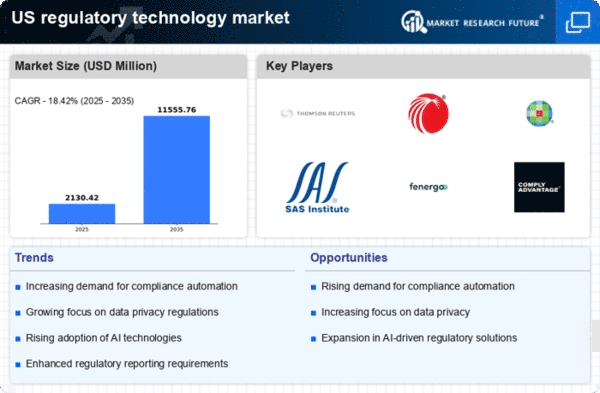
As per MRFR analysis, the US regulatory technology market size was estimated at 1799.04 USD Million in 2024. The US regulatory technology market is projected to grow from 2130.42 USD Million in 2025 to 11555.76 USD Million by 2035, exhibiting a compound annual growth rate (CAGR) of 18.42% during the forecast period 2025 - 2035.

Key Market Trends & Highlights

The US The US regulatory technology market is experiencing robust growth. This growth is driven by technological advancements and increasing regulatory demands.

  • The market is witnessing increased adoption of automation to enhance compliance efficiency.
  • Integration of advanced analytics is becoming prevalent, enabling organizations to derive actionable insights from regulatory data.
  • Industry-specific solutions are gaining traction, particularly in sectors such as finance and healthcare.
  • Heightened regulatory scrutiny and the emergence of data privacy regulations are key drivers propelling market growth.

Market Size & Forecast

2024 Market Size 1799.04 (USD Million)
2035 Market Size 11555.76 (USD Million)
CAGR (2025 - 2035) 18.42%

Major Players

Thomson Reuters (CA), LexisNexis (US), Wolters Kluwer (NL), SAS Institute (US), Fenergo (IE), ComplyAdvantage (GB), Riskified (US), Amlify (US), Trulioo (CA)

US Regulatory Technology Market Trends

The regulatory technology market is currently undergoing a transformative phase. This change is driven by the increasing complexity of compliance requirements and the need for organizations to enhance their operational efficiency. Regulatory frameworks are evolving, necessitating innovative solutions that can adapt to changing regulations. This market is characterized by a growing demand for automation and data analytics, which are essential for managing compliance risks effectively. As organizations strive to maintain compliance while minimizing costs, the adoption of regulatory technology solutions is becoming more prevalent. Furthermore, the integration of artificial intelligence and machine learning into these solutions is likely to enhance their capabilities, providing organizations with more robust tools for navigating regulatory landscapes. In addition, the regulatory technology market is witnessing a surge in investment as stakeholders recognize the potential for technology to streamline compliance processes. This influx of capital is fostering innovation and encouraging the development of new solutions tailored to specific industries. As regulatory bodies continue to emphasize transparency and accountability, the market is expected to expand further, with a focus on creating user-friendly platforms that facilitate compliance management. Overall, the regulatory technology market appears poised for significant growth, driven by technological advancements and the increasing need for effective compliance solutions.

Increased Adoption of Automation

Organizations are increasingly turning to automation to streamline compliance processes. This trend reflects a broader shift towards efficiency, as automated solutions can reduce human error and enhance accuracy in regulatory reporting.

Integration of Advanced Analytics

The incorporation of advanced analytics into regulatory technology solutions is becoming more common. This trend allows organizations to leverage data insights for better decision-making and risk management, ultimately improving compliance outcomes.

Focus on Industry-Specific Solutions

There is a growing emphasis on developing regulatory technology solutions tailored to specific industries. This trend indicates a recognition of the unique compliance challenges faced by different sectors, prompting the creation of specialized tools.

US Regulatory Technology Market Drivers

Heightened Regulatory Scrutiny

The regulatory technology market is experiencing a surge in demand due to heightened scrutiny from regulatory bodies. In the US, agencies such as the SEC and FINRA are intensifying their oversight, compelling organizations to adopt robust compliance solutions. This trend is reflected in the market's projected growth, with estimates suggesting a CAGR of approximately 20% over the next five years. Companies are increasingly investing in regulatory technology to ensure adherence to evolving regulations, thereby mitigating risks associated with non-compliance. The need for real-time monitoring and reporting capabilities is driving innovation within the regulatory technology market, as firms seek to enhance their compliance frameworks and avoid costly penalties.

Increased Focus on Risk Management

The regulatory technology market increasingly focuses on risk management as organizations recognize the importance of proactive compliance strategies. In the US, firms are adopting regulatory technology solutions to identify, assess, and mitigate risks associated with regulatory compliance. This shift is driven by the need for organizations to protect their reputations and financial stability. Market Research Future indicates that the risk management segment within the regulatory technology market is expected to grow by over 25% in the coming years. As businesses prioritize risk management, the demand for innovative regulatory technology solutions that provide comprehensive risk assessments and reporting capabilities is likely to rise.

Emergence of Data Privacy Regulations

The emergence of stringent data privacy regulations in the US significantly influences the regulatory technology market. Laws such as the California Consumer Privacy Act (CCPA) and the proposed federal privacy legislation are reshaping how organizations manage personal data. As businesses strive to comply with these regulations, the demand for regulatory technology solutions is expected to rise. Market analysts indicate that the data privacy segment could account for over 30% of the overall regulatory technology market by 2026. This shift necessitates the development of advanced tools that facilitate data governance, risk assessment, and compliance management, thereby propelling growth in the regulatory technology market.

Technological Advancements in Compliance Solutions

Technological advancements are playing a pivotal role in shaping the regulatory technology market. Innovations such as artificial intelligence (AI), machine learning, and blockchain are enhancing compliance solutions, making them more efficient and effective. For instance, AI-driven analytics can process vast amounts of data to identify compliance risks, while blockchain technology offers secure and transparent transaction records. The integration of these technologies is expected to drive market growth, with projections indicating that the market could reach $10 billion by 2027. As organizations seek to leverage these advancements, the regulatory technology market is likely to witness increased investment and development of cutting-edge solutions.

Growing Demand for Cost-Effective Compliance Solutions

The regulatory technology market is seeing increased demand for cost-effective compliance solutions as organizations seek to optimize their compliance budgets. With regulatory fines and penalties on the rise, companies are seeking technologies that can streamline compliance processes while reducing operational costs. This trend is particularly evident in small to medium-sized enterprises (SMEs) that may lack the resources for extensive compliance departments. Market data suggests that the adoption of regulatory technology can reduce compliance costs by up to 30%, making it an attractive option for businesses. As the need for affordable compliance solutions continues to grow, the regulatory technology market is likely to expand to meet these demands.


Market Segment Insights

By Technology: Artificial Intelligence (Largest) vs. Machine Learning (Fastest-Growing)

In the US regulatory technology market, the distribution of market share among various technological segments reveals that Artificial Intelligence holds the largest share, driven by its widespread adoption across regulatory processes. Conversely, Machine Learning, while currently smaller, is emerging as the fastest-growing segment due to increasing demand for advanced analytical capabilities and real-time data processing. The growth trends in this market are significantly influenced by the ongoing digital transformation in compliance and risk management sectors. The rising adoption of technology solutions is motivating more organizations to invest in innovative tools, especially those that employ Machine Learning and Artificial Intelligence, as these technologies offer enhanced efficiencies and accuracy in regulatory compliance, thereby attracting substantial investment and development efforts.

Technology: Artificial Intelligence (Dominant) vs. Machine Learning (Emerging)

Artificial Intelligence has established itself as the dominant technology within the segment, characterized by its ability to optimize compliance workflows and enhance decision-making processes. Organizations leverage AI for automating regulatory reporting and predictive analysis, ensuring they stay ahead in rapidly changing regulatory landscapes. In contrast, Machine Learning is recognized as an emerging force, transforming how data is processed and analyzed. Its ability to learn from data patterns allows organizations to detect anomalies and predict compliance risks effectively. As firms recognize the value of data in shaping their regulatory strategies, the integration of Machine Learning into existing systems is expected to rise, further closing the gap between it and the more established Artificial Intelligence.

By Solution Type: Compliance Management (Largest) vs. Risk Management (Fastest-Growing)

The compliance management segment constitutes the largest portion of the US regulatory technology market, driven by strong demand for organizations to meet ever-evolving regulatory requirements. This segment's market share is attributed to the necessity of maintaining compliance to avoid hefty penalties and legal challenges. Conversely, risk management is gaining traction as businesses prioritize proactive risk assessment to mitigate potential threats, capturing an increasing share of the market. Growth trends indicate that compliance management is bolstered by regulatory pressures, while risk management is fast becoming essential for organizations seeking agility in their operations. Factors such as increased digital transformation, cyber threats, and the growing complexity of regulations push companies to invest in advanced risk management solutions. This dual focus illustrates a balancing act between compliance and risk, crucial for sustainability in the market.

Compliance Management (Dominant) vs. Fraud Prevention (Emerging)

Compliance management stands as the dominant solution within the US regulatory technology market, characterized by comprehensive frameworks that assist organizations in adhering to legal standards. This segment typically encompasses tools that automate reporting, ensure audits, and facilitate training regarding regulatory changes. On the other hand, fraud prevention is emerging as a vital solution, fueled by rising incidents of digital fraud and the need for sophisticated detection mechanisms. This segment includes advanced analytics and AI-driven tools designed to identify unusual patterns and prevent illicit activities. While compliance management remains foundational, the burgeoning market for fraud prevention highlights an evolving landscape where companies increasingly invest in protective measures against financial crimes.

By Deployment Type: Cloud-Based (Largest) vs. Hybrid (Fastest-Growing)

In the US regulatory technology market, the deployment type segment exhibits a diverse distribution of preferences among Cloud-Based, On-Premise, and Hybrid models. Cloud-Based solutions command the largest share due to their scalability, cost-effectiveness, and flexibility that appeals to a wide range of regulatory environments. On-Premise solutions, while preferred by entities requiring stringent data control and security, have seen a gradual decline in market share as companies increasingly adopt more agile technology frameworks. The growth trends within this segment indicate that Hybrid deployment methods are rapidly gaining traction, marking them as the fastest-growing option. This trend is driven by organizations aiming to achieve a balanced approach between the agility of cloud services and the security of on-premise installations. The continued evolution of regulatory requirements and the need for adaptable solutions further propel the Hybrid model's growth, catering to diverse operational needs across various sectors.

Cloud-Based (Dominant) vs. On-Premise (Emerging)

Cloud-Based solutions are dominating the deployment type segment of the US regulatory technology market due to their inherent advantages in terms of scalability and ease of access. They allow organizations to rapidly implement compliance measures and adapt to regulatory changes without significant upfront investments. In contrast, On-Premise solutions are becoming an emerging choice for firms that prioritize stringent data security and customization. These organizations often operate in highly regulated environments where data governance is crucial. The shift towards Hybrid models is gaining momentum, blending the benefits of both approaches and offering strategic flexibility to meet evolving regulatory demands.

By End Use: Financial Services (Largest) vs. Healthcare (Fastest-Growing)

The US regulatory technology market exhibits a robust distribution across various end-use sectors, with Financial Services leading the way as the largest segment. This sector accounts for a significant share, driven by the increasing need for compliance and risk management solutions. Meanwhile, Healthcare emerges as a rapidly expanding sector, reflecting the growing regulatory requirements and emphasis on patient data integrity and security. Growth trends within the regulatory technology market are largely influenced by technological advancements and regulatory changes across industries. Financial Services will continue to see steady consumption due to ongoing financial regulations and the need for robust compliance frameworks. Conversely, Healthcare is set to experience the fastest growth, propelled by regulatory reforms, the proliferation of health technology, and a heightened focus on data privacy and security in healthcare practices.

Financial Services: Dominant vs. Healthcare: Emerging

Financial Services serves as the dominant end-use sector in the US regulatory technology market, characterized by its extensive reliance on compliance solutions to mitigate regulatory risks and ensure operational integrity. This sector encompasses a wide range of activities, including banking, insurance, and investment, where regulatory pressures are substantial. On the other hand, Healthcare is an emerging segment that is rapidly gaining traction, driven by the increasing complexity of healthcare regulations and a heightened focus on compliance management. This sector's growth is supported by innovations in health information technology and the ongoing demand for securing patient data against breaches, which positions it as a dynamic player in the regulatory technology landscape.

Get more detailed insights about US Regulatory Technology Market

Key Players and Competitive Insights

The regulatory technology market is currently characterized by a dynamic competitive landscape, driven by the increasing complexity of compliance requirements and the growing demand for automation in regulatory processes. Key players such as Thomson Reuters (CA), LexisNexis (US), and Wolters Kluwer (NL) are strategically positioned to leverage their extensive data resources and technological capabilities. Thomson Reuters (CA) focuses on integrating advanced analytics into its compliance solutions, while LexisNexis (US) emphasizes partnerships with fintech firms to enhance its service offerings. Wolters Kluwer (NL) is investing heavily in AI-driven solutions to streamline regulatory reporting, indicating a collective shift towards innovation and digital transformation among these companies, which shapes a competitive environment that is increasingly reliant on technological advancements.

The market structure appears moderately fragmented, with a mix of established players and emerging startups. Key business tactics include localizing services to meet regional compliance needs and optimizing supply chains to enhance service delivery. The influence of major players is significant, as they set industry standards and drive innovation, while smaller firms often focus on niche markets or specialized solutions, creating a diverse competitive landscape.

In October 2025, Thomson Reuters (CA) announced a partnership with a leading AI firm to enhance its compliance analytics platform. This strategic move is likely to bolster its market position by providing clients with more sophisticated tools for risk assessment and regulatory reporting. The integration of AI capabilities may also streamline operations, allowing for quicker adaptation to regulatory changes, which is crucial in a fast-evolving market.

In September 2025, LexisNexis (US) launched a new suite of compliance tools specifically designed for the financial services sector. This initiative reflects a targeted approach to address the unique challenges faced by financial institutions, suggesting that LexisNexis (US) is keen on solidifying its foothold in a lucrative segment of the market. By tailoring solutions to specific industries, the company enhances its competitive edge and meets the growing demand for specialized regulatory technology.

In August 2025, Wolters Kluwer (NL) expanded its regulatory technology offerings through the acquisition of a compliance software startup. This acquisition is indicative of a broader trend where established firms seek to enhance their capabilities through strategic mergers and acquisitions. By integrating innovative technologies and expertise from the startup, Wolters Kluwer (NL) is likely to accelerate its product development and improve its service delivery, thereby reinforcing its competitive position.

As of November 2025, the regulatory technology market is witnessing trends such as increased digitalization, a focus on sustainability, and the integration of AI across various platforms. Strategic alliances are becoming more prevalent, as companies recognize the value of collaboration in enhancing their technological capabilities. Looking ahead, competitive differentiation is expected to evolve, with a shift from price-based competition to a focus on innovation, technology, and supply chain reliability. This transition may redefine how companies position themselves in the market, emphasizing the importance of agility and responsiveness to regulatory changes.

Key Companies in the US Regulatory Technology Market market include

Industry Developments

Recent developments in the US Regulatory Technology Market have highlighted the rapid evolution and expansion within the sector. Companies such as Acuitus, IDnow, and Thomson Reuters are enhancing their services focused on compliance and risk management as regulatory requirements grow more complex. A notable acquisition occurred in June 2023, when Fenergo acquired a significant software firm to expand its compliance solutions, emphasizing the increasing trend of strategic mergers in this space. 

Chainalysis continues to play a pivotal role in bolstering financial security measures and combating fraud, showcasing the importance of blockchain analytics in regulatory frameworks. Furthermore, LexisNexis Risk Solutions and Wolters Kluwer reported growth in their market valuations, driven by heightened demand for sophisticated risk assessment tools. 

Additionally, Trulioo has been making strides in identity verification services, reinforcing the need for secure customer onboarding processes. Over the past two to three years, the shift towards automated compliance solutions has intensified, with firms focusing on leveraging artificial intelligence technologies to enhance efficiency in regulatory adherence. The US Regulatory Technology Market is witnessing a robust transformation as organizations respond to evolving legal environments and increasing scrutiny from regulatory bodies.

Future Outlook

US Regulatory Technology Market Future Outlook

The Regulatory Technology Market is projected to grow at an 18.42% CAGR from 2024 to 2035. This growth is driven by increasing compliance demands, technological advancements, and enhanced data analytics capabilities.

New opportunities lie in:

  • Development of AI-driven compliance monitoring tools
  • Integration of blockchain for secure transaction auditing
  • Expansion of regulatory reporting automation solutions

By 2035, the regulatory technology market is expected to achieve substantial growth and innovation.

Market Segmentation

US Regulatory Technology Market End Use Outlook

  • Financial Services
  • Healthcare
  • Manufacturing
  • Energy
  • Telecommunications

US Regulatory Technology Market Technology Outlook

  • Artificial Intelligence
  • Machine Learning
  • Blockchain
  • Natural Language Processing
  • Data Analytics

US Regulatory Technology Market Solution Type Outlook

  • Compliance Management
  • Risk Management
  • Fraud Prevention
  • Data Governance

US Regulatory Technology Market Deployment Type Outlook

  • Cloud-Based
  • On-Premise
  • Hybrid

Report Scope

MARKET SIZE 2024 1799.04(USD Million)
MARKET SIZE 2025 2130.42(USD Million)
MARKET SIZE 2035 11555.76(USD Million)
COMPOUND ANNUAL GROWTH RATE (CAGR) 18.42% (2024 - 2035)
REPORT COVERAGE Revenue Forecast, Competitive Landscape, Growth Factors, and Trends
BASE YEAR 2024
Market Forecast Period 2025 - 2035
Historical Data 2019 - 2024
Market Forecast Units USD Million
Key Companies Profiled Thomson Reuters (CA), LexisNexis (US), Wolters Kluwer (NL), SAS Institute (US), Fenergo (IE), ComplyAdvantage (GB), Riskified (US), Amlify (US), Trulioo (CA)
Segments Covered Technology, Solution Type, Deployment Type, End Use
Key Market Opportunities Integration of artificial intelligence for enhanced compliance monitoring and risk management solutions.
Key Market Dynamics Growing regulatory compliance demands drive innovation and competition in the regulatory technology market.
Countries Covered US

Leave a Comment

FAQs

What is the projected market size of the US Regulatory Technology Market by 2024?

The US Regulatory Technology Market is expected to be valued at 2.5 billion USD in 2024.

What is the expected market valuation for the US Regulatory Technology Market in 2035?

By 2035, the US Regulatory Technology Market is anticipated to reach a valuation of 7.5 billion USD.

What is the expected CAGR for the US Regulatory Technology Market from 2025 to 2035?

The compound annual growth rate for the US Regulatory Technology Market is projected to be 10.503% from 2025 to 2035.

Who are the major players in the US Regulatory Technology Market?

Key players in the market include Acuitus, IDnow, Thomson Reuters, Fenergo, and Chainalysis.

Which technology segment is expected to have the highest growth in the US Regulatory Technology Market?

The Data Analytics segment is projected to grow from 0.7 billion USD in 2024 to 2.1 billion USD in 2035.

What is the market size for Artificial Intelligence in the US Regulatory Technology Market by 2035?

The Artificial Intelligence segment is expected to be valued at 1.5 billion USD in 2035.

How much is the Machine Learning segment valued in 2024, and what is its expected growth by 2035?

The Machine Learning segment is valued at 0.6 billion USD in 2024 and is expected to reach 1.8 billion USD in 2035.

What is the anticipated market size for Blockchain in the US Regulatory Technology Market in 2035?

The Blockchain segment is projected to be valued at 1.2 billion USD by 2035.

What are the expected challenges and opportunities within the US Regulatory Technology Market through 2035?

The market faces challenges related to regulatory compliance, while opportunities lie in the advancement of technology solutions.

How will the current market dynamics affect the overall growth of the US Regulatory Technology Market?

Current market dynamics are expected to favor growth through an increased demand for compliance solutions and digital transformation.

Download Free Sample

Kindly complete the form below to receive a free sample of this Report

Compare Licence

×
Features License Type
Single User Multiuser License Enterprise User
Price $4,950 $5,950 $7,250
Maximum User Access Limit 1 User Upto 10 Users Unrestricted Access Throughout the Organization
Free Customization
Direct Access to Analyst
Deliverable Format
Platform Access
Discount on Next Purchase 10% 15% 15%
Printable Versions