×
Request Free Sample ×

Kindly complete the form below to receive a free sample of this Report

* Please use a valid business email

Leading companies partner with us for data-driven Insights

clients tt-cursor
Hero Background

US Syngas Market

ID: MRFR/CnM/11204-CR
200 Pages
Chitranshi Jaiswal
April 2025

US Syngas Market Research Report By Feedstock (Plastic Waste, Biomass, Petroleum Coke), By Process (Steam Reforming, Partial Oxidation), By Gasifier (Fixed Bed, Entrained Bed), and By Application (Industrial Gases, Chemical Synthesis) - Forecast to 2035

Share:
Download PDF ×

We do not share your information with anyone. However, we may send you emails based on your report interest from time to time. You may contact us at any time to opt-out.

US Syngas Market Infographic
Purchase Options

US Syngas Market Summary

As per analysis, the US syngas market is projected to grow from USD 8.72 Billion in 2024 to USD 9.26 Billion in 2025, exhibiting a compound annual growth rate (CAGR) of 6.1% during the forecast period (2025 - 2035).

Key Market Trends & Highlights

The US syngas market is poised for growth driven by technological advancements and increasing demand for clean energy solutions.

  • Technological innovations in syngas production are enhancing efficiency and reducing costs.
  • The hydrogen production segment is experiencing rapid growth, driven by the transition to cleaner energy sources.
  • Regulatory support and policy frameworks are fostering investment in syngas technologies.
  • Rising demand for clean energy solutions and advancements in gasification technologies are key drivers of market expansion.

Market Size & Forecast

2024 Market Size 8.72 (USD Billion)
2035 Market Size 16.74 (USD Billion)
CAGR (2025 - 2035) 6.1%

Major Players

Air Products and Chemicals Inc (US), Linde plc (US), Southern Company (US), ExxonMobil Corporation (US), Chevron Corporation (US), General Electric Company (US), Westlake Chemical Corporation (US), SABIC Innovative Plastics (US)

US Syngas Market Trends

The US syngas market is currently experiencing a transformative phase, driven by a confluence of technological advancements and evolving energy policies. The increasing emphasis on cleaner energy sources has prompted a shift towards syngas as a viable alternative for traditional fossil fuels. This market appears to be bolstered by the growing interest in carbon capture and storage technologies, which may enhance the sustainability of syngas production. Furthermore, the integration of renewable energy sources into the syngas production process suggests a potential for reduced greenhouse gas emissions, aligning with national goals for energy transition. In addition, the US syngas market is likely influenced by the rising demand for hydrogen as a clean fuel. As industries seek to decarbonize, syngas serves as a crucial feedstock for hydrogen production, which could further stimulate market growth. The regulatory landscape also plays a pivotal role, with various federal and state initiatives aimed at promoting syngas utilization. Overall, the US syngas market seems poised for growth, driven by innovation, regulatory support, and a shift towards sustainable energy solutions.

Technological Innovations in Syngas Production

Recent advancements in gasification technologies are enhancing the efficiency of syngas production in the US. These innovations may lead to lower operational costs and improved conversion rates, making syngas a more attractive option for energy generation and chemical feedstock.

Increased Focus on Hydrogen Production

The US syngas market is witnessing a heightened interest in hydrogen production, as syngas serves as a key precursor. This trend aligns with national decarbonization efforts, potentially positioning syngas as a cornerstone in the transition to a hydrogen economy.

Regulatory Support and Policy Frameworks

The evolving regulatory environment in the US is fostering the growth of the syngas market. Federal and state policies aimed at promoting cleaner energy sources and reducing carbon emissions are likely to create favorable conditions for syngas adoption.

Market Segment Insights

By Application: Chemical Production (Largest) vs. Hydrogen Production (Fastest-Growing)

In the US syngas market, the application segments showcase a diverse distribution of roles, with chemical production leading as the largest segment. This segment serves as a crucial source for various chemical intermediates and materials, leveraging syngas as a feedstock for developing chemicals such as methanol and ammonia. Competing for attention is the hydrogen production segment, which is gaining traction due to increasing demand for cleaner energy solutions, highlighting a shift in industrial focus towards sustainable practices.

Chemical Production (Dominant) vs. Hydrogen Production (Emerging)

Chemical production remains the dominant application within the US syngas market, driven by its extensive use in creating essential chemical compounds that are vital for various industries, including agriculture and pharmaceuticals. The consistency of demand from traditional industries has solidified its place, making it a reliable sector for syngas utilization. Conversely, hydrogen production is emerging as a fast-growing application, propelled by the global shift towards hydrogen as a clean energy source. The growing concerns about climate change and the need for sustainable energy solutions are propelling investments and innovations in this area, influencing its rapid growth trajectory and potential future dominance.

By End Use: Industrial (Largest) vs. Transportation (Fastest-Growing)

In the US syngas market, the 'End Use' segment is primarily dominated by the industrial sector, which accounts for the largest share of syngas consumption. Various industries, including chemicals and steel production, leverage syngas as a critical feedstock. In contrast, the transportation sector is emerging rapidly, with innovative advancements in syngas utilization methods, contributing to its increasing market presence.

Industrial (Dominant) vs. Transportation (Emerging)

The industrial segment plays a vital role in the US syngas market, being the dominant end user due to extensive reliance on syngas for producing chemicals, fertilizers, and fuels. This sector benefits from established infrastructure and significant investment, allowing for large-scale syngas applications. On the other hand, the transportation segment is recognized as an emerging player, with growing interest in syngas-derived fuels as a viable alternative to conventional fossil fuels. The increasing focus on reducing carbon emissions and achieving sustainability goals drives innovations that integrate syngas technology into transportation fuels, positioning it for dramatic growth in the upcoming years.

By Feedstock: Natural Gas (Largest) vs. Biomass (Fastest-Growing)

In the US syngas market, natural gas is the largest feedstock, dominating the landscape due to its cost-effectiveness and abundant supply. It holds a significant share, leveraging existing infrastructure and production facilities while meeting environmental regulations. Coal, although historically significant, is witnessing a decline due to shifts towards cleaner alternatives. Biomass also contributes to the market share, capitalizing on the trend towards sustainable energy sources and governmental support for renewable feedstock. Market growth trends show that biomass is emerging as the fastest-growing segment, propelled by increasing environmental concerns and policy frameworks promoting renewable energy. As technology improves the efficiency of biomass conversion and economies of scale are achieved, its attractiveness in energy production rises. Natural gas remains the backbone of syngas production, while biomass's growth is fueled by innovation and sustainability initiatives, reflecting a broader transition towards cleaner energy solutions.

Natural Gas (Dominant) vs. Biomass (Emerging)

Natural gas is the dominant feedstock in the US syngas market, recognized for its high efficiency, lower emissions, and well-established supply chain. Its ability to seamlessly integrate with existing infrastructure and its cost-effectiveness make it a preferred choice among producers. Conversely, biomass represents an emerging feedstock, characterized by its renewable nature and potential to reduce carbon emissions. While still a smaller player in terms of market share, it is gaining traction due to innovations in conversion technologies and supportive government policies. Biomass utilization gives rise to various sources, including agricultural waste and forestry byproducts, which are increasingly valued in meeting renewable energy goals. As the environmental impact of energy production becomes more central to policy and consumer behavior, biomass's growth trajectory is expected to accelerate rapidly.

By Technology: Gasification (Largest) vs. Reforming (Fastest-Growing)

In the US syngas market, the technology segment showcases a diverse range of methods with gasification leading in market share. This method is primarily utilized for converting solid carbonaceous materials into syngas, holding a significant portion of the total market. Reforming technology follows closely, becoming increasingly vital as industries shift towards cleaner energy solutions and look for efficient ways to produce hydrogen and other valuable chemicals.

Technology: Gasification (Dominant) vs. Reforming (Emerging)

Gasification stands out as the dominant technology in the US syngas market due to its capability to handle various feedstocks and lower emissions compared to conventional methods. It facilitates a sustainable approach to energy generation and is favored for its versatility in producing hydrogen, carbon monoxide, and other hydrocarbons. On the other hand, reforming technology is rapidly emerging, particularly in the hydrogen production sector. This method utilizes natural gas and is gaining traction due to advancements that enhance its efficiency and lower costs, positioning it for notable growth as industries move toward low-carbon alternatives.

Get more detailed insights about US Syngas Market

Key Players and Competitive Insights

The syngas market is currently characterized by a dynamic competitive landscape, driven by the increasing demand for cleaner energy solutions and the need for sustainable industrial processes. Key players such as Air Products and Chemicals Inc (US), Linde plc (US), and ExxonMobil Corporation (US) are at the forefront, each adopting distinct strategies to enhance their market positioning. Air Products and Chemicals Inc (US) focuses on innovation in gasification technologies, aiming to improve efficiency and reduce emissions. Linde plc (US) emphasizes strategic partnerships to expand its global footprint, while ExxonMobil Corporation (US) is investing heavily in carbon capture and storage technologies to align with environmental regulations and sustainability goals. Collectively, these strategies contribute to a competitive environment that is increasingly oriented towards sustainability and technological advancement.

In terms of business tactics, companies are localizing manufacturing and optimizing supply chains to enhance operational efficiency. The market structure appears moderately fragmented, with several key players exerting considerable influence. This fragmentation allows for a variety of competitive strategies, as companies seek to differentiate themselves through innovation and customer service, rather than solely on price.

In November 2025, Air Products and Chemicals Inc (US) announced a partnership with a leading renewable energy firm to develop a new syngas production facility utilizing biomass feedstock. This strategic move is significant as it not only diversifies their feedstock sources but also positions the company as a leader in sustainable syngas production, potentially reducing lifecycle emissions by up to 30%. Such initiatives reflect a broader trend towards integrating renewable resources into traditional syngas production processes.

In October 2025, Linde plc (US) unveiled a new digital platform aimed at optimizing syngas production processes through real-time data analytics. This platform is expected to enhance operational efficiency and reduce costs by up to 15%. The introduction of digital solutions indicates a shift towards Industry 4.0 practices, where data-driven decision-making becomes integral to operational success.

In September 2025, ExxonMobil Corporation (US) completed the acquisition of a technology firm specializing in advanced carbon capture technologies. This acquisition is pivotal as it strengthens ExxonMobil's capabilities in reducing emissions from syngas production, aligning with global climate goals. The integration of such technologies is likely to enhance the company's competitive edge in a market increasingly focused on sustainability.

As of December 2025, current competitive trends in the syngas market are heavily influenced by digitalization, sustainability initiatives, and the integration of artificial intelligence. Strategic alliances are becoming more prevalent, enabling companies to leverage complementary strengths and accelerate innovation. Looking ahead, competitive differentiation is expected to evolve, with a pronounced shift from price-based competition to a focus on technological innovation, reliability in supply chains, and sustainable practices. This transition underscores the importance of adapting to changing market dynamics and consumer preferences.


Key Companies in the US Syngas Market market include

Industry Developments

Recent developments in the US Syngas Market have seen various companies making significant strides, particularly in advancing gasification technologies and producing cleaner energy solutions. Companies like Air Products and Chemicals and Linde have been investing in innovative projects aimed at enhancing syngas production efficiency while reducing carbon emissions. In July 2023, it was noted that ExxonMobil and the Gas Technology Institute announced a collaboration focusing on syngas and carbon capture technologies, aiming for more sustainable energy solutions. 

Additionally, Valero Energy has been exploring syngas generation through renewable sources, supporting the transition to greener fuels. In terms of mergers and acquisitions, in May 2023, it was disclosed that Chart Industries acquired certain assets of a key competitor, aiming to expand its footprint in the US market. There has also been notable growth in the market valuation of companies, primarily driven by the increasing demand for sustainable energy sources and government initiatives promoting gasification and carbon management technologies. 

The commitment of major players like SABIC Innovative Plastics and Shell indicates a robust interest in diversifying syngas applications across various sectors, such as chemicals and fuels. Overall, the US Syngas Market is witnessing transformative changes conducive to a more sustainable energy future.

Future Outlook

US Syngas Market Future Outlook

The US syngas market is projected to grow at a 6.1% CAGR from 2024 to 2035, driven by increasing demand for clean energy and technological advancements.

New opportunities lie in:

  • Development of integrated gasification combined cycle (IGCC) plants
  • Expansion of syngas production from biomass feedstocks
  • Investment in carbon capture and storage technologies for syngas facilities

By 2035, the US syngas market is poised for robust growth and innovation.

Market Segmentation

US Syngas Market End Use Outlook

  • Industrial
  • Transportation
  • Residential
  • Commercial
  • Agricultural

US Syngas Market Feedstock Outlook

  • Natural Gas
  • Coal
  • Biomass
  • Petroleum Coke
  • Waste

US Syngas Market Technology Outlook

  • Gasification
  • Reforming
  • Combustion
  • Fermentation
  • Pyrolysis

US Syngas Market Application Outlook

  • Chemical Production
  • Power Generation
  • Fuel Production
  • Gasification
  • Hydrogen Production

Report Scope

MARKET SIZE 20248.72(USD Billion)
MARKET SIZE 20259.26(USD Billion)
MARKET SIZE 203516.74(USD Billion)
COMPOUND ANNUAL GROWTH RATE (CAGR)6.1% (2024 - 2035)
REPORT COVERAGERevenue Forecast, Competitive Landscape, Growth Factors, and Trends
BASE YEAR2024
Market Forecast Period2025 - 2035
Historical Data2019 - 2024
Market Forecast UnitsUSD Billion
Key Companies ProfiledAir Products and Chemicals Inc (US), Linde plc (US), Southern Company (US), ExxonMobil Corporation (US), Chevron Corporation (US), General Electric Company (US), Westlake Chemical Corporation (US), SABIC Innovative Plastics (US)
Segments CoveredApplication, End Use, Feedstock, Technology
Key Market OpportunitiesAdvancements in carbon capture technologies enhance sustainability in the US syngas market.
Key Market DynamicsGrowing emphasis on carbon capture technologies drives innovation in the US syngas market.
Countries CoveredUS

Leave a Comment

FAQs

What is the expected market size of the US Syngas Market in 2024?

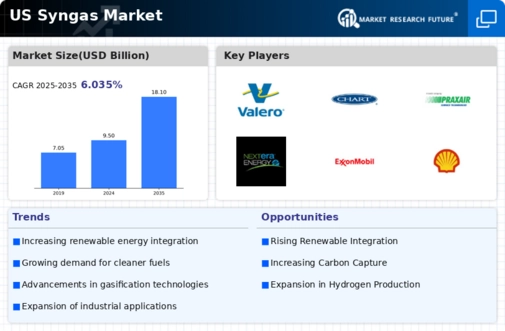
The US Syngas Market is expected to be valued at 9.5 billion USD in 2024.

What is the projected market size of the US Syngas Market by 2035?

By the year 2035, the US Syngas Market is projected to reach a value of 18.1 billion USD.

What is the expected compound annual growth rate (CAGR) for the US Syngas Market from 2025 to 2035?

The expected CAGR for the US Syngas Market from 2025 to 2035 is 6.035 percent.

What are the key feedstock segments in the US Syngas Market?

The key feedstock segments include Plastic Waste, Biomass, and Petroleum Coke.

What is the market value of the US Syngas segment for Plastic Waste in 2024?

The market value for the Plastic Waste segment is projected to be 3.8 billion USD in 2024.

How much is the Biomass feedstock expected to be valued in the US Syngas Market by 2035?

By 2035, the Biomass feedstock in the US Syngas Market is expected to be valued at 5.5 billion USD.

Which major companies are key players in the US Syngas Market?

Key players include Dow, SABIC Innovative Plastics, Valero Energy, and Air Products and Chemicals, among others.

What is the expected market value for Petroleum Coke in the US Syngas Market in 2024?

The expected market value for Petroleum Coke in 2024 is 2.7 billion USD.

What opportunities and trends are emerging in the US Syngas Market?

Emerging trends include increased adoption of sustainable feedstocks and advancements in gasification technologies.

What challenges does the US Syngas Market currently face?

The US Syngas Market currently faces challenges related to regulatory compliance and the volatility of feedstock prices.

Download Free Sample

Kindly complete the form below to receive a free sample of this Report

Compare Licence

×
Features License Type
Single User Multiuser License Enterprise User
Price $4,950 $5,950 $7,250
Maximum User Access Limit 1 User Upto 10 Users Unrestricted Access Throughout the Organization
Free Customization
Direct Access to Analyst
Deliverable Format
Platform Access
Discount on Next Purchase 10% 15% 15%
Printable Versions