×
Request Free Sample ×

Kindly complete the form below to receive a free sample of this Report

* Please use a valid business email

Leading companies partner with us for data-driven Insights

clients tt-cursor
Hero Background

US Water Clarifiers Market

ID: MRFR/CnM/12284-HCR
100 Pages
Garvit Vyas
October 2025

US Water Clarifiers Market

Share:
Download PDF ×

We do not share your information with anyone. However, we may send you emails based on your report interest from time to time. You may contact us at any time to opt-out.

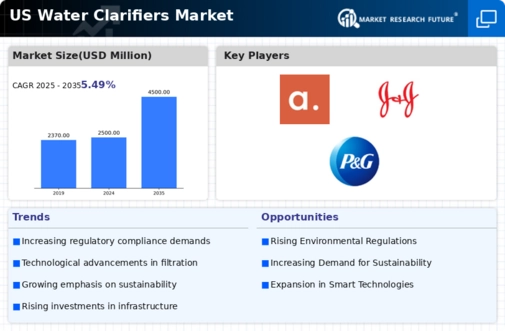
US Water Clarifiers Market Infographic
Purchase Options

US Water Clarifiers Market Summary

As per analysis, the US water clarifiers market is projected to grow from USD 1.26 Billion in 2025 to USD 2.33 Billion by 2035, exhibiting a compound annual growth rate (CAGR) of 6.3% during the forecast period (2025 - 2035).

Key Market Trends & Highlights

The US water clarifiers market is poised for growth driven by regulatory compliance and technological advancements.

  • The municipal water treatment segment remains the largest contributor to the market, reflecting a strong demand for effective water purification solutions.
  • Aquaculture is emerging as the fastest-growing segment, driven by the increasing need for sustainable fish farming practices.
  • Filtration technology continues to dominate the market, while membrane technology is rapidly gaining traction due to its efficiency.
  • Key market drivers include the rising demand for clean water and the impact of regulatory frameworks on water treatment practices.

Market Size & Forecast

2024 Market Size 1.19 (USD Billion)
2035 Market Size 2.33 (USD Billion)
CAGR (2025 - 2035) 6.3%

Major Players

Evoqua Water Technologies (US), Xylem Inc. (US), Pentair plc (US), SUEZ Water Technologies & Solutions (US), GE Water & Process Technologies (US), Aquatech International (US), Veolia North America (US), Aqua America Inc. (US)

US Water Clarifiers Market Trends

The US water clarifiers market is currently experiencing a notable evolution, driven by increasing awareness regarding water quality and the necessity for effective treatment solutions. As environmental regulations become more stringent, industries are compelled to adopt advanced technologies for water purification. This shift is not merely a response to regulatory pressures; it reflects a broader societal commitment to sustainability and public health. The demand for water clarifiers is likely to rise as municipalities and industries seek to enhance their water treatment processes, ensuring compliance with safety standards while addressing the growing concerns about waterborne contaminants. Moreover, the market appears to be influenced by technological advancements that enhance the efficiency and effectiveness of water clarifiers. Innovations in materials and design are enabling the development of more efficient systems that require less energy and maintenance. This trend suggests a potential shift towards more sustainable practices within the industry, as stakeholders increasingly prioritize eco-friendly solutions. The integration of smart technologies into water treatment processes may further transform the landscape, allowing for real-time monitoring and optimization of clarifier performance. As these trends unfold, the US water clarifiers market is poised for significant growth, reflecting a commitment to improving water quality across various sectors.

Increased Regulatory Compliance

The US water clarifiers market is witnessing a surge in demand due to heightened regulatory compliance requirements. Industries are increasingly required to meet stringent water quality standards, prompting investments in advanced clarifying technologies. This trend indicates a proactive approach to environmental stewardship, as organizations strive to align with federal and state regulations.

Technological Advancements

Innovations in water clarifier technology are reshaping the US market landscape. Enhanced materials and design improvements are leading to more efficient systems that minimize energy consumption and operational costs. This trend suggests a shift towards sustainable practices, as stakeholders seek to optimize performance while reducing environmental impact.

Growing Public Awareness

There is a noticeable increase in public awareness regarding water quality issues, which is influencing the US water clarifiers market. Consumers are becoming more informed about the importance of clean water, driving demand for effective treatment solutions. This trend highlights the role of education and advocacy in shaping market dynamics.

Market Segment Insights

By Application: Municipal Water Treatment (Largest) vs. Aquaculture (Fastest-Growing)

In the US water clarifiers market, Municipal Water Treatment holds the largest share, being the backbone of community infrastructure for clean water supply. Following closely, Wastewater Treatment plays a critical role in environmental management, while Industrial Water Treatment caters to diverse sectors that require high-quality water for operational efficiency. Swimming Pool Treatment and Aquaculture are significant yet smaller segments, each addressing niche markets within water clarity and safety requirements.

Aquaculture (Emerging) vs. Swimming Pool Treatment (Dominant)

Aquaculture is emerging as a vital segment within the US water clarifiers market, driven by increasing demand for sustainable fish farming practices and the need for clearer water to boost aquatic health. This segment's growth is supported by technological advancements in water filtration and clarifiers, enhancing efficiency and sustainability. In contrast, Swimming Pool Treatment remains dominant due to the growing popularity of recreational swimming and a focus on maintaining clean pool environments. This segment relies on robust chemical treatments and is characterized by high consumer awareness and consistent maintenance requirements.

By Technology: Filtration (Largest) vs. Membrane Technology (Fastest-Growing)

In the US water clarifiers market, the filtration segment commands the largest market share, thanks to its widespread application across various industries, including municipal water treatment and industrial operations. Following closely are coagulation and flocculation processes, which contribute significantly to the overall market but do not match the extensive utility of filtration. Sedimentation is also a critical part of the process, ensuring the removal of suspended solids efficiently, yet its market presence is comparatively smaller than filtration and membrane technologies. Membrane technology is observed as the fastest-growing segment in the market. Its advantage lies in advanced separation techniques that offer superior filtration capabilities and environmental sustainability. This segment is driven by technological advancements and increased regulatory standards that push industries to adopt more efficient water treatment solutions. The growing concerns around water scarcity and pollution further fuel the demand for innovative technologies, making membrane technology a key player in the market's future growth.

Technology: Filtration (Dominant) vs. Membrane Technology (Emerging)

Filtration remains the dominant technology in the US water clarifiers market due to its versatile applications and reliability in removing impurities from water sources. This segment includes various methods such as sand filtration and activated carbon filtration, which are widely utilized in both municipal and industrial settings. The ability to adapt to different water qualities makes filtration indispensable to water treatment processes. On the other hand, membrane technology is an emerging force, characterized by its innovative approach to water purification through processes like reverse osmosis and ultrafiltration. Membrane technology's growing adoption is driven by its effectiveness in removing micro-pollutants and enhancing water quality standards, appealing to sectors increasingly focused on sustainability and compliance with stringent environmental regulations.

By End Use: Residential (Largest) vs. Commercial (Fastest-Growing)

In the US water clarifiers market, the residential segment holds the largest market share, catering primarily to individual households seeking to improve water quality for consumption and domestic use. This segment's prominence is due to rising awareness about waterborne diseases and the increasing demand for cleaner, safer water solutions in households, thus driving its growth significantly.

End Use: Residential (Dominant) vs. Commercial (Emerging)

The residential segment serves as the dominant player in the US water clarifiers market, characterized by a robust demand for point-of-use and point-of-entry systems designed to enhance drinking water quality. Households are increasingly investing in water filtration and purification technologies, reflecting growing health and safety concerns. In contrast, the commercial segment is emerging rapidly, propelled by heightened regulatory standards for water quality in restaurants, hotels, and office buildings. As businesses strive to comply with these regulations while providing safe and appealing water to their customers, the demand for water clarifiers in the commercial sector is expected to rise sharply in the coming years.

By Product Type: Liquid Clarifiers (Largest) vs. Powdered Clarifiers (Fastest-Growing)

In the US water clarifiers market, Liquid Clarifiers hold the largest market share, favored for their ease of use and versatility. Powdered Clarifiers, while currently smaller in share, are rapidly gaining traction due to their high concentration and effectiveness in targeted applications. Granular and Tablet Clarifiers play supporting roles, catering to specific needs and preferences of end-users, thereby defining niche markets within the segment.

Liquid Clarifiers (Dominant) vs. Powdered Clarifiers (Emerging)

Liquid Clarifiers are recognized for their superior efficiency and user-friendly application process, making them a preferred choice among both residential and commercial users. Their ability to quickly clarify large volumes of water is unmatched, leading to sustained dominance in the market. In contrast, Powdered Clarifiers are emerging with notable growth, driven by their cost-effectiveness and concentration benefits. These clarifiers require minimal storage space and are ideal for specific water quality issues, enhancing their appeal in regions with particular water treatment needs. As environmental considerations push for more efficient solutions, both segments are likely to see innovation, shaping the overall market landscape.

By Distribution Channel: Direct Sales (Largest) vs. Online Sales (Fastest-Growing)

In the US water clarifiers market, the distribution landscape is diverse, with various channels playing significant roles. Direct Sales dominates the market, accounting for the largest share due to established relationships between manufacturers and customers. Distributors follow closely, leveraging their extensive networks to enhance reach. Online Sales have witnessed a remarkable increase in popularity, appealing to tech-savvy consumers seeking convenience. Retail remains a traditional yet essential channel, catering to customers who prefer hands-on shopping experiences.

Direct Sales (Dominant) vs. Online Sales (Emerging)

Direct Sales is characterized by direct engagement between manufacturers and consumers, allowing for personalized services and tailored solutions, which enhances customer loyalty. It remains the dominant force in the US water clarifiers market due to established relationships and trust. In contrast, Online Sales is rapidly emerging, driven by the increasing preference for e-commerce and digital solutions. This channel offers convenience, quick access to product information, and competitive pricing, attracting a younger demographic. The shift towards online purchasing is reshaping distribution strategies, prompting manufacturers to enhance their online presence.

Get more detailed insights about US Water Clarifiers Market

Key Players and Competitive Insights

The water clarifiers market is characterized by a dynamic competitive landscape, driven by increasing demand for clean water and stringent regulatory frameworks. Key players such as Evoqua Water Technologies (US), Xylem Inc. (US), and Pentair plc (US) are at the forefront, each adopting distinct strategies to enhance their market positioning. Evoqua Water Technologies (US) focuses on innovation and sustainability, emphasizing advanced filtration technologies to meet evolving environmental standards. Meanwhile, Xylem Inc. (US) leverages its extensive portfolio to drive digital transformation initiatives, integrating IoT solutions into its product offerings. Pentair plc (US) appears to prioritize strategic partnerships, collaborating with local entities to expand its reach and enhance service delivery, thereby shaping a competitive environment that increasingly values technological advancement and customer-centric solutions.

The market structure is moderately fragmented, with numerous players vying for market share. Key business tactics include localizing manufacturing to reduce costs and optimize supply chains, which is particularly relevant in the context of rising operational expenses. The collective influence of these major players fosters a competitive atmosphere where innovation and efficiency are paramount, compelling companies to continuously adapt to market demands.

In November 2025, Evoqua Water Technologies (US) announced the launch of a new line of eco-friendly clarifiers designed to reduce energy consumption by 30%. This strategic move not only aligns with global sustainability trends but also positions Evoqua as a leader in environmentally responsible water treatment solutions. The introduction of these products is likely to enhance their competitive edge, appealing to environmentally conscious consumers and regulatory bodies alike.

In October 2025, Xylem Inc. (US) unveiled a partnership with a leading tech firm to develop AI-driven water management systems. This collaboration aims to enhance operational efficiency and predictive maintenance capabilities for water treatment facilities. By integrating AI technologies, Xylem is poised to revolutionize the way water clarifiers operate, potentially setting new industry standards and improving service reliability.

In September 2025, Pentair plc (US) expanded its operations in the Midwest by acquiring a regional water treatment company. This acquisition is expected to bolster Pentair's market presence and enhance its service capabilities in a key growth area. Such strategic expansions reflect a broader trend of consolidation within the industry, as companies seek to strengthen their market positions through acquisitions and mergers.

As of December 2025, current competitive trends are increasingly defined by digitalization, sustainability, and the integration of advanced technologies such as AI. Strategic alliances are becoming more prevalent, enabling companies to pool resources and expertise to tackle complex challenges in water treatment. Looking ahead, competitive differentiation is likely to evolve from traditional price-based competition to a focus on innovation, technological advancements, and supply chain reliability. This shift underscores the importance of adaptability and forward-thinking strategies in maintaining a competitive edge in the water clarifiers market.


Key Companies in the US Water Clarifiers Market market include

Future Outlook

US Water Clarifiers Market Future Outlook

The US water clarifiers market is projected to grow at a 6.3% CAGR from 2024 to 2035, driven by increasing environmental regulations, technological advancements, and rising demand for clean water.

New opportunities lie in:

  • Development of advanced polymer-based clarifiers for enhanced efficiency.
  • Integration of IoT technology for real-time monitoring and maintenance.
  • Expansion into underserved rural markets with tailored solutions.

By 2035, the market is expected to be robust, driven by innovation and strategic expansion.

Market Segmentation

US Water Clarifiers Market End Use Outlook

  • Residential
  • Commercial
  • Industrial
  • Agricultural
  • Institutional

US Water Clarifiers Market Technology Outlook

  • Coagulation
  • Flocculation
  • Sedimentation
  • Filtration
  • Membrane Technology

US Water Clarifiers Market Application Outlook

  • Municipal Water Treatment
  • Industrial Water Treatment
  • Wastewater Treatment
  • Aquaculture
  • Swimming Pool Treatment

US Water Clarifiers Market Product Type Outlook

  • Liquid Clarifiers
  • Powdered Clarifiers
  • Granular Clarifiers
  • Tablet Clarifiers

US Water Clarifiers Market Distribution Channel Outlook

  • Direct Sales
  • Distributors
  • Online Sales
  • Retail

Report Scope

MARKET SIZE 20241.19(USD Billion)
MARKET SIZE 20251.26(USD Billion)
MARKET SIZE 20352.33(USD Billion)
COMPOUND ANNUAL GROWTH RATE (CAGR)6.3% (2024 - 2035)
REPORT COVERAGERevenue Forecast, Competitive Landscape, Growth Factors, and Trends
BASE YEAR2024
Market Forecast Period2025 - 2035
Historical Data2019 - 2024
Market Forecast UnitsUSD Billion
Key Companies ProfiledEvoqua Water Technologies (US), Xylem Inc. (US), Pentair plc (US), SUEZ Water Technologies & Solutions (US), GE Water & Process Technologies (US), Aquatech International (US), Veolia North America (US), Aqua America Inc. (US)
Segments CoveredApplication, Technology, End Use, Product Type, Distribution Channel
Key Market OpportunitiesAdoption of advanced filtration technologies driven by increasing regulatory standards and consumer demand for clean water.
Key Market DynamicsRising regulatory pressures drive innovation and competition in the US water clarifiers market.

Countries CoveredUS

Leave a Comment

Download Free Sample

Kindly complete the form below to receive a free sample of this Report

Compare Licence

×
Features License Type
Single User Multiuser License Enterprise User
Price $4,950 $5,950 $7,250
Maximum User Access Limit 1 User Upto 10 Users Unrestricted Access Throughout the Organization
Free Customization
Direct Access to Analyst
Deliverable Format
Platform Access
Discount on Next Purchase 10% 15% 15%
Printable Versions