User Experience Research Software Market
User Experience Research Software Market Summary
As per Market Research Future analysis, the UX Research Software Market Size was estimated at 0.27 USD Billion in 2024. The UX Research Software industry is projected to grow from USD 0.2946 Billion in 2025 to USD 0.7039 Billion by 2035, exhibiting a compound annual growth rate (CAGR) of 9.1% during the forecast period 2025 - 2035
Key Market Trends & Highlights
The UX Research Software Market is experiencing robust growth driven by technological advancements and evolving user needs.
- The integration of AI and machine learning is transforming UX research methodologies, enhancing data analysis and user insights.
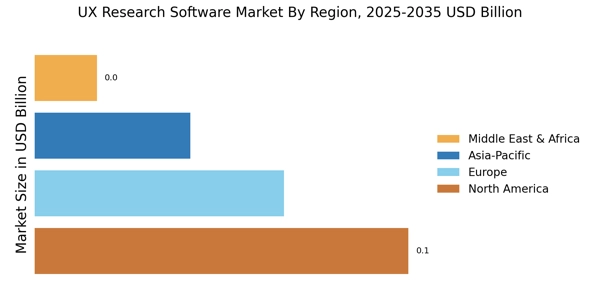
- North America remains the largest market for UX research software, while Asia-Pacific is emerging as the fastest-growing region.
- Cloud-based solutions dominate the market, although on-premise offerings are witnessing rapid growth due to specific enterprise needs.
- The increased demand for user-centric design and the adoption of agile methodologies are key drivers propelling market expansion.
Market Size & Forecast
| 2024 Market Size | 0.27 (USD Billion) |
| 2035 Market Size | 0.7039 (USD Billion) |
| CAGR (2025 - 2035) | 9.1% |
Major Players
UserTesting (US), Lookback (US), Optimal Workshop (NZ), UsabilityHub (AU), Maze (US), Dovetail (AU), Hotjar (MT), Qualaroo (US), Crazy Egg (US)
User Experience Research Software Market Trends
The UX Research Software Market is currently experiencing a dynamic evolution, driven by the increasing emphasis on user-centered design and the necessity for organizations to understand user behavior more deeply. As digital products proliferate, the demand for tools that facilitate effective user research has surged. Companies are recognizing that investing in UX research software not only enhances product usability but also fosters customer loyalty and satisfaction. This market appears to be characterized by a diverse array of solutions, ranging from qualitative research tools to quantitative analytics platforms, each catering to different aspects of user experience research. Furthermore, the integration of artificial intelligence and machine learning technologies into these tools is likely to enhance their capabilities, providing deeper insights and more efficient data analysis. In addition, the UX Research Software Market seems to be influenced by the growing trend of remote work and distributed teams. As organizations adapt to new working environments, the need for collaborative research tools that can be accessed from various locations has become increasingly apparent. This shift may lead to the development of more cloud-based solutions that facilitate real-time collaboration among researchers and stakeholders. Overall, the UX Research Software Market is poised for continued growth, with innovations and evolving user needs shaping its trajectory in the coming years.
Integration of AI and Machine Learning
The incorporation of artificial intelligence and machine learning into UX research software is becoming more prevalent. These technologies can automate data analysis, identify patterns, and provide actionable insights, thereby streamlining the research process. This trend suggests a shift towards more sophisticated tools that enhance the efficiency and effectiveness of user research.
Rise of Remote Collaboration Tools
As remote work becomes a standard practice, there is a noticeable increase in demand for UX research software that supports collaboration among distributed teams. Tools that enable real-time sharing of insights and findings are likely to gain traction, facilitating a more inclusive research process that accommodates diverse perspectives.
Focus on Data Privacy and Security
With growing concerns about data privacy, UX research software is increasingly prioritizing security features. Organizations are seeking solutions that not only comply with regulations but also ensure the protection of user data. This trend indicates a heightened awareness of ethical considerations in user research.
User Experience Research Software Market Drivers
Emergence of New Technologies
The emergence of new technologies is reshaping the UX Research Software Market in profound ways. Innovations such as virtual reality, augmented reality, and artificial intelligence are creating new avenues for user research and testing. These technologies enable researchers to gather insights in more immersive and interactive ways, enhancing the overall understanding of user experiences. As organizations explore these advanced technologies, the demand for specialized UX research software that can accommodate these tools is expected to rise. This trend indicates a potential shift in the UX Research Software Market, as companies seek to leverage cutting-edge technologies to gain a competitive edge in understanding user needs and preferences.
Adoption of Agile Methodologies
The UX Research Software Market is significantly influenced by the widespread adoption of agile methodologies across various sectors. Agile practices emphasize iterative development and continuous feedback, which align closely with the objectives of UX research. As organizations strive to enhance their product development processes, the integration of UX research tools becomes essential for gathering user feedback in real-time. This shift towards agile methodologies is reflected in a 70% increase in the use of UX research software among agile teams. Consequently, the UX Research Software Market is likely to expand as more companies recognize the value of incorporating user insights into their agile workflows, thereby improving overall product quality and user satisfaction.
Increased Demand for User-Centric Design
The UX Research Software Market experiences a notable surge in demand for user-centric design solutions. As organizations increasingly recognize the importance of user experience in driving customer satisfaction and loyalty, the need for effective UX research tools becomes paramount. According to recent data, companies that prioritize user experience can see conversion rates increase by up to 400%. This trend indicates that businesses are willing to invest in UX research software to gain insights into user behavior and preferences, ultimately leading to more informed design decisions. The emphasis on user-centric design is likely to propel the growth of the UX Research Software Market, as companies seek to enhance their products and services to meet evolving consumer expectations.
Expansion of E-Commerce and Digital Services
The ongoing expansion of e-commerce and digital services is a significant driver for the UX Research Software Market. As more businesses transition to online platforms, the need for effective UX research tools becomes increasingly critical to ensure optimal user experiences. With e-commerce sales projected to reach over 6 trillion dollars by 2024, companies are investing in UX research software to understand user behavior and preferences in the digital space. This investment is essential for creating seamless online experiences that can lead to higher conversion rates and customer retention. The growth of e-commerce and digital services is likely to propel the UX Research Software Market, as organizations strive to meet the demands of a rapidly evolving digital landscape.
Growing Importance of Data-Driven Decision Making
In the current landscape, the UX Research Software Market is witnessing a growing emphasis on data-driven decision making. Organizations are increasingly relying on analytics and user data to inform their design strategies, leading to a heightened demand for robust UX research tools. The ability to collect, analyze, and interpret user data is crucial for making informed design choices that resonate with target audiences. Recent statistics indicate that companies utilizing data-driven approaches are 5 times more likely to make faster decisions than their competitors. This trend suggests that the UX Research Software Market will continue to thrive as businesses seek to leverage data insights to enhance user experiences and drive innovation.
Market Segment Insights
By Type: Cloud (Largest) vs. On-Premise (Fastest-Growing)
In the UX Research Software Market, the distribution of market share between On-Premise and Cloud solutions is quite pronounced. The Cloud segment currently holds the largest share of the market, primarily due to its flexibility, accessibility, and consistent updates that enhance user experience. On-Premise solutions, although trailing in overall market share, offer critical benefits such as enhanced security and customization, making them appealing to specific user bases who value control and data integrity. The growth trends within this segment indicate a shifting landscape, where Cloud solutions are becoming increasingly dominant due to their scalability and cost-effectiveness. On-Premise software, however, has shown robust growth patterns, driven by industries with stringent compliance requirements and a need for tailored solutions. As organizations become more aware of data privacy, On-Premise systems may see heightened adoption, marking them as an emerging force in the market.
Cloud (Dominant) vs. On-Premise (Emerging)
The Cloud segment in UX Research Software is characterized by its ability to deliver a range of user-friendly applications that can be accessed from anywhere, fostering greater collaboration and faster iteration cycles. This flexibility is enhancing its popularity among businesses looking to streamline their UX research processes. In contrast, On-Premise solutions are being increasingly recognized for their robustness and security, making them especially appealing to larger organizations that require extensive customization and are willing to invest in sophisticated infrastructure. While Cloud software caters to a broad base of users seeking convenience and lower initial costs, On-Premise offerings are gradually gaining traction as organizations prioritize data sovereignty and adhere to stringent industry standards.
By Application: Large Enterprises (Largest) vs. SMEs (Fastest-Growing)
In the UX Research Software Market, large enterprises hold a significant share due to their robust budgets and the necessity for extensive user research across various platforms. They leverage advanced tools to gain comprehensive insights, which enhances their competitive advantage. Conversely, SMEs, while smaller in share, are rapidly adopting UX research software to improve user engagement and customer satisfaction, marking a shift in market dynamics.
Large Enterprises: (Dominant) vs. SMEs (Emerging)
Large enterprises dominate the UX Research Software Market by utilizing advanced resources and large-scale research initiatives. They tend to integrate UX software across various departments to streamline user experience, ensuring consistent and high-quality outputs. On the other hand, SMEs represent an emerging segment, increasingly recognizing the importance of user experience in driving business success. With limited resources, they seek cost-effective UX research tools tailored for smaller scale operations. This shift indicates that SMEs are scaling up their investment in user research, making them a vital growth driver in the industry.
Regional Insights
By region, the study provides market insights for UX research software into North America, Europe, Asia-Pacific, and the Rest of the World. The North America UX Research Software market accounted for USD 91.6 million in 2022 and is expected to exhibit a significant CAGR growth during the study period. This is attributed to the high investments by market players in marketing and in improving customer satisfaction.
Further, the major countries studied in the market report for UX research software are The U.S., Canada, Germany, France, the UK, Italy, Spain, China, Japan, India, Australia, South Korea, and Brazil.
Figure 4: UX RESEARCH SOFTWARE MARKET SHARE BY REGION 2022 (%)
Europe's UX research software market accounts for the second-largest market share due to the high number of internet users, better internet facilities, and high focus of players on user satisfaction. The rising demand in the region has seen players acquiring local market leaders to improve their market presence. For instance, in May 2022 UserZoom, a London-based research platform, acquired Testapic, a French UX insights company, to improve their performance in France. Moreover, UK UX research software market held the largest market share, and the Germany UX research software market was the fastest growing market in the region.
The Asia-Pacific UX research software market is expected to grow at the fastest CAGR from 2022 to 2030. The increasing customer base and rising use of mobile devices are major factors for this significant market growth. A growing focus on digital marketing and providing a high level of customer satisfaction to grow business in the region is also expected to help the market. The rising number of digital platforms and their influence on purchase behavior, combined with the rising purchasing power of the consumer base in the region, is also expected to have a positive impact on market growth.
Further, the China UX research software market held the largest market share, and the India UX research software market was the fastest growing market in the region.
Key Players and Competitive Insights
Major market players for UX research software are spending a lot of money on R&D to improve their software performance, which will help the UX research software market grow even more. Market participants are also taking a range of strategic initiatives to grow their worldwide footprint, with key market developments for UX research software such as contractual agreements, mergers and acquisitions, increased investments, and collaboration with other organizations. Competitors in the UX research software industry must offer cost-effective items to expand and survive in an increasingly competitive and rising market environment.
One of the primary business strategies adopted by manufacturers in the UX Research Software industry to benefit clients and expand the market sector is to provide comprehensive solutions. In recent years, the UX Research Software industry has provided marketing departments with some of the most significant benefits. The UX Research Software markets major players such as UserTesting (US), Qualtrics (US), Hotjar (Malta), UserZoom(UK), and others are working on expanding the market demand by investing in research and development activities.
UserTesting (US) is a human insights platform. The company provides a platform that can capture customer feedback with the help of data visualization. It also makes use of machine learning to understand sentiment and behavioral nuances.
In April UserTesting introduced features that gave players to customize their findings with personal terminologies.
In January Thomas Bravo, a software investment firm, invested about USD 1.3 Billion in UserTesting.
Also, Qualtrics (US) is an American company that provides an experience management platform. It uses a cloud-based subscription model to offer the service. In 2019, Qualtrics was acquired by SAP SE for USD 8 billion. Firms like KFC, Qualcomm, Kyndryl, Wipro, Domino's, and BMW use Qualtrics for their employee feedback and customer satisfaction analysis.
In January Qualtrics expanded its operating centers to Australia, Singapore, and Japan, with new headquarters in Tokyo and Greater China to improve its presence in the Asia-Pacific market.
Key Companies in the User Experience Research Software Market include
Industry Developments
- Q2 2024: UserTesting appoints former Google executive as new CEO UserTesting announced the appointment of a former Google executive as its new Chief Executive Officer, aiming to accelerate product innovation and global expansion in the user experience research software sector.
- Q2 2024: UserZoom launches AI-powered usability testing suite UserZoom unveiled a new suite of AI-powered usability testing tools designed to automate user feedback analysis and deliver faster, actionable insights for enterprise clients.
- Q3 2024: Hotjar acquires session replay startup Reflectly Hotjar announced the acquisition of Reflectly, a session replay and analytics startup, to enhance its user experience research platform with advanced behavioral analytics capabilities.
- Q3 2024: Lookback secures $15M in Series B funding to expand remote research platform Lookback raised $15 million in a Series B funding round to scale its remote user research platform and invest in new features for real-time collaboration and video analysis.
- Q4 2024: Qualtrics partners with Microsoft to integrate UX research tools into Teams Qualtrics announced a strategic partnership with Microsoft to integrate its user experience research tools directly into Microsoft Teams, enabling seamless feedback collection within enterprise workflows.
- Q4 2024: PlaybookUX launches automated participant recruitment feature PlaybookUX introduced a new automated participant recruitment feature, streamlining the process for researchers to find and onboard study participants for usability testing.
- Q1 2025: Userlytics opens new European headquarters in Berlin Userlytics opened a new European headquarters in Berlin to support its growing client base in the region and comply with evolving data privacy regulations.
- Q1 2025: Validately launches mobile-first UX research platform Validately released a new mobile-first user experience research platform, enabling researchers to conduct usability studies and collect feedback directly from mobile devices.
- Q2 2025: UserTesting acquires AI analytics startup DeepInsight UserTesting completed the acquisition of DeepInsight, an AI analytics startup, to bolster its automated data analysis capabilities and enhance its user research offerings.
- Q2 2025: Dovetail announces partnership with Atlassian for integrated research workflows Dovetail entered into a partnership with Atlassian to integrate its user research repository with Jira and Confluence, streamlining research documentation and collaboration for product teams.
- Q3 2025: Maze secures $30M Series C funding to accelerate product development Maze raised $30 million in Series C funding to accelerate the development of its rapid user testing platform and expand its global operations.
- Q3 2025: UserZoom launches compliance-ready UX research suite for healthcare sector UserZoom introduced a new compliance-ready user experience research suite tailored for the healthcare sector, supporting HIPAA and GDPR requirements for sensitive user data.
Future Outlook
User Experience Research Software Market Future Outlook
The UX Research Software Market is projected to grow at a 9.1% CAGR from 2025 to 2035, driven by increasing demand for user-centric design and technological advancements.
New opportunities lie in:
- Integration of AI-driven analytics for enhanced user insights.
- Development of mobile UX research tools for remote testing.
- Expansion into emerging markets with localized UX solutions.
By 2035, the market is expected to be robust, reflecting substantial growth and innovation.

Market Segmentation
User Experience Research Software Market Type Outlook
- On-Premise
- Cloud
User Experience Research Software Market Application Outlook
- Large Enterprises
- SMEs
Report Scope
| MARKET SIZE 2024 | 0.27(USD Billion) |
| MARKET SIZE 2025 | 0.2946(USD Billion) |
| MARKET SIZE 2035 | 0.7039(USD Billion) |
| COMPOUND ANNUAL GROWTH RATE (CAGR) | 9.1% (2025 - 2035) |
| REPORT COVERAGE | Revenue Forecast, Competitive Landscape, Growth Factors, and Trends |
| BASE YEAR | 2024 |
| Market Forecast Period | 2025 - 2035 |
| Historical Data | 2019 - 2024 |
| Market Forecast Units | USD Billion |
| Key Companies Profiled | UserTesting (US), Lookback (US), Optimal Workshop (NZ), UsabilityHub (AU), Maze (US), Dovetail (AU), Hotjar (MT), Qualaroo (US), Crazy Egg (US) |
| Segments Covered | Type, Application, Region |
| Key Market Opportunities | Integration of artificial intelligence enhances user insights in the UX Research Software Market. |
| Key Market Dynamics | Rising demand for user-centric design drives innovation and competition in the UX Research Software market. |
| Countries Covered | North America, Europe, APAC, South America, MEA |
Market Highlights
FAQs
What is the current valuation of the UX Research Software Market as of 2024?
The UX Research Software Market was valued at 0.27 USD Billion in 2024.
What is the projected market size for the UX Research Software Market in 2035?
The market is projected to reach 0.7039 USD Billion by 2035.
What is the expected CAGR for the UX Research Software Market from 2025 to 2035?
The expected CAGR for the UX Research Software Market during the forecast period 2025 - 2035 is 9.1%.
Which companies are considered key players in the UX Research Software Market?
Key players include UserTesting, Lookback, Optimal Workshop, UsabilityHub, Maze, Dovetail, Hotjar, Qualaroo, and Crazy Egg.
How does the market segmentation by type look in terms of valuation?
In 2024, the On-Premise segment was valued at 0.1 USD Billion, while the Cloud segment reached 0.17 USD Billion.
What is the projected growth for the Cloud segment by 2035?
The Cloud segment is expected to grow significantly, potentially reaching 0.4539 USD Billion by 2035.
What are the market valuations for large enterprises and SMEs in 2024?
What is the anticipated performance of SMEs in the UX Research Software Market by 2035?
How does the UX Research Software Market's growth compare between large enterprises and SMEs?
What trends are influencing the UX Research Software Market in 2025?
Kindly complete the form below to receive a free sample of this Report
Customer Stories
“This is really good guys. Excellent work on a tight deadline. I will continue to use you going forward and recommend you to others. Nice job”
“Thanks. It’s been a pleasure working with you, please use me as reference with any other Intel employees.”
“Thanks for sending the report it gives us a good global view of the Betaïne market.”
“Thank you, this will be very helpful for OQS.”
“We found the report very insightful! we found your research firm very helpful. I'm sending this email to secure our future business.”
“I am very pleased with how market segments have been defined in a relevant way for my purposes (such as "Portable Freezers & refrigerators" and "last-mile"). In general the report is well structured. Thanks very much for your efforts.”
“I have been reading the first document or the study, ,the Global HVAC and FP market report 2021 till 2026. Must say, good info! I have not gone in depth at all parts, but got a good indication of the data inside!”
“We got the report in time, we really thank you for your support in this process. I also thank to all of your team as they did a great job.”