×
Request Free Sample ×

Kindly complete the form below to receive a free sample of this Report

* Please use a valid business email

Leading companies partner with us for data-driven Insights

clients tt-cursor
Hero Background

Utility Asset Management Market

ID: MRFR/ICT/3946-HCR
111 Pages
Aarti Dhapte
October 2025

Utility Asset Management Market Research Report Information By Application (Transformer, Sub-Station, Transmission, and Distribution Lines), By Component (Hardware (sensors, infrared cameras, others) and Software (Equipment/component management, performance management, production management)), By Utility Type (Public Utility and Private Utility) And By Region (North America, Europe, Asia-Pacific, And Rest Of The World) –Market Forecast Till 2035

Share:
Download PDF ×

We do not share your information with anyone. However, we may send you emails based on your report interest from time to time. You may contact us at any time to opt-out.

Utility Asset Management Market Infographic
Purchase Options

Utility Asset Management Market Summary

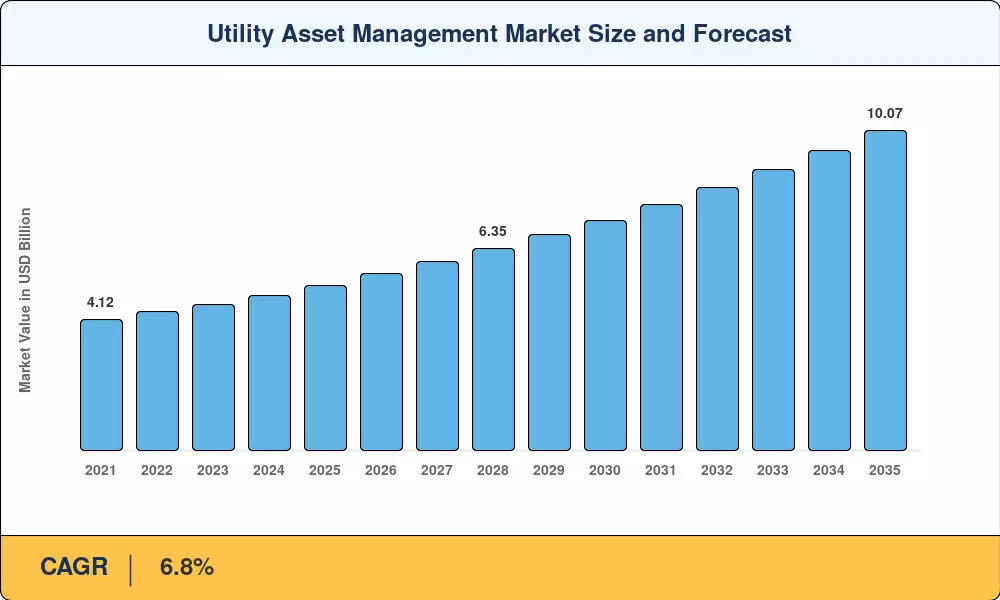
As per MRFR analysis, the Utility Asset Management Market Size was estimated at 5.44 USD Billion in 2024. The Utility Asset Management industry is projected to grow from 5.98 in 2025 to 15.38 by 2035, exhibiting a compound annual growth rate (CAGR) of 9.9 during the forecast period 2025 - 2035.

Key Market Trends & Highlights

The Utility Asset Management Market is experiencing robust growth driven by digital transformation and sustainability initiatives.

  • Digital transformation is reshaping asset management practices, particularly in North America, which remains the largest market.
  • Sustainability and regulatory compliance are becoming increasingly critical, influencing strategies across both electric and water utilities.
  • Predictive maintenance strategies are gaining traction, especially within the asset performance management segment, which is the largest.
  • Technological advancements and the growing demand for renewable energy sources are key drivers propelling market expansion in the Asia-Pacific region.

Market Size & Forecast

2024 Market Size 5.44 (USD Billion)
2035 Market Size 15.38 (USD Billion)
CAGR (2025 - 2035) 9.9%

Major Players

Siemens (DE), Schneider Electric (FR), GE Digital (US), IBM (US), Oracle (US), SAP (DE), Honeywell (US), ABB (CH), Emerson Electric (US)

Utility Asset Management Market Trends

The Utility Asset Management Market is currently experiencing a transformative phase, driven by the increasing need for efficient resource allocation and enhanced operational performance. Organizations are recognizing the importance of managing their assets effectively to reduce costs and improve service delivery. This shift is largely influenced by advancements in technology, which facilitate better data collection and analysis, enabling utilities to make informed decisions regarding asset lifecycle management. Furthermore, regulatory pressures and the growing emphasis on sustainability are prompting companies to adopt more proactive asset management strategies. In December 2025, the market appears poised for further growth as stakeholders increasingly prioritize digital solutions and integrated management systems. The integration of Internet of Things (IoT) devices and artificial intelligence into asset management practices is likely to enhance predictive maintenance capabilities, thereby minimizing downtime and extending asset lifespan. As the Utility Asset Management Market evolves, it seems that organizations will continue to seek innovative approaches to optimize their operations and meet the demands of a changing energy landscape.

Digital Transformation in Asset Management

The ongoing digital transformation within the Utility Asset Management Market indicates a shift towards the adoption of advanced technologies. This trend encompasses the integration of IoT devices, cloud computing, and big data analytics, which collectively enhance the ability to monitor and manage assets in real-time. As utilities embrace these innovations, they are likely to improve operational efficiency and decision-making processes.

Sustainability and Regulatory Compliance

There is a growing emphasis on sustainability within the Utility Asset Management Market, driven by regulatory frameworks and societal expectations. Companies are increasingly focusing on environmentally responsible practices, which may lead to the adoption of green technologies and sustainable asset management strategies. This trend suggests that compliance with regulations will become a critical factor in shaping asset management approaches.

Predictive Maintenance Strategies

The trend towards predictive maintenance within the Utility Asset Management Market appears to be gaining traction. By leveraging data analytics and machine learning, utilities can anticipate potential failures and address issues before they escalate. This proactive approach not only reduces operational disruptions but also optimizes maintenance costs, thereby enhancing overall asset performance.

Utility Asset Management Market Drivers

Market Growth Projections

The Global Utility Asset Management Market Industry is poised for substantial growth, with projections indicating a market size of 5.98 USD Billion in 2024 and an anticipated increase to 15.4 USD Billion by 2035. This growth trajectory suggests a robust demand for asset management solutions driven by technological advancements, regulatory compliance, and sustainability initiatives. The expected CAGR of 8.96% from 2025 to 2035 further emphasizes the market's potential as utilities increasingly prioritize efficient asset management strategies to enhance operational performance and service delivery.

Technological Advancements

Technological innovations are reshaping the Global Utility Asset Management Market Industry, enabling utilities to optimize operations and enhance asset performance. The integration of IoT, AI, and big data analytics allows for real-time monitoring and predictive maintenance, reducing downtime and improving service reliability. For example, utilities can leverage these technologies to analyze asset health and forecast failures, thereby minimizing costly outages. As these technologies become more accessible, the market is expected to expand significantly, potentially reaching 15.4 USD Billion by 2035. This growth indicates a shift towards data-driven decision-making in asset management.

Rising Demand for Renewable Energy

The transition towards renewable energy sources is a key driver of the Global Utility Asset Management Market Industry. As countries aim to meet their carbon reduction targets, there is an increasing need for effective management of renewable assets such as wind and solar farms. This shift necessitates advanced asset management solutions that can optimize the performance and reliability of these resources. The growing emphasis on renewable energy is likely to propel market growth, as utilities seek to integrate these assets into their portfolios while ensuring compliance with regulatory standards. This trend underscores the importance of innovative asset management practices in the evolving energy landscape.

Regulatory Compliance and Standards

The Global Utility Asset Management Market Industry is heavily influenced by regulatory frameworks that mandate utilities to adhere to safety and performance standards. Compliance with these regulations often necessitates the adoption of advanced asset management practices to ensure operational integrity and environmental sustainability. For instance, utilities may need to implement rigorous monitoring systems to meet regulatory requirements, which can drive the demand for sophisticated asset management solutions. As regulations evolve, utilities are likely to invest in technologies that facilitate compliance, thereby contributing to market growth and enhancing overall service quality.

Focus on Sustainability and Resilience

Sustainability initiatives are increasingly shaping the Global Utility Asset Management Market Industry, as utilities strive to reduce their environmental impact and enhance resilience against climate change. This focus on sustainability often leads to the adoption of renewable energy sources and energy-efficient technologies. Utilities are investing in asset management strategies that prioritize sustainable practices, which can improve operational efficiency and reduce costs. As a result, the market is expected to grow at a CAGR of 8.96% from 2025 to 2035, reflecting the industry's commitment to balancing economic viability with environmental stewardship.

Increasing Investment in Infrastructure

The Global Utility Asset Management Market Industry is witnessing a surge in investments aimed at modernizing and expanding infrastructure. Governments worldwide are recognizing the necessity of upgrading aging utility systems to enhance reliability and efficiency. For instance, in 2024, the market is projected to reach 5.98 USD Billion, driven by initiatives to replace outdated equipment and implement smart technologies. This trend suggests a commitment to improving service delivery and reducing operational costs, which could lead to a more sustainable utility landscape. As countries prioritize infrastructure development, the demand for advanced asset management solutions is likely to grow.

Market Segment Insights

By Application: Asset Performance Management (Largest) vs. Risk Management (Fastest-Growing)

In the Utility Asset Management Market, Asset Performance Management emerges as the largest segment, dominating the market share due to its critical role in optimizing the lifespan and functionality of assets. This segment encompasses tools and strategies for measuring asset performance, resulting in improved operational efficiency and cost savings. Risk Management follows closely, growing rapidly as companies prioritize identifying, assessing, and mitigating potential risks associated with their utility assets, ensuring operational resilience and reliability.

Asset Performance Management (Dominant) vs. Risk Management (Emerging)

Asset Performance Management serves as the cornerstone of utility asset management, focusing on the analytics of asset performance to drive effective decision-making. It leverages advanced technologies like IoT and predictive analytics to enhance asset reliability and minimize downtime. Meanwhile, Risk Management has become an emerging segment, fueled by increasing regulatory scrutiny and the need to navigate complex operational challenges. It emphasizes proactive risk assessment and management strategies, making it essential for utilities to sustain service delivery without interruptions. As utilities shift their focus from reactive to proactive management, the growth trajectory of Risk Management is expected to accelerate, complementing the established dominance of Asset Performance Management.

By End Use: Electric Utilities (Largest) vs. Water Utilities (Fastest-Growing)

In the Utility Asset Management Market, the Electric Utilities segment holds the largest market share, driven by the increasing demand for efficient and reliable electricity distribution. This segment's dominance is attributed to the expansion of electrical grids and innovations in smart grid technologies that enable better asset management. Following closely, Water Utilities are emerging as the fastest-growing segment, highlighting the increasing focus on sustainable water management and regulatory mandates for water quality and infrastructure improvements.

Water Utilities: Emerging vs. Gas Utilities: Dominant

The Water Utilities sector has become an emerging force within the Utility Asset Management Market, primarily due to the pressing need for advanced water management solutions. This segment is responding to challenges such as aging infrastructure and growing water scarcity. In contrast, the Gas Utilities sector remains dominant, benefiting from stable demand patterns and the crucial role of natural gas in energy transition strategies. Both sectors address unique challenges and opportunities, with Water Utilities aiming for modernization and efficiency, while Gas Utilities leverage existing infrastructure to enhance service reliability.

By Deployment Type: Cloud-Based (Largest) vs. On-Premises (Fastest-Growing)

The Utility Asset Management Market exhibits a significant distribution among its deployment types. The Cloud-Based segment has emerged as the largest, dominating the market due to its scalability, cost-effectiveness, and enhanced accessibility. On the other hand, while the On-Premises deployment is currently gaining traction among larger utilities that prioritize data control and security, it stands as the fastest-growing segment, fueled by increasing demand for tailored solutions. Overall, this shift highlights a dynamic balance between traditional and modern deployment strategies in the sector. Growing concerns over cybersecurity and the need for robust, real-time data analytics are driving the adoption rates of various deployment types in the Utility Asset Management Market. While Cloud-Based solutions lead in overall market presence, the rapid digitization and technological advancements are pushing organizations towards On-Premises deployments, particularly in sectors concerned with compliance and data sovereignty. Therefore, while Cloud-Based remains a stronghold, the On-Premises segment is expected to witness remarkable growth, adapting to meet the evolving needs of utility providers.

Cloud-Based (Dominant) vs. On-Premises (Emerging)

The Cloud-Based deployment within the Utility Asset Management Market is characterized by its ability to deliver real-time analytics, ease of integration, and lower upfront costs. Companies utilizing this model benefit from the flexibility of scaling resources according to demand, enabling enhanced operational efficiency and collaboration across teams. In contrast, the On-Premises deployment, while emerging, is favored by organizations seeking greater control over their data and infrastructure. Such systems provide robust security measures and customization options, appealing to larger utility providers who prioritize compliance and risk management in their operations. As these segments evolve, a careful analysis of their advantages will shape the future landscape of utility asset management.

By Component: Software (Largest) vs. Services (Fastest-Growing)

In the Utility Asset Management Market, the component segment is primarily driven by three key players: Software, Services, and Hardware. Notably, Software holds the largest share of the market, given its essential role in data management, operational efficiency, and asset tracking. Services, while relatively smaller in terms of market share, are rapidly gaining traction, reflecting a shift in focus towards more integrated solutions that encompass ongoing maintenance and support. Hardware remains a critical segment but is overshadowed by the growing reliance on software solutions.

Software: Data Management (Dominant) vs. Services: Consulting (Emerging)

Software solutions like data management platforms dominate the Utility Asset Management Market by facilitating real-time monitoring, predictive maintenance, and efficient operational workflows. This dominance stems from an increasing dependence on data analytics to optimize asset performance. On the other hand, consulting services are emerging as a critical value proposition, assisting utilities in navigating complex regulatory landscapes and implementing best practices in asset management. These consulting services complement software offerings by providing strategic insights and hands-on support, enhancing overall asset management effectiveness and driving industry-wide innovations.

By Technology: IoT (Largest) vs. AI (Fastest-Growing)

In the Utility Asset Management Market, the segment of technology is primarily dominated by the Internet of Things (IoT), which has become an essential tool for enhancing operational efficiency and real-time data collection. The adoption of IoT technology is widespread, enabling utilities to minimize operational disruptions and improve service delivery. Meanwhile, Artificial Intelligence (AI) is rapidly gaining traction as organizations increasingly leverage advanced algorithms for predictive maintenance, thereby expanding its market share.

Technology: IoT (Dominant) vs. AI (Emerging)

The IoT segment is characterized by its capacity to interconnect devices and sensors, enabling utilities to monitor assets in real time. This leads to enhanced decision-making and reduced downtime. In contrast, AI represents an emerging technology that enhances predictive analytics capabilities, allowing utilities to foresee potential failures and optimize resource allocation. AI's ability to process large datasets with precision makes it a vital component in modern asset management strategies. As utilities strive for digital transformation, AI is positioned to play a crucial role in driving operational efficiencies and providing deeper insights into asset performance.

Get more detailed insights about Utility Asset Management Market

Regional Insights

North America : Market Leader in Asset Management

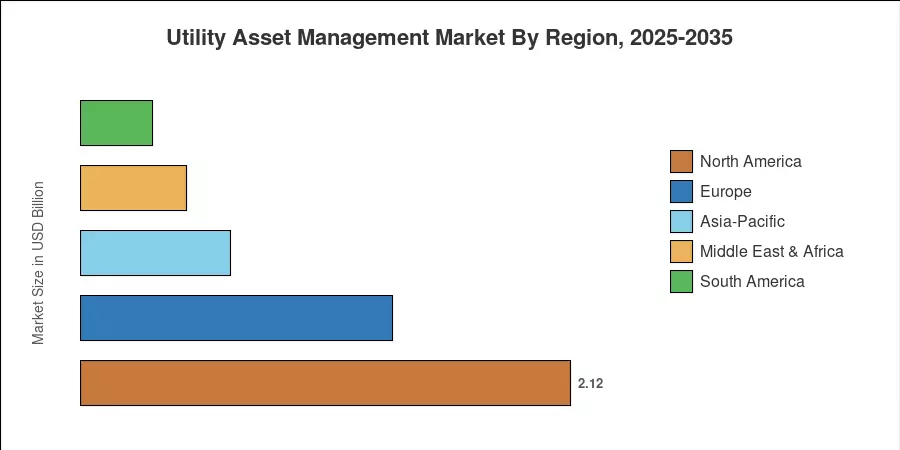
North America is poised to maintain its leadership in the Utility Asset Management Market, holding a significant market share of 2.5 in 2024. The region's growth is driven by increasing investments in smart grid technologies, regulatory support for sustainable energy practices, and a rising demand for efficient asset management solutions. The focus on digital transformation and data analytics further propels market expansion, as utilities seek to optimize operations and reduce costs. The competitive landscape in North America is robust, featuring key players such as GE Digital, IBM, and Oracle, who are at the forefront of innovation. The U.S. leads the market, supported by favorable government policies and substantial funding for infrastructure upgrades. Companies are increasingly adopting advanced technologies like IoT and AI to enhance asset performance and reliability, ensuring a strong foothold in this dynamic market.

Europe : Emerging Market with Growth Potential

Europe is witnessing a notable rise in the Utility Asset Management Market, with a market size of 1.5. The growth is fueled by stringent regulatory frameworks aimed at enhancing energy efficiency and sustainability. Initiatives such as the European Green Deal and various national policies are driving utilities to adopt advanced asset management solutions. The increasing focus on renewable energy sources and digitalization is also contributing to market expansion, as utilities strive to modernize their infrastructure. Leading countries in this region include Germany, France, and the UK, where major players like Siemens and Schneider Electric are actively innovating. The competitive landscape is characterized by a mix of established firms and emerging startups, all vying for market share. The presence of strong regulatory support and funding for green initiatives positions Europe as a promising market for utility asset management solutions.

Asia-Pacific : Rapid Growth in Emerging Economies

The Asia-Pacific region is experiencing rapid growth in the Utility Asset Management Market, with a market size of 1.3. This growth is primarily driven by urbanization, increasing energy demands, and government initiatives aimed at enhancing infrastructure. Countries like China and India are investing heavily in smart grid technologies and renewable energy projects, which are essential for modernizing their utility sectors. Regulatory support for energy efficiency and sustainability is also a significant catalyst for market growth. China leads the region, with substantial investments from state-owned enterprises in advanced asset management solutions. The competitive landscape features both global players and local firms, creating a dynamic environment for innovation. Companies are leveraging technologies such as AI and big data analytics to improve asset performance and reliability, ensuring they meet the growing energy demands of the region.

Middle East and Africa : Emerging Market with Untapped Potential

The Middle East and Africa (MEA) region represents an emerging market for Utility Asset Management, with a market size of 0.14. The growth potential is significant, driven by increasing investments in infrastructure and energy projects. Governments are focusing on diversifying their energy sources and enhancing operational efficiencies, which is creating demand for advanced asset management solutions. Regulatory frameworks are gradually evolving to support sustainable practices, further catalyzing market growth. Leading countries in this region include South Africa and the UAE, where there is a growing presence of international players. The competitive landscape is characterized by a mix of local and global firms, all aiming to capture market share. As utilities in the region modernize their operations, the adoption of innovative technologies will be crucial for enhancing asset management capabilities and meeting future energy demands.

Key Players and Competitive Insights

The Utility Asset Management Market is currently characterized by a dynamic competitive landscape, driven by the increasing need for efficient resource management and the integration of advanced technologies. Key players such as Siemens (DE), Schneider Electric (FR), and GE Digital (US) are at the forefront, each adopting distinct strategies to enhance their market positioning. Siemens (DE) emphasizes innovation through its digital twin technology, which allows for real-time asset monitoring and predictive maintenance, thereby improving operational efficiency. Meanwhile, Schneider Electric (FR) focuses on sustainability and energy management solutions, aligning its offerings with global environmental goals. GE Digital (US) leverages its expertise in industrial IoT to provide comprehensive asset management solutions, enhancing data analytics capabilities for better decision-making.

The business tactics employed by these companies reflect a concerted effort to optimize operations and adapt to market demands. The competitive structure of the Utility Asset Management Market appears moderately fragmented, with several players vying for market share. However, the influence of major companies is substantial, as they set benchmarks for innovation and operational excellence. Localizing manufacturing and optimizing supply chains are common strategies, enabling these firms to respond swiftly to regional market needs while maintaining cost efficiency.

In November 2025, Siemens (DE) announced a strategic partnership with a leading AI firm to enhance its asset management solutions through machine learning capabilities. This collaboration is poised to significantly improve predictive analytics, allowing utilities to anticipate failures and reduce downtime. Such advancements not only bolster Siemens' competitive edge but also reflect a broader trend towards AI integration in asset management.

In October 2025, Schneider Electric (FR) launched a new suite of software solutions aimed at optimizing energy consumption for utility companies. This initiative underscores the company's commitment to sustainability and positions it as a leader in energy efficiency. By providing tools that enable utilities to monitor and manage their energy usage more effectively, Schneider Electric is likely to attract environmentally conscious clients and enhance its market share.

In September 2025, GE Digital (US) expanded its digital asset management platform to include enhanced cybersecurity features, addressing growing concerns over data protection in the utility sector. This strategic move not only strengthens GE Digital's offerings but also aligns with the increasing regulatory focus on cybersecurity, positioning the company favorably in a market that prioritizes data integrity and security.

As of December 2025, the competitive trends in the Utility Asset Management Market are increasingly defined by digitalization, sustainability, and the integration of AI technologies. Strategic alliances are becoming more prevalent, as companies recognize the value of collaboration in driving innovation. The shift from price-based competition to a focus on technological advancement and supply chain reliability is evident, suggesting that future competitive differentiation will hinge on the ability to innovate and adapt to evolving market demands.

Key Companies in the Utility Asset Management Market market include

Industry Developments

October 2022:To reduce CO2 emissions overall, Adani PowerLimited (APL) hired Black & Veatch to optimize operations and enhance the dependability and performance of its power assets in India. The implementation will support the dependable, efficient, and sustainable operation of India's almost 12 GW of thermal power generating equipment by reducing unscheduled shutdowns and increasing operational efficiency.

February 2022:A new sustainable electric vehicle charging concept structure was introduced by Siemens Smart Infrastructure in the United States. It is intended to electrify fleets and large-scale, high-demand charging applications. The new VersiCharge XL (U.L. Standard) concept was developed in collaboration with Nexii Building Solutions using their exclusive low-carbon footprint sustainable building material in the U.S. to quickly and effectively electrify parking lots and new or existing building structures.

April 2024 Leading provider of structural asset management solutions for the electric utility industry, Osmose Utilities Services Inc. is pleased to announce the acquisition of IMCORP, the technology leader in underground power cable life cycle condition assessment and performance. In this strategic acquisition, which expands its portfolio of utility asset management services, Osmose has added state-of-the-art diagnostics and assessments for underground power cable systems as part of its offerings.

Electric utilities will benefit from a unique approach that ensures the reliability and performance of both above-ground as well as underground infrastructure by integrating IMCORP's expertise and innovative technology with Osmose's comprehensive asset management solutions.

November 2023 Stem, a global leader in AI-driven clean energy solutions and services, announced a multi-year technology and commercial alliance with SB Energy USA Corp (SB Energy), one of America's largest owner-operators and renewable developers. In the month of March 2023, the US Department of Energy announced a $13 billion dollar investment towards the power grid through the Grid Resilience Innovative Partnership (GRIP) initiative and the Transmission Facilitation Programme.

This will boost demand for grid upgrading, enhancing its infrastructure, as well as is anticipated to enhance utility asset management firms.Adani Power Limited (APL), in October 2022, engaged Black & Veatch’s services to improve its assets’ efficiency and reliability in India.

During September 2022: there was a full-scale installation of computerized monitoring and control system by an electric utility company located in Seguin, Texas. These included integration of SCADA system with Outage Management System software, Advanced Metering Infrastructure (AMI) technology, GIS Mapping and energy efficiency software for better customer reliability. It would enable the utility firm to manage its huge networks spread over wide distances. In May 2022: GE Digital announced Distributed Energy Resource Management System (DERMS), which will support utilities on Distributed Energy Resources (DERs) journey toward a safe, secure, and resilient grid.

That application provides intelligence, operations and economics necessary to connect with DERs while optimizing them.

Siemens launched an electrification concept called VersiCharge XL in February 2022, meant for large fleets as well as high-demand charging applications throughout the United States. A modular design that could be scaled quickly enabled this new development using Nexii Building Solutions. One anticipated solution is this modern gas station-like feature installed at Siemens’ research center for mobility solutions electrical products at Peachtree Corners, Georgia, within three days after being built during H2 2021. GE DIGITAL’S Asset Performance Management (APM) has been recognized as a capabilities leader across utilities, oil and gas, manufacturing and mining industries since February 2022.

It is a blend of software solutions and services known as APM that have undergone development with the goal of enhancing the performance of industrial companies’ most critical assets.

Future Outlook

Utility Asset Management Market Future Outlook

The Utility Asset Management Market is projected to grow at a 9.9% CAGR from 2024 to 2035, driven by technological advancements, regulatory support, and increasing demand for efficiency.

New opportunities lie in:

  • Integration of AI-driven predictive maintenance solutions
  • Development of cloud-based asset management platforms
  • Expansion of IoT-enabled monitoring systems for real-time data analysis

By 2035, the market is expected to be robust, driven by innovation and strategic investments.

Market Segmentation

Utility Asset Management Market End Use Outlook

  • Electric Utilities
  • Water Utilities
  • Gas Utilities
  • Telecommunications
  • Transportation

Utility Asset Management Market Component Outlook

  • Software
  • Services
  • Hardware

Utility Asset Management Market Technology Outlook

  • Internet of Things
  • Artificial Intelligence
  • Big Data Analytics
  • Blockchain

Utility Asset Management Market Application Outlook

  • Asset Performance Management
  • Work Management
  • Risk Management
  • Compliance Management
  • Inventory Management

Utility Asset Management Market Deployment Type Outlook

  • On-Premises
  • Cloud-Based
  • Hybrid

Report Scope

MARKET SIZE 20245.44(USD Billion)
MARKET SIZE 20255.98(USD Billion)
MARKET SIZE 203515.38(USD Billion)
COMPOUND ANNUAL GROWTH RATE (CAGR)9.9% (2024 - 2035)
REPORT COVERAGERevenue Forecast, Competitive Landscape, Growth Factors, and Trends
BASE YEAR2024
Market Forecast Period2025 - 2035
Historical Data2019 - 2024
Market Forecast UnitsUSD Billion
Key Companies ProfiledSiemens (DE), Schneider Electric (FR), GE Digital (US), IBM (US), Oracle (US), SAP (DE), Honeywell (US), ABB (CH), Emerson Electric (US)
Segments CoveredApplication, End Use, Deployment Type, Component, Technology
Key Market OpportunitiesIntegration of advanced analytics and IoT for enhanced asset performance and predictive maintenance in Utility Asset Management Market.
Key Market DynamicsTechnological advancements drive efficiency and sustainability in Utility Asset Management, reshaping competitive dynamics and regulatory compliance.
Countries CoveredNorth America, Europe, APAC, South America, MEA

Market Highlights

Author
Aarti Dhapte
Team Lead - Research

She holds an experience of about 6+ years in Market Research and Business Consulting, working under the spectrum of Information Communication Technology, Telecommunications and Semiconductor domains. Aarti conceptualizes and implements a scalable business strategy and provides strategic leadership to the clients. Her expertise lies in market estimation, competitive intelligence, pipeline analysis, customer assessment, etc.

Leave a Comment

FAQs

How much is the Utility Asset Management market?

The Utility Asset Management market size was valued at USD 5.44 Billion in 2024.

What is the growth rate of the Utility Asset Management market?

The global market is projected to grow at a CAGR of 9.90% during the forecast period, 2025-2034.

Which region held the largest market share in the Utility Asset Management market?

North America had the largest share in the global market

Who are the key players in the Utility Asset Management market?

The key players in the market are ABB Ltd. (Switzerland), Siemens AG (Germany), General Electric Company (U.S.), S & C Electric Company (U.S.), Sentient Energy Inc. (U.S.), Aclara Technologies LLC (U.S.).

Which type led the Utility Asset Management market?

The Sub-Station dominated the market in 2023.

Which Utility Type had the largest market share in the Utility Asset Management market?

The Private Utility had the largest share in the global market.

Download Free Sample

Kindly complete the form below to receive a free sample of this Report

Compare Licence

×
Features License Type
Single User Multiuser License Enterprise User
Price $4,950 $5,950 $7,250
Maximum User Access Limit 1 User Upto 10 Users Unrestricted Access Throughout the Organization
Free Customization
Direct Access to Analyst
Deliverable Format
Platform Access
Discount on Next Purchase 10% 15% 15%
Printable Versions