×
Request Free Sample ×

Kindly complete the form below to receive a free sample of this Report

Leading companies partner with us for data-driven Insights

clients tt-cursor
Hero Background

Vacation Rental Software Market

ID: MRFR/ICT/26427-HCR
100 Pages
Aarti Dhapte
October 2025

Vacation Rental Software Market Research Report By Deployment Model (Cloud, On-premise), By Property Type (Whole Home/Villa, Apartment/Condo, Cabin, Cottage), By Features (Booking Management, Guest Management, Revenue Management, Property Management), By End-User (Property Owners, Property Managers, Travel Agents, Online Travel Agencies), By Integration (Payment Gateways, Property Management Systems, Channel Management Systems, Customer Relationship Management Systems) and By Regional (North America, Europe, South America, Asia Pacific, Midd... read more

Share:
Download PDF ×

We do not share your information with anyone. However, we may send you emails based on your report interest from time to time. You may contact us at any time to opt-out.

Vacation Rental Software Market Infographic
Purchase Options

Vacation Rental Software Market Summary

As per MRFR analysis, the Vacation Rental Software Market Size was estimated at 20.14 USD Billion in 2024. The Vacation Rental Software industry is projected to grow from 21.87 USD Billion in 2025 to 49.78 USD Billion by 2035, exhibiting a compound annual growth rate (CAGR) of 8.57 during the forecast period 2025 - 2035.

Key Market Trends & Highlights

The Vacation Rental Software Market is experiencing robust growth driven by technological advancements and evolving consumer preferences.

  • North America remains the largest market for vacation rental software, characterized by a high adoption rate of cloud-based solutions.
  • The Asia-Pacific region is emerging as the fastest-growing market, fueled by increasing internet penetration and mobile accessibility.
  • Cloud-based solutions dominate the market, while on-premise systems are witnessing rapid growth due to specific regional demands.
  • The rise in short-term rentals and the growing demand for seamless booking experiences are key drivers propelling market expansion.

Market Size & Forecast

2024 Market Size 20.14 (USD Billion)
2035 Market Size 49.78 (USD Billion)
CAGR (2025 - 2035) 8.57%

Major Players

Airbnb (US), Vrbo (US), Booking.com (NL), Expedia Group (US), Tripadvisor (US), HomeAway (US), FlipKey (US), Vacasa (US), Sonder (US)

Vacation Rental Software Market Trends

The Vacation Rental Software Market is currently experiencing a dynamic evolution, driven by the increasing demand for seamless property management solutions. As more individuals and businesses enter the vacation rental sector, the need for efficient software that can streamline operations, enhance guest experiences, and optimize revenue generation becomes paramount. This market appears to be characterized by a growing emphasis on user-friendly interfaces and integration capabilities, allowing property owners to manage listings across multiple platforms effortlessly. Furthermore, the rise of mobile technology is influencing the development of applications that facilitate on-the-go management, catering to the needs of a more mobile-centric user base. In addition, the Vacation Rental Software Market seems to be witnessing a shift towards data-driven decision-making. Property managers are increasingly leveraging analytics tools to gain insights into market trends, guest preferences, and operational efficiencies. This trend indicates a broader movement towards personalization and tailored experiences, as software solutions evolve to meet the specific needs of diverse clientele. Overall, the market is poised for continued growth, with innovations likely to focus on enhancing user engagement and operational effectiveness, thereby shaping the future landscape of vacation rentals.

Integration with Smart Home Technology

The Vacation Rental Software Market is increasingly integrating with smart home technologies, allowing property owners to enhance guest experiences through automation. This trend suggests that features such as keyless entry, smart thermostats, and automated lighting systems are becoming standard offerings, providing convenience and security for both hosts and guests.

Emphasis on Data Analytics

There is a notable emphasis on data analytics within the Vacation Rental Software Market, as property managers seek to harness insights for better decision-making. This trend indicates a shift towards utilizing data to understand guest behavior, optimize pricing strategies, and improve overall operational efficiency.

Focus on Mobile Accessibility

The Vacation Rental Software Market is witnessing a growing focus on mobile accessibility, reflecting the increasing reliance on smartphones for managing properties. This trend suggests that software solutions are being designed with mobile-first approaches, enabling users to manage bookings, communicate with guests, and access critical information from anywhere.

Vacation Rental Software Market Drivers

Rise in Short-Term Rentals

The increasing popularity of short-term rentals is a primary driver for the Vacation Rental Software Market. As travelers seek unique and personalized experiences, property owners are turning to vacation rentals as a lucrative alternative to traditional lodging. According to recent data, the short-term rental market has seen a substantial growth rate, with projections indicating a continued upward trajectory. This trend compels property managers to adopt sophisticated software solutions that streamline operations, enhance guest experiences, and optimize pricing strategies. Consequently, the demand for vacation rental software is likely to surge as property owners and managers strive to remain competitive in a rapidly evolving market.

Emphasis on Enhanced Guest Experience

The emphasis on providing an enhanced guest experience is a pivotal driver for the Vacation Rental Software Market. As travelers increasingly seek personalized and memorable stays, property owners are leveraging software solutions to tailor their offerings. Data shows that properties equipped with technology that facilitates personalized communication and customized services tend to receive higher guest satisfaction ratings. This trend encourages property managers to invest in software that enables them to engage with guests effectively, from pre-arrival communication to post-stay follow-ups. Consequently, the focus on guest experience is likely to propel the growth of vacation rental software, as it becomes integral to attracting and retaining customers.

Integration of Advanced Payment Solutions

The integration of advanced payment solutions is a crucial factor influencing the Vacation Rental Software Market. As the landscape of online transactions evolves, property managers are increasingly adopting software that supports diverse payment methods, including digital wallets and cryptocurrencies. This shift is driven by consumer preferences for secure and flexible payment options. Data indicates that a growing number of travelers are willing to pay a premium for properties that offer modern payment solutions. Consequently, vacation rental software that incorporates these features is likely to gain traction, as it not only enhances the booking experience but also reduces transaction-related friction for both guests and property owners.

Growing Demand for Seamless Booking Experiences

The demand for seamless booking experiences is reshaping the Vacation Rental Software Market. As consumers increasingly prioritize convenience, software solutions that facilitate easy booking processes are becoming essential. Recent statistics suggest that a significant percentage of travelers prefer platforms that offer instant booking capabilities, flexible payment options, and user-friendly interfaces. This trend drives software developers to innovate and enhance their offerings, ensuring that property managers can provide a frictionless experience for guests. The emphasis on user experience not only attracts more bookings but also fosters customer loyalty, further propelling the growth of the vacation rental software sector.

Increased Focus on Property Management Efficiency

The need for enhanced property management efficiency is a significant driver in the Vacation Rental Software Market. As competition intensifies, property managers are seeking software solutions that streamline operations, from booking management to maintenance tracking. Recent findings suggest that property managers who utilize comprehensive software solutions experience improved operational efficiency and reduced overhead costs. This trend highlights the importance of adopting technology that automates routine tasks, allowing managers to focus on strategic growth initiatives. As a result, the demand for vacation rental software that offers robust property management features is expected to rise, reflecting the industry's shift towards operational excellence.

Market Segment Insights

By Deployment Model: Cloud (Largest) vs. On-Premise (Fastest-Growing)

In the Vacation Rental Software Market, the distribution of deployment models highlights a clear preference for cloud-based solutions, which dominate with the largest market share. This model offers flexibility, cost-effectiveness, and seamless updates, attracting numerous property managers and owners. Conversely, the on-premise solutions cater to a niche segment, appealing to those who require higher customization and data control, but they currently hold a smaller slice of the market. Growth trends within this segment reveal a shift towards cloud solutions, driven by increasing digital transformation and the need for remote access to rental management tools. However, the on-premise deployment is witnessing a resurgence due to organizations that seek enhanced security and privacy for their data, positioning it as the fastest-growing alternative in the market.

Deployment Model: Cloud (Dominant) vs. On-Premise (Emerging)

Cloud-based deployment in the Vacation Rental Software Market serves as the dominant model, offering benefits like scalability, ease of use, and integration with various online travel agency platforms. Its high adaptability makes it ideal for property managers looking to streamline operations across multiple properties. Conversely, on-premise solutions are emerging as a viable option for businesses that prioritize security and data sovereignty. While these solutions require higher upfront investments and maintenance, they provide greater control over proprietary data and customization of the software to fit specific business needs. As the market evolves, both deployment models have important roles to play in catering to the diverse needs of vacation rental businesses.

By Property Type: Whole Home/Villa (Largest) vs. Apartment/Condo (Fastest-Growing)

The property type segment for vacation rental software is primarily driven by Whole Home/Villa listings, which hold the largest share in the market. This category appeals to families or large groups seeking spacious accommodations, often leading to extended stays. Following closely is the Apartment/Condo segment, which has seen significant growth as urban travelers favor more localized and flexible lodging options. The demand for these smaller units is increasingly complemented by the rise of remote work, enabling longer trips in city settings.

Whole Home/Villa (Dominant) vs. Cabin (Emerging)

Whole Home/Villa properties dominate the vacation rental market due to their appeal to families and groups, providing ample space and privacy. These expansive rentals often come equipped with fully functional kitchens and communal areas, enhancing guest experience. In contrast, the Cabin segment, while currently smaller, is emerging as a sought-after alternative for vacationers seeking a rustic retreat. Cabins cater to nature lovers and those wanting a unique vacation experience, which is driving interest and investment in this asset type. With features like scenic locations and outdoor amenities, cabins are becoming increasingly popular, appealing to various demographics.

By Features: Booking Management (Largest) vs. Guest Management (Fastest-Growing)

In the Vacation Rental Software Market, Booking Management holds a prominent position, accounting for the largest share among the various features. This segment is crucial as it streamlines the reservation process, allowing property managers and owners to manage bookings efficiently. On the other hand, Guest Management is rapidly gaining traction and can be seen as the fastest-growing feature. This segment focuses on enhancing the guest experience, from pre-booking inquiries to post-checkout follow-ups, and is increasingly recognized for its importance in building customer loyalty and satisfaction.

Booking Management (Dominant) vs. Revenue Management (Emerging)

Booking Management is considered the dominant feature in the Vacation Rental Software Market due to its essential role in handling reservations, cancellations, and customer preferences. Its deep integration with various channels allows property managers to optimize occupancy rates and improve operational efficiency. In contrast, Revenue Management is an emerging trend that leverages data analytics to maximize income through dynamic pricing strategies. It has recently gained attention as property managers look to enhance profitability by adjusting prices based on demand, competitor pricing, and market conditions. Both features are critical for success in a competitive landscape, yet they serve distinct operational purposes.

By End-User: Property Managers (Largest) vs. Property Owners (Fastest-Growing)

In the Vacation Rental Software Market, Property Managers hold the largest share among end-users, primarily due to their extensive management needs and the growing number of properties under their oversight. They leverage vacation rental software to enhance operational efficiency, streamline bookings, and improve tenant experiences. Property Owners represent the fastest-growing segment, driven by the rising trend of individual owners entering the market to capitalize on the increasing demand for unique short-term rental experiences.

Property Managers (Dominant) vs. Property Owners (Emerging)

Property Managers are the dominant force in the Vacation Rental Software Market, as they require comprehensive solutions to manage multiple properties effectively. They utilize advanced software features for automated bookings, analytics, and customer relationship management, ensuring high occupancy rates and seamless operations. On the other hand, Property Owners are considered the emerging segment, increasingly adopting these software solutions to manage their rentals independently. With the rise of platform-based rental listings, they are seeking user-friendly, cost-effective tools to enhance their property visibility and guest interactions, contributing to their swift market growth.

By Integration: Property Management Systems (Largest) vs. Payment Gateways (Fastest-Growing)

In the Vacation Rental Software Market, Property Management Systems (PMS) hold the largest market share, esteemed for their comprehensive functionality that streamlines operations for property managers. PMS solutions enable efficient management of booking, occupancy, and maintenance tasks, making them indispensable for large-scale vacation rental operations. Following closely are Payment Gateways, which, though smaller in comparison, play a critical role in facilitating secure transactions between property owners and guests, reflecting growing importance in enhancing customer experience.

Property Management Systems (Dominant) vs. Payment Gateways (Emerging)

Property Management Systems (PMS) are the backbone of the vacation rental software market, offering an all-encompassing solution for property owners to manage bookings, guests, and operational tasks seamlessly. Their ability to integrate various functionalities—such as calendar syncing, reporting, and guest communication—positions them as the dominant force in the industry. On the other hand, Payment Gateways are emerging rapidly, driven by the increasing demand for secure, efficient, and user-friendly payment solutions, enhancing transactional flexibility for both hosts and guests. With the shift towards digital financial transactions, the integration of advanced payment gateways provides a competitive edge, ensuring swift processing and customer satisfaction.

Get more detailed insights about Vacation Rental Software Market

Regional Insights

North America : Market Leader in Vacation Rentals

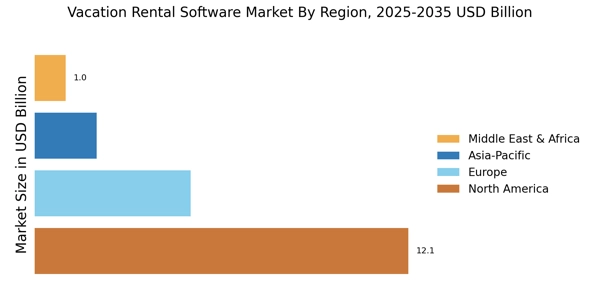
North America is the largest market for vacation rental software, holding approximately 60% of the global market share. The region's growth is driven by increasing travel demand, a rise in remote work, and a growing preference for unique lodging experiences. Regulatory support for short-term rentals in many cities further fuels this growth, making it a favorable environment for vacation rental platforms. The United States is the leading country in this market, with major players like Airbnb, Vrbo, and Expedia Group dominating the landscape. Canada also contributes significantly, with a growing number of vacation rental listings. The competitive landscape is characterized by innovation and customer-centric services, as companies strive to enhance user experience and streamline operations.

Europe : Emerging Market with Growth Potential

Europe is witnessing a significant rise in the vacation rental software market, accounting for approximately 25% of the global share. The growth is driven by increased tourism, particularly in countries like France and Spain, and a shift towards alternative accommodations. Regulatory frameworks in various European countries are evolving, promoting transparency and safety in the vacation rental sector, which is crucial for sustaining growth. Leading countries in this region include France, Germany, and Spain, where platforms like Booking.com and Airbnb are well-established. The competitive landscape is marked by a mix of local and international players, with a focus on enhancing customer experience and compliance with local regulations. The presence of diverse cultural attractions further boosts the demand for vacation rentals across Europe.

Asia-Pacific : Rapid Growth in Emerging Markets

The Asia-Pacific region is rapidly emerging in the vacation rental software market, holding about 10% of the global share. Key growth drivers include rising disposable incomes, increasing domestic and international travel, and a growing preference for personalized travel experiences. Countries like Australia and Japan are leading this trend, supported by favorable regulations that encourage short-term rentals and tourism development. Australia and Japan are at the forefront, with a mix of local and international players like Airbnb and HomeAway. The competitive landscape is evolving, with companies focusing on technology integration and customer service enhancements. The region's diverse offerings, from urban apartments to rural retreats, cater to a wide range of traveler preferences, further driving market growth.

Middle East and Africa : Untapped Potential in Rentals

The Middle East and Africa region is gradually emerging in the vacation rental software market, currently holding around 5% of the global share. The growth is driven by increasing tourism, particularly in countries like the UAE and South Africa, and a rising interest in alternative accommodations. Regulatory frameworks are beginning to adapt to support the burgeoning vacation rental sector, which is essential for attracting investment and ensuring safety. The UAE, particularly Dubai, is a key player in this market, with a growing number of vacation rental listings. South Africa is also gaining traction, with local platforms emerging alongside international giants. The competitive landscape is characterized by a mix of established players and new entrants, focusing on enhancing user experience and compliance with local regulations to capture the growing demand.

Vacation Rental Software Market Regional Image

Key Players and Competitive Insights

Key participants in the vacation rental software market continually strive to maintain their position in the market by investing in R, enhancing their product portfolio and forming partnerships. To provide high-quality vacation rental services and gain a reasonable market share, leading market players focus on the development of innovative solutions that target the rapidly changing needs of vacation rental businesses and travelers. The vacation rental software market is expected to observe substantial development in the forthcoming years, owing to the increasing popularity of vacation rentals combined with the growing role of technologies in the travel industry.

The competitive environment of the vacation rental software market can be characterized as a combination of leading, well-established brands and emerging startups. An example of a leading enterprise involved in the Vacation Rental Software Market is Airbnb.

Airbnb is a well-known global platform that connects travelers with local property owners. Airbnb has a broad target audience and an extensive number of properties, which makes it a popular choice for many travelers. In order to meet the requirements of guests and hosts, Airbnb provides numerous benefits, including secure booking and payment options, customer support, a simplified search mechanism and other relevant examples. The key factors explaining the success of Airbnb include Airbnb's ability to stay abreast of relevant trends in the market and innovation.

In addition to connecting travelers with local property owners, Airbnb has developed a more extensive platform that allows users to search for related options, such as experiences, activities and other relevant tools, promoting it as a one-stop solution. Vrbo is another leading competitor involved in the vacational rental software market and a subsidiary of the global company Expedia.

Similar to Airbnb, Vrbo targets owners of various properties that can be used as vacation rentals and travelers whose requirements are satisfied by the identified options.

Key Companies in the Vacation Rental Software Market market include

Industry Developments

The Vacation Rental Software Market size was valued at USD 17.09 billion in 2023 and is projected to grow to USD 35.8 billion by 2032, exhibiting a CAGR of 8.57% during the forecast period. The market growth is attributed to the increasing popularity of vacation rentals, the growing adoption of online booking platforms, and the rising demand for personalized travel experiences. Key industry developments include the emergence of cloud-based vacation rental software solutions, the integration of artificial intelligence (AI) and machine learning (ML) to enhance guest experiences, and the growing focus on sustainability in the vacation rental industry.

Strategic partnerships and acquisitions are also shaping the market landscape, with established players seeking to expand their offerings and gain a competitive edge.

Future Outlook

Vacation Rental Software Market Future Outlook

The Vacation Rental Software Market is projected to grow at an 8.57% CAGR from 2024 to 2035, driven by increasing digitalization, consumer demand for personalized experiences, and enhanced property management solutions.

New opportunities lie in:

  • Integration of AI-driven pricing algorithms for dynamic revenue management.
  • Development of mobile applications for seamless guest communication and booking.
  • Expansion into emerging markets with localized software solutions.

By 2035, the market is expected to be robust, reflecting substantial growth and innovation.

Market Segmentation

Vacation Rental Software Market End-User Outlook

  • Property Owners
  • Property Managers
  • Travel Agents
  • Online Travel Agencies

Vacation Rental Software Market Features Outlook

  • Booking Management
  • Guest Management
  • Revenue Management
  • Property Management

Vacation Rental Software Market Integration Outlook

  • Payment Gateways
  • Property Management Systems
  • Channel Management Systems
  • Customer Relationship Management Systems

Vacation Rental Software Market Property Type Outlook

  • Whole Home/Villa
  • Apartment/Condo
  • Cabin
  • Cottage

Vacation Rental Software Market Deployment Model Outlook

  • Cloud
  • On-premise

Report Scope

MARKET SIZE 202420.14(USD Billion)
MARKET SIZE 202521.87(USD Billion)
MARKET SIZE 203549.78(USD Billion)
COMPOUND ANNUAL GROWTH RATE (CAGR)8.57% (2024 - 2035)
REPORT COVERAGERevenue Forecast, Competitive Landscape, Growth Factors, and Trends
BASE YEAR2024
Market Forecast Period2025 - 2035
Historical Data2019 - 2024
Market Forecast UnitsUSD Billion
Key Companies ProfiledMarket analysis in progress
Segments CoveredMarket segmentation analysis in progress
Key Market OpportunitiesIntegration of artificial intelligence for personalized guest experiences in the Vacation Rental Software Market.
Key Market DynamicsRising demand for integrated solutions drives innovation and competition in the Vacation Rental Software Market.
Countries CoveredNorth America, Europe, APAC, South America, MEA

Leave a Comment

FAQs

What is the current valuation of the Vacation Rental Software Market?

The market valuation reached 20.14 USD Billion in 2024.

What is the projected market size for the Vacation Rental Software Market by 2035?

The market is expected to grow to 49.78 USD Billion by 2035.

What is the expected CAGR for the Vacation Rental Software Market during the forecast period?

The market is projected to experience a CAGR of 8.57% from 2025 to 2035.

Which deployment model holds the largest market share in the Vacation Rental Software Market?

The Cloud deployment model is anticipated to dominate, with a valuation of 30.0 USD Billion projected by 2035.

What are the key property types contributing to the Vacation Rental Software Market?

Whole Home/Villa and Apartment/Condo are significant segments, with projected valuations of 19.0 USD Billion and 14.0 USD Billion, respectively, by 2035.

Which features are most valued in the Vacation Rental Software Market?

Property Management features are expected to lead, with a projected valuation of 19.78 USD Billion by 2035.

Who are the primary end-users of Vacation Rental Software?

Property Managers and Property Owners are the main end-users, with projected valuations of 17.12 USD Billion and 14.56 USD Billion, respectively, by 2035.

What integration systems are crucial for the Vacation Rental Software Market?

Property Management Systems are likely to be the most critical, with a projected valuation of 12.0 USD Billion by 2035.

Which companies are considered key players in the Vacation Rental Software Market?

Prominent players include Airbnb, Vrbo, Booking.com, and Expedia Group, among others.

How does the market's growth trajectory appear for the next decade?

The market's growth trajectory appears robust, with a significant increase anticipated from 20.14 USD Billion in 2024 to 49.78 USD Billion by 2035.

Download Free Sample

Kindly complete the form below to receive a free sample of this Report

Compare Licence

×
Features License Type
Single User Multiuser License Enterprise User
Price $4,950 $5,950 $7,250
Maximum User Access Limit 1 User Upto 10 Users Unrestricted Access Throughout the Organization
Free Customization
Direct Access to Analyst
Deliverable Format
Platform Access
Discount on Next Purchase 10% 15% 15%
Printable Versions