Download Free Sample
Kindly complete the form below to receive a free sample of this Report
Asia-Pacific Vacation Rental Market Size, Share, Industry Trend & Analysis Research Report Information By Accommodation Type (Apartments, Resort/Condominium, Home, and Others), By Booking Mode (Online and Offline) –and Asia-Pacific Forecast Till 2035
As per Market Research Future analysis, the APAC vacation rental market size was estimated at 16.73 USD Billion in 2024. The APAC vacation rental market is projected to grow from 17.89 USD Billion in 2025 to 35.0 USD Billion by 2035, exhibiting a compound annual growth rate (CAGR) of 6.9% during the forecast period 2025 - 2035
The APAC vacation rental market is experiencing dynamic growth driven by evolving consumer preferences and technological advancements.
| 2024 Market Size | 16.73 (USD Billion) |
| 2035 Market Size | 35.0 (USD Billion) |
| CAGR (2025 - 2035) | 6.94% |
Airbnb (US), Vrbo (US), Booking.com (NL), Tripadvisor (US), HomeAway (US), FlipKey (US), Vacasa (US), Sonder (US), OYO Rooms (IN)
Our Impact
Enabled $4.3B Revenue Impact for Fortune 500 and Leading Multinationals
Partnering with 2000+ Global Organizations Each Year
30K+ Citations by Top-Tier Firms in the Industry
The vacation rental market in the Asia-Pacific region is currently experiencing a dynamic transformation, driven by evolving consumer preferences and technological advancements. Travelers are increasingly seeking unique and personalized experiences, which vacation rentals can provide. This shift is evident as more individuals opt for accommodations that offer local flavor and amenities tailored to their needs. Additionally, the rise of digital platforms has facilitated easier access to a diverse range of properties, enhancing the overall appeal of vacation rentals. As a result, property owners are adapting their offerings to meet the growing demand for flexibility and convenience. Moreover, the regulatory landscape surrounding the vacation rental market is becoming more defined, with various governments implementing policies to ensure safety and compliance. This trend may lead to increased trust among consumers, as they feel more secure booking accommodations that adhere to local regulations. Furthermore, sustainability is gaining traction, with many travelers prioritizing eco-friendly options. This focus on responsible tourism could influence property owners to adopt greener practices, thereby attracting a conscientious clientele. Overall, the vacation rental market is poised for continued growth, reflecting the changing dynamics of travel in the region.
There is a noticeable trend towards unique and unconventional lodging options within the vacation rental market. Travelers are increasingly drawn to properties that offer distinctive experiences, such as treehouses, yurts, and converted industrial spaces. This shift reflects a desire for memorable stays that go beyond traditional hotel offerings.
The integration of technology is reshaping the vacation rental market. Property owners are leveraging smart home devices and online booking platforms to enhance guest experiences. This technological advancement not only streamlines the booking process but also improves communication between hosts and guests, fostering a more personalized experience.
Sustainability is becoming a key consideration for travelers in the vacation rental market. Many consumers are actively seeking eco-friendly accommodations that minimize environmental impact. This trend encourages property owners to adopt sustainable practices, such as energy-efficient appliances and waste reduction initiatives, appealing to environmentally conscious guests.
The vacation rental market in APAC is experiencing a notable surge in domestic tourism, driven by a growing preference for local travel experiences. As individuals seek to explore their own countries, the demand for vacation rentals has escalated. In 2025, domestic travel accounted for approximately 70% of all tourism in the region, indicating a robust market for vacation rentals. This trend is further supported by government initiatives promoting local tourism, which have led to increased awareness and accessibility of vacation rental options. The vacation rental market is likely to benefit from this shift, as travelers opt for unique accommodations that offer a more personalized experience compared to traditional hotels.
The vacation rental market is increasingly leveraging advanced marketing strategies to reach potential customers. With the rise of digital marketing and social media, property owners and rental platforms are utilizing targeted advertising to attract specific demographics. In 2025, it is projected that online marketing will account for over 75% of all vacation rental bookings in APAC. This shift towards digital engagement allows for more personalized marketing efforts, enhancing visibility and appeal. As competition intensifies, effective marketing strategies will be crucial for property owners to differentiate their offerings in the crowded vacation rental market.
The expansion of the middle-class population in APAC is significantly impacting the vacation rental market. With rising disposable incomes, more individuals are able to afford travel, leading to increased demand for vacation rentals. In 2025, it is estimated that the middle class in the region will comprise over 1.5 billion people, creating a substantial customer base for the vacation rental market. This demographic shift is encouraging property owners to invest in vacation rentals, as they recognize the potential for lucrative returns. Furthermore, the growing trend of experiential travel among this demographic suggests that vacation rentals will continue to thrive as they offer unique and immersive experiences.
The vacation rental market is witnessing a shift towards more flexible booking policies, which is becoming a key driver of growth. In response to changing consumer preferences, many vacation rental platforms are implementing policies that allow for easier cancellations and modifications. This trend is particularly appealing to travelers who prioritize flexibility in their travel plans. In 2025, it is estimated that 60% of vacation rental bookings will be influenced by flexible policies, indicating a significant market shift. As consumers increasingly seek reassurance in their travel choices, the vacation rental market is likely to benefit from this adaptation, attracting a broader audience.
Rapid urbanization in APAC is reshaping the vacation rental market landscape. As cities expand and infrastructure improves, more travelers are drawn to urban centers for their vibrant culture and amenities. In 2025, urban areas are projected to host over 50% of the region's population, leading to increased demand for vacation rentals in these locales. The vacation rental market is likely to capitalize on this trend, as urban properties offer convenient access to attractions and services. Additionally, improved transportation networks facilitate easier travel to and from these urban destinations, further enhancing the appeal of vacation rentals for both domestic and international tourists.
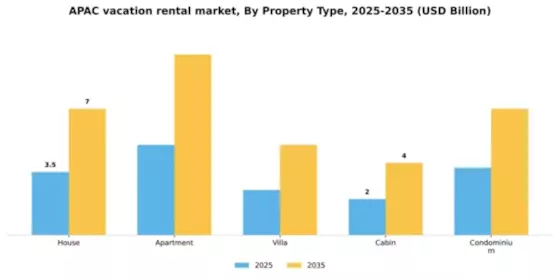
In the APAC vacation rental market, houses represent the largest segment in terms of market share, benefiting from preferences for spacious accommodations among families and larger groups. Apartments follow closely, capturing a significant portion of the market, appealing to travelers seeking convenience and amenities in urban settings. Cabins and villas also have their niche, attracting specific demographics looking for unique experiences or luxury stays, while condominiums gain popularity due to affordability and location advantages. The growth trends within this segment are primarily driven by the increasing travel frequency in the region and a diverse demographic seeking varied types of accommodations. The rise of the millennial traveler and a shift towards experiences over material possessions have significantly boosted the demand for unique property types like cabins and villas. Additionally, the urbanization trend has further enhanced the appeal of apartment rentals, especially in metropolitan areas, making them the fastest-growing segment in the market.
House: Dominant vs. Apartment: Emerging
Houses, as the dominant property type in the APAC vacation rental market, offer ample space and amenities that cater well to families and groups. These properties often come equipped with kitchens and multiple bedrooms, enhancing the overall experience for guests looking for home-like comforts during their travels. On the other hand, apartments are the emerging choice for individuals and smaller groups seeking cost-effective and centrally located lodging options. Their growing popularity can be attributed to urban lifestyles and the demand for facilities and conveniences in proximity to city attractions. Both segments fulfill distinct traveler needs, making them essential to the evolving market landscape.
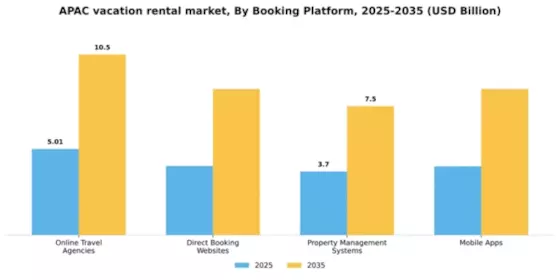
In the APAC vacation rental market, Online Travel Agencies (OTAs) hold the largest share, benefiting from established customer bases and extensive marketing strategies that attract diverse consumer segments. Direct Booking Websites also represent a significant portion, appealing to those seeking cost-effective options. Meanwhile, Property Management Systems and Mobile Apps cater to niche markets with specific needs, yet they remain behind the dominant players in terms of overall market share. As the digital landscape evolves, Mobile Apps are emerging as the fastest-growing segment, driven by the increasing mobile penetration and consumer preference for convenience. Advances in technology are facilitating seamless booking experiences, while growing tourism in the region fuels the demand for efficient and user-friendly platforms. This trend is pushing both established and new entrants to innovate and optimize their mobile offerings, solidifying the mobile app's position in the market.
Direct Booking Websites (Dominant) vs. Property Management Systems (Emerging)
Direct Booking Websites maintain a dominant stance in the APAC vacation rental market, attracting consumers with the promise of lower prices and more personalized booking experiences. They cater directly to guests, building loyalty through rewards programs and exclusive offers. In contrast, Property Management Systems are considered an emerging trend, providing essential support to property owners and managers by streamlining operations and enhancing guest interactions. As the demand for more efficient management solutions grows, these systems are progressively evolving to include features that improve revenue management and customer engagement, making them increasingly vital to the success of vacation rental operators.
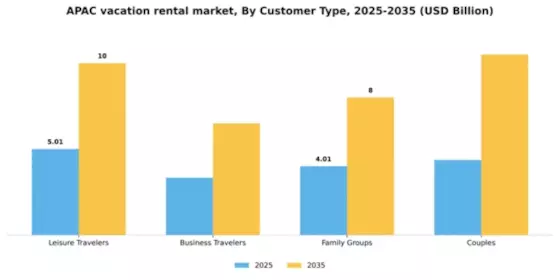
In the vacation rental market, Leisure Travelers hold the largest share, significantly influencing the dynamics of the sector due to their high demand for unique and immersive experiences. Family Groups and Couples also contribute to market diversity, but it is the Leisure segment that stands out with its robust presence, reflecting a trend towards experiential travel. On the other hand, Business Travelers are emerging rapidly, seeking flexibility and amenities conducive to work-life balance, with their segment expanding quickly as remote work becomes normalized. The growth in the Business Travelers segment is being driven by an increase in remote work and flexible travel policies among corporations. . Moreover, companies are recognizing the advantages of utilizing vacation rentals for their teams, aligning well with employee well-being and productivity. This shift indicates a changing landscape where traditional business accommodations are being re-evaluated, leading to a stronger presence in the vacation rental sector.
Leisure Travelers (Dominant) vs. Family Groups (Emerging)
Leisure Travelers are characterized by their propensity to book unique, experiential stays that offer a break from routine. This segment typically seeks out properties that provide local immersion, cultural experiences, and family-oriented amenities. Conversely, Family Groups are emerging as an important segment, focusing on larger accommodations that cater to their diverse needs, including multiple bedrooms and kid-friendly facilities. This demographic is increasingly prioritizing convenience and value, opting for rentals that enhance family bonding time while also offering the comforts expected in a home. Both segments, while distinct in their needs, drive substantial growth within the vacation rental landscape.
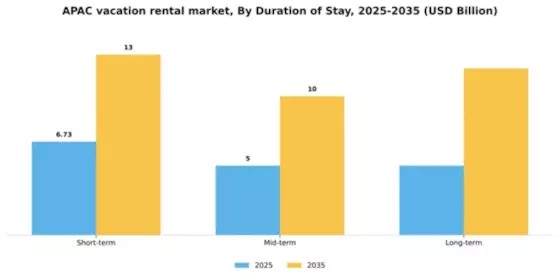
In the APAC vacation rental market, the distribution of market share among the duration of stay segments is diverse. Short-term rentals hold the largest share, appealing primarily to travelers seeking flexibility and convenience. This segment is popular among tourists and business travelers, driving significant demand in urban areas. On the other hand, mid-term and long-term rentals are gaining traction, with long-term rentals particularly appealing to expatriates and remote workers looking for stable accommodations. Growth trends in this segment are largely driven by shifting consumer preferences and the increasing trend of remote working. The long-term rental market is emerging as a rapidly expanding segment as more individuals seek extended stays and a home-like environment during their travels. Similarly, mid-term rentals are becoming attractive due to the rise in lifestyle changes, allowing for a balance between work and leisure. This segment's growth is supported by evolving property management strategies and increasing supply options.
Short-term (Dominant) vs. Long-term (Emerging)
Short-term rentals are characterized by their flexibility, catering mainly to travelers looking for temporary accommodations that provide all the amenities of home. This segment typically attracts vacationers and business travelers who value location and convenience. With platforms like Airbnb and Vrbo boosting their visibility, short-term rentals are often preferred for their ease of booking and relatively lower commitment. Conversely, long-term rentals are becoming increasingly important as more people seek stable living arrangements, especially in urban settings. This segment caters to individuals relocating for work or study and offers the benefit of lower costs over longer stays. The increasing popularity of long-term rentals signifies a shift in the market, highlighting the need for property owners to adapt to changing consumer demands.
Get more detailed insights about Asia-Pacific Vacation Rental Market Request Free Sample
China holds a commanding market share of 6.5% in the APAC vacation rental sector, driven by urbanization and a burgeoning middle class. Key growth drivers include increased domestic travel, government support for tourism, and a shift towards online booking platforms. Regulatory policies are becoming more favorable, with local governments promoting short-term rentals to boost tourism. Infrastructure improvements, such as high-speed rail and airports, further enhance accessibility to popular destinations.
India's vacation rental market accounts for 3.2% of the APAC total, fueled by a growing interest in experiential travel and cultural tourism. The rise of digital platforms and increased disposable income among millennials are key growth drivers. Government initiatives like the Incredible India campaign promote domestic tourism, while regulatory frameworks are evolving to accommodate short-term rentals. Infrastructure development, particularly in tier-2 cities, is also enhancing market accessibility.
Japan's vacation rental market holds a 2.8% share in APAC, characterized by a blend of traditional hospitality and modern rental options. Key growth drivers include the increasing influx of international tourists and the government's push to promote tourism ahead of major events. Regulatory measures, such as the Minpaku Law, have formalized the short-term rental market, ensuring safety and quality. Infrastructure improvements, especially in urban areas, are facilitating easier access to tourist attractions.
South Korea's vacation rental market represents 1.8% of the APAC sector, driven by technological advancements and a strong domestic travel culture. The rise of mobile booking apps and platforms has transformed consumer behavior, making it easier to find and book accommodations. Government initiatives to support tourism and regulatory frameworks that encourage short-term rentals are also contributing to growth. Major cities like Seoul and Busan are key markets, with a competitive landscape featuring both local and international players.
Malaysia's vacation rental market accounts for 1.0% of the APAC total, benefiting from its diverse cultural landscape and affordability. Key growth drivers include increased international arrivals and a growing preference for unique travel experiences. Government initiatives to promote tourism, along with favorable regulations for short-term rentals, are enhancing market conditions. Key cities like Kuala Lumpur and Penang are emerging as popular destinations, with a mix of local and international players competing for market share.
Thailand's vacation rental market holds a 0.9% share in APAC, heavily influenced by its status as a top tourist destination. The growth is driven by increasing international arrivals and a shift towards personalized travel experiences. Regulatory frameworks are evolving to support short-term rentals, while government initiatives promote tourism. Key markets include Bangkok and Phuket, where major players like Airbnb and local operators are vying for market presence, creating a competitive landscape.
Indonesia's vacation rental market represents 0.8% of the APAC sector, driven by its rich cultural heritage and stunning landscapes. Key growth drivers include rising domestic tourism and increasing international interest in destinations like Bali. Regulatory policies are gradually adapting to accommodate the growing rental market, while government initiatives promote tourism. Key cities such as Bali and Jakarta are central to the market, with a mix of local and international players enhancing competition.
The Rest of APAC accounts for a 0.73% share in the vacation rental market, characterized by diverse offerings across various countries. Growth drivers include increasing travel accessibility and a rising interest in unique accommodations. Regulatory environments are varied, with some countries embracing short-term rentals while others impose restrictions. Key markets include emerging tourist destinations in Vietnam and the Philippines, where local and international players are beginning to establish a presence.

The vacation rental marketis currently characterized by a dynamic competitive landscape, driven by evolving consumer preferences and technological advancements. Major players such as Airbnb (US), OYO Rooms (IN), and Booking.com (NL) are at the forefront, each adopting distinct strategies to enhance their market positioning. Airbnb (US) continues to innovate its platform, focusing on user experience and expanding its offerings to include unique stays and experiences, thereby appealing to a broader demographic. OYO Rooms (IN), on the other hand, emphasizes aggressive regional expansion and partnerships with local property owners, aiming to increase its footprint across Asia. Meanwhile, Booking.com (NL) leverages its extensive global reach and data analytics capabilities to optimize pricing strategies and enhance customer engagement, which collectively shapes a competitive environment that is both fragmented and highly competitive. Key business tactics within this market include localized service offerings and supply chain optimization, which are essential for meeting diverse consumer needs. The competitive structure appears moderately fragmented, with numerous players vying for market share, yet dominated by a few key companies that exert considerable influence. This fragmentation allows for innovation and differentiation, as smaller players often introduce niche offerings that challenge the status quo. In October 2025, Airbnb (US) announced a strategic partnership with local tourism boards across several APAC countries to promote sustainable travel options. This initiative not only enhances Airbnb's brand image but also aligns with the growing consumer demand for eco-friendly travel solutions. Such partnerships are likely to bolster Airbnb's market presence while fostering community engagement. In September 2025, OYO Rooms (IN) launched a new loyalty program aimed at frequent travelers, offering exclusive discounts and personalized experiences. This move is strategically significant as it seeks to enhance customer retention and loyalty in a market where repeat business is crucial. By focusing on customer-centric initiatives, OYO Rooms (IN) positions itself as a preferred choice among budget-conscious travelers. In August 2025, Booking.com (NL) introduced an AI-driven pricing tool designed to optimize rental rates based on real-time market data. This technological advancement is indicative of a broader trend towards digital transformation within the industry, allowing Booking.com (NL) to maintain competitive pricing while maximizing revenue potential. The integration of AI into operational strategies is likely to set a new standard for efficiency and responsiveness in the market. As of November 2025, current trends in the vacation rental market are increasingly defined by digitalization, sustainability, and the integration of advanced technologies such as AI. Strategic alliances are becoming more prevalent, as companies recognize the value of collaboration in enhancing service offerings and expanding market reach. Looking ahead, competitive differentiation is expected to evolve, shifting from traditional price-based competition to a focus on innovation, technology, and supply chain reliability. This transition may redefine consumer expectations and reshape the competitive landscape, compelling companies to adapt swiftly to remain relevant.


June 2019: Peng Tao, president of Airbnb China, declared that the firm undertook to introduce educational initiatives to educate landlords in second and third-tier cities in China. This initiative expanded the quality of the company's listings, consolidated online reviews, and encouraged brand-building.
The vacation rental market is projected to grow at a 6.94% CAGR from 2025 to 2035, driven by increasing travel demand, technological advancements, and evolving consumer preferences.
New opportunities lie in:
By 2035, the vacation rental market is expected to achieve substantial growth and diversification.
| MARKET SIZE 2024 | 16.73(USD Billion) |
| MARKET SIZE 2025 | 17.89(USD Billion) |
| MARKET SIZE 2035 | 35.0(USD Billion) |
| COMPOUND ANNUAL GROWTH RATE (CAGR) | 6.94% (2025 - 2035) |
| REPORT COVERAGE | Revenue Forecast, Competitive Landscape, Growth Factors, and Trends |
| BASE YEAR | 2024 |
| Market Forecast Period | 2025 - 2035 |
| Historical Data | 2019 - 2024 |
| Market Forecast Units | USD Billion |
| Key Companies Profiled | Airbnb (US), Vrbo (US), Booking.com (NL), Tripadvisor (US), HomeAway (US), FlipKey (US), Vacasa (US), Sonder (US), OYO Rooms (IN) |
| Segments Covered | Property Type, Booking Platform, Customer Type, Duration of Stay |
| Key Market Opportunities | Integration of smart home technology enhances guest experience in the vacation rental market. |
| Key Market Dynamics | Rising consumer preference for unique accommodations drives competition in the vacation rental market. |
| Countries Covered | China, India, Japan, South Korea, Malaysia, Thailand, Indonesia, Rest of APAC |
The overall market valuation was $16.73 Billion in 2024.
The projected valuation for 2035 is $35.0 Billion.
The expected CAGR for the vacation rental market during the forecast period 2025 - 2035 is 6.94%.
In 2024, the apartment segment had the highest valuation at $5.0 Billion.
The projected valuation for the house segment by 2035 is $7.0 Billion.
The online travel agencies segment is expected to grow the most, reaching $10.5 Billion by 2035.
The valuation of the leisure travelers segment was $5.01 Billion in 2024.
The projected valuation for the family groups segment by 2035 is $8.0 Billion.
Airbnb is known for its strong presence in the vacation rental market.
The valuation of the short-term stay segment was $6.73 Billion in 2024.



Kindly complete the form below to receive a free sample of this Report

“This is really good guys. Excellent work on a tight deadline. I will continue to use you going forward and recommend you to others. Nice job”


“Thanks. It’s been a pleasure working with you, please use me as reference with any other Intel employees.”


“Thanks for sending the report it gives us a good global view of the Betaïne market.”


“Thank you, this will be very helpful for OQS.”


“We found the report very insightful! we found your research firm very helpful. I'm sending this email to secure our future business.”


“I am very pleased with how market segments have been defined in a relevant way for my purposes (such as "Portable Freezers & refrigerators" and "last-mile"). In general the report is well structured. Thanks very much for your efforts.”


“I have been reading the first document or the study, ,the Global HVAC and FP market report 2021 till 2026. Must say, good info! I have not gone in depth at all parts, but got a good indication of the data inside!”


“We got the report in time, we really thank you for your support in this process. I also thank to all of your team as they did a great job.”


“The Automotive 48V ECU Components Procurement Intelligence Study” was a complex project, but the Market Research Future (MRFR) team handled it with quality, agility, and customer-centricity. They delivered all requested data on time and within the agreed scope. The team, including Shubhendra Anand and Rahul Gotadki, was always readily available to clarify questions and swiftly implement necessary adjustments, driving the project to a successful conclusion within a very demanding timeframe.
I would also like to specifically commend Akshay Agarwal for his responsiveness and support at every stage—from our initial inquiry on May 6th through to final delivery on June 18th. His dedication made the entire process seamless.”



